
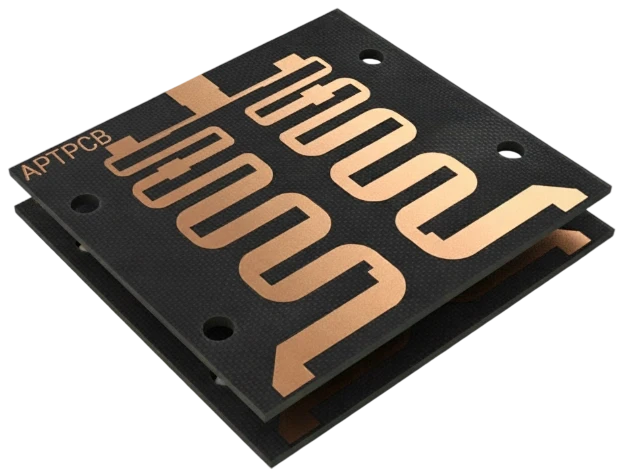
A synthetic aperture radar PCB is a circuit board used in a SAR antenna, transmit/receive, timing, data-conversion, processing, or power subsystem. It is not a formal PCB construction class: the correct stack-up and controls come from the radar architecture, frequency band, bandwidth, channel matching, thermal load, environment, and verification plan.
Key takeaways
- SAR combines measurements collected as the platform moves, so timing, phase, amplitude, and calibration stability matter across the complete RF channel.
- Do not begin with a laminate brand or a generic “radar board” specification. Begin with frequency, bandwidth, loss, phase, power, temperature, channel count, and mechanical requirements.
- Control the full signal path: transmission lines, launches, vias, connectors, packages, filters, antennas, and reference planes all contribute delay and mismatch.
- Select dielectric and copper using characterized data at the operating frequency and temperature, not a room-temperature nominal Dk alone.
- Hybrid RF/FR-4 stack-ups can reduce cost and add routing density, but mixed-material lamination, registration, flatness, and reliability must be qualified.
- TDR verifies impedance discontinuities; a vector network analyzer is normally required to evaluate microwave insertion loss, return loss, phase, group delay, and isolation.
- Release test coupons, acceptance limits, calibration features, and evidence requirements with the fabrication data. “Build to Gerber” is insufficient for a phase-sensitive array.
Table of contents
- What the PCB does in a SAR system
- Requirements that control the board
- RF material and stack-up
- Routing, launches, and vias
- Phase and channel matching
- Thermal and mechanical design
- Manufacturing controls
- Verification matrix
- Failure analysis
- RFQ checklist
What does the PCB do in a SAR system?
Synthetic aperture radar is an active sensing method: it transmits energy, receives reflections, and combines a sequence of acquisitions to emulate a larger antenna aperture. NASA Earthdata notes that the wavelength and effective antenna aperture influence spatial resolution, while SAR processing uses coherent measurements and, in some applications, recorded phase information.
The hardware is rarely one universal “SAR PCB.” A system may divide functions across several assemblies:
| Board or module | Main PCB responsibilities | Dominant risks |
|---|---|---|
| Antenna or feed panel | Radiating elements, feed network, polarization, element spacing, grounding | Element variation, feed loss, coupling, registration, surface finish |
| Transmit/receive module | PA, LNA, switches, filters, gain/phase control, bias | Heat flux, isolation, compression, oscillation, phase drift |
| Beamformer or distribution board | Clock/LO/RF distribution, control, calibration paths | Channel skew, reference discontinuities, leakage, connector repeatability |
| Converter and timing board | ADC/DAC, clock tree, synchronization, high-speed serial links | Jitter, power noise, return-path breaks, digital-to-RF coupling |
| Processing board | FPGA/SoC, memory, storage, interfaces | BGA escape, PDN impedance, heat removal, high-speed channel loss |
| Power board | Conversion, filtering, sequencing, protection | Switching noise, current density, thermal cycling, conducted emissions |
This functional split avoids forcing every layer into RF material or treating an antenna feed like an ordinary digital board. Use microwave PCB construction for critical RF paths and HDI PCB features only where routing density requires them.
Which SAR requirements control the PCB?
Convert system requirements into board-level limits before layout. A frequency name such as X-band does not define enough to manufacture or test the board.
| System input | PCB question | Evidence to release |
|---|---|---|
| Center frequency and occupied bandwidth | Which material data, line models, launches, vias, and connectors are valid across the band? | Frequency-dependent stack-up model and S-parameter limits |
| Channel amplitude and phase budget | How much variation may the PCB, assembly, and connector contribute? | Per-path loss, phase, delay, and matching limits |
| Polarization and antenna geometry | What feed symmetry, element registration, and coupling limits apply? | Antenna drawing, coordinate system, EM model, and dimensional report |
| Transmit power, duty cycle, and waveform | Where are peak electric field, current, heating, and isolation risks? | Power map, thermal model, spacing rules, and load test |
| Receiver noise and dynamic range | Which losses or noise sources occur before gain, and how are sensitive nodes isolated? | Cascaded RF budget, isolation targets, and power-noise limits |
| Clock and synchronization | What jitter, skew, phase-noise, and reference distribution limits reach the PCB? | Clock tree, timing budget, and measured jitter/skew criteria |
| Calibration strategy | Which couplers, loopbacks, detectors, reference channels, or correction data are required? | Calibration block diagram, access points, and procedure |
| Temperature and mission profile | How much electrical and mechanical drift is acceptable over the real environment? | Temperature range, dwell/ramp profile, vibration loads, and retest plan |
| Size, mass, and power constraints | Can the selected layer count, shielding, cooling, and connector scheme fit? | Mechanical envelope, mass budget, power map, and interface control drawing |
Allocate the permitted phase mismatch across the antenna, PCB, active components, connectors, assembly, temperature drift, and calibration residual. The PCB supplier cannot control an undefined share of a system-level budget.
How to select the RF material and stack-up
Material selection should preserve the simulated electrical behavior while surviving fabrication, assembly, and the operating environment. A low nominal dissipation factor is useful, but it is only one input.
Use design values at the operating condition
Request the material data and modeling method used for the line geometry. Review:
- Design Dk and Df across the operating band, not only a catalog value at one test frequency
- Dk and loss variation with temperature, moisture, and material lot
- Dielectric thickness tolerance and resin/glass construction
- Copper foil profile and the roughness model used in loss prediction
- X/Y and Z-axis coefficient of thermal expansion
- Thermal, moisture, and sequential-lamination compatibility
- Supplier availability, thickness options, minimum order, and lot traceability
Conductor roughness can increase microwave loss and change phase velocity. Woven reinforcement can create local dielectric variation when narrow traces sample different glass/resin regions. Model the actual construction and geometry instead of relying on a “low-loss” label.
Decide whether a hybrid stack-up is justified
A hybrid stack-up reserves microwave material for critical RF layers and uses another material elsewhere. It can reduce cost but adds lamination and registration constraints.
| Architecture | Advantage | Main trade-off | Suitable when |
|---|---|---|---|
| All-RF laminate | Consistent material system and modeling | Higher material cost; may not suit dense digital routing or mechanical goals | Most layers carry critical RF or antenna structures |
| Hybrid RF plus high-speed digital material | RF performance with practical BGA and serial-link routing | Mixed CTE, cure, thickness, and bonding behavior | RF and digital functions can be assigned to controlled layer groups |
| Separate RF and digital boards | Independent stack-ups and easier function-level validation | Connectors, mass, assembly, and interface discontinuities | Modularity and test access outweigh interconnect penalties |
Freeze the stack-up before final impedance and phase optimization. Substituting a “similar” core or bondply can change thickness, Dk, loss, registration, and lamination behavior even when the material family sounds equivalent.
How to route SAR RF channels, launches, and vias
Microstrip, stripline, and grounded coplanar waveguide can all be valid. Select from loss, shielding, fabrication tolerance, launch geometry, thermal needs, and test access.
Keep critical channels short, reference-plane continuous, and physically separated from clocks, switch nodes, memory buses, and other high-energy aggressors. Avoid routing across plane splits or changing reference layers without a designed return transition. Model bends, tapers, pads, component land patterns, launches, and connector transitions when their electrical length is significant.
The signal via, return path, pad, antipad, barrel, unused stub, plane openings, and ground vias form one electromagnetic structure. Options include:
- Back-drilling a through-via to remove an unused stub
- Using blind, buried, or microvias to shorten the transition
- Optimizing pad and antipad geometry through 3D EM analysis
- Adding ground-return vias and via fences where the modeled field and isolation require them
- Using launch coupons or representative structures for correlation
Do not copy generic via-fence or residual-stub limits. Geometry depends on bandwidth, layer transition, substrate, and fabrication capability. Select the high-frequency PCB process after those inputs are known.
How to control phase and channel matching
Phased arrays combine channels coherently. Analog Devices shows that relative time or phase between antenna elements controls combining and beam direction. PCB matching is one part of the array calibration problem.
For a propagation delay difference Δt at frequency f, the phase difference is:
Δφ = 360° × f × Δt
The delay depends on physical length and propagation velocity. A length-matched layout can still be phase-mismatched if channels use different dielectric environments, copper profiles, launches, packages, connectors, or temperatures.
Use these controls:
- Define the reference planes and endpoints for every matched channel.
- Match electrical delay, not just CAD length.
- Keep layer, transmission-line structure, via count, bend style, connector, and component geometry consistent where possible.
- Include amplitude balance, return loss, isolation, and group delay with phase; a channel with correct phase but excessive loss is not equivalent.
- Add calibration couplers, loopbacks, detectors, or reference paths when required by the system architecture.
- Measure representative channels across the panel and temperature range, then connect the results to the calibration model.
Element placement and feed geometry also affect the antenna pattern. Dimensional registration between copper, drill, profile, and mechanical interfaces should therefore be included in the RF budget, not treated only as a cosmetic drawing tolerance.
Thermal, power, and mechanical design
Transmit amplifiers, converters, FPGAs, regulators, and clocks can create concentrated heat. Temperature changes active-device behavior and also changes dielectric properties, conductor resistance, mechanical alignment, and phase delay.
Build a power map by operating mode and define the heat path from junction to chassis, cold plate, or airflow. Heavy copper PCB structures can distribute current and heat, but near RF lines they change etching, planarity, and impedance. Coins and metal-backed solutions require stack-specific review.
Validate flatness, connector alignment, fastener preload, shock, vibration, and thermal expansion. A heat sink can cool the board while loading it mechanically if flatness and mounting are uncontrolled.
For airborne or space hardware, board-level evidence does not establish flight qualification. Radiation, outgassing, vacuum, thermal-vacuum, launch vibration, workmanship, component qualification, and product-level compliance remain program-specific responsibilities.
Manufacturing controls for SAR PCBs
The fabrication drawing should convert simulated assumptions into measurable controls. Important items include:
- Approved material manufacturer, grade, construction, thickness, copper type, and substitution policy
- Final stack-up with dielectric targets and tolerances
- Controlled-impedance and phase-matched structures with coupon correlation
- Etch-compensation ownership and finished conductor geometry
- Copper roughness, treatment, and surface-finish restrictions where electrically relevant
- Layer-to-layer, drill-to-copper, antenna-to-profile, and connector registration requirements
- Back-drill layers, side, diameter, and residual-stub acceptance method
- Sequential lamination, filled/capped via, and planarization requirements
- Flatness, routing/profile, edge plating, cavity, coin, or heat-spreader details
- Lot serialization, material certificates, traveler records, and change notification
Avoid universal impedance or plating defaults. Verify each required limit against the selected construction and place the agreed value on the controlled drawing.
SAR PCB verification matrix
TDR alone is not a microwave acceptance plan. Use the smallest set of tests that proves the released risks.
| Risk | Board-level method | Evidence | Important boundary |
|---|---|---|---|
| Material or stack-up drift | Certificate review, thickness measurements, microsection | Lot, construction, dielectric and copper record | Certificate values may not equal the design Dk used by the model |
| Impedance discontinuity | TDR coupon or representative path | Impedance profile and reference setup | TDR does not directly prove in-band insertion loss or phase |
| RF loss and mismatch | VNA S-parameters | S11/S22, S21/S12 across the specified band | Fixture, connector, cable, and de-embedding method must be defined |
| Channel phase/delay mismatch | Multi-path VNA comparison or calibrated system measurement | Phase and group-delay spread by path and temperature | Reference planes and phase unwrap must be controlled |
| Coupling and isolation | Adjacent-channel S-parameter or powered test | Isolation versus frequency and operating mode | Bare-board coupling differs from the populated enclosure |
| Registration | AOI, X-ray, dimensional inspection, coupon | Layer, drill, antenna, connector, and profile offsets | Coupon location must represent the critical panel region |
| Via reliability | Microsection plus required stress test | Plating, fill, interface, residual stub, and post-stress condition | Sample plan and acceptance class are contract-specific |
| Thermal path | Thermal resistance or temperature mapping on representative assembly | Temperature at defined power, boundary, and ambient conditions | Board data alone does not prove junction temperature |
| Assembly quality | AOI, X-ray, cleanliness, electrical and functional test | Defect records and test results tied to serial/lot | Inspection coverage must match package and failure risk |
Use PCBA testing and quality planning to define fixtures, inspection coverage, data retention, and system-level tests before the first build.
SAR PCB failure and reaction matrix
| Symptom | Likely PCB or interface contributors | First evidence to inspect | Corrective direction |
|---|---|---|---|
| Beam pointing or sidelobe changes with temperature | Unequal channel delay drift, connector movement, material TCDk, calibration error | Per-channel phase/delay versus temperature and mechanical alignment | Separate PCB, component, connector, and calibration contributions |
| Higher-than-modeled insertion loss | Material loss, copper roughness, finish, etch geometry, launch or via transition | Coupon and channel S-parameters, cross-section, material lot | Correlate the fabricated geometry to the EM model before changing laminate |
| Channel-to-channel gain spread | Trace loss, assembly variation, bias/PDN differences, component tolerance | Gain/loss map, power rails, assembly inspection | Localize bare-board, assembly, and active-device variation |
| Resonance or narrow-band mismatch | Via stub, cavity, connector launch, plane opening, unintended coupling | Broadband S-parameters and field/EM review | Redesign the discontinuity; do not tune only at center frequency |
| Receiver desense during transmit or digital activity | RF leakage, shared return path, power noise, shield seam, clock coupling | Isolation tests by operating state and near-field probing | Correct partition, return, filtering, shielding, or timing ownership |
| Intermittent failure after thermal or vibration stress | Via/barrel defect, solder fatigue, connector preload, board flex | Event monitoring, X-ray, microsection, mechanical inspection | Fix the load path and process cause before widening test limits |
| Array calibration varies by build | Uncontrolled material/geometry lots, reference-plane mismatch, fixture drift | Lot comparison, coupon data, fixture verification, calibration coefficients | Tighten only the inputs shown to drive variation |
Synthetic aperture radar PCB RFQ checklist
Provide the information needed to quote the required process and evidence, not only the board outline and layer files.
- System boundary: Board function, block diagram, frequency band, bandwidth, channel count, transmit/receive role, calibration approach, and controlled interfaces
- Electrical: Target impedance, insertion/return loss, phase or delay matching, isolation, power, clock/jitter, PDN, antenna/feed, and connector requirements
- Fabrication: Gerber, ODB++, or IPC-2581 data; netlist; stack-up; material callouts; drill and back-drill tables; impedance table; coupons; profile; and revision history
- Mechanical and thermal: STEP model, datum scheme, antenna/connector registration, flatness, fasteners, shielding, heat sources, cooling boundary, shock, vibration, and temperature range
- Assembly: BOM with manufacturer part numbers, placement data, drawings, special processes, soldering limits, X-ray access, cleanliness, coating, and handling controls
- Verification: IPC class, dimensional report, microsections, TDR, VNA test, test bandwidth, reference planes, de-embedding, thermal test, functional test, sample plan, and raw-data format
- Quality and supply: Approved substitutions, material and component traceability, first-article scope, change notification, record retention, packaging, volumes, and delivery target
Use the DFM guidelines to close data-package gaps. Submit the controlled RF, mechanical, assembly, and verification package through the PCB quotation page for a manufacturability review.
Standards, references, and scope
Relevant references may include:
- IPC-2221 — Generic Standard on Printed Board Design
- IPC-2222 — Sectional Design Standard for Rigid Organic Printed Boards
- IPC-6012 — Qualification and Performance Specification for Rigid Printed Boards
- IPC-6018 — Qualification and Performance Specification for High Frequency (Microwave) Printed Boards
- IPC-A-600 — Acceptability of Printed Boards
- J-STD-001 — Requirements for Soldered Electrical and Electronic Assemblies
- IPC-A-610 — Acceptability of Electronic Assemblies
- NASA Earthdata — Synthetic Aperture Radar (SAR), accessed 2026-07-23
- Analog Devices — Phased Array Antenna Patterns—Part 1: Linear Array Beam Characteristics and Array Factor, May 2020
Confirm the current revision, contractual hierarchy, product class, program-specific aerospace or defense requirements, and supplier capability. This guide addresses PCB and PCBA design-for-manufacture and verification; it does not establish radar performance, airworthiness, mission qualification, export classification, or product-level compliance.
Synthetic aperture radar PCB FAQ
Is a synthetic aperture PCB a special PCB type?
No. The phrase normally describes a PCB used in a synthetic aperture radar subsystem. The board may be an antenna panel, RF module, timing board, processor, or power assembly, each with different materials and acceptance tests.
Why does phase matching matter in a SAR PCB?
Phased arrays and coherent radar channels combine signals using controlled amplitude and phase. Unequal electrical delay can change beamforming or calibration, but the total error also includes components, connectors, antennas, temperature, mechanics, and algorithms.
Which PCB material is best for synthetic aperture radar?
There is no universal best material. Select it from frequency, bandwidth, line loss, design Dk/Df, temperature behavior, copper roughness, moisture, CTE, stack-up, fabrication process, availability, and cost.
Can SAR RF and digital circuits share one PCB?
Yes, when partitioning, stack-up, grounding, power integrity, isolation, thermal design, and fabrication tolerances are proven. Separate boards may be better when modular test access or independent material systems outweigh connector penalties.
Is TDR enough to test a radar PCB?
TDR is useful for impedance profiles and discontinuity location. Microwave acceptance commonly also needs VNA measurements for insertion loss, return loss, phase, group delay, or isolation across the operating band.
When is back-drilling needed?
Back-drilling is considered when an unused plated-through-hole stub produces unacceptable resonance, reflection, or loss. Set the residual-stub requirement from channel modeling, bandwidth, layer geometry, and verified fabrication capability.
How should channels be length matched?
Match electrical delay between defined reference planes. Keep material, layer, transmission-line type, via transitions, connectors, and component geometry consistent, then verify phase or group delay across frequency and temperature.
Does immersion silver always outperform ENIG at microwave frequencies?
No. Finish selection depends on RF loss, nickel sensitivity, soldering, wire bonding, contact use, corrosion, storage, assembly, and reliability requirements. Model and test the actual finish stack where it affects the RF path.
What coupons should a SAR PCB include?
Coupons may represent impedance, insertion loss, phase matching, via structures, registration, plating, and microsection features. Their geometry and panel location should reproduce the critical board condition rather than use a generic coupon.
What should be frozen before requesting a SAR PCB quote?
Freeze the system boundary, frequency and bandwidth, stack-up intent, material and substitution rules, channel limits, mechanical datums, thermal interfaces, assembly scope, test methods, acceptance limits, and required quality records.
Release the evidence with the design
A strong SAR PCB release connects every critical system requirement to a board feature, manufacturing control, and acceptance record. That traceability is more valuable than a generic “high-frequency” label: it lets the fabricator quote the right process, lets test engineering measure the right risks, and gives calibration data a stable hardware baseline.