
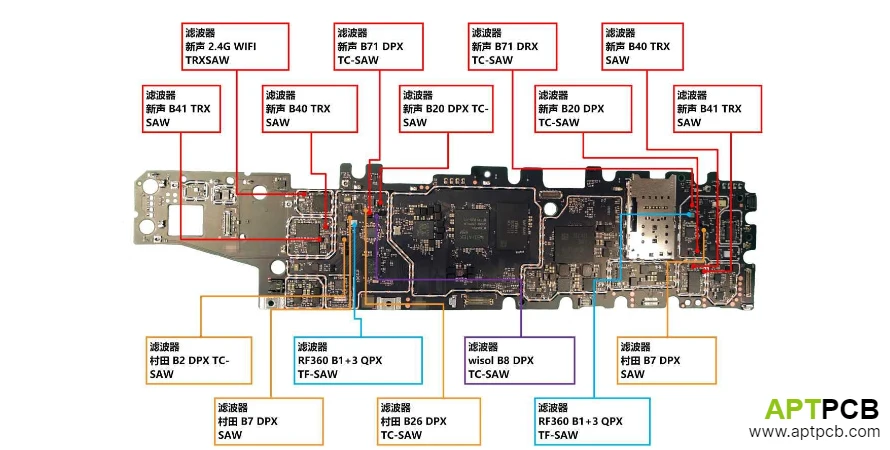
Tablet PCB design combines smartphone-level density with laptop-class power and display requirements. A production tablet PCB must fit into a thin mechanical envelope while supporting processors, memory, wireless modules, lithium batteries, touch sensing, and high-resolution displays.
The highest-impact decisions are made before routing begins:
- Selecting a stackup that meets thickness, impedance, and manufacturing targets.
- Defining whether battery management belongs on the main PCB or a separate battery board.
- Protecting touch sensing from display, RF, and switching noise.
- Choosing the correct display interface architecture.
- Confirming that the PCB supplier can repeatedly manufacture thin HDI boards.
This guide provides the engineering criteria required to move from tablet concept design to production-ready hardware.
In This Guide
- How do you choose a tablet PCB stackup for thin designs?
- When does a tablet PCB require HDI technology?
- Should BMS functions be integrated into the tablet main PCB?
- How do you route touch controller signals with low noise?
- Should a tablet use MIPI DSI or eDP?
- What manufacturing checks qualify a tablet PCB supplier?
How do you choose a tablet PCB stackup for thin designs?
Premium tablets commonly require PCB thickness below 0.8mm while maintaining sufficient routing capacity for processors, memory, power rails, and high-speed interfaces.
The stackup decision affects:
- Final mechanical thickness.
- Signal integrity.
- Power distribution.
- Warpage behavior.
- Manufacturing yield.
A typical tablet PCB uses 6–8 layers.
| Tablet requirement | Typical PCB choice | Engineering impact |
|---|---|---|
| Standard tablet architecture | 6-layer PCB | Lower cost with limited routing margin |
| Premium tablet with high-speed interfaces | 8-layer PCB | Better reference planes and power integrity |
| Dense processor and memory layout | 8-layer HDI PCB | Supports fine-pitch escape routing |
Thin tablet stackups commonly require:
- 50–75μm prepregs.
- 100–150μm cores.
- 12μm or 18μm copper for fine routing layers.
- 1oz copper where current capacity requires additional thickness.
- High-Tg laminate materials.
The final pressed thickness must be calculated from the completed construction, not only laminate specifications. Dielectric compression and lamination variation directly influence impedance performance.
Understanding PCB stackup design principles helps optimize layer arrangement for electrical and mechanical constraints.
When does a tablet PCB require HDI technology?
HDI becomes necessary when component density exceeds what conventional drilled vias can support.
| Design condition | Suitable approach |
|---|---|
| Moderate component density | Through-hole vias with optimized routing |
| Fine-pitch BGA packages | Laser microvias and HDI layers |
| PCB thickness below 0.6mm | Thin dielectric HDI construction |
| High-speed processor routing | Additional reference layers |
HDI provides:
- Smaller via structures.
- Improved BGA escape routing.
- Higher wiring density in thin constructions.
However, HDI increases manufacturing complexity. Supplier capability must include microvia reliability control, laser drilling accuracy, copper filling processes, and inspection capability.
Should BMS functions be integrated into the tablet main PCB?
Tablet batteries typically use lithium polymer cells in the 20–40Wh range. Battery management must handle charging control, protection, temperature monitoring, and fuel estimation.
The main architecture decision is whether battery management remains integrated with the main PCB or separated into a battery protection board.
| Architecture | Advantages | Design considerations |
|---|---|---|
| Main PCB integrated BMS | Saves space and reduces connectors | Requires careful power and noise separation |
| Separate battery protection PCB | Simplifies battery qualification | Adds volume and interconnect cost |
Important battery PCB design parameters include:
- Continuous current paths around 2–4A for typical designs.
- Higher current capability for fast charging systems.
- Current sensing resistors typically in the 5–20mΩ range.
- Kelvin routing from shunt resistor connections.
- Protection MOSFET placement close to battery terminals.
- NTC temperature sensing near cells.
- Clean analog grounding for fuel gauge accuracy.
Battery protection must consider creepage, clearance, thermal behavior, and applicable safety requirements.
How do you route touch controller signals with low noise?
Capacitive touch systems measure very small changes in capacitance, making them sensitive to interference from:
- Display drivers.
- Switching regulators.
- RF circuits.
- Processor activity.
- High-speed interfaces.
A reliable tablet PCB separates sensitive touch paths from noisy circuits.
| Area | Design target |
|---|---|
| Touch controller placement | Away from inductors and switching nodes |
| Sense routing | Short, direct, noise-controlled paths |
| Grounding | Dedicated reference strategy |
| Connector routing | Ground protection around sensitive signals |
Touch layout should include:
- Separation between touch traces and high-current paths.
- Ground shielding where sensitive routes approach noisy areas.
- Filtering on touch power rails.
- Mechanical stack validation including glass, adhesive, and sensor layers.
The electrical behavior depends on the complete touch stack, not only PCB routing.
Should a tablet use MIPI DSI or eDP?
Tablet display architecture usually depends on panel technology, bandwidth requirements, and system origin.
| Interface | Typical application | PCB requirement |
|---|---|---|
| MIPI DSI | Mobile-class displays | Compact routing and EMI control |
| eDP | Higher-resolution laptop-style displays | Higher bandwidth and stricter signal integrity |
MIPI DSI commonly uses 1–4 data lane pairs plus clock lanes operating around 1–2.5Gbps per lane.
eDP commonly operates from 1.62Gbps to 8.1Gbps per lane depending on link configuration.
Display routing requires:
- Controlled differential impedance around 85–100Ω depending on PHY requirements.
- Intra-pair skew control around 5 mils or less.
- Continuous reference planes.
- Minimal connector discontinuities.
- Correct AC coupling capacitor placement where required.
- EMI control around display connectors.
High-speed display routing benefits from high-speed PCB design principles.
What manufacturing checks qualify a tablet PCB supplier?
Ultra-thin tablet boards require manufacturing controls beyond standard multilayer PCB production.
| Manufacturing area | Qualification requirement |
|---|---|
| Thin PCB processing | Proven production below 0.8mm thickness |
| HDI capability | Stable laser microvia yield |
| Impedance control | Verified stackup calculations and testing |
| Assembly | Fine-pitch BGA and flex connector experience |
| Reliability | Thermal and mechanical validation support |
For thin boards, manufacturing variation directly affects mechanical fit and electrical performance.
A 0.6mm target PCB with ±10% thickness tolerance may vary approximately from 0.54mm to 0.66mm, which can affect enclosure assembly.
HDI manufacturing capability improves routing density and supports compact tablet architectures.
Working with suppliers experienced in HDI PCB fabrication improves consistency during production scaling.
Tablet PCB Failure-Mode Decision Matrix
| Failure mode | Primary cause | Design control |
|---|---|---|
| Touch malfunction | Noise coupling from power or display circuits | Dedicated routing and grounding strategy |
| Display instability | Poor impedance control or return path interruption | Controlled differential routing |
| Battery overheating | Poor current path or thermal design | Optimized copper and sensing layout |
| PCB warpage | Thin construction stress | Controlled lamination and material selection |
| BGA reliability issues | Mechanical stress on thin boards | Verified assembly and thermal cycling |
Tablet PCB Supplier RFQ Checklist
A production RFQ should include:
| Supplier capability | Evaluation point |
|---|---|
| Thin PCB production | Demonstrated experience with sub-0.8mm boards |
| HDI process | Microvia structure and reliability data |
| Stackup engineering | Controlled impedance documentation |
| Assembly capability | Fine-pitch packages and connector handling |
| Validation support | Thermal, mechanical, and electrical testing |
Technical Summary
Tablet PCB development requires balancing thickness, routing density, power delivery, touch sensitivity, display bandwidth, and manufacturing capability.
The strongest designs begin with a defined stackup strategy, a validated battery architecture, controlled touch routing, a suitable display interface, and a supplier capable of producing thin HDI boards consistently.
Early cooperation between PCB engineers, mechanical teams, display suppliers, and manufacturing partners reduces redesign cycles and improves volume-production readiness.
Which expansion should I prepare next: tablet PCB RFQ checklist or tablet HDI stackup selection matrix?