
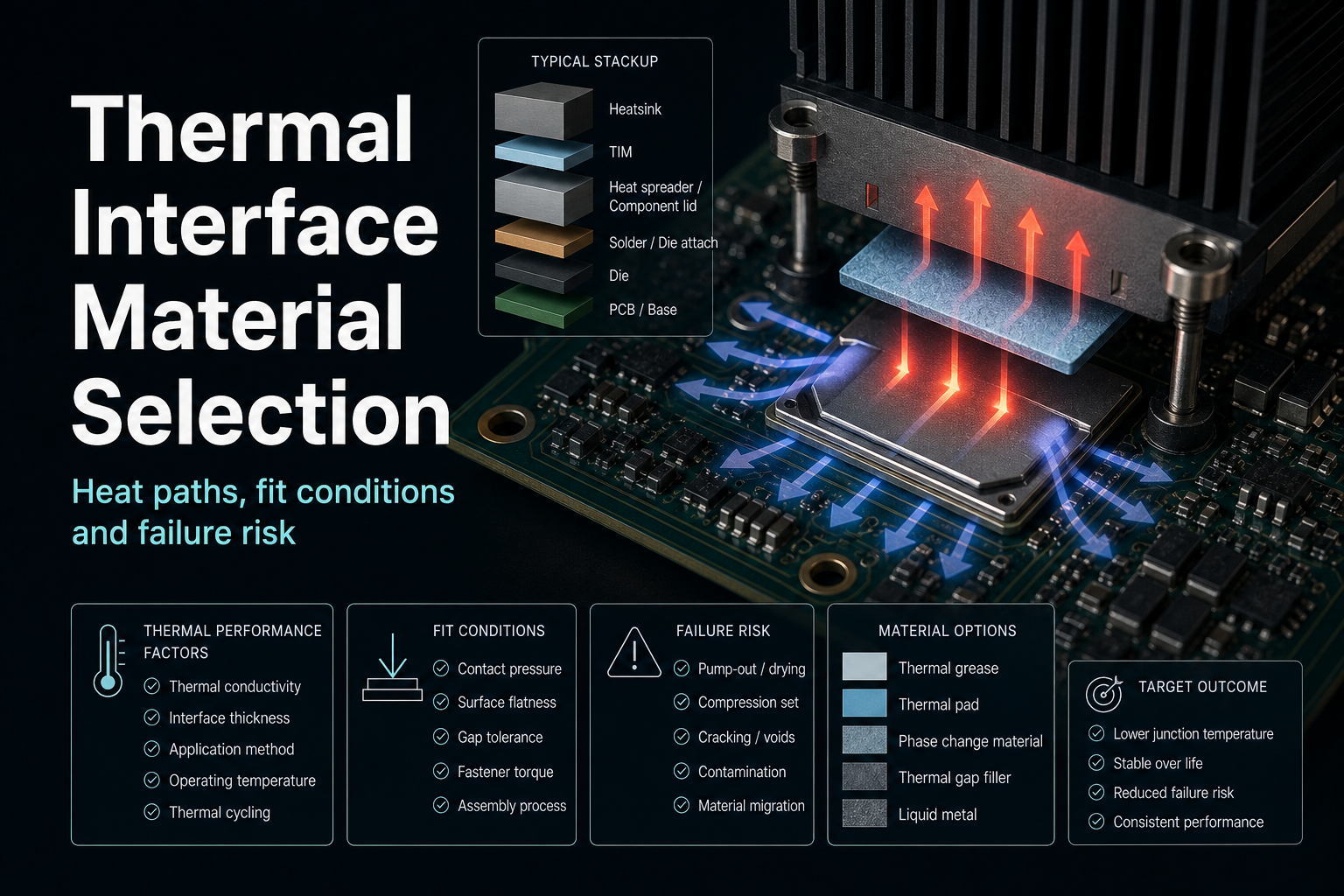
Thermal interface material selection is not a search for the highest conductivity number on a datasheet. For PCB assemblies, the real job is to close the heat path between the board, the chassis, and the heatsink without creating new assembly or reliability problems.
This is why the material decision sits downstream of the board-platform decision. A metal-core PCB, high thermal PCB, ceramic substrate, heavy-copper board, or standard FR-4 design with thermal vias will each create a different interface geometry, pressure condition, and inspection plan. The TIM has to match that stack, not replace it.
If the board platform is still open, start with APTPCB's materials overview and thermal platform pages before narrowing to a pad, grease, gel, or film.
Quick answer
Use TIM selection as a heat-path decision exercise:
| Review area | What to decide | Why it matters | How to verify | If ignored |
|---|---|---|---|---|
| Heat source map | Which components actually need a board-to-heatsink interface | Avoids padding every warm part instead of solving the main hotspot | Review power devices, LED modules, processors, or drivers in layout and mechanical stack | Cost and complexity increase without improving the dominant thermal bottleneck |
| Board platform | Whether the design should stay on FR-4 with vias, move to metal-core, heavy copper, or ceramic | The board platform sets flatness, isolation, and spreading behavior before TIM is chosen | Review stackup, copper distribution, isolation needs, and enclosure contact plan | TIM gets asked to solve a board-choice problem it cannot fix |
| Interface gap | Whether the interface needs grease, pad, gel, phase-change film, or adhesive tape | Form factor affects compression, rework, cleanliness, and assembly repeatability | Check surface gap, pressure method, rework needs, and fixture tolerance | Air gaps, pump-out, squeeze-out, or difficult service work |
| Electrical boundary | Whether the interface must remain insulating | Some heatsinks or chassis surfaces cannot share potential with the hot device or copper region | Review grounding and creepage strategy with the mechanical team | Shorts or unsafe enclosure coupling |
| Validation plan | How the interface will be checked in pilot builds | TIM performance depends on pressure, flatness, and assembly process, not just the part number | Use thermocouples, IR review, torque checks, and first-build inspection | A theoretically good material underperforms in production |
How to choose a thermal interface material in five steps
If you only need the order of decisions, this is it:
- Measure the gap. Use the worst-case gap from the tolerance stack, not the nominal value. Gaps well under 0.1 mm point to grease, paste or phase-change film. Larger or uneven gaps point to pads, gels or gap fillers.
- Check the clamping force. Know how the interface is loaded (screws, springs, clips or adhesive only) and how much force the board and package can take.
- Decide whether it must insulate. If the heatsink or chassis cannot share potential with the copper or device tab, the TIM, or a separate insulator, has to provide the isolation.
- Decide on rework and service. Wet materials are harder to rework cleanly. Pads and films come off more easily.
- Only then compare conductivity. Among materials that pass steps 1–4, compare thermal resistance at your real thickness and pressure, not the bulk W/mK headline.
| Gap and condition | Usually the first TIM family to evaluate |
|---|---|
| Very thin, flat, well-clamped, rework rare | Thermal grease or paste |
| Thin, flat, clean handling wanted | Phase-change film |
| Uneven or tolerance-driven gap, several parts under one cover | Pad, gel or dispensed gap filler |
| No mechanical fasteners, part must be held in place | Thermal adhesive or adhesive tape |
| Must insulate between tab and heatsink | Insulating pad or film rated for the voltage |
When this article is useful
This article is useful for board and assembly teams deciding how to connect a hot PCB area to a mechanical thermal sink. Typical cases include:
- Power stages mounted to a chassis or cold plate
- LED boards clamped to an aluminum housing
- Processor or FPGA zones that need a compressible path to an enclosure
- Mixed assemblies where one local hotspot must be pulled off the board
Full junction-temperature modeling, product lifetime projection, and enclosure-level thermal certification still require separate work. This article helps define the interface decision and the checks needed before release.
It is especially useful when the real query is one of these:
- Which TIM category fits my board-to-housing gap and clamping method?
- Should I keep the design on FR-4 with vias or escalate to a thermal platform change first?
- How should I validate a board-to-sink interface before design release?
Start with the thermal path, not the TIM catalog
Before narrowing down pads, grease, or phase-change films, confirm where the board sits in the overall heat path:
- Heat leaves the device package.
- It enters copper, vias, or a metal or ceramic base structure.
- It crosses the board-to-sink interface.
- It moves into the chassis, heatsink, or housing.
- It exits to ambient through convection, conduction, or a larger system structure.
If step 2 is weak, changing only the TIM rarely fixes the system. That is why many designs first need a platform choice between metal-core, high thermal, ceramic, or a standard construction reviewed through the broader materials library.
For LED-specific board decisions, the related guide on LED thermal management at board level covers when the thermal path issue starts upstream of the TIM itself.
Match TIM type to board and assembly conditions
The safest selection route is to start from interface behavior rather than vendor marketing labels.
Grease or dispensable paste
Best when the interface is relatively flat, the assembly can control mess and process variation, and the lowest possible bond line is important.
Use it carefully when:
- Mounting pressure is well controlled
- Rework access is acceptable
- Bleed or migration near contacts is not a concern
Avoid treating grease as the default answer for every high-power board. It can solve contact resistance, but it also adds process-control work.
Pads, gels, and gap fillers
Best when the stack has tolerance variation, the enclosure is not perfectly flat, or the assembly needs a cleaner and more repeatable installation method.
They are often the practical choice when:
- The board sits against a housing with a measurable gap
- Several devices share one cover or spreader
- The product needs easier service handling than wet materials allow
The tradeoff is that a thicker interface may make the board-platform decision even more important.
A common mistake is to chase the highest conductivity number without checking compressibility. Engineers sometimes place a 10 W/mK or even 15 W/mK pad into the BOM for a CPU, FPGA, or RF processor zone and assume the interface is now safer because the datasheet looks stronger. In practice, that grade often carries heavy ceramic loading and much higher Shore hardness. The pad stops behaving like a compliant gap filler and starts behaving like a rigid spacer.
That is where the thermal part becomes a mechanical failure source. When the line operator tightens the heatsink screws to the normal torque, the hard pad does not collapse enough to absorb stack tolerance. It turns into a mechanical fulcrum under the sink. Local board warpage rises, the load concentrates around the package, and the BGA solder joints underneath can shear or crack with almost no visible warning. In worse cases, the die itself can fracture under clamping stress. TIM selection is therefore not only a thermal-conductivity problem. If the compression modulus does not match the real gap and torque path, the pad is no longer a cooling aid. It is a board-breaking tool.
Phase-change or film-based interfaces
Useful when the program wants cleaner handling than grease but tighter contact than a thick pad. These options still need validation around activation temperature, assembly pressure, and rework handling.
Adhesive thermal tapes
Useful when the interface must provide both attachment and heat transfer, but they should be treated as a mounting method as much as a thermal one. Do not assume adhesive convenience equals best thermal performance.
What is the thermal conductivity of glue and thermal adhesives?
Ordinary epoxy and silicone glues are poor heat conductors. Unfilled adhesive resin is in the same low range as the FR-4 resin itself (well under 1 W/mK). Thermally conductive adhesives add ceramic or metal fillers to raise that value, but they are usually chosen because they bond, not because they conduct best. When you compare an adhesive with a pad or grease:
- Compare thermal resistance at the bond line you will actually get, not the bulk conductivity figure.
- Check whether the datasheet value comes from a standard test method such as ASTM D5470, and at what thickness.
- Remember that a cured adhesive cannot absorb movement the way a soft pad can, so CTE mismatch between the part and the heatsink goes straight into the joint.
- Plan for rework: a bonded part often cannot be removed without damaging the board.
Board-platform decisions that change TIM selection
The interface choice depends heavily on the board route already in play.
FR-4 with thermal vias
This route can work when the hotspot is manageable and the design can spread heat through copper and vias before it reaches the interface. TIM selection here usually focuses on local contact quality to a bracket, cover, or secondary spreader.
Metal-core or IMS boards
For many LED and power designs, an IMS or MCPCB route already creates a direct thermal path to an aluminum base. In that case, the TIM decision is about the contact from the metal base to the final sink, plus reflow and flatness control during assembly. Dielectric thickness, base flatness and board size limits for this route are listed under metal core PCB capabilities.
Heavy-copper boards
Heavy copper can improve spreading and current handling, but it is not the same route as metal-core or ceramic. The TIM still needs a clear exit path into a sink or enclosure.
Ceramic boards
Ceramic substrates belong to a separate thermal platform family, not a synonym for MCPCB. If the project is truly in a ceramic category, the interface review must also consider mechanical brittleness, clamping approach, and the exact substrate family being used.
When to escalate from TIM selection to a platform review
Pause TIM part-number selection and move back to the board platform review when:
- The interface gap is growing because the enclosure and board do not meet cleanly
- The design depends on very thick interface material to compensate for weak heat spreading
- Pressure control is inconsistent across the mounting area
- Electrical isolation needs are still unresolved between copper, fasteners, and chassis
- The team is comparing TIM grades before agreeing on FR-4, metal-core, heavy-copper, or ceramic direction
In those cases, the next useful handoff is usually to a board platform review (high thermal, metal-core, or ceramic), not a narrower vendor-material comparison. If the gap problem comes from the housing itself, the PCB enclosure and box build stage is where board, TIM and chassis tolerances get reviewed together.
A practical selection checklist
Use this short checklist before locking the part number:
- Confirm the dominant hotspot and its exit path.
- Confirm whether the board platform itself is still under review.
- Confirm the required interface gap under real stack tolerances.
- Confirm whether the interface must stay electrically insulating.
- Confirm how pressure is applied and controlled in assembly.
- Confirm whether the product needs field rework.
- Confirm how the interface will be validated in pilot builds.
If any of those answers are unclear, the safer next step is not to guess a TIM grade. It is to tighten the thermal-path review with fabrication, assembly, and mechanical teams.
Common failure modes
| Failure mode | What usually caused it | What to check next |
|---|---|---|
| Good datasheet, poor real cooling | The board platform or contact pressure was wrong | Recheck flatness, torque path, and whether the board should have used a different thermal platform |
| Pump-out or dry contact over time | The interface did not match the movement and cycling profile | Review compression, service temperature range, and whether a different form factor is needed |
| Pad too thick to perform well | Large mechanical gap drove the choice | Revisit enclosure tolerance or board-to-sink geometry instead of only upgrading pad grade |
| Rework becomes messy or inconsistent | Wet TIM was chosen for a service-heavy design | Consider pad, gel, or film routes with clearer handling |
| Unexpected electrical risk | The interface was assumed to be insulating without a grounding review | Recheck chassis potential, mounting hardware, and insulation requirements |
Validation before release
Do not sign off based on datasheet comparison alone. At minimum, review:
- Temperature behavior on first-build hardware
- Mechanical pressure consistency across units
- Whether the board sits flat in the intended fixture
- Whether the TIM application method is repeatable on the real assembly line
- Whether rework leaves residue or handling risk that the program can accept
If the thermal route is still uncertain, move upstream and review the board platform first. The thermal board pages listed under Related pages below are better starting points than forcing a narrow TIM choice too early.
Next steps with APTPCB
If your program is pushing heat through a dense compute board, a high-power LED module, or an automotive power assembly, do not treat TIM choice as a datasheet shopping exercise. Pump-out during thermal cycling, hard-pad clamping stress, and hidden board warpage can destroy the assembly long before the conductivity number becomes useful.
Send the Gerber or ODB++ package, STEP assembly files, expected gap tolerances, and heatsink torque specifications to [email protected], or request a TIM and thermal path review with your quote. APTPCB's thermal-management and mechanical-assembly engineering team will return a TIM Compressibility & Assembly Stress Review within 24 hours.
That review is designed to stop the failure before hardware is damaged: interface-gap mismatch, pump-out risk, heatsink load concentration, board-bending under clamp force, and the compression behavior that decides whether a pad becomes a thermal path or a BGA fracture mechanism. The goal is to calculate the real tolerance stack, evaluate how the fastening load deforms the PCB, and lock the thermal and mechanical balance before an expensive device is crushed.
FAQ
Is higher thermal conductivity always better?
No. A material with an impressive datasheet value can still underperform if the real bond line is too thick, the pressure is inconsistent, or the board platform is wrong for the job.
Can TIM fix an underspecified PCB thermal path?
Usually not by itself. If heat cannot spread through the board or reach the interface cleanly, changing only the TIM often produces a disappointing result.
Should LED boards always use MCPCB plus a pad?
Not automatically. LED thermal design starts with the heat path and validation plan. Some designs fit MCPCB well; others need a different platform or a different mechanical interface.
When should ceramic enter the discussion?
When the project truly needs a ceramic substrate category, not as a generic synonym for a high-thermal board. Ceramic, IMS, and heavy copper are adjacent but distinct platform families.
Related pages
- Materials overview
- Metal core PCB
- High thermal PCB
- Ceramic PCB
- LED thermal management at board level
- DFM guidelines
- Request a quote
Conclusion
Thermal interface material selection works best when it follows a clear board-level heat-path review. The right question is not "which TIM has the biggest number," but "what interface problem does this assembly actually need to solve?"
Once the board platform, interface geometry, and validation method are clear, the TIM choice becomes much simpler and much safer to implement.
Public references
Bergquist thermal materials and interfaces overview Supports the distinction between pad, grease, gap-filler, and interface behavior in real board-to-sink assemblies.
APTPCB Metal core PCB page Supports the IMS or metal-core branch used when the board platform itself owns the thermal path.
APTPCB High thermal PCB page Supports the thermal-platform routing used when TIM selection must be framed against board-level heat-path choices.
APTPCB Ceramic PCB page Supports the ceramic-platform comparison where clamping and brittleness change the interface decision.
Author and review information
- Author: APTPCB thermal, materials, and DFM content team
- Technical review: thermal-path, interface-control, and assembly-validation engineering team
- Last updated: 2026-10-01