
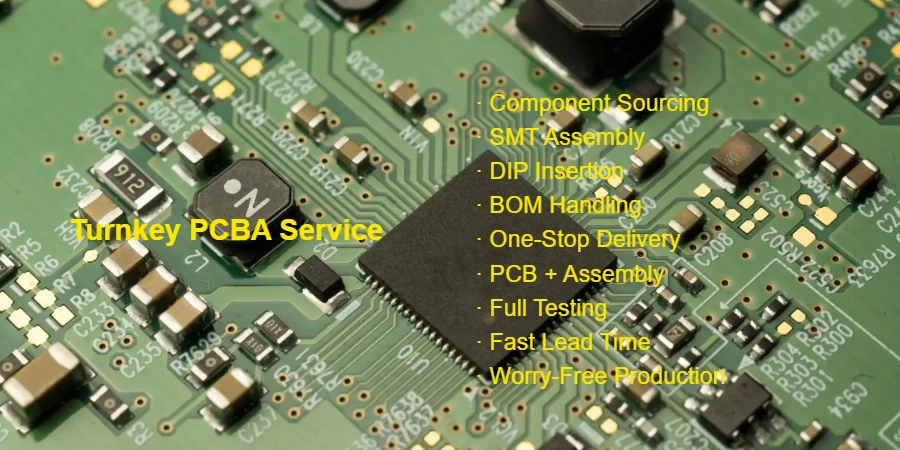
As products get smaller, smarter, and more connected, very few hardware teams can afford to manage separate PCB factories, brokers, and assembly houses for every project. That’s why more and more engineers and purchasers are searching for:
- turnkey PCBA service
- turnkey PCB assembly
- one stop turnkey PCBA manufacturer in China
Instead of juggling multiple vendors, turnkey PCBA gives you a single partner that takes responsibility for the entire chain:
From PCB fabrication and component sourcing
→ to SMT/THT assembly, inspection, testing, and shipment of finished PCBAs.
As a PCB manufacturing and PCB assembly factory, we focus on helping customers shorten development cycles, stabilize quality, and simplify supply chain management through true turnkey PCBA services.
What Turnkey PCBA Is and Why Hardware Teams Are Switching
In a traditional model, getting a single electronic assembly built may involve separate suppliers for bare PCBs, components, assembly, and test. Each link has its own priorities, paperwork, and lead times. A late IC shipment, a stack-up mistake, or a footprint mismatch can quickly translate into delays, extra cost, and endless back-and-forth.
Turnkey PCBA compresses this fragmented process into a single integrated service. You send complete design data and requirements to one manufacturing partner, and receive fully assembled, inspected, and tested PCBAs ready for integration or shipment.
Instead of “assembly only”, real turnkey PCBA means taking responsibility for the full manufacturing outcome—from the first engineering review to the last functional test.
Key Benefits of Turnkey PCBA
Single Point of Accountability
One partner responsible for PCB, components, and assembly quality, instead of multiple suppliers blaming each other.Unified Engineering Review
PCB layout, stack-up, BOM, and test requirements are reviewed together, reducing oversights and misalignments.Tighter Schedule Control
PCB fabrication, sourcing, and assembly are planned under one system with coordinated lead times and buffers.Transparent Total Project Cost
Less hidden cost from scrap, rework, logistics inefficiencies, and miscommunication between vendors.Reduced Internal Workload
Your team spends more time on architecture, design, and validation—and less on chasing ETAs, fixing data mismatches, and resolving supplier conflicts.
Consistent Performance and Reliability
By treating the entire build—PCB, sourcing, assembly, and testing—as a single integrated process, turnkey PCBA improves overall predictability. Instead of debugging quality issues across multiple factories, hardware teams work with one partner that sees the complete picture and can optimize it end-to-end.
When Turnkey PCBA Makes Sense for Your Project
Turnkey PCBA is not mandatory for every design. But as system complexity, board count, and schedule pressure increase, the advantages become clearer. It is especially valuable when you are juggling multiple PCB technologies, frequent design changes, or limited internal supply chain resources.
Key Scenarios Where Turnkey PCBA Fits Best
High-Mix, Multi-Board Systems
Products combining multilayer logic boards, flex or rigid-flex interconnects, ceramic modules, MCPCBs for LEDs, and heavy-copper power boards benefit from a single partner that can coordinate all PCB types and assemblies.Teams Without Large Sourcing or Ops Departments
Startups, labs, and engineering-centric companies that lack dedicated buyers or logistics staff can offload BOM management, part allocation, and supplier coordination to the turnkey partner.Fast Prototyping and Frequent Iterations
When you need quick spins with changes between each build, every extra supplier handoff costs time. Turnkey PCBA lets you modify data once and have it reflected in PCB, BOM, assembly, and test in a coordinated way.Long-Term Outsourced Manufacturing Strategy
Overseas SMEs often use a China-based turnkey PCBA factory as their virtual production arm, covering prototypes, NPI, and continuous small-to-mid-volume builds with one consistent team.
Consistent Performance and Reliability
By choosing turnkey PCBA in these scenarios, teams reduce the risk of schedule slips and latent quality issues caused by fragmented responsibility. A single partner sees how design decisions affect PCB yield, component risk, and assembly quality, and can adjust the process to keep performance consistent from prototype to volume.
What a Real Turnkey PCBA Service Includes
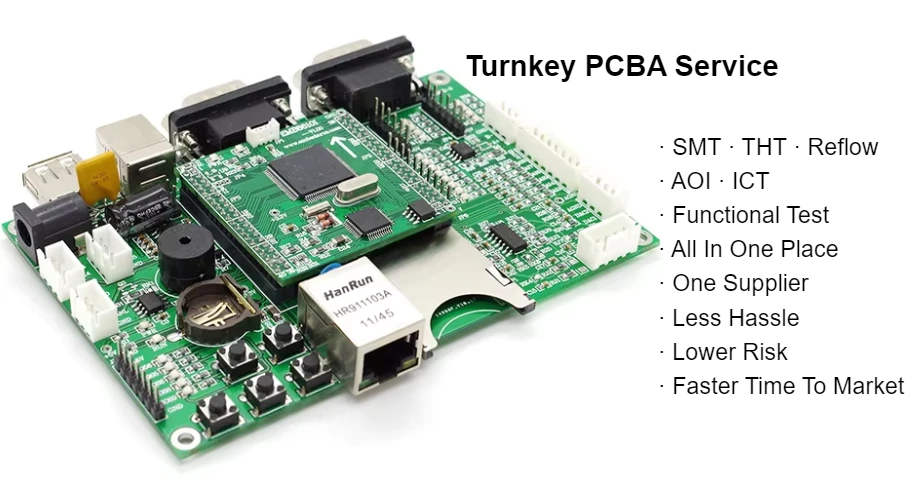
Different companies use the term turnkey in different ways. A robust, production-ready turnkey PCBA service should go far beyond “we assemble your boards if you ship us PCBs and parts.”
Core Elements of a Complete Turnkey PCBA Package
PCB Fabrication
- Single- and double-sided FR4 PCBs
- Multilayer PCBs (4 / 6 / 8 / 10 / 12+ layers)
- HDI PCBs with microvias, blind/buried vias, via-in-pad
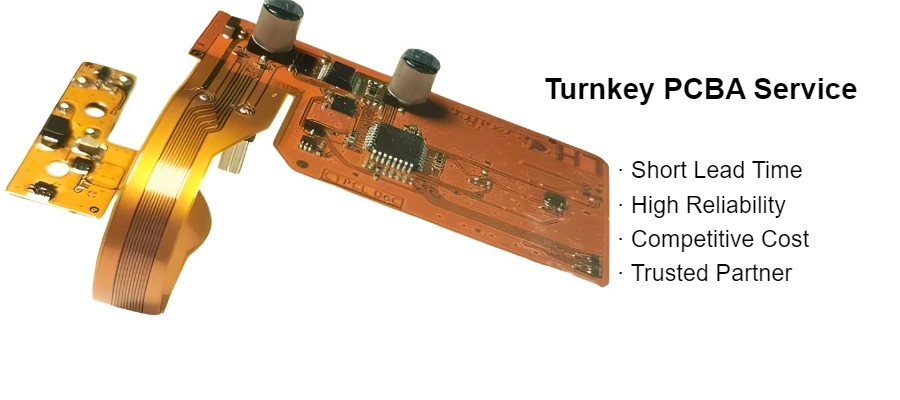
- Flex and rigid-flex PCBs for 3D routing and bending
- Metal core PCBs (aluminum, copper) for LED and power stages
- Ceramic PCBs (Al₂O₃, AlN) for high-temperature and RF power
- High-frequency PCBs using PTFE or low-loss materials
- Heavy-copper boards for high current and robust power paths
Component Sourcing and BOM Management
- Procurement from authorized or vetted channels
- Alignment with your AVL and compliance requirements
- Suggestions for drop-in alternates during shortages or price spikes
- Incoming inspection for critical ICs and custom parts
SMT and THT Assembly
- High-speed SMT for fine-pitch BGAs, QFNs, CSPs and tiny passives
- Double-sided reflow where needed
- THT (DIP) insertion and wave/selective solder
- Specialized fixturing and handling for flex, rigid-flex, ceramic, MCPCB, and heavy-copper substrates
Testing, Programming, and Finishing
- AOI for solder joint quality and component placement
- X-ray inspection for hidden joints (BGA, LGA, BTC)
- ICT or flying-probe where test points and fixtures are available
- Functional test according to your procedures and fixtures
- Optional firmware programming, conformal coating, labeling, and serialization
Packaging and Logistics
- ESD-safe and moisture-controlled packing
- Clear lot and revision labeling
- Documentation bundles with test records and traceability
- Domestic and international shipping support
Consistent Performance and Reliability
A true turnkey PCBA service provides a controlled, traceable path from raw material to finished assembly. Because all process steps are coordinated under one framework, it is easier to maintain stable yield, reduce defects, and replicate results across multiple builds and product generations.
Key Technical Capabilities That Define Serious Turnkey Providers
Not every PCB or assembly shop is prepared for demanding turnkey projects. The gap often shows up in limits on PCB technology, assembly precision, or process control.
Critical Capability Areas to Evaluate
PCB Manufacturing Limits
- Maximum layer count and practical yields at higher layer numbers
- Minimum trace/space and drilled via sizes for your design rules
- Reliable impedance control and documentation for high-speed signals
- Supported laminates (standard FR4, high-Tg, halogen-free, RF, etc.)
- Available finishes (ENIG, immersion silver/tin, OSP, lead-free HASL, and others)
Assembly Capability and Process Control
- Smallest component size and BGA pitch they can handle consistently
- Use of SPI, AOI, and X-ray as standard process tools
- Experience assembling on flex, rigid-flex, ceramic, MCPCB, and heavy-copper boards
- Stable reflow profiles, solder paste control, and lot-level traceability
Engineering Support: DFM, DFT, Cost & Risk Optimization
- Practical DFM feedback on pads, vias, panelization, and stencil design
- DFT guidance on test points, fixtures, and test coverage
- Suggestions to reduce cost and supply risk without harming performance (stack-up choices, alternates, etc.)
Consistent Performance and Reliability
When these technical capabilities are in place, your first turnkey build is much closer to a production-ready result. Instead of discovering basic manufacturability limits late, you benefit from engineering feedback before tooling and procurement, which keeps quality and reliability stable as volumes grow.
Inside a Turnkey PCBA Project: From Data to Qualified Build
A well-structured turnkey PCBA project follows a clear, repeatable workflow from data submission to final shipment. Understanding this flow helps you prepare better data packages and set realistic expectations.
Key Stages in a Typical Turnkey PCBA Workflow
Data Submission and Requirement Alignment
- PCB files (Gerber / ODB++ / IPC-2581)
- BOM with specific part numbers and allowed alternates
- Pick-and-place data, assembly drawings, and mechanical constraints
- Test and programming requirements, if applicable
Integrated Engineering Review and Quotation
- Combined evaluation of PCB complexity, materials, and processes
- Sourcing checks on availability and lifecycle of key components
- DFM/DFT review to highlight risks and optimization opportunities
- A consolidated quote covering PCB, components, assembly, and testing
NPI Preparation and Process Setup
- CAM work for panelization, drilling, and stack-up documentation
- Definition of stencil thickness, reflow profiles, and work instructions
- Component reservation and purchase planning for your lot
PCB Fabrication and Incoming Quality Control
- PCB manufacturing with AOI and e-test where applicable
- Incoming inspection for critical components and materials (labels, packaging, sampling tests)
Assembly, Inspection, and Testing
- Solder paste printing, SMT placement, and reflow
- THT assembly, wave/selective soldering, and manual inspection
- AOI and X-ray for high-risk or hidden joints
- ICT / flying probe / functional tests according to your plan
Packaging, Documentation, and Shipment
- ESD-safe packing, lot labeling, and documentation
- Shipment coordination and tracking for domestic or international delivery
Consistent Performance and Reliability
By following a structured workflow, turnkey PCBA partners can repeat successful builds and scale from prototypes to volume without reinventing the process each time. This stability is crucial for high-reliability applications in industrial, medical, automotive, and communication markets.
Choosing and Working with a Turnkey PCBA Partner
Choosing the right turnkey PCBA partner is about more than price—it is about technical fit, communication style, and long-term collaboration potential.
Key Factors When Selecting a Turnkey PCBA Partner
Technology Alignment
Ensure they support all PCB types and assembly processes your roadmap requires, not just your current revision.Real Turnkey vs. Pure Broker Model
Confirm which processes are in-house or tightly controlled, and how quality and project management are handled.Engineering Access and Communication
Look for direct access to engineers who can discuss DFM, DFT, and test, not just sales staff.Lead Time and Capacity Stability
Check standard and expedited lead times, capacity planning, and their track record during peak seasons.Quality Systems and Traceability
Review certifications, failure handling, corrective action processes, and traceability depth.Willingness to Support Long-Term Optimization
Prefer partners who help refine your designs and processes over multiple product generations.
Practical Tips for Smooth Cooperation
Standardize Where Possible
Reuse proven libraries, preferred components, and sub-assemblies to speed up builds and reduce variability.Think About DFM/DFT Early
Good land pattern, via, and test point decisions during layout save time and cost later.Treat the BOM Strategically
Maintain approved alternates for critical parts with your partner to reduce supply risk.Define Test Strategy Up Front
Decide on ICT, functional test, or both early, so fixtures and coverage fit naturally into the turnkey flow.Document Special Requirements Clearly
Programming, coating, labeling, and packing rules should be in formal documents, not only in email threads.
Consistent Performance and Reliability
A strong turnkey relationship allows both sides to learn from each project and improve continuously. Over time, your partner builds a deep understanding of your standards, making it easier to meet reliability, compliance, and cost targets with fewer surprises.
Quick FAQ About Turnkey PCBA
Q1: Is turnkey PCBA always more expensive than managing everything myself?
Not necessarily. While unit prices may look higher than “assembly only”, total project cost often decreases once you factor in engineering time, coordination overhead, scrap, rework, and schedule slip risks.
Q2: Can I still supply some components while using turnkey PCBA?
Yes. Many companies start with a hybrid model, where the factory sources common parts and you provide critical ICs or custom items. Over time, the mix can shift as trust and processes mature.
Q3: Can the same partner handle both prototypes and production?
Ideally, yes. Using one partner for prototypes, NPI, and volume builds lets lessons from early runs directly improve mass production quality, yield, and cost.
Q4: What’s a practical way to evaluate a new turnkey PCBA supplier?
Start with a representative but manageable project, send a clean data package, and evaluate not just the boards, but also communication quality, documentation, responsiveness, and problem-solving attitude.