
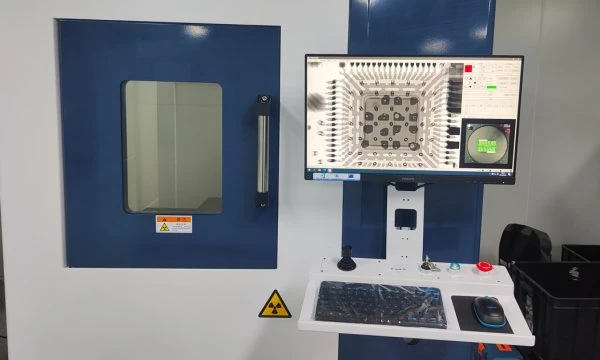
An RF upconverter PCB converts an intermediate-frequency (IF) or baseband signal into a higher RF frequency by mixing it with a local oscillator (LO). A production-ready design must control much more than the desired carrier frequency. Mixer products, LO leakage, image rejection, phase noise, impedance discontinuities, power noise, and thermal variation all affect whether the final assembly meets system requirements.
A reliable RF upconverter design connects four decisions:
- Frequency architecture and mixer operating point
- PCB electromagnetic structure and material selection
- Manufacturing controls for repeatable RF performance
- Validation methods that prove conversion performance
What should be decided before designing an RF upconverter PCB?
Before schematic capture, define the complete frequency plan.
A mixer generates sum and difference products:
[ RF = LO + IF ]
or
[ RF = LO - IF ]
depending on the injection scheme. Real mixers also create unwanted harmonics, LO feedthrough, image products, and intermodulation components.
The frequency plan should define:
| Parameter | Design decision | Release evidence |
|---|---|---|
| IF frequency | Bandwidth, signal level, modulation format | IF spectrum specification |
| LO frequency | Source phase noise, output power, harmonic content | LO spectrum measurement |
| RF output | Required band and channel spacing | RF allocation document |
| Mixer type | Passive, active, IQ, image-reject | Component selection report |
| Filtering | Required rejection of unwanted products | Filter simulation and measured response |
| Gain chain | Gain, attenuation, compression margin | Link budget |
For IQ upconverters, include carrier leakage, sideband suppression, and amplitude/phase mismatch calibration in the system validation plan. Digital correction can improve performance, but it cannot fully compensate for poor isolation or unstable RF layout.
How do you choose an RF upconverter architecture?
The architecture determines PCB complexity, power requirements, and validation effort.
| Architecture | Advantages | Design considerations |
|---|---|---|
| Passive mixer | High linearity, low noise contribution | Requires sufficient LO drive and external gain planning |
| Active mixer | Conversion gain and lower LO drive requirements | Requires bias control and power integrity management |
| IQ upconverter | Supports image rejection and modulation control | Requires accurate phase/amplitude matching |
| Integrated converter IC | Reduced layout complexity | PCB still requires RF isolation and thermal control |
Component selection should include:
- Conversion gain or conversion loss
- LO drive requirement
- LO-to-RF isolation
- Input/output return loss
- IP3 and compression performance
- Operating temperature range
- Package grounding requirements
Evaluation-board performance should be treated as a starting reference. The final PCB stack-up, connectors, shielding, and assembly process can significantly change RF behavior.
What PCB materials are suitable for RF upconverter designs?
Material selection depends on frequency, insertion-loss budget, phase stability requirements, and manufacturing tolerance.
| Frequency/application condition | Typical PCB approach | Key concern |
|---|---|---|
| Lower RF frequencies with short traces | Controlled FR-4 construction | Dielectric variation and loss |
| Microwave signal paths | RF laminate such as Rogers materials | Thickness and dielectric tolerance |
| Mixed digital and RF systems | Hybrid stack-up | Transition control between materials |
| High-frequency microwave/mmWave | Low-loss laminate or specialized substrate | Connector, via, and fabrication precision |
Specify the actual laminate grade, thickness, copper profile, and dielectric parameters used for impedance modeling. Generic material names are insufficient for repeatable RF production.
How should an RF upconverter PCB be laid out?
RF performance depends on controlling electromagnetic paths.
Place the mixer, LO network, matching components, filters, and amplifier stages as a compact RF chain. Maintain controlled impedance from connector launch through every transition.
Key layout decisions include:
- Route RF, LO, and IF paths with continuous reference planes.
- Keep LO energy away from sensitive IF and output RF paths.
- Minimize unnecessary layer transitions.
- Control via inductance and unused via stubs.
- Add grounding structures where electromagnetic simulation or measurement supports them.
- Model connectors, launches, filters, and transitions at the operating frequency.
A typical RF chain layout follows:
IF Input → Matching Network → Mixer → Filter → Gain Stage → RF Output
                    ↑
               LO Injection
The LO path deserves special attention because leakage can appear directly at the RF output and may create unwanted emissions.
What causes LO leakage and unwanted spurs in an RF upconverter?
LO leakage usually results from a combination of mixer limitations and PCB implementation issues.
| Observed problem | Possible cause | Verification method |
|---|---|---|
| High LO carrier at RF output | Poor mixer isolation or PCB coupling | Spectrum analyzer measurement |
| Unexpected harmonics | Insufficient filtering or nonlinear operation | Spur sweep |
| Gain compression | Excessive input/output power | Output power sweep |
| Frequency ripple | Impedance discontinuity or connector mismatch | VNA S-parameter measurement |
| Sideband imbalance | IQ amplitude/phase error | Modulated signal analysis |
| Supply-related spurs | Bias noise coupling into RF chain | Correlate power and RF spectrum |
A spur budget should be created before PCB release. The target is not only the desired RF output but also compliance with the system spectral mask.
How should power integrity be handled in an RF upconverter PCB?
Mixer and amplifier performance can degrade when supply noise reaches sensitive RF nodes.
Recommended power architecture includes:
- Separate supply filtering for LO, mixer, and amplifier sections.
- Local bypass capacitors placed according to component requirements.
- Controlled return-current paths.
- Low-noise regulators for frequency-sensitive circuits.
- Thermal analysis for active RF devices.
Check regulator noise over the frequency offsets that affect phase noise, modulation quality, or unwanted sidebands.
What RF tests should be performed before production release?
A complete RF validation plan should combine electrical, mechanical, and environmental verification.
| Test | Purpose | Required evidence |
|---|---|---|
| S-parameter measurement | Verify impedance and matching | VNA data |
| Conversion gain/loss | Confirm frequency translation performance | Gain versus frequency report |
| LO leakage measurement | Verify isolation | Spectrum plots |
| Spur measurement | Confirm unwanted-product suppression | Spur table |
| P1dB/IP3 testing | Confirm linearity margin | Compression data |
| Phase noise/EVM testing | Validate communication performance | Modulation results |
| Temperature testing | Confirm stability | Thermal sweep data |
The test setup should record:
- Calibration method
- Cable configuration
- Fixture design
- Reference plane
- Instrument settings
- Environmental conditions
Without this information, RF measurements cannot be reliably compared between prototype builds.
RF upconverter PCB supplier selection checklist
A qualified manufacturing package should include:
Electrical requirements
- Complete IF, LO, and RF frequency plan
- Signal levels and modulation requirements
- Conversion gain/loss targets
- Spur and leakage limits
- Phase noise and EVM requirements
PCB fabrication requirements
- Stack-up definition
- Laminate grade
- Controlled impedance requirements
- Copper thickness
- Surface finish
- Via structure requirements
- RF connector specifications
Assembly requirements
- RF component placement tolerance
- Ground pad solder requirements
- Shield installation requirements
- Cleaning requirements
- Inspection method
Validation requirements
- TDR impedance testing when required
- VNA testing requirements
- Spectrum analysis
- RF power measurement
- Golden-unit comparison process
Use high-frequency PCB, microwave PCB and turnkey PCB assembly, then send the package through the PCB quotation page.
Standards and references
- IPC-2221 — Generic printed board design
- IPC-2141 — Controlled impedance circuit boards and high-speed logic design
- IPC-6018 — Qualification and performance for high-frequency printed boards
- IPC-4103 — Base materials for high-speed/high-frequency applications
- IEEE 287 — Precision coaxial connectors at RF and microwave frequencies
Component manufacturer application notes, RF simulation models, and measurement standards should be reviewed according to the operating frequency range.
RF upconverter PCB FAQ
What is the main difference between an RF upconverter and an RF amplifier?
An RF upconverter changes signal frequency through mixing. An RF amplifier increases signal power without intentionally changing frequency. Many transmit chains require both functions.
Does an RF upconverter always generate LO plus IF output?
No. Mixers generate multiple products. The required output depends on the injection plan, filtering, and system architecture.
Can FR-4 be used for RF upconverter PCBs?
Yes in some applications. The decision depends on frequency, trace length, insertion-loss budget, phase stability, and manufacturing variation.
Why does an RF upconverter have high LO leakage?
LO leakage may result from mixer isolation limits, insufficient PCB separation, grounding problems, shielding limitations, bias issues, or IQ imbalance.
What should an RF PCB supplier provide during qualification?
The supplier should define fabrication capability, impedance control method, RF test capability, fixture ownership, and production acceptance criteria before volume release.