
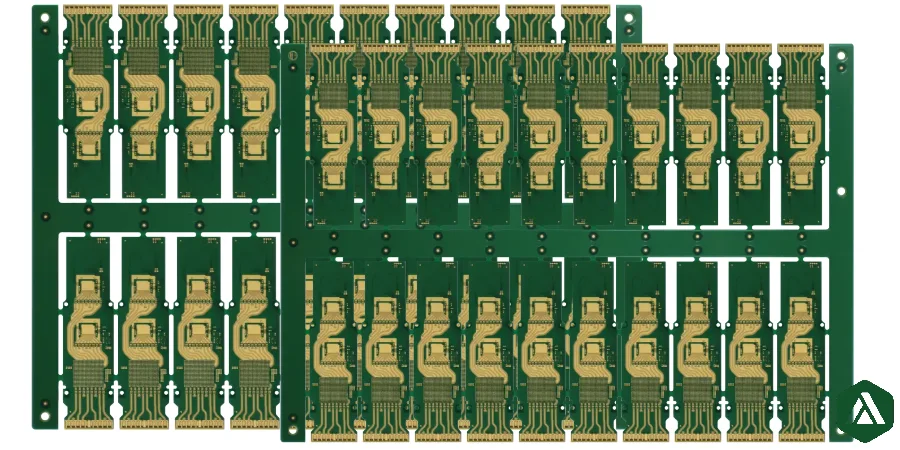
Via-in-pad plated over (VIPPO) is a PCB manufacturing structure used when conventional via fanout cannot support modern package density.
The technology places a via directly inside a component pad, then fills, planarizes, and copper caps the via to create a flat solderable surface.
VIPPO is commonly used for:
- Fine-pitch BGA packages
- High-density FPGA and processor boards
- QFN thermal pads
- HDI PCB structures
- High-speed signal escape routing
- Compact industrial, medical, and communication electronics
The important manufacturing decision is not simply whether to use via-in-pad. The real question is whether the PCB supplier can repeatedly manufacture the required filled and capped structure with controlled geometry and inspection evidence.
Key Takeaways
- VIPPO normally requires filled, planarized, and copper-capped vias according to IPC-4761 Type VII.
- Open vias inside SMT pads can cause solder wicking and solder joint volume loss.
- Non-conductive epoxy fill is the common choice for signal vias because reliability depends on thermal expansion control as well as conductivity.
- Supplier process capability has a direct impact on assembly yield.
- First article approval should include microsection analysis, X-ray inspection, and surface planarity verification.
When Should You Use VIPPO PCB Manufacturing?
VIPPO solves a routing problem, not every PCB problem.
Before adding VIPPO cost and process complexity, evaluate whether the package density or electrical requirements justify the structure.
| Design Situation | VIPPO Decision | Reason |
|---|---|---|
| BGA pitch below 0.5 mm | Recommended | Traditional fanout usually cannot provide enough routing channels |
| BGA pitch around 0.65–0.8 mm | Evaluate | Standard fanout may still work depending on layer count |
| High-power QFN thermal pad | Often beneficial | Improves thermal connection and pad reliability |
| High-speed signal breakout | Consider | Reduces via transition length and parasitic effects |
| Cost-sensitive PCB with available routing space | Usually unnecessary | Added fabrication steps increase cost |
VIPPO is a manufacturing solution for density constraints. When standard dog-bone routing meets electrical and mechanical requirements, the additional process cost may not provide enough value.
What Is the Difference Between Via-in-Pad and VIPPO?
The terms are often used together, but the manufacturing requirements are different.
| Structure | Manufacturing Method | Assembly Risk |
|---|---|---|
| Open via-in-pad | Via remains exposed inside pad | High solder wicking risk |
| Filled via | Hole filled with material | Surface may not be flat enough for SMT |
| VIPPO | Filled, planarized, copper capped | Creates solderable SMT surface |
A reliable VIPPO process normally includes:
- Via drilling
- Desmear and preparation
- Copper plating
- Via filling
- Fill curing
- Surface planarization
- Copper cap plating
- Final surface finish application
IPC-4761 Type VII defines the filled and capped via structure commonly used for VIPPO applications.
What VIPPO Specifications Should Be Included in PCB Fabrication Notes?
A VIPPO requirement should never be left as a general note such as "fill vias under BGA."
The fabrication package should define the exact structure.
| Parameter | Typical Requirement | Manufacturing Purpose |
|---|---|---|
| Via structure | IPC-4761 Type VII | Defines filled and capped construction |
| Fill material | Non-conductive epoxy preferred for general applications | Controls CTE and reliability |
| Finished hole diameter | 0.15–0.25 mm typical | Balances routing density and fill reliability |
| Copper wrap plating | ≥25 µm for demanding applications | Supports via reliability |
| Copper cap plating | Typically 12–25 µm target | Creates solderable surface |
| Dimple depth | <25 µm typical target | Maintains solder paste consistency |
| Aspect ratio | Preferably controlled below 10:1 | Improves fill quality |
The exact values should be confirmed against PCB thickness, reliability class, supplier capability, and package requirements.
How Do You Select VIPPO Fill Material?
Fill selection affects electrical, thermal, and mechanical performance.
| Fill Type | Characteristics | Typical Application |
|---|---|---|
| Non-conductive epoxy | Lower cost, good reliability, controlled CTE | General BGA VIPPO |
| Conductive epoxy | Improved thermal conduction but higher cost | Moderate thermal applications |
| Copper fill | Highest conductivity, complex process | High-current or thermal-critical designs |
Non-conductive epoxy is commonly selected because the primary reliability concern is maintaining mechanical integrity through thermal cycling.
Conductive fill does not automatically provide copper-like performance because conductive epoxy contains resin and particles rather than a solid copper structure.
What Are the Main VIPPO Manufacturing Risks?
Via Fill Voids
| Failure Cause | Production Impact | Control Method |
|---|---|---|
| Poor filling process | Hidden voids inside via | X-ray inspection and microsection review |
| Excessive aspect ratio | Incomplete fill | Supplier capability verification |
| Trapped air | Reliability degradation | Vacuum filling process |
Internal voids can expand during thermal cycling and reduce long-term reliability.
Excessive Dimpling or Surface Variation
VIPPO pads must provide a flat solderable surface.
| Condition | Result |
|---|---|
| Excessive dimple | Uneven solder paste volume |
| Surface protrusion | Component placement variation |
| Poor planarization | Reduced assembly yield |
Planarity should be measured during qualification rather than assumed from fabrication capability.
Copper Cap Separation
Copper cap adhesion depends on:
- Surface preparation
- Fill curing
- Plating quality
- Thermal stress resistance
Detection methods include:
- Microsection inspection
- Thermal cycling
- Reliability testing
Solder Joint Defects
Incorrect via treatment can create:
- Solder starvation
- Excessive voiding
- BGA connection instability
This is why open vias inside solder pads are generally unsuitable for production BGA assembly.
How Do You Qualify a VIPPO PCB Supplier?
A VIPPO supplier should be evaluated with manufacturing evidence, not only capability statements.
VIPPO Supplier Qualification Checklist
Process Capability
- IPC-4761 Type VII production experience
- Vacuum via filling capability
- Controlled curing process
- Mechanical or chemical planarization capability
- Copper cap plating process
- Surface finish compatibility
Engineering Review
- VIPPO DFM review before production
- Stackup validation
- Drill capability confirmation
- BGA escape analysis
- Material compatibility review
Quality Evidence
- Microsection samples
- Fill void inspection results
- Copper cap thickness records
- Process traceability
- Change notification procedure
What Acceptance Tests Should Be Required for VIPPO Production?
A production approval plan should combine destructive and non-destructive inspection.
| Test | Method | Acceptance Purpose |
|---|---|---|
| Microsection | IPC-TM-650 2.1.1 | Verify fill, plating, and interface quality |
| X-ray inspection | Internal void analysis | Confirm fill integrity |
| Planarity measurement | Profilometry | Verify SMT surface condition |
| Thermal stress testing | IPC reliability methods | Detect cracking or separation |
| AOI measurement tracking | Production data analysis | Monitor process drift |
AOI data analytics can help identify changes in capped pad dimensions and planarization consistency before defects reach assembly.
How Should VIPPO Be Specified in an RFQ Package?
A complete RFQ should include:
- PCB fabrication files
- VIP drill information
- Fabrication drawing
- Stackup requirements
- IPC class requirement
- BGA/QFN package information
- Assembly process requirements
- Planarity requirements
Recommended file package:
VIP_Drill.drl
Fabrication_Notes.pdf
Stackup.pdf
Assembly_BGA_Data.csv
Example fabrication note:
All vias located within component pads shall be processed as IPC-4761 Type VII filled and capped structures. Filled vias shall be planarized before copper cap plating. Surface depression shall meet the specified planarity requirement.
How Much Does VIPPO Manufacturing Cost?
VIPPO increases PCB fabrication cost because additional processes are required:
- Via filling
- Additional curing
- Planarization
- Copper cap plating
- Inspection
| Production Type | Cost Impact |
|---|---|
| Prototype | Highest impact due to setup |
| Small batch | Moderate increase |
| Volume production | Lower impact through process optimization |
The cost decision should compare VIPPO processing against alternatives such as additional routing layers, larger board size, or different HDI structures.
FAQ: VIPPO PCB Manufacturing Questions
Does every BGA require VIPPO?
No. VIPPO is mainly required when package pitch and routing density prevent reliable conventional fanout.
Is conductive fill always better?
No. Non-conductive epoxy is commonly used because mechanical reliability and thermal expansion matching are critical factors.
Can VIPPO improve signal integrity?
Yes. A shorter vertical connection can reduce unwanted parasitic effects compared with longer via structures.
Why are open vias inside pads risky?
Because solder can flow into the via during reflow, reducing solder volume available for the component connection.
Request a VIPPO PCB Manufacturing Review
Provide:
- PCB fabrication files
- VIPPO requirements
- Stackup information
- BGA/QFN package details
- IPC class target
- Planarity requirements
- Expected production volume
Glossary
| Term | Definition |
|---|---|
| VIPPO | Via-in-Pad Plated Over structure |
| Dimple | Surface depression after via filling |
| Planarization | Process used to create a flat via surface |
| Copper Cap | Plated copper layer covering filled via |
| Aspect Ratio | Relationship between board thickness and via diameter |
Conclusion
VIPPO enables smaller, denser, and more reliable PCB designs when conventional routing methods reach their limits.
Successful implementation requires alignment between PCB design rules, fabrication specifications, supplier capability, and acceptance testing.
The most reliable VIPPO projects define the structure before fabrication, verify supplier process control, and approve measurable manufacturing evidence before volume production. ```