
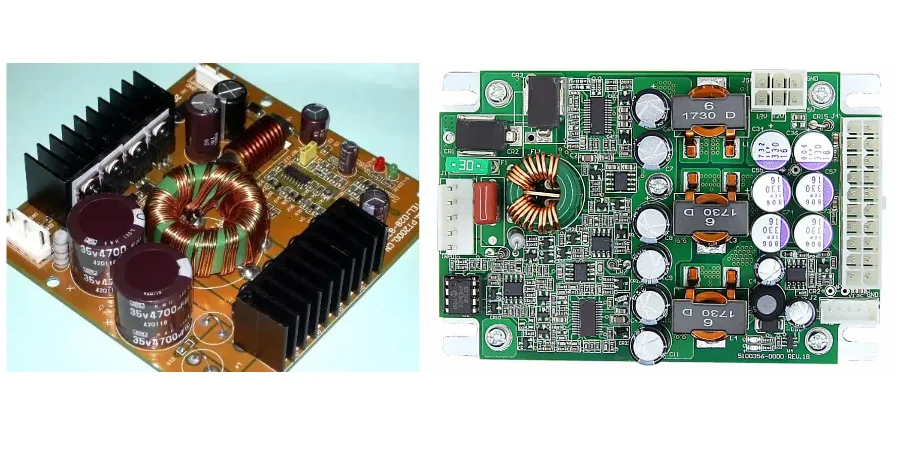
An EV wallbox PCB is the control and power-distribution board inside wall-mounted AC electric vehicle supply equipment (EVSE). It manages charging authorization, control-pilot communication, contactor switching, fault detection, metering, connectivity, and status functions while maintaining safe separation between mains and user-accessible circuits.
An AC wallbox normally does not convert AC into the vehicle battery's DC charging voltage; that conversion is performed by the vehicle's onboard charger. This guide does not cover solar junction boxes, generic wall-mounted electronics, onboard chargers, or DC fast-charger power modules.
Key takeaways
- Freeze market, supply, earthing system, connector/cable arrangement, current rating, fault-protection architecture, environment, networking, and applicable standards before PCB layout.
- Size conductors, terminals, contactors, busbars, and thermal paths from the actual continuous load, contact resistance, enclosure temperature, duty cycle, and allowed temperature rise—not a universal copper weight.
- Calculate creepage and clearance from working voltage, transient category, pollution degree, material group/CTI, insulation function, altitude, and product standard.
- Treat residual-current protection, protective-earth monitoring, contactor control, weld detection, and control pilot as product safety functions. The PCB supports them but does not independently certify the EVSE.
- IP or NEMA ratings belong to the completed enclosure. Conformal coating cannot compensate for poor sealing, drainage, venting, connector, or cable-entry design.
- Release production test limits for pilot states, protection faults, metering, contactors, communications, dielectric safety, and loaded thermal behavior before volume assembly.
What does an AC EV wallbox PCB control?
Wallbox architecture varies by region and product, but most designs combine a mains path with low-voltage control. Some use one board; others separate the high-current switching board, controller, display, communications, and residual-current sensing.
| Functional block | Purpose | PCB and PCBA risks |
|---|---|---|
| AC input and protection | Accept supply and coordinate protective devices | Surge stress, heating, spacing, incorrect line/neutral routing |
| Contactor or relay path | Connect and disconnect power to the vehicle | Contact heating, coil transient, welded contacts, inadequate isolation |
| Residual-current or ground-fault protection | Detect unsafe leakage conditions | Sensor placement, test-circuit failure, noise, delayed trip path |
| Control pilot and proximity interface | Exchange connection and available-current states | ESD/surge damage, reference error, noise coupling, connector mismatch |
| Energy metering | Measure voltage, current, power, and energy | Accuracy drift, isolation, shunt heating, calibration loss |
| Auxiliary power and control | Power MCU, safety logic, sensing, display, and I/O | Startup failure, brownout, isolation stress, common-mode coupling |
| Connectivity | Ethernet, cellular, Wi-Fi, Bluetooth, RS-485, or other links | EMC susceptibility, antenna detuning, port surge, update/security risk |
| Thermal and environmental monitoring | Detect overheated terminals, relays, cable or enclosure | Poor sensor placement, slow response, untested thresholds |
The product owner must define which functions are safety-related, how independent protection paths work, and what happens after a fault, loss of power, communication failure, or self-test failure.
Requirements to freeze before PCB layout
The fastest route to a stable design is to connect every system requirement to a board control and acceptance record.
| Requirement | PCB or assembly consequence | Evidence required for release |
|---|---|---|
| Target market and charging mode | Applicable interface, protection, EMC and safety rules | Compliance matrix and approved standard editions |
| Supply voltage, phase, frequency, earthing and fault level | Protection, switching, conductor, terminal and insulation design | Rated schematic and protection-coordination inputs |
| Continuous current and duty profile | Copper, busbar, contactor, connector, shunt and cooling | Current profile, loss budget and thermal limits |
| Tethered cable or socket | CP/PP interface, lock control, connector sensing and mechanics | Connector/cable specification and state table |
| Residual-current strategy | Sensor, test winding/circuit, trip path and diagnostics | Fault thresholds, response sequence and test method |
| Contactor architecture | Coil drive, auxiliary feedback, weld detection and spacing | Approved device, fault table and switching-life assumptions |
| Metering target | Sensor topology, isolation, reference, calibration and storage | Accuracy budget and calibration procedure |
| Network and backend features | Interfaces, antenna, isolation, secure update and service access | Protocol, security, provisioning and recovery requirements |
| Environment and enclosure | Materials, coating, ventilation, condensation and mechanical support | Temperature, humidity, ingress, UV, corrosion and vibration profile |
| Manufacturing and service | Mixed SMT/THT process, fixtures, access, traceability and repair | Assembly flow, test limits, serial records and change control |
This matrix is also the core RFQ document. Without it, a PCB supplier can quote board construction but cannot assess the complete EVSE manufacturing and validation risk.
Design the mains path, contactor, and thermal system together
The main current path may use PCB copper, terminals, relays/contactors, shunts, connectors, busbars, or wired assemblies. Select the architecture before fixing the stack-up. A heavy-copper PCB can reduce conductor resistance, but thicker copper changes trace/space capability, etch compensation, resin fill, planarity, soldering thermal mass, and cost.
Use current waveform, conductor geometry, layer environment, allowable temperature rise, terminal resistance, enclosure temperature, airflow, fault duty, and applicable guidance such as IPC-2152 to size copper. A narrow neck at a relay pad, fuse holder, terminal, via transition, or connector can dominate heating even when the main pour is wide.
Relays and contactors must be selected for the supply, load, prospective fault conditions, inrush, switching category, coil drive, mechanical life, electrical life, and certification path. Keep mains contact spacing and low-voltage coil/control spacing explicit. Provide suppression for the coil without delaying release beyond the safety architecture's limit.
If auxiliary contacts or voltage sensing support weld detection, define how the controller distinguishes a welded contact from wiring, sensor, or supply faults. The PCB cannot make an underrated contactor acceptable.
Build a loss and temperature budget for contacts, copper, terminals, shunts, power supplies, surge components, and enclosure. Validate at worst-case current, ambient, supply, torque, cable termination, mounting orientation, solar load where relevant, and ventilation condition. Measure terminal and joint temperatures, not only PCB surface temperature.
Creepage, clearance, surge, and protective earth
Divide the board into mains, protective-earth/chassis, isolated low-voltage, communication, antenna, and user-interface zones. Keep each return path intentional; do not use arbitrary ground splits or route low-voltage signals through mains switching areas.
Creepage and clearance values depend on the product's working voltage, transient or overvoltage category, pollution degree, material group/CTI, insulation type, altitude, environment, and governing standard. Slots can increase surface path length, but their geometry, plating status, manufacturability, and standard treatment must be documented. Solder mask is not automatically credited as insulation.
Surge, EFT, ESD, and conducted/radiated EMC paths include the cable, connector, enclosure, protective earth, shields, filters, contactor, auxiliary supply, and PCB. Place protection so surge current has a short, controlled path that does not cross sensitive references. Separate the line and protected sides of filters to prevent coupling around them.
Protective earth continuity and bonding are mechanical and electrical system properties. PCB traces should not be assumed to replace a dedicated protective conductor unless the product standard, fault-current analysis, construction, and test evidence support that choice.
Control pilot, proximity, leakage, and metering integrity
The control pilot (CP) communicates connection and charging states and indicates available current according to the applicable charging interface. Proximity pilot (PP) or related cable coding may identify cable capability and latch state. Implement the exact circuit, thresholds, timing, diode checks, tolerances, and fault states required by the chosen IEC 61851 or SAE J1772 architecture.
Keep CP/PP routing away from contactor switching, mains current, isolated power-transformer nodes, antennas, and noisy digital clocks. Protect external pins against the defined ESD and surge environment without adding leakage or capacitance that invalidates signal thresholds. Production test should simulate every required state and fault, not only a connected vehicle.
Residual-current or ground-fault protection differs by market and installation. The design may need to detect AC and DC residual components, verify the sensing path, trip the contactor, inhibit restart, and record a fault. Follow the applicable IEC 62955, UL 2231, product, and installation requirements rather than copying a threshold from another wallbox.
Metering accuracy depends on the current sensor or shunt, voltage divider, isolation, reference, ADC, temperature, phase error, layout, calibration, and firmware. Route sensitive differential paths with defined returns and separate them from contactor and power-supply loops. Store calibration data with revision and serial traceability, and define what happens after firmware or component substitution.
Networking, firmware, and service boundaries
Connectivity can be required for load management, billing, authorization, monitoring, updates, or building-energy integration. Ethernet and RS-485 ports need cable-environment protection and isolation appropriate to the architecture. Radio modules need antenna clearance, enclosure/material review, coexistence testing, and controlled module/firmware revisions.
Security is a product lifecycle responsibility. Define device identity, credential injection, secure update, rollback or recovery, debug-port control, logging, and end-of-life support. PCB assembly records should link the programmed firmware and provisioning result to the unit serial number.
Design service access without exposing mains hazards. Test pads, programming headers, reset controls, and manual release mechanisms need safe placement, access control, and documented service states.
Wallbox PCB manufacturing and test matrix
Wallbox assemblies often mix fine-pitch SMT with relays, transformers, terminals, current sensors, displays, cables, and mechanical hardware. Freeze the sequence for reflow, selective or wave soldering, press-fit or hand operations, cleaning, coating, torque, enclosure assembly, and test.
| Risk | Manufacturing control | Acceptance evidence |
|---|---|---|
| Wrong PCB material or copper | Controlled stack-up, approved laminate and copper callout | Certificate/lot record and cross-section where specified |
| Insufficient THT solder or heat damage | Hole-to-lead fit, thermal design, selective/wave profile | Joint inspection and barrel-fill criteria |
| Terminal or contactor stress | Board support, insertion and torque procedure | Mechanical inspection and torque record |
| Residue across insulation barrier | Process compatibility, cleaning and handling controls | Visual and cleanliness evidence where specified |
| Coating blocks contacts or service points | Masking drawing and coverage inspection | Coating record and keep-out verification |
| Wrong safety-critical component | Approved BOM/alternates and identity control | Incoming and serialized traceability |
| Functional or calibration drift | Controlled fixtures, references and software version | Per-unit test and calibration record |
PCBA testing and quality planning should separate these gates:
- Bare-board netlist and dimensional inspection
- SPI/AOI and targeted X-ray where joint geometry requires it
- Unpowered continuity, resistance, polarity and isolation checks
- Current-limited auxiliary-power startup and programming
- CP/PP state simulation, sensor self-test and fault injection
- Contactor drive, feedback, weld-detection and restart behavior
- Metering calibration and communication/provisioning tests
- Applicable dielectric, leakage, protective-earth and product safety tests
- Loaded temperature-rise, EMC, surge and environmental validation on the completed EVSE
High-energy tests require purpose-built fixtures, interlocks, discharge checks, guarding, and trained personnel. Define which tests are performed on every unit, by sample, or during qualification according to product risk and certification requirements.
Wallbox PCB failure and reaction matrix
| Symptom | Possible contributors | First evidence to inspect |
|---|---|---|
| Vehicle will not enter charging state | CP/PP threshold, diode check, cable/lock state, firmware | State simulator, CP waveform and event log |
| Contactor will not close | Coil supply, driver, interlock, temperature or protection fault | Rail, coil current, command and fault state |
| Output remains energized | Welded contact, feedback failure, sensing or software fault | Output voltage, auxiliary contact and trip sequence |
| Nuisance residual-current trip | Sensor offset, routing, filter, cable leakage, EMC coupling | Raw sensor data, test circuit and installation condition |
| Hot terminal or relay | Contact resistance, torque, conductor neck, load, airflow | Voltage drop, torque, current and temperature map |
| Metering error | Sensor/shunt, reference, temperature, calibration or phase error | Reference-load comparison and calibration record |
| Communication resets during switching | Supply dip, common-mode current, grounding or surge path | Rail/reset log and contactor event waveform |
| Tracking, corrosion or dielectric failure | Contamination, condensation, spacing, coating or enclosure leak | Failure path, cleanliness and ingress evidence |
EV wallbox PCB RFQ checklist
- Product: Target markets, AC charging mode, supply/earthing, current, connector/cable, installation, enclosure and service model
- Safety functions: Protection architecture, residual-current sensing, PE monitoring, contactor/weld detection, CP/PP states, thermal limits and fault response
- PCB data: Gerber, ODB++, or IPC-2581; netlist; stack-up; material/CTI; copper; insulation table; drill; slots; profile; drawings and revisions
- Assembly: Controlled BOM and alternates, placement, THT/SMT sequence, cable and terminal hardware, torque, cleaning, coating, programming and calibration
- Test: Fixtures, state simulator, fault injection, metering references, dielectric/PE tests, loaded thermal limits, EMC/environmental scope and data retention
- Quality: First article, serialization, material and component lots, firmware/provisioning traceability, substitution control, change notification, quantities and delivery target
Use the DFM guidelines to close package gaps, then submit the controlled data through the PCB quotation page.
Standards, references, and scope
Depending on market and product architecture, references may include:
- IEC 61851-1 — Electric vehicle conductive charging system, general requirements
- IEC 62196 series — Plugs, socket-outlets, vehicle connectors and vehicle inlets
- IEC 62955 — Residual direct current detecting device for Mode 3 charging
- IEC 60664-1 — Insulation coordination for equipment within low-voltage systems
- IEC 60364-7-722 — Low-voltage electrical installations for EV supplies
- IEC 61000-4 series — EMC immunity test methods
- UL 2594 — Electric Vehicle Supply Equipment
- UL 2231-1 and UL 2231-2 — Personnel protection systems for EV supply circuits
- UL 2251 — Plugs, receptacles and couplers for electric vehicles
- SAE J1772 — Electric Vehicle and Plug in Hybrid Electric Vehicle Conductive Charge Coupler
- IPC-2152 — Current-Carrying Capacity in Printed Board Design
- IPC-2221, IPC-6012, J-STD-001 and IPC-A-610
Confirm the applicable editions, national deviations, installation rules, connector scheme, utility requirements, certification body, and system architecture. PCB fabrication and assembly do not independently establish EVSE safety, ingress rating, metering approval, EMC, cybersecurity, or product certification.
EV wallbox PCB FAQ
What is an EV wallbox PCB?
It is the board that controls and monitors a wall-mounted AC EVSE, including pilot communication, contactors, fault protection, metering, connectivity, and user-interface functions.
Does an AC wallbox convert AC power to DC?
Normally no. It safely switches and communicates the AC supply to the vehicle; the onboard charger converts AC to the battery's DC charging voltage.
How much copper does a wallbox PCB need?
There is no universal copper weight. Size the path using continuous current, conductor geometry, terminal and relay resistance, enclosure temperature, cooling, fault duty, fabrication limits, and permitted temperature rise.
How are wallbox PCB creepage and clearance calculated?
Use working voltage, overvoltage category, pollution degree, material group/CTI, insulation type, altitude, coating recognition, and the applicable product standard. Do not copy one spacing value across markets or architectures.
Does conformal coating give a wallbox an IP rating?
No. IP rating applies to the tested enclosure. Coating may protect the PCB, but seals, vents, drains, cable entries, connectors, fasteners, condensation control, and assembly also determine ingress performance.
Can a two-layer PCB be used in an EV wallbox?
Possibly. Layer count follows routing density, current paths, isolation, EMC, thermal spreading, references, cost, and manufacturability. A multilayer board can help but does not replace correct zoning and validation.
What should be tested in the control-pilot circuit?
Test every required connection state, available-current command, threshold, timing, diode or fault condition, connector/lock input, ESD protection effect, and restart behavior using a controlled simulator and recorded limits.
How is contactor weld detection tested?
Simulate the commanded-open state and verify the independent feedback or output-voltage sensing path, diagnostic timing, fault latch, user indication, and restart inhibition required by the safety architecture.
Is IPC Class 3 always required for wallbox PCBs?
No. Select the IPC performance class and acceptance criteria from the product reliability, regulatory, environment, contract, and risk requirements. Safety functions still need product-specific validation.
What files are needed for an EV wallbox PCB quote?
Provide controlled PCB and assembly data plus supply/current ratings, safety architecture, connector and enclosure details, materials, contactors, inspection, programming, calibration, test limits, traceability, quantities, and change-control requirements.