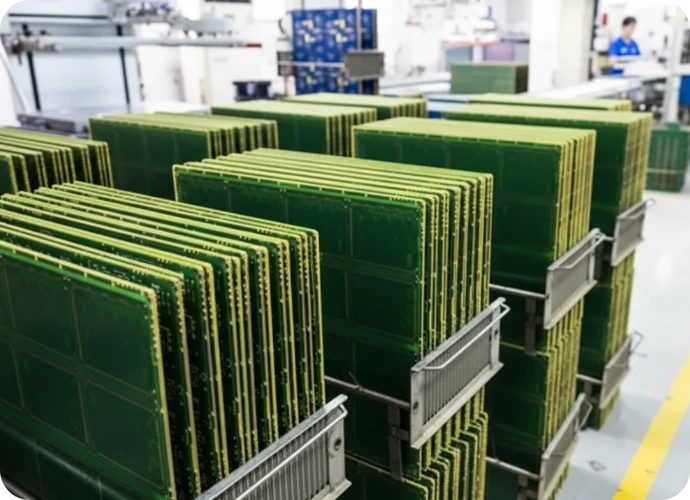
Effective warpage control during assembly is the difference between a high-yield production run and a costly scrap pile. As PCBs become thinner and components become smaller, the physical stress of thermal cycling during reflow and wave soldering can distort the board substrate. This distortion leads to open joints, component cracking, and coplanarity failures. At APTPCB (APTPCB PCB Factory), we implement strict design and process controls to maintain flatness within IPC specifications, ensuring reliable performance for everything from consumer electronics to advanced aerospace systems.
Warpage control during assembly quick answer (30 seconds)
Managing board flatness requires a combination of design foresight and process discipline. Here are the critical boundaries for successful control:
- Standard Limit: Maintain bow and twist below 0.75% for SMT assembly (IPC-A-610 Class 2/3) to prevent placement errors.
- Moisture Management: Bake PCBs for 2–4 hours at 120°C if they have been exposed to humidity, as trapped moisture expands rapidly and causes delamination or warping.
- Copper Balance: Ensure copper distribution is symmetrical on top and bottom layers to prevent uneven thermal expansion rates (CTE mismatch).
- Fixture Usage: Use synthetic stone (Durostone) pallets for thin boards (<0.8mm) or flexible circuits to mechanically constrain the PCB during reflow.
- Cooling Rate: Control the cooling ramp-down speed (<3°C/sec) to reduce residual stress that locks in warpage after solidification.
- Material Selection: Choose High-Tg (Glass Transition Temperature) materials for lead-free processes, as they remain rigid at higher soldering temperatures.
When warpage control during assembly applies (and when it doesn’t)
Understanding when to invest in advanced fixtures and strict material controls helps optimize manufacturing costs.
When strict warpage control is mandatory:
- Thin Substrates: PCBs with a thickness of 0.8mm or less lack the structural rigidity to resist thermal stress.
- Fine-Pitch Components: Assemblies using BGAs, CSPs, or QFNs require near-perfect flatness; even minor warping causes head-in-pillow defects.
- Advanced Applications: High-frequency RF boards requiring precise antenna tuning and trimming rely on consistent geometry; warping alters impedance and signal range.
- Advanced Packaging: Technologies like wirebonding for qubit interface in quantum computing demand extreme flatness to ensure successful wire bond formation.
- Rigid-Flex Designs: The transition zone between rigid and flexible materials is highly susceptible to deformation without dedicated tooling.
When standard tolerances are sufficient:
- Thick Backplanes: Boards thicker than 2.4mm generally have enough inherent stiffness to resist standard reflow profiles.
- Through-Hole Only: THT components are more forgiving of minor board curvature than surface mount devices.
- Low-Temperature Soldering: Processes using bismuth-tin or other low-temp alloys generate less thermal stress, reducing the risk of substrate deformation.
- Small Form Factors: Very small PCBs (e.g., 20mm x 20mm) often do not have enough span to develop significant bow or twist.
Warpage control during assembly rules and specifications (key parameters and limits)

The following table outlines the critical parameters APTPCB monitors to ensure warpage control during assembly. Adhering to these rules prevents the majority of flatness-related defects.
| Rule / Parameter | Recommended Value / Range | Why it matters | How to verify | If ignored (Consequence) |
|---|---|---|---|---|
| Max Bow & Twist (SMT) | < 0.75% (diagonal dimension) | Prevents component lifting and placement errors. | Shadow Moiré or Feeler Gauge on surface plate. | Open solder joints; machine stoppages. |
| Max Bow & Twist (BGA) | < 0.50% | BGAs have very low standoff; warping bridges balls. | Laser profilometry before reflow. | Head-in-pillow defects; short circuits. |
| Copper Balance | > 85% symmetry | Uneven copper causes uneven expansion rates. | CAM/Gerber analysis tools. | Board twists like a potato chip during heat. |
| Glass Transition (Tg) | > 170°C for Lead-Free | Higher Tg materials resist softening at reflow temps. | Datasheet verification (IPC-4101). | Z-axis expansion; barrel cracks; severe warp. |
| Moisture Content | < 0.1% by weight | Moisture turns to steam, forcing layers apart. | Weight test before/after bake. | Delamination; popcorn effect; instant warping. |
| Reflow Peak Temp | 240°C – 250°C (SAC305) | Excessive heat softens epoxy resin too much. | Thermal profiling (profiler). | Board sagging; burnt flux; component damage. |
| Cooling Ramp Rate | 2°C – 3°C / sec | Rapid cooling locks in stress and deformation. | Reflow oven zone settings. | Warpage sets in permanently; solder fractures. |
| Pallet Support | Support every 50-80mm | Prevents sagging under gravity when resin is soft. | Visual check of fixture design. | Center of board sags; components slide. |
| Panel Frame Width | > 5mm (min) | Provides mechanical strength for handling rails. | Dimensional drawing check. | Panel falls off conveyor; edges curl up. |
| Break-away Tab Location | Evenly distributed | Uneven tabs create stress concentration points. | DFM review of panelization. | Panel snaps prematurely; twists during break-out. |
Warpage control during assembly implementation steps (process checkpoints)

To achieve consistent results, warpage control during assembly must be integrated into every stage of the manufacturing workflow.
Design for Manufacturing (DFM) Review
- Action: Analyze the stack-up for symmetry. Ensure dielectric thicknesses and copper weights are balanced around the center of the board.
- Key Parameter: Stack-up symmetry.
- Acceptance Check: No "unbalanced construction" warnings in CAM software.
Material Selection & Procurement
- Action: Select laminate materials with appropriate CTE (Coefficient of Thermal Expansion) and Tg values for the intended assembly process.
- Key Parameter: Tg > 150°C (standard) or > 170°C (high reliability).
- Acceptance Check: Material certificate of compliance matches spec.
Pre-Assembly Baking
- Action: Bake bare boards to remove absorbed moisture before they enter the reflow oven.
- Key Parameter: 120°C for 2–4 hours (depending on thickness).
- Acceptance Check: Moisture indicator card or weight test.
Solder Paste Printing Support
- Action: Use dedicated support blocks or vacuum tooling under the PCB during printing to ensure the board is perfectly flat against the stencil.
- Key Parameter: Support density.
- Acceptance Check: Paste volume measurement (SPI) shows consistent height across the board.
Reflow Profile Optimization
- Action: Tune the oven profile to minimize the thermal gradient (Delta T) across the board. A large temperature difference between the center and edge causes warping.
- Key Parameter: Delta T < 5°C at peak.
- Acceptance Check: Thermal profile graph shows tight convergence of all thermocouples.
Fixture / Pallet Application
- Action: For flexible or thin boards, load PCBs into a synthetic stone carrier that mechanically clamps the edges and supports the center.
- Key Parameter: Fixture flatness < 0.1mm.
- Acceptance Check: Visual verification that the board is seated flat in the pocket.
Cooling Cycle Management
- Action: Ensure the cooling zone brings the board temperature down gradually.
- Key Parameter: Cooling slope < 3°C/sec.
- Acceptance Check: Exit temperature < 60°C; no audible cracking sounds.
Post-Reflow Inspection
- Action: Measure the bow and twist of the assembled board before it moves to the next stage (e.g., wave soldering or housing assembly).
- Key Parameter: IPC-A-610 Class 2/3 limits.
- Acceptance Check: Pass/Fail based on gauge measurement.
Warpage control during assembly troubleshooting (failure modes and fixes)
Even with good planning, issues can arise. Use this guide to diagnose failures related to warpage control during assembly.
Symptom: Head-in-Pillow (HiP) Defects on BGAs
- Cause: The PCB warps downward or the BGA component warps upward during peak reflow, separating the ball from the paste. When it cools, they touch but do not fuse.
- Check: Inspect the reflow profile peak time; check BGA component moisture sensitivity.
- Fix: Use a "soak" profile to equalize temperatures; switch to a high-tack solder paste.
- Prevention: Use lower-CTE laminate materials; bake components before assembly.
Symptom: Bridged Solder Joints at Board Corners
- Cause: Corners of the PCB curl upward (smile warp), pressing components into the stencil paste or compressing solder balls.
- Check: Verify copper balance on outer layers; check panel frame stiffness.
- Fix: Add stiffeners to the panel frame; use a carrier pallet.
- Prevention: Add copper thieving (dummy copper) to empty areas on the PCB design to balance density.
Symptom: Ceramic Capacitor Cracking
- Cause: Board flexure during cooling or depanalization stresses the rigid ceramic body of the capacitor.
- Check: Look for cracks near the termination (solder fillet).
- Fix: Move capacitors away from V-score lines; change component orientation parallel to the stress line.
- Prevention: Use "soft termination" capacitors; optimize cooling ramp rate.
Symptom: Conveyor Jams in Pick-and-Place Machine
- Cause: Excessive bow causes the board to slip out of the transport rails or get stuck.
- Check: Measure board width at center vs. ends.
- Fix: Adjust rail width; use edge clamps.
- Prevention: Increase panel border width; use a stiffer panel design.
Symptom: Inconsistent Wire Bond Strength
- Cause: Localized warpage prevents the bonding capillary from applying consistent force, critical for wirebonding for qubit interface or other high-reliability chips.
- Check: Measure local flatness under the die area.
- Fix: Use a vacuum chuck fixture during bonding.
- Prevention: Specify stricter local flatness tolerances in PCB fabrication notes.
Symptom: RF Performance Drift
- Cause: Warpage changes the distance between the antenna and the ground plane or casing, detuning the frequency.
- Check: Network analyzer results show frequency shift.
- Fix: Mechanical shimming during housing assembly.
- Prevention: Design for antenna tuning and trimming capabilities; use rigid-flex to isolate the antenna section.
How to choose warpage control during assembly (design decisions and trade-offs)
Engineers must balance cost against the strictness of warpage control during assembly. Not every board needs aerospace-grade flatness.
1. Material Selection: Standard FR4 vs. High-Tg vs. Low-CTE
- Standard FR4: Cheapest, but softens significantly at lead-free temps. Good for simple consumer goods.
- High-Tg (170°C+): Moderate cost increase. Essential for multi-layer boards (6+ layers) and lead-free assembly.
- Low-CTE / Rogers: Expensive. Required for large BGAs and RF applications where dimensional stability is paramount.
2. Panelization Strategy: V-Score vs. Tab-Route
- V-Score: Retains more material stiffness but can lead to cracking during separation if the board is warped.
- Tab-Route: Removes more material, making the panel less rigid during reflow, but puts less stress on components during separation.
- Decision: Use Tab-Route for sensitive components; use V-Score for standard rigid boards to save material.
3. Fixturing: Universal vs. Custom Pallets
- No Fixture: Zero cost. Risk of sagging. Only for thick, balanced boards.
- Universal Support: Low cost. Adjustable pins. Good for prototypes.
- Custom Durostone Pallet: High initial cost ($200-$500). Guarantees flatness. Mandatory for thin boards, flex, and heavy component loads.
Warpage control during assembly FAQ (cost, lead time, common defects, acceptance criteria, Design for Manufacturing (DFM) files)
Q: How much does strict warpage control add to the PCB cost? A: Specifying tighter tolerances (e.g., <0.5%) may increase bare board cost by 5-10% due to lower yield at the fab house. Using custom reflow pallets adds a non-recurring engineering (NRE) charge for the fixture but reduces assembly scrap rates significantly.
Q: Does warpage control affect production lead time? A: Yes. If custom pallets are required, add 1-2 days for fixture fabrication. Additionally, baking boards prior to assembly adds 4-8 hours to the process cycle time.
Q: What is the standard acceptance criteria for warpage? A: IPC-A-610 and IPC-6012 define the standard as 0.75% for surface mount applications and 1.5% for through-hole. For example, on a 100mm long board, a 0.75mm bow is acceptable.
Q: How does warpage affect antenna tuning and trimming? A: Warpage alters the physical gap between the antenna element and nearby dielectric or metal housing. This capacitance change shifts the resonant frequency. For high-precision RF devices, warpage control ensures the starting point for antenna tuning and trimming is consistent, reducing calibration time.
Q: What files are needed for a DFM review regarding warpage? A: Submit Gerber files, the stack-up diagram (showing copper weights and dielectric types), and the panel drawing. APTPCB engineers use these to simulate thermal expansion and recommend design changes.
Q: Can warpage be fixed after assembly? A: Rarely. While some "de-warping" can be attempted by heating and pressing, it puts immense stress on solder joints and is not recommended for reliability. Prevention is the only viable strategy.
Q: Why is warpage critical for wirebonding for qubit interface? A: Quantum computing interfaces often use superconducting materials and wire bonds that are extremely sensitive to vibration and stress. Any substrate warpage can cause bond lift-off or inconsistent inductance, ruining the qubit's coherence.
Q: How do you test for warpage during mass production? A: For high-volume runs, we use automated laser profilometry or Shadow Moiré systems that map the topography of the board in seconds. For smaller batches, pass/fail checks with go/no-go gauges on a granite surface plate are standard.
Q: Does the surface finish affect warpage? A: Indirectly. Hot Air Solder Leveling (HASL) exposes the board to an extra thermal shock during fabrication, potentially introducing stress. Electroless Nickel Immersion Gold (ENIG) or OSP are chemically applied at lower temperatures, resulting in flatter bare boards.
Q: What is the "potato chip" effect? A: This refers to a board that twists (corners go up and down in alternating fashion) rather than just bowing. It is usually caused by a lack of symmetry in the copper layout (e.g., Layer 2 is a solid plane, Layer 3 is signal traces).
Resources for warpage control during assembly (related pages and tools)
To deepen your understanding of the factors influencing board flatness, explore these related APTPCB resources:
- Rigid-Flex PCB Manufacturing: Learn about the unique warpage challenges in hybrid material stacks.
- SMT & THT Assembly Services: Details on our assembly capabilities and reflow ovens.
- DFM Guidelines: Best practices for designing boards that stay flat.
- High Tg PCB Materials: Specifications for heat-resistant laminates.
- Testing and Quality Control: How we validate board geometry and solder joint reliability.
Warpage control during assembly glossary (key terms)
| Term | Definition | Context in Warpage Control |
|---|---|---|
| Bow | Cylindrical curvature of the board. | The four corners touch the plane, but the center is lifted (or vice versa). |
| Twist | Deformation where one corner is not in the same plane as the other three. | More difficult to fixture than bow; often causes machine jams. |
| CTE (Coefficient of Thermal Expansion) | The rate at which a material expands when heated. | Mismatch between copper (17 ppm) and FR4 (14-17 ppm) causes stress. |
| Tg (Glass Transition Temperature) | The temp where resin changes from hard/glassy to soft/rubbery. | Above Tg, the Z-axis expansion increases drastically, worsening warpage. |
| Coplanarity | The condition where all leads of a component lie on the same plane. | Board warpage ruins coplanarity, leading to open joints. |
| Reflow Profile | The temperature vs. time curve the board experiences in the oven. | Ramp-up and cooling rates directly influence residual stress. |
| Shadow Moiré | An optical method for measuring surface topography. | The industry standard for high-precision warpage measurement. |
| Thieving (Copper Balance) | Adding non-functional copper to empty areas. | Balances the copper density to ensure even heating and cooling. |
| Pallet / Carrier | A fixture used to hold the PCB during soldering. | Mechanically forces the board to stay flat while the resin is soft. |
| Stress Relaxation | The process of relieving internal material stresses. | Achieved through baking or controlled cooling cycles. |
Request a quote for warpage control during assembly
Ensure your next project meets strict flatness requirements by partnering with APTPCB. We provide a comprehensive DFM review to identify potential warpage risks in your stack-up and panel design before production begins.
What to send for an accurate quote:
- Gerber Files: To analyze copper distribution.
- Stack-up Diagram: To check material symmetry and CTE matching.
- Assembly Drawing: To identify critical components (BGA, QFN) requiring special fixtures.
- Volume: To determine if custom pallets are cost-effective.
Conclusion (next steps)
Achieving reliable warpage control during assembly is not an accident; it is the result of deliberate design choices, material selection, and process control. By adhering to IPC specs, balancing copper layers, and utilizing appropriate fixtures, you can eliminate defects like head-in-pillow and component cracking. Whether you are developing standard consumer electronics or high-precision modules requiring antenna tuning and trimming, APTPCB delivers the engineering expertise and manufacturing precision needed to keep your boards flat and your yields high.