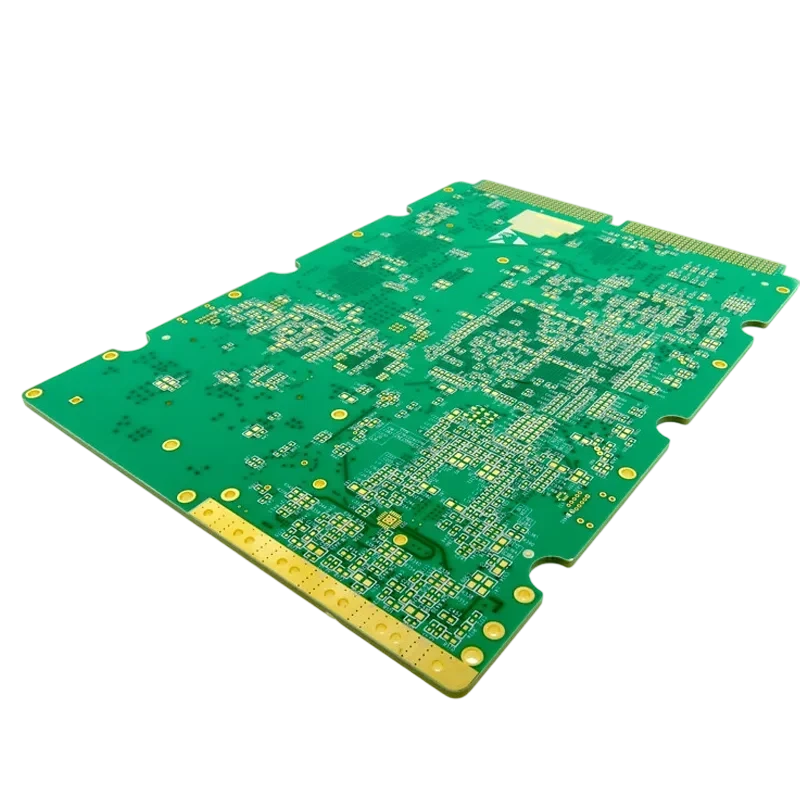
High-frequency signal transmission faces a critical bottleneck whenever it moves between different transmission media. In the world of millimeter-wave (mmWave) and microwave engineering, the interface between a hollow metallic waveguide and a planar printed circuit board is often the point of highest signal loss. The waveguide-to-PCB transition fixture is the engineered solution to this problem, serving as the physical and electromagnetic bridge that allows energy to flow efficiently between these two distinct domains.
For engineers and procurement managers at APTPCB (APTPCB PCB Factory), understanding this transition is vital. It is not merely a connector; it is a complex mode converter that transforms electromagnetic fields. Whether you are designing for 5G backhaul, automotive radar, or satellite communications, the quality of this fixture determines the system's overall performance. This guide covers the entire lifecycle of the transition fixture, from theoretical metrics to manufacturing reality.
Key Takeaways
- Definition: A waveguide-to-PCB transition fixture converts electromagnetic waves from a waveguide mode (usually TE10) to a planar transmission line mode (Microstrip, CPW, or SIW).
- Critical Metric: Return Loss (S11) is the primary indicator of quality; a value better than -15 dB is typically required for high-performance systems.
- Material Impact: Standard FR4 is rarely suitable; PTFE-based substrates are necessary to minimize dielectric loss at mmWave frequencies.
- Manufacturing Precision: Mechanical tolerances in the fixture assembly are just as critical as the PCB etching accuracy.
- LSI Relevance: Processes like antenna tuning and trimming often rely on these fixtures for accurate measurement during validation.
- Validation: Without proper calibration (TRL or SOLT), measurements taken through the fixture will yield inaccurate data regarding the PCB's performance.
What “waveguide-to-PCB fixture” means (scope & boundaries)
Having established the high-level importance of these components, we must define exactly what constitutes a waveguide-to-PCB transition fixture to avoid confusion with standard coaxial connectors.
In RF engineering, a waveguide is a metal pipe (rectangular or circular) that guides high-frequency waves with low loss. A PCB, conversely, uses planar conductors (copper traces) to guide signals. These two operate on different physics: waveguides typically support Transverse Electric (TE) or Transverse Magnetic (TM) modes, while PCBs support Transverse Electromagnetic (TEM) or Quasi-TEM modes.
The "fixture" refers to the mechanical assembly that holds the PCB and the waveguide in perfect alignment. It usually includes:
- The Transition Design: The copper pattern on the PCB (e.g., a probe, a tapered slot, or a coupling aperture) that performs the electromagnetic mode conversion.
- The Mechanical Housing: A metal block (often aluminum or brass) that acts as the waveguide extension and clamps the PCB.
- The Backshort: A conductive cavity behind the transition point that reflects energy in phase to maximize forward transmission.
This fixture is distinct from a simple SMA or K-connector. It is a direct interface where the PCB becomes part of the waveguide wall or protrudes into the waveguide cavity.
Metrics that matter (how to evaluate quality)
Once the scope of the fixture is understood, we must quantify "good" performance using specific RF metrics.
The following table outlines the essential parameters you must specify when designing or ordering a waveguide-to-PCB transition fixture.
| Metric | Why it matters | Typical Range / Target | How to Measure |
|---|---|---|---|
| Return Loss (S11) | Indicates how much signal is reflected back to the source. High reflection means poor energy transfer. | < -10 dB (General) < -15 dB (High Perf) < -20 dB (Lab Grade) |
Vector Network Analyzer (VNA) |
| Insertion Loss (S21) | Measures the signal power lost as it passes through the fixture. | < 0.3 dB to 0.5 dB per transition (frequency dependent) | VNA (Thru measurement) |
| Bandwidth | The frequency range where the transition maintains acceptable S11 and S21. | 10% to full waveguide band (e.g., 60-90 GHz for E-band) | Frequency sweep |
| Alignment Tolerance | Misalignment creates capacitive discontinuities, ruining impedance matching. | ± 0.05 mm (Standard) ± 0.02 mm (Precision) |
Optical CMM or Microscope |
| Phase Stability | Critical for phased arrays; ensures phase doesn't shift with temperature or vibration. | < 5 degrees variation over operating temp | Temperature chamber + VNA |
| Leakage / Radiation | Energy escaping the fixture interferes with other components. | < -40 dBc | Near-field probe scan |
Selection guidance by scenario (trade-offs)
Understanding the metrics allows us to select the right fixture architecture for specific real-world applications.
Different industries prioritize different metrics. A lab environment prioritizes precision, while consumer electronics prioritize cost and volume.
1. Laboratory Characterization & Testing
- Scenario: Testing a new mmWave chip or material.
- Priority: Accuracy and repeatability.
- Selection: Use a Clamp-style End-Launch Fixture. These allow you to swap PCBs quickly without soldering. They are expensive but reusable.
- Trade-off: High initial cost; bulky form factor.
2. Automotive Radar (77 GHz)
- Scenario: Mass production of radar modules.
- Priority: Reliability and vibration resistance.
- Selection: Substrate Integrated Waveguide (SIW) transition. The "waveguide" is formed inside the PCB using vias, transitioning to a metal waveguide launcher.
- Trade-off: Narrower bandwidth compared to ridge waveguides; requires complex via stitching.
3. 5G Backhaul Units (E-Band)
- Scenario: Outdoor units linking cell towers.
- Priority: Low loss and weatherproofing.
- Selection: E-plane Probe Transition. A probe printed on the PCB inserts directly into the waveguide channel.
- Trade-off: Very sensitive to assembly tolerance (Z-axis height). Requires precise mmWave module SMT process controls.
4. Satellite Communications (Ku/Ka Band)
- Scenario: High-power transmission.
- Priority: Thermal management and power handling.
- Selection: Ridged Waveguide Transition. Uses a stepped metal ridge to match impedance gradually.
- Trade-off: Complex machining of the metal housing; difficult to miniaturize.
5. Compact IoT Sensors (60 GHz)
- Scenario: Short-range gesture sensing.
- Priority: Small footprint and integration.
- Selection: Aperture Coupled Patch. The waveguide couples through a slot in the ground plane to a patch on the PCB.
- Trade-off: Lower efficiency; radiation leakage can be an issue if not shielded.
6. High-Speed Digital Test
- Scenario: Validating signal integrity over 50 GHz.
- Priority: Wide bandwidth.
- Selection: Finline Transition. A tapered fin printed on the PCB is inserted into the center of the waveguide E-plane.
- Trade-off: Requires the PCB to be cut into a specific shape to fit inside the waveguide; mechanically fragile.
From design to manufacturing (implementation checkpoints)

After selecting the architecture, the focus shifts to the rigorous execution of the design and manufacturing process.
At APTPCB, we recommend a checkpoint-based approach to ensure the final waveguide-to-PCB transition fixture performs as simulated.
Phase 1: Design & Material
- Material Selection: Do not use standard FR4. Select high-frequency laminates like Rogers PCB materials or Taconic. The dielectric constant (Dk) tolerance must be tight (±0.05 or better).
- Risk: High Dk variation shifts the center frequency.
- Stackup Definition: Define copper roughness profile. Standard ED copper is too rough for mmWave; use rolled or VLP (Very Low Profile) copper.
- Risk: Skin effect losses increase drastically with rough copper.
- Simulation: Full 3D EM simulation (HFSS/CST) is mandatory. Simulate the transition with the metal housing, not just the PCB in isolation.
- Risk: Ignoring the housing resonance can lead to "suck-outs" in the passband.
Phase 2: PCB Fabrication
- Etching Tolerance: Line width tolerance should be controlled to ±10-15μm.
- Acceptance: Automated Optical Inspection (AOI).
- Plating: Electroless Nickel Immersion Gold (ENIG) or Immersion Silver is preferred. Avoid HASL due to uneven surface thickness.
- Risk: Uneven plating affects the gap distance in coupled transitions.
- Back-drilling: If using vias in the transition path, stubs must be removed via back-drilling to prevent resonance.
- Acceptance: Cross-section analysis.
Phase 3: Assembly & Integration
- Solder Paste Printing: For probe transitions, the solder fillet volume is critical. Excess solder changes the probe's electrical length.
- Recommendation: Use stepped stencils for the mmWave module SMT process.
- Mechanical Alignment: The PCB must align with the waveguide opening within 0.05mm. Use dowel pins or alignment jigs in the fixture.
- Risk: Misalignment causes mode conversion to higher-order modes (ghost modes).
- Gap Control: Ensure zero air gaps between the PCB ground plane and the metal fixture body.
- Recommendation: Use conductive gaskets or silver epoxy if mechanical clamping is insufficient.
Phase 4: Post-Processing
- Antenna Tuning and Trimming: In high-end applications, laser trimming may be required to adjust the matching network on the PCB after assembly to compensate for manufacturing tolerances.
- Method: Laser ablation of small copper tabs while monitoring S11.
Common mistakes (and the correct approach)
Even with a checklist, engineers often encounter specific pitfalls that degrade the performance of the waveguide-to-PCB transition fixture.
Here are the most frequent errors we see in production files:
- Mistake 1: Ignoring Thermal Expansion (CTE Mismatch).
- Issue: The aluminum fixture expands at a different rate than the PTFE PCB. This shears solder joints or bows the PCB.
- Correction: Use slotted mounting holes or compliant conductive elastomers to allow slight movement without breaking electrical contact.
- Mistake 2: Poor Grounding at the Interface.
- Issue: Relying on a few screws to ground the PCB to the waveguide block. This creates a "leak" for RF energy.
- Correction: Use a dense via fence (via stitching) right at the edge of the transition and ensure continuous metal-to-metal contact along the entire perimeter of the waveguide opening.
- Mistake 3: Overlooking Surface Roughness of the Fixture.
- Issue: The PCB is perfect, but the machined aluminum waveguide channel is rough.
- Correction: Specify a surface finish of Ra 0.4μm or better for the internal walls of the waveguide fixture.
- Mistake 4: Neglecting the "Keep-Out" Zone.
- Issue: Placing other components or routing traces too close to the transition area.
- Correction: Maintain a keep-out zone of at least 2 wavelengths around the transition to prevent parasitic coupling.
- Mistake 5: Assuming Simulation Equals Reality.
- Issue: Simulation uses perfect conductivity and sharp corners. Real manufacturing has rounded corners (milling radius) and finite conductivity.
- Correction: Add "manufacturing realism" to your simulation model, including corner radii and solder mask effects.
- Mistake 6: Forgetting DFM Guidelines.
- Issue: Designing features that cannot be etched or drilled reliably.
- Correction: Consult DFM guidelines early in the design phase to ensure the transition is manufacturable.
FAQ
Q1: Can I use FR4 for a waveguide-to-PCB transition? Generally, no. Above 5-10 GHz, the dielectric loss of FR4 is too high, and its dielectric constant is too inconsistent for stable impedance matching.
Q2: What is the difference between a "launcher" and a "transition"? They are often used interchangeably. Technically, a "launcher" is the connector (like a coax-to-waveguide adapter), while a "transition" usually refers to the integrated design structure on the PCB that couples the field.
Q3: How do I validate the loss of the fixture itself? You typically use a "Back-to-Back" test configuration. You build a fixture with two transitions connected by a short transmission line. You measure the total loss and divide by two (subtracting the line loss) to estimate the loss per transition.
Q4: What is the maximum frequency for these fixtures? PCB-based transitions work well up to 110 GHz (W-band). Beyond that (D-band, G-band), the dimensions become so small that on-chip or fully metallic solutions are often preferred over PCB transitions.
Q5: Does the surface finish of the PCB matter? Yes. ENIG is standard, but for extremely high frequencies (>60 GHz), the nickel layer in ENIG can add magnetic loss. Immersion Silver or ENEPIG are often better choices for ultra-low loss.
Q6: How does "antenna tuning and trimming" relate to this? If the transition feeds an antenna, the transition's impedance match directly affects the antenna's radiated power. Trimming the transition network can "tune" the antenna system for optimal efficiency.
Q7: What is a "Backshort"? A backshort is a metal wall placed at a specific distance (usually $\lambda/4$) behind the probe in the waveguide. It reflects rearward-traveling waves back in phase with the forward wave to maximize power transfer.
Q8: Can APTPCB manufacture the metal fixture housing as well? While our primary focus is the PCB, we work with partners to provide complete assembly services. Contact us for details.
Related pages & tools
- Rogers PCB materials: Essential substrates for high-frequency transitions.
- DFM guidelines: Ensure your RF design is manufacturable.
- Impedance Calculator: Verify your transmission line dimensions before designing the transition.
Glossary (key terms)
To navigate the technical landscape of waveguide transitions, familiarity with these terms is essential.
| Term | Definition |
|---|---|
| Waveguide | A hollow metal pipe used to carry high-frequency radio waves. |
| TE Mode | Transverse Electric mode; the electric field is perpendicular to the direction of propagation. |
| TEM Mode | Transverse Electromagnetic mode; both electric and magnetic fields are perpendicular to propagation (typical in Coax/PCB). |
| Microstrip | A type of electrical transmission line which can be fabricated using printed circuit board technology. |
| SIW | Substrate Integrated Waveguide; a synthetic waveguide formed in a dielectric substrate by two rows of vias. |
| Probe Transition | A method where a PCB trace protrudes into the waveguide to act as an antenna. |
| Finline | A waveguide transmission line in which a metal fin is suspended in the E-plane of the waveguide. |
| Cutoff Frequency | The lowest frequency at which a waveguide mode can propagate. |
| Backshort | A short-circuit termination used to reflect energy in a specific phase. |
| VNA | Vector Network Analyzer; an instrument used to measure network parameters (S-parameters). |
| S11 | Reflection coefficient (Return Loss); measures how much power bounces back from the transition. |
| S21 | Transmission coefficient (Insertion Loss); measures how much power passes through the transition. |
Conclusion (next steps)
The waveguide-to-PCB transition fixture is the unsung hero of modern mmWave systems. It bridges the gap between the rugged, low-loss world of waveguides and the compact, integrated world of PCBs. Achieving a high-performance transition requires a holistic approach that combines precise electromagnetic simulation, correct material selection, and rigorous manufacturing tolerances.
Whether you are developing next-generation automotive radar or high-speed data links, the transition must be treated as a precision component, not just a connector.
Ready to manufacture your high-frequency designs? At APTPCB, we specialize in the tight tolerances and advanced materials required for successful waveguide transitions.
To get a quote or DFM review, please provide:
- Gerber Files: With clear outline layers for the transition area.
- Stackup Details: Including specific material types (e.g., Rogers 3003, RO4350B).
- Drill Chart: Highlighting any back-drilling requirements.
- Surface Finish: Specifying ENIG, Immersion Silver, or ENEPIG.
- Tolerance Specs: Explicitly stating critical dimensions for the transition gap.
Get a quote today and ensure your RF signal makes the jump without missing a beat.