
The market for personal health technology is exploding, but many products fail to reach shelves due to one major hurdle: electromagnetic interference (EMI) testing. A wellness device fcc compliance pcb is not just a standard circuit board; it is a precision-engineered component designed to minimize noise and adhere to strict regulatory standards like FCC Part 15. Whether you are building a sleep tracker or a muscle stimulator, the layout of your Printed Circuit Board (PCB) dictates whether you pass certification or face costly redesigns. At APTPCB (APTPCB PCB Factory), we specialize in navigating these complexities to ensure your product is manufacturable and compliant.
Key Takeaways
- Definition: A compliant PCB minimizes electromagnetic emissions to meet FCC (US) and CE (Europe) standards.
- Critical Metric: Loop inductance and impedance control are the primary factors influencing EMI performance.
- Layer Stackup: Proper grounding layers are more effective than shielding cans for noise suppression.
- Misconception: Passing functional tests does not mean you will pass FCC compliance tests.
- Validation: Pre-compliance scanning during the prototyping phase saves thousands of dollars.
- Tip: Always design for FCC Class B (residential) limits, even if you think Class A (industrial) applies.
What in non-invasive health products that must meet Federal Communications Commission (FCC) compliance means for wellness devices (scope & boundaries)
Building on the key takeaways, it is vital to define exactly what falls under the scope of a compliant wellness PCB. A wellness device fcc compliance pcb refers to the printed circuit board assembly used in non-invasive health products that must meet Federal Communications Commission (FCC) regulations regarding electromagnetic compatibility (EMC).
Unlike critical life-support equipment, wellness devices often sit in a regulatory middle ground. They may be a cosmetic device fda class1 pcb or a general consumer gadget. However, if they contain a digital clock greater than 9 kHz or a wireless transmitter (Bluetooth/WiFi), they fall under FCC jurisdiction.
The Scope Includes:
- Intentional Radiators: Devices that purposefully send RF signals (e.g., a fitness device wifi ble pcb).
- Unintentional Radiators: Devices that generate RF energy internally for operation but do not intend to emit it (e.g., high-speed processors in a massager).
- Signal Integrity: Ensuring the board functions correctly without being disrupted by external noise.
The Boundaries:
- It does not cover biological compatibility (biocompatibility of materials).
- It is distinct from FDA 510(k) clearance, though the hardware often overlaps.
- It focuses strictly on the electrical layout, stackup, and material properties that influence EMI.
Metrics that matter (how to evaluate quality)
Once you understand the scope, you must identify the specific metrics that determine if a board will pass compliance testing. The following table outlines the technical parameters APTPCB monitors during fabrication.
| Metric | Why it matters | Typical range or influencing factors | How to measure |
|---|---|---|---|
| Characteristic Impedance | Mismatched impedance causes signal reflection, creating EMI. | 50Ω (Single-ended), 90Ω/100Ω (Differential) ±10% | TDR (Time Domain Reflectometry) |
| Return Loss | Indicates how much signal is reflected back to the source. | < -10dB (for critical high-speed lines) | Network Analyzer |
| Loop Area | Large current loops act as antennas, radiating noise. | Minimized by placing signal traces over ground planes. | CAD Review / Near-field Probe |
| Dielectric Constant (Dk) | Affects signal speed and impedance stability. | 3.8 – 4.5 (FR4); lower for high-frequency materials. | Material Data Sheet / Resonator Method |
| Ground Bounce | Noise on the ground plane that can cause logic errors and radiation. | < 5% of logic voltage swing. | Oscilloscope with low-inductance probe |
| Shielding Effectiveness | Ability of the PCB layers or cans to block RF. | 20dB – 60dB depending on frequency. | TEM Cell / Anechoic Chamber |
Design choices by scenario (trade-offs)
With metrics defined, the next step is choosing the right PCB architecture for your specific product application. Different wellness devices have vastly different power and frequency requirements.
1. The Microcurrent Facial Device
- Scenario: A handheld beauty tool delivering low-voltage pulses.
- Focus: Safety and isolation.
- Trade-off: You need high-voltage spacing (creepage/clearance) which consumes board space.
- Recommendation: Use a standard 2-layer or 4-layer FR4 board. Prioritize isolation slots over miniaturization.
- Keyword Context: This is a classic microcurrent facial device pcb.
2. The Connected Fitness Tracker
- Scenario: A wrist-worn device tracking heart rate and syncing via Bluetooth.
- Focus: RF performance and size.
- Trade-off: High Density Interconnect (HDI) increases cost but is necessary for size.
- Recommendation: Use an HDI PCB with blind/buried vias to keep the antenna ground plane unbroken.
- Keyword Context: Requires a robust fitness device wifi ble pcb design.
3. The Smart Sleep Mask
- Scenario: A soft wearable monitoring REM cycles.
- Focus: Flexibility and comfort.
- Trade-off: Flex PCBs are mechanically robust but harder to shield against EMI than rigid boards.
- Recommendation: Use a Rigid-Flex combination. Place the noisy processor on the rigid section and sensors on the flex.
- Keyword Context: Often categorized as a medical grade sleep device pcb.
4. The Rugged Outdoor Wellness Monitor
- Scenario: A hiking GPS/health monitor exposed to elements.
- Focus: Durability and environmental protection.
- Trade-off: Thick conformal coating or potting can alter impedance slightly.
- Recommendation: Select high-Tg materials and specify IPC Class 3 reliability standards.
- Keyword Context: A mil 810 camping device pcb requiring vibration resistance.
5. The FDA Class I Cosmetic Laser
- Scenario: A home-use hair removal device.
- Focus: Thermal management and power handling.
- Trade-off: Heavy copper handles heat but limits fine-pitch components.
- Recommendation: Use a Metal Core PCB (MCPCB) for the laser driver and a separate FR4 board for control logic.
- Keyword Context: A cosmetic device fda class1 pcb.
6. The Disposable Smart Patch
- Scenario: A temporary glucose or hydration monitor.
- Focus: Extremely low cost.
- Trade-off: 2-layer boards save money but make EMI containment difficult.
- Recommendation: Use aggressive "via stitching" around the board edge to create a Faraday cage effect on a budget.
Implementation checkpoints (design to manufacturing)
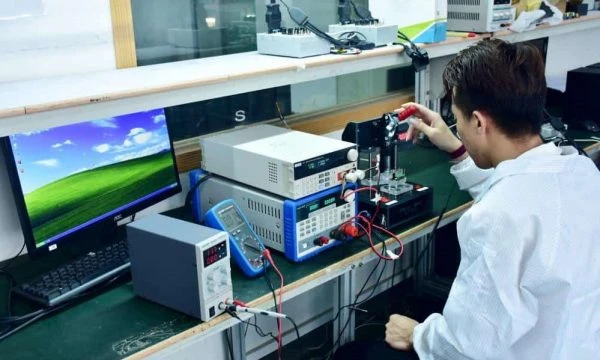
After selecting the right approach for your scenario, you must execute the design phase with manufacturing and compliance in mind. APTPCB recommends the following checkpoint system to ensure your wellness device fcc compliance pcb passes on the first attempt.
1. Stackup Definition
- Action: Define layers before routing. Ensure every signal layer has an adjacent reference (ground) plane.
- Risk: Poor stackup is the #1 cause of EMI failure.
- Acceptance: Confirm impedance calculations with your fab house.
2. Component Placement (Floorplanning)
- Action: Separate analog (sensors), digital (MCU), and RF (Bluetooth) sections physically.
- Risk: Digital noise coupling into sensitive analog sensors.
- Acceptance: Visual check for clear "moats" or separation zones.
3. Critical Trace Routing
- Action: Route high-speed clocks and USB lines first. Keep them short and surrounded by ground.
- Risk: Long clock lines act as broadcast antennas.
- Acceptance: Simulation or length-matching verification.
4. Grounding Strategy
- Action: Use a solid ground plane. Do not split grounds unless you are an expert; return currents will find the path of least inductance, often crossing gaps and creating noise.
- Risk: Split planes create dipole antennas.
- Acceptance: Verify return paths for all high-speed signals.
5. Decoupling Capacitor Placement
- Action: Place capacitors as close to power pins as possible.
- Risk: Power supply noise will radiate if not dampened immediately.
- Acceptance: Review placement in 3D viewer.
6. DFM Review
- Action: Submit files for DFM Guidelines check.
- Risk: Unmanufacturable features (e.g., acid traps, slivers) cause defects that alter electrical performance.
- Acceptance: Clean DFM report from the fabricator.
7. Shielding Implementation
- Action: Add footprints for metal shielding cans over the processor and RF sections.
- Risk: If you fail testing later, you cannot add a shield without a board re-spin if the footprint isn't there.
- Acceptance: Footprints present in Gerber files.
8. Pre-Compliance Testing
- Action: Test a prototype in a near-field scanner before full certification.
- Risk: Failing the official $2,000+ lab test.
- Acceptance: Scan shows emissions 6dB below the limit line.
9. Final Fabrication Data Generation
- Action: Export ODB++ or RS-274X Gerbers.
- Risk: Version control errors.
- Acceptance: Compare output files to design files.
Common mistakes (and the correct approach)
Even with a solid process, designers often fall into specific traps that compromise wellness device fcc compliance pcb performance.
The "Split Ground" Myth
- Mistake: Splitting analog and digital grounds and connecting them with a ferrite bead.
- Correction: Use a single solid ground plane. Manage noise by component placement, not by cutting the plane.
Ignoring the Return Path
- Mistake: Routing a signal trace over a split in the plane or a void.
- Correction: Ensure every signal trace runs directly over a solid copper reference plane to minimize loop area.
Right-Angle Routing
- Mistake: Using 90-degree corners on high-speed traces.
- Correction: Use 45-degree bends or curved routing to prevent impedance changes and signal reflection.
Crystal Placement Errors
- Mistake: Placing the crystal oscillator near the edge of the board or connectors.
- Correction: Place crystals in the center of the board, close to the IC, and surround them with a ground ring.
Connector Neglect
- Mistake: Failing to ground the metal shells of USB or charging connectors.
- Correction: Connect connector shells to the chassis ground (if available) or board ground with multiple vias to prevent them from acting as antennas.
Changing BOM Post-Testing
- Mistake: Swapping a cheaper inductor or capacitor after passing FCC tests.
- Correction: Any component change on the power or RF path requires re-validation, as it can alter emission profiles.
FAQ
To clarify common pitfalls regarding regulatory hardware, here are answers to frequent questions.
Q1: What is the difference between FCC Class A and Class B? Class A is for industrial environments. Class B is for residential use. Wellness devices almost always require Class B, which has stricter (lower) emission limits.
Q2: Can a 2-layer PCB pass FCC compliance for a wellness device? Yes, but it is difficult for complex digital devices. A 4-layer board (Signal-Ground-Power-Signal) is significantly easier to make compliant due to the dedicated ground plane.
Q3: Does using a pre-certified Bluetooth module exempt me from FCC testing? No. It exempts you from intentional radiator testing for the module itself, but you still must pass unintentional radiator testing (Part 15B) for the rest of your circuit.
Q4: How does a "medical grade sleep device pcb" differ from a standard tracker? It often requires higher reliability standards (IPC Class 3), better thermal management, and stricter leakage current controls for patient safety.
Q5: What is the most common frequency that fails testing? Harmonics of the main system clock or the switching power supply frequency are the most common failure points.
Q6: Why is my "fitness device wifi ble pcb" failing connectivity tests? Likely due to poor antenna placement. Ensure the antenna area is free of copper on all layers and the enclosure doesn't detune it.
Q7: What is "via stitching"? It is the practice of placing ground vias close together along the edge of a copper pour or board edge. This creates a barrier that blocks RF energy from escaping laterally.
Q8: How much does a board re-spin cost if I fail compliance? Beyond the fabrication cost, you lose 2-4 weeks of time and must pay for re-testing (often $1,000 - $3,000 per session).
Q9: Can APTPCB help with impedance control? Yes, we provide stackup verification and impedance reports to ensure your design matches the physical reality of the manufactured board.
Glossary (key terms)
For clarity on technical terms used in this guide, refer to the table below.
| Term | Definition |
|---|---|
| EMC (Electromagnetic Compatibility) | The ability of a device to operate in its environment without causing or suffering from interference. |
| EMI (Electromagnetic Interference) | The actual noise or disturbance generated by an electronic device. |
| FCC Part 15 | The US regulation governing radio frequency devices and unintentional radiators. |
| Stackup | The arrangement of copper layers and insulating material (dielectric) in a PCB. |
| Reference Plane | A continuous copper layer (usually ground) adjacent to a signal layer that provides a return path for current. |
| Differential Pair | Two complementary signals used to transmit data; highly resistant to noise. |
| Decoupling Capacitor | A component used to stabilize power supply voltage and filter out high-frequency noise. |
| Via Stitching | Connecting ground planes on different layers with multiple vias to reduce impedance and block radiation. |
| Crosstalk | Unwanted signal transfer between adjacent communication channels or traces. |
| IPC Class 2/3 | Manufacturing standards. Class 2 is standard consumer; Class 3 is high-reliability (medical/aerospace). |
| Gerber Files | The standard file format used to manufacture PCBs. |
| BOM (Bill of Materials) | The list of all components to be assembled onto the PCB. |
| DFM (Design for Manufacturing) | The practice of designing board layouts to make them easy and cheap to manufacture. |
Conclusion (next steps)
Achieving a wellness device fcc compliance pcb is a balancing act between electrical performance, mechanical constraints, and regulatory limits. By focusing on a solid ground strategy, controlling impedance, and validating your design early, you can avoid the expensive cycle of "fail-fix-repeat." Whether you are designing a microcurrent facial device pcb or a complex medical grade sleep device pcb, the principles of physics remain the same: control the current loop, and you control the noise.
Ready to move to production? To ensure your design is ready for manufacturing and compliance, please provide the following when requesting a quote from APTPCB:
- Gerber Files (RS-274X or ODB++): The complete layout.
- Stackup Requirements: Desired layer count and thickness (e.g., 1.6mm, 4-layer).
- Impedance Specs: Specific traces that require control (e.g., 50Ω RF lines).
- Material Requirements: FR4, Rogers, or Flex materials.
- Assembly BOM: If you require Medical PCB assembly services.
Contact us today to start your DFM review and ensure your wellness device is built for success.