
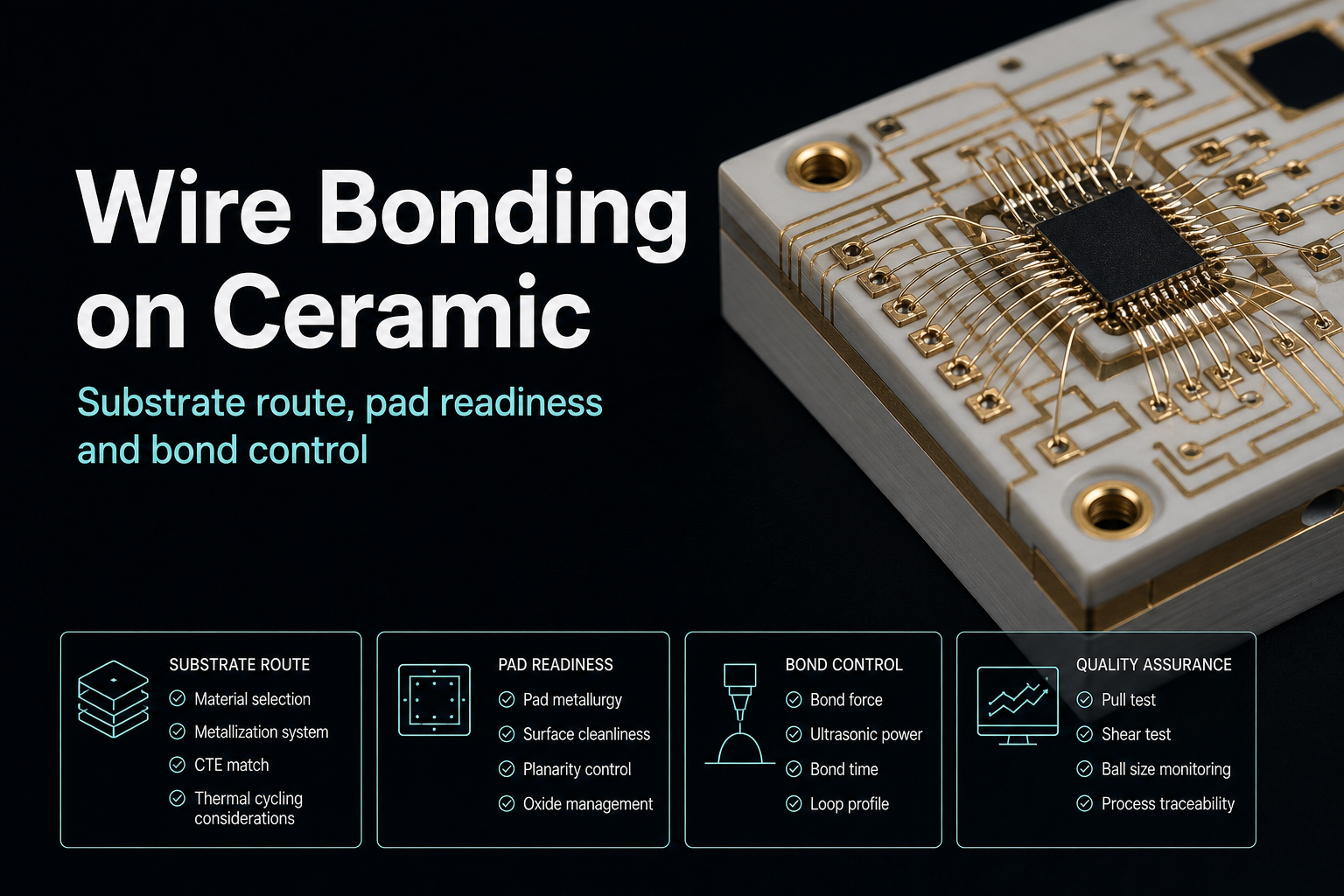
- Successful wire bonding on ceramic depends less on one machine setting and more on a controlled chain: substrate route, pad finish, cleanliness, die attach discipline, and bond validation.
- Ceramic should be treated as its own substrate category, not as a simple extension of ordinary FR-4 assembly language.
- The strongest release question is usually
Is the pad actually ready for the intended bond process?
Quick Answer Wire bonding on ceramic works best when the team freezes the ceramic route, pad metallurgy or finish strategy, cleaning method, die-attach boundary, and bond-validation plan before release. The article stays at that practical release level and avoids turning class-level ceramic guidance into unsupported universal process numbers.
For the broader materials context, start with the Advanced PCB Materials and Substrates Guide. For related APTPCB pages, review Ceramic PCB and PCB Surface Finishes.
Table of Contents
- What should be decided first?
- What does wire bonding on ceramic mean here?
- Why substrate route and finish must be reviewed together
- What usually blocks bondability first
- How to structure process validation
- What should be frozen before release?
- Where should this page route next?
- Next steps with APTPCB
- FAQ
What should be decided first?
Before discussing bond force, ultrasonic power, or loop shape, settle these boundaries:
- the ceramic substrate route
- the assembly flow around the bond pads
- the finish or pad-metallization strategy
- the cleaning and handling discipline
- the bond-validation method
That order matters because many bond failures begin upstream. A weak pad surface, contaminated bond area, or poorly controlled die-attach step will usually defeat later machine tuning.
| Review boundary | What it answers | What it does not prove |
|---|---|---|
| Ceramic route | What substrate family and process context the board belongs to | That every finish or pad scheme is valid |
| Assembly flow | What happens before and after wire bonding | Final bond robustness |
| Finish or metallization | Whether the pad is intended for the bonding method | Universal compatibility across all wire types |
| Cleaning discipline | Whether contamination risk is being actively controlled | That the final process is already qualified |
| Validation method | How the bond process will be checked | Lifetime performance in every field condition |
What does wire bonding on ceramic mean here?
Here, wire bonding on ceramic is a process-planning topic inside the ceramic-substrate category.
It covers:
- ceramic substrate and assembly-route framing
- bond-pad readiness and finish selection
- contamination and handling risks
- process validation and incoming or outgoing checks
It does not prove:
- universal bond settings for all ceramic programs
- one numeric temperature, force, or pull-strength rule for every wire type
- that every ceramic board is automatically wire-bond ready
- that
ENIGandENEPIGare interchangeable in every bond process
APTPCB's published finish guidance supports ENIG and ENEPIG as finish families that appear in wire-bonding discussions. Final compatibility still belongs to the actual wire type, pad design, and process qualification package.
Why substrate route and finish must be reviewed together
Wire bonding on ceramic is not just a surface-finish choice. The substrate route and the assembly route change the meaning of the finish discussion.
Questions that should stay linked:
- Is the substrate a ceramic board intended for die attach and bond pads, or a broader thermal board discussion that does not yet justify wire bonding?
- Is the design using bond pads as a primary interconnect method, or only for a local module section?
- Does the finish conversation belong to solderability, wire bondability, or both?
- Will the assembly flow expose the pads to contamination before bonding?
That is why the process is stronger when the team stops asking What finish is best for wire bonding? and instead asks What finish and pad route fit this ceramic assembly flow?
What usually blocks bondability first
The first problems are often basic and preventable:
1. Pad contamination
Residues from storage, handling, die attach, or nearby process steps can make a bond recipe look unstable even when the pad geometry is correct.
2. Finish selection without bond-process ownership
A finish may be acceptable for one assembly conversation and weak for another. The finish decision should stay connected to the intended wire type and bonding method.
3. Pad geometry that ignores the bonding tool path
The pad may look adequate in layout but still create clearance or landing problems once the capillary path, neighboring structures, and loop direction are reviewed together.
4. Die attach bleed or thermal-side effects
If the die-attach step contaminates nearby pads or changes local mechanical behavior, later wire bonding becomes a downstream symptom rather than the root cause.
The hidden factory-floor disaster is usually resin bleed-out, not the visible silver fillet everyone stares at under the microscope. In ceramic micro-assembly, bare die are often attached with conductive silver epoxy or other die-attach adhesives. If dispense volume is too aggressive, or if the cure profile is wrong, the transparent resin fraction can separate and creep far beyond the intended die edge. That resin bleed-out, or RBO, is easy to miss because it can spread as a thin, nearly invisible polymer film over adjacent gold bond pads while the main die-attach joint still looks acceptable.
Then the capillary comes down and tries to form a wire bond on what appears to be clean gold. In reality it is striking through a contaminated polymer skin. The bond may still survive outgoing pull test because the initial mechanical grip is just good enough to avoid immediate rejection. The field failure appears later, after the ceramic RF module, high-power LED assembly, or high-temperature sensor package has been pushed through repeated thermal cycling. The intermetallic formation was never truly established on a clean pad, so the bond lifts cleanly from the surface and the gold wire peels away in one catastrophic event. That is why ceramic wire-bond review cannot stop at ENIG versus ENEPIG. Plasma cleaning, die-attach bleed control, and strict surface-contamination discipline are the real floor-level boundary between an expensive module that survives and one that loses the bond after release.
5. Validation that starts too late
If pull, shear, visual criteria, and failure-mode review are defined only after yield problems appear, the process window is already weak.
How to structure process validation
Describe the validation layers rather than publishing one generic recipe.
| Validation layer | What it should answer |
|---|---|
| Incoming substrate review | Are the ceramic surface, pad condition, and finish state acceptable for bonding? |
| Pre-bond cleanliness review | Has the bond area remained clean after upstream handling and die attach? |
| First-article bond validation | Does the chosen recipe create acceptable bond formation on the released pad structure? |
| Destructive and visual checks | Are failure modes understood, not just pass/fail labels? |
| Change-control review | What must trigger requalification if finish, substrate, wire, or upstream process conditions change? |
Useful acceptance topics usually include:
- visual bond formation
- pull or shear method appropriate to the process
- failure-mode review rather than force alone
- loop consistency where loop geometry matters
- evidence that upstream pad cleanliness is controlled
Those checks are more dependable than a copied recipe because they tie the process back to the actual board and assembly route.
What should be frozen before release?
Before the build is released for ceramic wire bonding, freeze:
- the ceramic substrate route and intended use of bond pads
- the assembly sequence around die attach, cleaning, bonding, and later protection steps
- the finish or metallization scheme tied to the intended wire-bond process
- pad geometry, access, and local keep-out expectations
- handling and storage rules for bondable surfaces
- first-article validation and ongoing inspection ownership
- requalification triggers if materials or upstream steps change
If those items are still moving, the program may still be learnable as NPI, but it is not yet a stable wire-bond release.
APTPCB's ceramic and finish pages are useful for routing the discussion into the right substrate and finish category. Final bondability still needs to be reviewed on the actual substrate, finish stack, and assembly route.
Where should this page route next?
Use the next step that matches the unresolved decision:
- If the team is still deciding whether the board belongs in ceramic at all, continue to Ceramic PCB and the Advanced PCB Materials and Substrates Guide.
- If the substrate is fixed but the open question is pad finish or solder-versus-bond interface control, continue to PCB Surface Finishes.
- If the question is upstream ceramic route selection for power-substrate work, continue to Ceramic DBC/AMB Copper Bonding.
Next steps with APTPCB
If you are building an expensive ceramic RF module, high-power LED package, or high-temperature sensor assembly, and you are still worried that the ENIG or ENEPIG surface may not actually be bond-ready, or that die-attach bleed could quietly poison bond yield before anyone sees it, treat that as a micro-assembly risk review now, not as a late production detail.
Send the Gerber or ODB++ package, die placement map, wire-bond diagram, and the intended finish plus cleaning requirements through the ceramic PCB wire bonding review request or to [email protected]. APTPCB's ceramic-substrate and micro-assembly engineering team will return a professional Ceramic Pad Readiness & Bond Yield Audit within 24 hours.
That review is built to catch the failures that usually hide until the module is already expensive: resin-bleed conflict zones around the die, finish stacks that look solderable but are weak for bonding, and contamination paths that undermine pull strength long before the wire peels in the field. The objective is simple: lock the cleanest and most stable ceramic micro-assembly route before you scrap a high-value die on a pad that was never truly bond-ready.
Useful related reading:
FAQ
Is ceramic automatically better for wire bonding than FR-4?
Not as a blanket statement. Ceramic belongs to a different substrate category, but bond success still depends on pad condition, finish choice, and process control.
Is ENEPIG always required for wire bonding on ceramic?
No. ENEPIG is a valid finish-family option in wire-bond discussions, but the right choice depends on the wire-bond process and the full assembly flow.
Can I qualify the bond process with machine settings alone?
No. Upstream pad preparation, finish condition, contamination control, and die-attach discipline all affect bondability.
Should die attach and wire bonding be reviewed separately?
They can be reviewed as separate steps, but the release package should treat them as linked because contamination or local stress from die attach can weaken bonding.
What is the most common release mistake?
Teams often name a finish and a ceramic substrate but leave the validation method, handling rules, and upstream cleanliness controls undefined.
When should the process be requalified?
Requalification should be reviewed whenever the substrate route, finish stack, wire type, or upstream assembly conditions change in a way that could affect bond formation.
Public references
IPC flex and rigid-flex standards overview Supports the bounded use of PCB construction vocabulary when the article routes ceramic work to a released board or substrate package.
APTPCB Ceramic PCB page Supports the ceramic-substrate context used to keep the article inside the ceramic manufacturing boundary.
APTPCB PCB surface finishes page Supports the finish-family framing where pad readiness and finish choice affect bondability.
APTPCB Ceramic DBC/AMB copper bonding page Supports the upstream ceramic-route decision when wire bonding depends on substrate and copper-process choices.
Author and review information
- Author: APTPCB ceramic, packaging, and DFM content team
- Technical review: ceramic-substrate, bond-pad, and assembly-validation engineering team
- Last updated: 2026-05-15