
Definition, scope, and who this guide is for
A Workflow System PCB is the central hardware backbone designed to manage high-throughput data processing, automated task execution, and continuous signal routing in industrial or enterprise environments. Unlike standard consumer boards, these PCBs are engineered for 24/7 uptime, often integrating complex control logic with high-speed data interfaces to support automated workflows, such as robotic assembly lines, document digitization hubs, or automated storage and retrieval systems (AS/RS).
This guide is written specifically for hardware engineers, procurement leads, and technical project managers who are tasked with sourcing reliable PCBs for these critical systems. If you are building hardware that must coordinate multiple subsystems—sensors, actuators, and data archives—without failure, this playbook provides the technical framework you need. It moves beyond basic fabrication notes to cover the specific reliability standards required for workflow automation.
You will find a structured approach to defining specifications, identifying manufacturing risks before they become costly scrap, and validating the final product. We focus on actionable data: material choices, impedance controls, and specific testing protocols that ensure your Workflow System PCB performs flawlessly in the field.
At APTPCB (APTPCB PCB Factory), we understand that a workflow interruption translates directly to lost revenue. This guide condenses our manufacturing experience into a decision-making tool, helping you navigate the complexities of high-reliability PCB fabrication with confidence.
When to use Workflow System PCB (and when a standard approach is better)
Defining the right architecture starts with understanding the operational demands placed on the board, which dictates whether a specialized Workflow System PCB is necessary or if a standard commercial board suffices.
Use a specialized Workflow System PCB when:
- Continuous Operation is Mandatory: The system runs 24/7/365 (e.g., server farms, automated warehouses) where thermal cycling and constant voltage stress are high.
- Data Integrity is Critical: The board handles sensitive data transfer for an Archive System PCB, requiring strict impedance control and signal integrity measures to prevent data corruption.
- Mixed-Signal Environments: The design integrates high-voltage motor control (for actuators) alongside sensitive low-voltage logic (for processors) on the same board, requiring advanced isolation and noise suppression.
- Harsh Environments: The workflow occurs in industrial settings with vibration, dust, or temperature extremes, necessitating robust surface finishes and thicker copper weights.
- Long Lifecycle Requirements: The product is expected to be serviceable for 10+ years, requiring materials that resist aging and delamination.
Use a standard commercial PCB approach when:
- Intermittent Usage: The device is consumer-grade or used only for short durations during the day.
- Low Speed/Low Power: The system performs simple logic tasks without high-speed data buses or significant power loads.
- Cost is the Primary Driver: The budget is extremely tight, and the cost of a potential failure is lower than the cost of premium manufacturing.
- Rapid Prototyping: You are in the early proof-of-concept phase where functionality is being tested, not long-term reliability.
- Benign Environment: The device operates in a climate-controlled office with no vibration or electrical noise.
Workflow System PCB specifications (materials, stackup, tolerances)
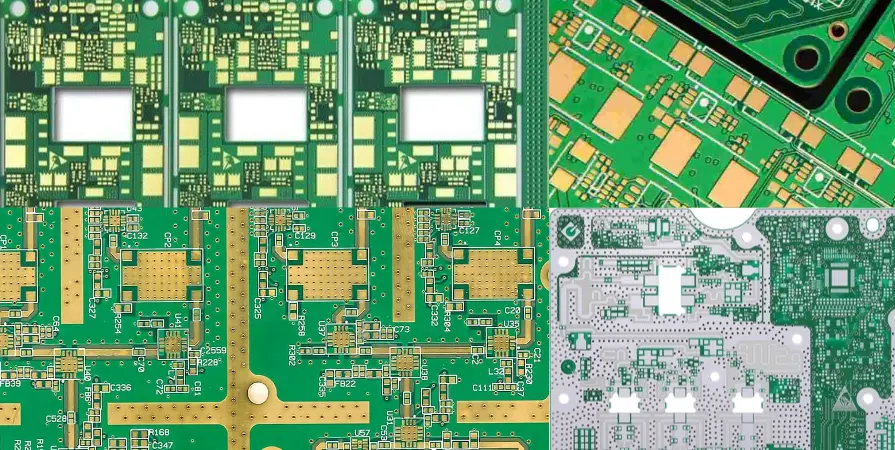
Once you have determined that a robust Workflow System PCB is required, the next step is to lock down the technical specifications that will govern the manufacturing process.
Base Material (Laminate):
- Standard: High-Tg FR4 (Tg ≥ 170°C) is the baseline to withstand thermal stress during continuous operation.
- High-Speed: For data-heavy Storage System PCB applications, consider low-loss materials like Megtron 6 or Rogers 4350B to minimize signal attenuation.
- Target: Decomposition Temperature (Td) ≥ 340°C to prevent material breakdown during assembly reflow.
Layer Stackup:
- Count: Typically 6 to 12 layers to accommodate separate power/ground planes and controlled impedance routing.
- Symmetry: strictly symmetrical build-up to prevent warpage during reflow; copper balance within 5% per layer pair.
- Dielectric Thickness: Tightly controlled prepreg thickness (e.g., ±10%) to ensure consistent impedance values (50Ω single-ended, 90Ω/100Ω differential).
Copper Weight:
- Signal Layers: 0.5 oz to 1 oz (18µm to 35µm) for fine-pitch components.
- Power Layers: 2 oz (70µm) or higher if the workflow system drives motors or actuators, ensuring sufficient current carrying capacity without overheating.
Impedance Control:
- Tolerance: ±10% is standard; ±5% is recommended for high-speed interfaces like PCIe, DDR, or Ethernet in an Archive System PCB.
- Test Coupons: Must be included on the panel rails for batch verification.
Surface Finish:
- Preferred: ENIG (Electroless Nickel Immersion Gold) for flat pads (good for BGA) and excellent corrosion resistance.
- Alternative: Hard Gold for edge connectors if the board is frequently inserted/removed from a backplane.
Via Technology:
- Aspect Ratio: Keep through-hole aspect ratio below 10:1 to ensure reliable plating (e.g., 0.2mm drill for 2.0mm thick board).
- Plugging: Via-in-pad plated over (VIPPO) for high-density BGA areas to improve thermal management and routing density.
Solder Mask:
- Type: LPI (Liquid Photoimageable) with high chemical resistance.
- Dam Size: Minimum 3-4 mil solder dam between pads to prevent solder bridging on fine-pitch components.
- Color: Matte Green or Blue is preferred to reduce glare during automated optical inspection (AOI).
Dimensional Tolerances:
- Outline: ±0.10mm (±4 mil) for precise mechanical fit into chassis or rack mounts.
- Hole Position: ±0.075mm (±3 mil) to ensure alignment with press-fit connectors.
- Bow and Twist: ≤ 0.75% (IPC Class 2 standard), but aim for ≤ 0.5% for SMT assembly efficiency.
Thermal Management:
- Thermal Vias: Arrays of 0.3mm vias under hot components connected to ground planes.
- Heatsink Prep: Define keep-out zones and unmasked copper areas for direct heatsink attachment if required.
Cleanliness Standards:
- Ionic Contamination: ≤ 1.56 µg/cm² NaCl equivalent (IPC-6012) to prevent electrochemical migration in humid environments.
Marking and Traceability:
- Serialization: Laser marking or permanent ink for unique ID per board.
- Date Code: Clearly etched or screened in copper/legend.
- UL Marking: Mandatory flammability rating (94V-0) and manufacturer logo location.
Workflow System PCB manufacturing risks (root causes and prevention)
Even with perfect specifications, the manufacturing process introduces variables that can compromise a Workflow System PCB; identifying these risks early is the key to consistent quality.
Risk: Impedance Mismatch
- Why it happens: Variation in dielectric thickness (prepreg pressing) or over-etching of trace widths.
- Detection: TDR (Time Domain Reflectometry) testing on coupons fails or shows high variance.
- Prevention: Specify "impedance controlled" in Gerber notes; require the fab house to adjust trace widths based on their specific material stock.
Risk: Plated Through Hole (PTH) Failure
- Why it happens: Incomplete drilling (smear), poor desmear process, or insufficient plating thickness leading to barrel cracks during thermal cycling.
- Detection: Cross-section analysis (microsection) showing voids or thin copper; open circuits after thermal stress.
- Prevention: Mandate IPC Class 3 plating thickness (average 25µm); enforce strict drill bit life management.
Risk: Warpage (Bow and Twist)
- Why it happens: Asymmetrical copper distribution in the stackup or improper cooling after lamination/reflow.
- Detection: Board does not sit flat on the assembly fixture; SMT placement errors.
- Prevention: Design with copper balance in mind; use "thieving" (copper pour) on empty layers; specify horizontal cooling during fabrication.
Risk: CAF (Conductive Anodic Filament) Growth
- Why it happens: Electrochemical migration along glass fibers inside the PCB material, causing internal shorts over time.
- Detection: High-voltage testing fails after humidity exposure; field failures after months of use.
- Prevention: Use "CAF-resistant" materials; increase spacing between high-voltage vias; avoid aligning vias with glass weave direction if possible.
Risk: Solder Mask Peeling
- Why it happens: Poor surface preparation before mask application or insufficient curing.
- Detection: Mask flakes off during tape test or assembly reflow.
- Prevention: Ensure proper chemical cleaning/micro-etching of copper before mask application; verify curing oven profiles.
Risk: BGA Pad Cratering
- Why it happens: Brittle laminate material combined with mechanical stress during assembly or testing.
- Detection: Dye-and-pry testing reveals cracks under BGA pads.
- Prevention: Use high-Tg materials with lower CTE (Coefficient of Thermal Expansion); avoid placing large BGAs near board edges or mounting holes.
Risk: Delamination
- Why it happens: Moisture trapped inside the PCB expands during reflow (popcorning).
- Detection: Visible blistering on the board surface; internal separation seen in microsections.
- Prevention: Bake boards before assembly to remove moisture; store in vacuum-sealed bags with desiccant (MSL control).
Risk: Inner Layer Misregistration
- Why it happens: Material shrinkage/stretch during lamination is not compensated for; poor pinning alignment.
- Detection: X-ray inspection shows drill holes breaking out of internal pads (breakout).
- Prevention: Use Laser Direct Imaging (LDI) for inner layers; include specific alignment targets; allow larger annular rings on inner layers.
Risk: Surface Finish Oxidation
- Why it happens: Expired shelf life or poor storage conditions (humidity/temperature).
- Detection: Discolored pads; poor wetting during soldering (black pad in ENIG).
- Prevention: Check manufacture date; ensure vacuum packaging is intact; use fresh chemistry in the plating line.
Risk: Signal Integrity Loss in Storage Systems
- Why it happens: Stub resonance from unused via portions in high-speed lines.
- Detection: High bit error rates (BER) in data transmission tests.
- Prevention: Implement back-drilling to remove via stubs on high-speed nets (e.g., >10Gbps).
Workflow System PCB validation and acceptance (tests and pass criteria)

Mitigating risks requires a robust validation plan; you must define exactly how the finished Workflow System PCB will be tested before it leaves the factory.
Electrical Continuity & Isolation Test (E-Test):
- Objective: Ensure all nets are connected as per netlist and no shorts exist.
- Method: Flying probe (for prototypes) or Bed of Nails (for mass production).
- Acceptance Criteria: 100% pass; 0 opens, 0 shorts. Resistance < 10Ω for continuity, > 10MΩ for isolation.
Impedance Verification (TDR):
- Objective: Confirm signal traces meet design impedance targets.
- Method: Time Domain Reflectometry on test coupons.
- Acceptance Criteria: Measured impedance within ±10% (or ±5% if specified) of target value. Report must be supplied.
Microsection Analysis (Cross-Section):
- Objective: Verify internal build quality, plating thickness, and layer alignment.
- Method: Cut and polish a sample from the panel edge; inspect under microscope.
- Acceptance Criteria: Copper plating in holes ≥ 20µm (Class 2) or ≥ 25µm (Class 3); no cracks; proper registration.
Solderability Test:
- Objective: Ensure pads will wet properly during assembly.
- Method: Dip and look / Wetting balance test (IPC-J-STD-003).
- Acceptance Criteria: > 95% coverage of the surface with a smooth, continuous solder coating.
Thermal Stress Test (Solder Float):
- Objective: Verify board integrity under thermal shock.
- Method: Float sample on molten solder (288°C) for 10 seconds.
- Acceptance Criteria: No delamination, blistering, or measles; no lifting of pads.
Ionic Contamination Test (ROSE Test):
- Objective: Ensure board cleanliness to prevent corrosion.
- Method: Resistivity of Solvent Extract.
- Acceptance Criteria: < 1.56 µg/cm² NaCl equivalent.
Dimensional Verification:
- Objective: Confirm physical size and hole sizes.
- Method: CMM (Coordinate Measuring Machine) or calibrated calipers/pin gauges.
- Acceptance Criteria: All dimensions within specified tolerances (e.g., ±0.1mm).
High Potential (Hi-Pot) Test:
- Objective: Verify dielectric strength between isolated high-voltage nets.
- Method: Apply high voltage (e.g., 1000VDC) between specific nets.
- Acceptance Criteria: Leakage current < specified limit (e.g., 1mA); no breakdown/arcing.
Peel Strength Test:
- Objective: Check adhesion of copper foil to laminate.
- Method: Pull copper strip at 90 degrees.
- Acceptance Criteria: Meets IPC-4101 specification for the chosen material (typically > 0.8 N/mm).
Visual Inspection:
- Objective: Catch cosmetic and surface defects.
- Method: Manual inspection or AOI (Automated Optical Inspection).
- Acceptance Criteria: No scratches exposing copper, legible silkscreen, uniform solder mask color.
Workflow System PCB supplier qualification checklist (RFQ, audit, traceability)
To ensure your supplier can deliver a compliant Workflow System PCB, use this checklist during the RFQ and vendor audit phases.
RFQ Inputs (What you must provide):
- Gerber Files: RS-274X or ODB++ format, complete with all layers.
- Fabrication Drawing: PDF specifying dimensions, tolerances, and special notes.
- Stackup Definition: Explicit layer order, material type, and dielectric thicknesses.
- Netlist: IPC-356 format for electrical test comparison.
- Drill File: Excellon format with tool list and plated/non-plated definitions.
- Impedance Requirements: Table listing layers, trace widths, and target impedance values.
- Material Specs: Specific Tg, Td, and halogen-free requirements if applicable.
- Surface Finish: Clearly stated (e.g., ENIG, HASL, Immersion Silver).
- Class Requirement: IPC Class 2 or Class 3.
- Volume & EAU: Prototype quantity vs. Estimated Annual Usage.
- Panelization: Single board or delivery panel array (with rails/fiducials).
Capability Proof (What the supplier must demonstrate):
- Min/Max Specs: Can they meet your min trace/space and aspect ratio?
- Material Stock: Do they stock your required high-speed or high-Tg material?
- Impedance Control: Do they have in-house TDR testing equipment?
- Via Tech: Capability for blind/buried vias and VIPPO if needed.
- Certifications: ISO 9001 (Quality), ISO 14001 (Env), UL (Safety), IATF 16949 (if automotive).
- Capacity: Can they handle your ramp-up from NPI to mass production?
Quality System & Traceability (Audit points):
- IQC: How do they inspect incoming raw materials (laminate, chemistry)?
- Process Control: Are there travelers/route sheets following every batch?
- AOI: Is AOI used on inner layers before lamination?
- X-Ray: Is X-ray used to verify registration and BGA pads?
- Calibration: Are measurement tools (CMM, TDR) calibrated regularly?
- Record Retention: How long do they keep quality records and microsections (usually 2+ years)?
Change Control & Delivery (Logistics):
- PCN Policy: Will they notify you before changing materials or processes?
- EQ Handling: Is there a formal Engineering Query process for Gerber discrepancies?
- Packaging: ESD safe vacuum packing with humidity indicator cards.
- Lead Time: Clear standard vs. expedited lead times.
- DDP/Incoterms: Clear definition of shipping terms and responsibility.
- RMA Process: Defined procedure for handling non-conforming product.
How to choose Workflow System PCB (trade-offs and decision rules)
Selecting the right configuration for a Workflow System PCB involves balancing performance, reliability, and cost; use these rules to navigate common trade-offs.
Material Selection: FR4 vs. High-Speed Laminates
- Rule: If your signal speeds exceed 5 Gbps (e.g., in a Storage System PCB), choose low-loss materials like Megtron 6. Otherwise, stick to High-Tg FR4 to save 30-50% on material cost.
Surface Finish: ENIG vs. HASL
- Rule: If you have fine-pitch components (BGA, QFN < 0.5mm pitch), choose ENIG for planarity. Otherwise, Lead-Free HASL is cheaper and offers robust solderability for larger components.
Via Type: Through-Hole vs. HDI (Blind/Buried)
- Rule: If you can route the board with standard through-holes, do so. Only choose HDI (High Density Interconnect) if space constraints are critical or BGA pin density demands it, as HDI increases cost by 20-40%.
Copper Weight: 1 oz vs. 2 oz+
- Rule: If your workflow system drives motors or high-current loads (> 3A per trace), prioritize 2 oz copper. Otherwise, 1 oz is standard and allows for finer trace widths (better for data lines).
Class 2 vs. Class 3 Manufacturing
- Rule: If a failure puts human safety at risk or repair is impossible (e.g., aerospace, medical), choose IPC Class 3. For most industrial automation and Archive System PCB applications, IPC Class 2 is sufficient and more cost-effective.
Panelization: V-Score vs. Tab-Route
- Rule: If the board is rectangular, use V-Score for better material utilization (lower cost). If the board has irregular shapes or overhanging components, use Tab-Route (mouse bites).
Solder Mask: Green vs. Other Colors
- Rule: If you want the fastest lead time and most reliable AOI inspection, choose Green. Other colors (Black, White, Blue) may have longer cure times or make inspection harder.
Workflow System PCB FAQ (cost, lead time, Design for Manufacturability (DFM) files, materials, testing)
Q: What factors most significantly impact the cost of a Workflow System PCB? A: Layer count and technology level are the biggest drivers.
- Adding blind/buried vias can increase price by 30%+.
- Switching from FR4 to Rogers/Megtron materials can double the bare board cost.
Q: What is the standard lead time for a Workflow System PCB prototype? A: Standard prototypes typically take 5-7 working days.
- Expedited service (24-48 hours) is available but carries a premium.
- Complex stackups (10+ layers, HDI) may require 10-12 days.
Q: What specific DFM files are needed for a Workflow System PCB quote? A: Beyond standard Gerbers, you must provide a detailed stackup and drill chart.
- Include an IPC-356 netlist to ensure electrical test accuracy.
- Provide a "Read Me" text file clarifying special requirements like impedance or gold fingers.
Q: Can I use standard FR4 for an Archive System PCB with high-speed storage? A: It depends on the data rate and trace length.
- For SATA/SAS interfaces over short distances, high-quality FR4 may work.
- For PCIe Gen 4/5 or long runs, standard FR4 is too lossy; use low-loss laminates.
Q: What are the acceptance criteria for Workflow System PCB impedance testing? A: The industry standard is ±10% tolerance.
- For critical differential pairs (USB, Ethernet), you can request ±5%, but this may lower yield and increase cost.
- Suppliers should provide a TDR report confirming these values.
Q: How do I ensure material traceability for my Workflow System PCB? A: Request a Certificate of Conformance (CoC) with every shipment.
- The CoC should list the laminate manufacturer (e.g., Isola, Panasonic) and batch number.
- UL markings on the board itself verify the flammability rating and manufacturer UL file number.
Q: Why is back-drilling recommended for Storage System PCB backplanes? A: Back-drilling removes the unused portion of a plated through-hole (stub).
- Stubs act as antennas that reflect signals, causing data corruption at high speeds (>5 Gbps).
- Removing them improves signal integrity significantly.
Q: What testing is required for Workflow System PCBs in humid environments? A: You should request Ionic Contamination (ROSE) testing and consider conformal coating.
- Ensuring the board is free of process residues prevents corrosion.
- Specifying a high-reliability surface finish like ENIG also helps.
Resources for Workflow System PCB (related pages and tools)
- PCB Stack-up Design: Learn how to define the correct layer arrangement to control impedance and minimize crosstalk in your workflow system.
- High Frequency PCB Manufacturing: Explore material options and processing techniques for boards that handle high-speed data transmission.
- Rigid-Flex PCB Capabilities: Understand when to integrate flexible sections to eliminate cables and improve reliability in dynamic workflow machinery.
- Impedance Calculator: Use this tool to estimate trace widths and spacing for your controlled impedance requirements before finalizing the design.
- DFM Guidelines: Review our design-for-manufacturing rules to ensure your Workflow System PCB is optimized for production yield and cost.
Request a quote for Workflow System PCB (Design for Manufacturability (DFM) review + pricing)
Ready to move from design to production? Request a quote from APTPCB today to get a comprehensive DFM review and accurate pricing for your project.
Please include the following for the most accurate assessment:
- Gerber Files (RS-274X or ODB++)
- Fabrication Drawing with Stackup Details
- Quantity (Prototype vs. Production Volume)
- Impedance Requirements & Material Specifications
- Any Special Testing Requirements (e.g., TDR, Class 3)
Conclusion (next steps)
A Workflow System PCB is more than just a circuit board; it is the reliability engine of your automated infrastructure. By defining clear specifications for materials and stackups, understanding the manufacturing risks like impedance mismatch and CAF, and enforcing a rigorous validation checklist, you secure the foundation of your system's performance. Whether you are building an Archive System PCB for data retention or a control board for industrial robotics, the disciplined approach outlined here ensures scalability and uptime. APTPCB is ready to support your engineering team with the precision manufacturing required to bring these critical systems to life.