
Key Takeaways
- Definition: X-ray inspection (AXI) is a non-destructive testing method used to visualize hidden solder joints, such as those under BGAs, QFNs, and CSPs.
- Critical Metric: Void percentage is the most common quality indicator; typically, voids should remain under 25% of the solder joint area per IPC standards.
- Resolution Matters: High-resolution systems (measured in microns) are necessary to detect micro-cracks and Head-in-Pillow defects.
- Misconception: X-ray does not replace optical inspection; it complements aoi basics by covering areas line-of-sight cameras cannot reach.
- Process Tip: 3D X-ray (Laminography) is essential for double-sided boards to avoid image interference from components on the opposite side.
- Validation: Acceptance is based on grayscale density differences, indicating solder thickness and shape.
- Standard: Always reference IPC-A-610 Class 2 or Class 3 solder joint criteria when setting pass/fail thresholds.
What x ray inspection intro really means (scope & boundaries)
Understanding the core mechanics of inspection technology is the first step before analyzing specific metrics. An x ray inspection intro must begin by defining the technology's role in modern electronics manufacturing: it is the only non-destructive way to verify connections that are physically hidden from view.
In the context of Printed Circuit Board Assembly (PCBA), X-ray inspection uses high-frequency electromagnetic waves to penetrate the PCB material. Solder, being dense and containing heavy metals like tin, lead, or silver, absorbs these waves more than the fiberglass substrate or silicon chips. This absorption creates a shadow image (grayscale) where darker areas represent thicker or denser material.
For manufacturers like APTPCB (APTPCB PCB Factory), this technology is indispensable. As components shrink and density increases, traditional visual inspection becomes insufficient. X-ray is primarily used for:
- Hidden Joints: Ball Grid Arrays (BGAs), Quad Flat No-leads (QFNs), and Flip Chips.
- Through-Hole Fill: Verifying barrel fill percentages in connectors.
- Multilayer Alignment: Checking inner layer registration during bare board fabrication.
- Counterfeit Detection: Inspecting wire bonding inside IC packages.
While Automated Optical Inspection (AOI) handles visible surface mount parts, X-ray handles the "invisible" risks.
x ray inspection intro metrics that matter (how to evaluate quality)
Once the scope of inspection is defined, engineers must quantify quality using specific data points. The following table outlines the critical metrics used during an x ray inspection intro and daily operations to ensure board reliability.
| Metric | Why it matters | Typical range or influencing factors | How to measure |
|---|---|---|---|
| Void Percentage | Large air pockets weaken the joint and reduce thermal conductivity. | < 25% (Class 2/3). < 15% for high-power LEDs. | Calculated area of the void divided by total ball area. |
| Grayscale Value | Indicates solder thickness and density. Inconsistent values suggest open circuits or insufficient solder. | 0 (Black) to 255 (White). Solder usually appears dark grey/black. | Histogram analysis of the pixel density in the image. |
| Resolution (Microns) | Determines the smallest defect visible. Crucial for micro-BGAs. | 0.5µm to 5µm. Lower is better for fine pitch. | Calibrated using a resolution target or gauge. |
| Tube Voltage (kV) | Higher voltage penetrates thicker boards and shields but reduces contrast on light materials. | 80kV to 160kV depending on board thickness. | Set via the X-ray machine control software. |
| Field of View (FOV) | The area visible in a single scan. Larger FOV is faster but lowers magnification. | 10mm x 10mm to 50mm x 50mm. | Physical movement of the detector or stage. |
| False Call Rate | High false calls slow down production; low false calls risk escaping defects. | Target < 500 ppm (parts per million). | Comparison of machine flags vs. operator verification. |
| Solder Ball Circularity | Distorted shapes indicate reflow issues or pad misalignment. | Deviation from a perfect circle (1.0). | Geometric analysis software algorithms. |
How to choose x ray inspection intro: selection guidance by scenario (trade-offs)
After establishing the metrics, the next challenge is selecting the right inspection strategy for your specific product type. This section covers "how to choose" the correct x ray inspection intro approach versus other testing methods based on production scenarios.
Scenario 1: Standard SMT with Passive Components
- Recommendation: AOI Only.
- Trade-off: X-ray is slow and expensive. If all leads are visible (resistors, capacitors, SOIC), AOI is faster and sufficient.
- Verdict: Skip X-ray unless troubleshooting specific soldering defects.
Scenario 2: Complex BGA and QFN Assembly
- Recommendation: 2D Automated X-ray Inspection (AXI).
- Trade-off: Essential for quality. You cannot visually inspect these joints. 2D is faster than 3D but struggles if components are on both sides of the board.
- Verdict: Mandatory. See our capabilities in BGA and QFN assembly for more details.
Scenario 3: Double-Sided High-Density Boards
- Recommendation: 3D X-ray (Laminography).
- Trade-off: 2D X-ray produces overlapping images of top and bottom components, making analysis impossible. 3D slices the image to focus on one layer. It is slower but accurate.
- Verdict: Required for double-sided populated boards.
Scenario 4: High-Reliability (Automotive/Aerospace)
- Recommendation: 100% Inline AXI.
- Trade-off: Every single board is scanned automatically. This creates a bottleneck in the line but guarantees zero escapes for critical defects.
- Verdict: Necessary for safety-critical applications.
Scenario 5: Prototype and NPI (New Product Introduction)
- Recommendation: Manual X-ray (Offline).
- Trade-off: An operator manually moves the board to inspect specific areas. It is flexible for debugging process issues but too slow for volume.
- Verdict: Best for engineering analysis and first article inspection.
Scenario 6: Bare PCB Fabrication
- Recommendation: X-ray Drill Target Verification.
- Trade-off: Used to check inner layer alignment before drilling. Not for solder quality, but for structural integrity.
- Verdict: Standard process in multilayer PCB manufacturing.
x ray inspection intro implementation checkpoints (design to manufacturing)
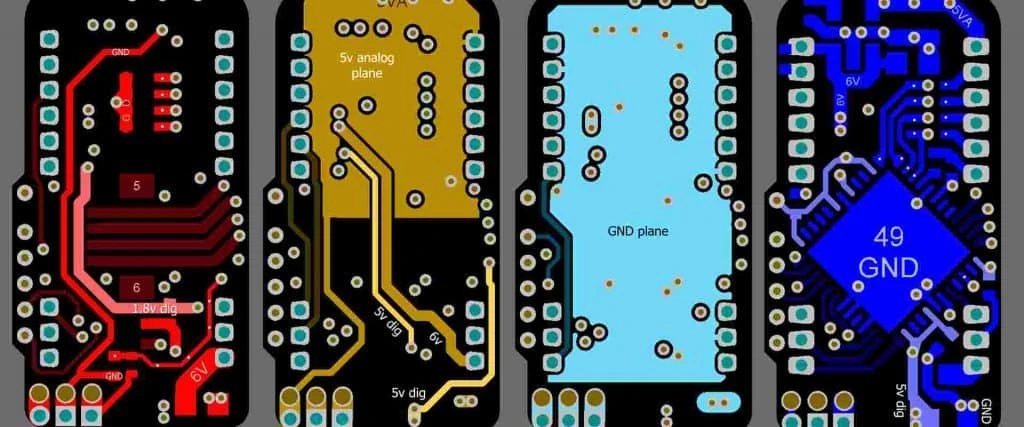
Selecting the right method is only effective if the implementation process is rigorously controlled. A successful x ray inspection intro requires checkpoints at every stage, from the initial layout to the final reflow oven.
1. Design Phase: Pad Geometry
- Recommendation: Ensure BGA pads are "Non-Solder Mask Defined" (NSMD) where possible for better X-ray contrast.
- Risk: Poor pad definition makes automated measurement of ball diameter inaccurate.
- Acceptance: DFM check passes.
2. Design Phase: Component Placement
- Recommendation: Avoid placing heavy components (transformers) directly opposite fine-pitch BGAs on double-sided boards.
- Risk: Shadowing effects in X-ray images.
- Acceptance: 3D modeling review.
3. Material Phase: Solder Paste Selection
- Recommendation: Use consistent particle size (Type 4 or 5) for fine-pitch components.
- Risk: Inconsistent paste volume leads to voiding visible in X-ray.
- Acceptance: Paste inspection (SPI) data correlation.
4. Setup Phase: Machine Calibration
- Recommendation: Calibrate grayscale and geometric accuracy daily.
- Risk: Drift in measurements leads to false passes.
- Acceptance: Calibration target verification.
5. Process Phase: Reflow Profile
- Recommendation: Optimize soak zones to minimize voiding.
- Risk: Rapid outgassing creates voids > 25%.
- Acceptance: X-ray sample run shows voids within spec.
6. Inspection Phase: Threshold Tuning
- Recommendation: Tune sensitivity to balance false calls and escapes.
- Risk: Too sensitive = line stops; Too loose = defects ship.
- Acceptance: Gage R&R study.
7. Validation Phase: Image Storage
- Recommendation: Archive X-ray images for critical components by serial number.
- Risk: No traceability if field failures occur.
- Acceptance: Database log verification.
8. Maintenance Phase: Tube Life
- Recommendation: Monitor X-ray tube hours.
- Risk: Filament degradation reduces image sharpness.
- Acceptance: Preventive maintenance schedule adherence.
For a deeper dive into how we handle these steps, review our X-ray inspection capabilities.
x ray inspection intro common mistakes (and the correct approach)
Even with robust checkpoints, manufacturers often fall into specific traps during execution. This section highlights common errors when conducting an x ray inspection intro and how APTPCB avoids them.
Relying Solely on 2D for Double-Sided Boards
- Mistake: Trying to inspect a BGA on the top side while a QFN is directly underneath on the bottom side. The images merge, making void calculation impossible.
- Correction: Use 3D Laminography or offset component placement during design.
Ignoring "Head-in-Pillow" (HiP) Defects
- Mistake: Focusing only on shorts and bridges. HiP defects (where the ball rests on the pad but doesn't coalesce) often look like good circles in 2D X-ray.
- Correction: Use angled views (oblique X-ray) or 3D inspection to see the interface shape.
Misinterpreting Void Criteria
- Mistake: Rejecting any board with a void. Small voids are normal and often acceptable.
- Correction: Follow IPC-A-610 standards. Reject only if the cumulative void area exceeds the limit (usually 25%) or if voids are located at the interface (planar micro-voids).
Overlooking Thermal Pads on QFNs
- Mistake: Inspecting the leads but ignoring the large center ground pad.
- Correction: The center pad is critical for heat dissipation. Ensure voiding here is < 50% (or per specific customer spec).
High Power on Low Density
- Mistake: Using high kV settings for thin, flexible boards. The beam passes through too easily, resulting in a washed-out image with low contrast.
- Correction: Lower the voltage to increase contrast for lighter materials.
Neglecting Heel Fillets in THT
- Mistake: Using X-ray only for SMT.
- Correction: X-ray is the best way to verify barrel fill (75% or 100%) for Through-Hole Technology (THT) connectors that are obscured by the connector body.
x ray inspection intro FAQ (cost, lead time, materials, testing, acceptance criteria)
To wrap up the practical application, here are answers to the most frequent questions regarding x ray inspection intro logistics and standards.
1. How does x ray inspection intro affect the cost of assembly? X-ray inspection adds a cost premium compared to standard AOI because the equipment is more expensive and the process is slower. However, for BGA/QFN boards, the cost of not inspecting (rework, field failure) is significantly higher. At APTPCB, we optimize this by using sampling plans for stable lots and 100% inspection for NPI.
2. Does x ray inspection intro increase production lead time? Inline AXI can be a bottleneck if not balanced correctly. Offline batch inspection adds minimal time (usually less than 1 day) to the total turnaround. For quick-turn prototypes, we prioritize X-ray to ensure immediate feedback.
3. Which materials interfere with x ray inspection intro results? Heavy metals (RF shields, thick copper heat sinks, large inductors) block X-rays, creating "shadows." If a BGA is placed under a metal shield, X-ray cannot see through it effectively. Design the shield to be removable or place it after inspection.
4. How does x ray inspection intro testing coverage compare to ICT? X-ray checks structural integrity (solder shape, voids), while In-Circuit Test (ICT) checks electrical function. They are complementary. X-ray can find a marginal joint that passes ICT electrically but will fail mechanically later due to vibration.
5. What are the standard acceptance criteria for x ray inspection intro? We strictly follow IPC-A-610 (Acceptability of Electronic Assemblies). For Class 2, voids must be under 25% of the ball area. For Class 3 (High Reliability), criteria may be tighter depending on the specific defect type.
6. Can X-ray damage sensitive components? Generally, no. The radiation dose used for PCBA inspection is very low and safe for standard silicon and memory. However, certain specialized sensors or unprogrammed flash memory may have exposure limits, which should be communicated during the quote phase.
7. What is the difference between 2.5D and 3D X-ray? 2.5D allows the detector to tilt, letting operators look "under" a component from an angle. 3D builds a volumetric model layer by layer. 2.5D is often sufficient for debugging; 3D is best for automated pass/fail on complex boards.
8. Why do I see "gray" solder joints in the X-ray image? Solder absorbs X-rays, so it should appear dark. If it appears light gray, it may indicate insufficient solder volume, a "cold" solder joint, or a Head-in-Pillow defect where the ball has not fully wetted to the paste.
Resources for x ray inspection intro (related pages and tools)
- PCB Quality Standards: Understand the broader context of quality control beyond just X-ray.
- IPC Standards: The official source for acceptance criteria (IPC-A-610).
- Gerber Viewer: Use our tools to check your layout for BGA placement before manufacturing.
x ray inspection intro glossary (key terms)
| Term | Definition |
|---|---|
| AXI | Automated X-ray Inspection. A machine that automatically scans and grades solder joints based on algorithms. |
| BGA | Ball Grid Array. A component package where connections are under the chip, requiring X-ray for inspection. |
| Voiding | Air or flux gas trapped inside a solder joint. Measured as a percentage of the total joint area. |
| Bridging | A defect where solder connects two adjacent pads that should be electrically isolated (a short circuit). |
| Head-in-Pillow (HiP) | A defect where the BGA ball rests on the solder paste but does not coalesce into a single joint. |
| Laminography | A 3D X-ray technique that creates cross-sectional slices of the board to isolate specific layers. |
| Grayscale | The range of shades from black to white in an X-ray image, representing material density. |
| Field of View (FOV) | The physical area of the PCB that can be seen by the X-ray detector in a single shot. |
| Micron (µm) | Unit of measurement for resolution. 1 µm = 0.001 mm. Critical for detecting micro-cracks. |
| kV (Kilovolts) | The unit of energy for the X-ray tube. Higher kV penetrates denser materials. |
| IPC-A-610 | The industry standard specification for the acceptability of electronic assemblies. |
| Solder Ball | The spherical solder connection on a BGA package. |
Conclusion (next steps)
Mastering the x ray inspection intro is about more than just looking at black-and-white images; it is about ensuring the long-term reliability of your electronic products. From defining the right metrics like void percentage to selecting between 2D and 3D inspection based on your board's complexity, X-ray is the ultimate gatekeeper for hidden quality.
At APTPCB, we integrate advanced X-ray inspection into our standard workflow for all BGA and leadless component assemblies. To ensure your next project moves smoothly through validation, please provide the following when requesting a quote:
- Gerber Files: To analyze component density and placement.
- Stackup Details: To determine total board thickness and required X-ray power.
- Test Requirements: Specify if you need Class 2 or Class 3 inspection, or if you have custom voiding limits.
- Critical Components: Highlight any specific BGAs or QFNs that require 100% X-ray validation.
Ready to validate your design? Contact us today for a comprehensive DFM review.