
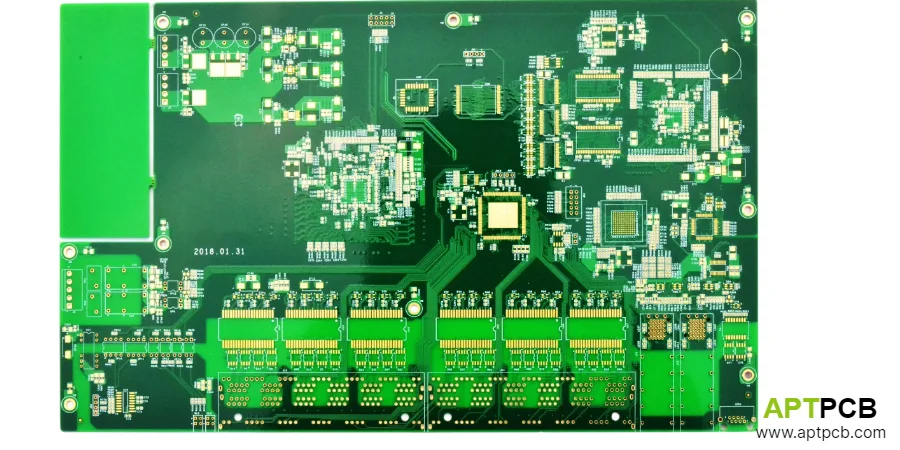
A high-frequency circuit board is a specialized PCB designed to preserve signal integrity when electrical behavior is dominated by transmission-line effects, dielectric properties, and electromagnetic interactions. These boards are commonly used for RF, microwave, wireless communication, radar, satellite, and high-speed electronic systems operating from hundreds of MHz into the GHz range.
Unlike a standard PCB where traces can often be treated as simple electrical connections, a high-frequency PCB becomes part of the circuit itself. Trace geometry, laminate properties, copper roughness, stack-up construction, and manufacturing variation directly influence impedance, insertion loss, phase stability, and overall system performance.
This guide explains when a high-frequency circuit board is required, how to select the right materials, which specifications matter during fabrication, and how to evaluate a manufacturing partner.
When does a PCB become a high-frequency circuit board?
There is no single frequency threshold that defines every high-frequency PCB application. In practical engineering, high-frequency circuit boards are typically associated with RF and microwave signals above several hundred MHz and especially above 1 GHz, where transmission-line behavior and material characteristics significantly affect performance.
At 1 GHz, electrical wavelengths become small enough that normal PCB dimensions can influence signal behavior. At 10 GHz, even short traces and discontinuities become important electromagnetic structures.
A high-frequency PCB is usually required when a design must control:
- Characteristic impedance
- Signal attenuation
- Phase consistency
- Crosstalk and electromagnetic interference
- Temperature-dependent electrical variation
- RF power handling capability
Standard FR-4 remains effective for many digital and low-frequency applications, but its dielectric properties can become unpredictable at higher frequencies. Typical FR-4 has higher dielectric loss and greater variation in dielectric constant compared with engineered RF laminates.
What materials are used for high-frequency circuit boards?
Material selection is one of the most important high-frequency PCB decisions because dielectric properties directly determine signal behavior.
The two primary electrical properties are:
- Dielectric constant (Dk): Controls propagation speed and affects impedance calculations.
- Dissipation factor (Df): Determines dielectric signal loss.
A stable Dk allows manufacturers to maintain predictable impedance. A low Df reduces energy loss as signals travel through the board.
High-frequency PCB material selection matrix
| Application requirement | Typical frequency range | Recommended material families | Key considerations |
|---|---|---|---|
| Cost-sensitive RF designs | Hundreds of MHz to several GHz | Enhanced FR-4, low-loss FR-4 | Lower cost, moderate loss performance |
| General RF and microwave | 1–10+ GHz | Rogers RO4000 series, similar hydrocarbon ceramics | Good balance of performance and manufacturability |
| Precision RF systems | Several GHz to tens of GHz | Ceramic-filled PTFE laminates | Stable Dk, low loss, improved thermal behavior |
| Millimeter-wave systems | 24 GHz and above | PTFE-based low-loss materials | Lowest dielectric loss and high phase stability |
| Mixed digital/RF systems | Multiple frequency domains | Hybrid FR-4 and RF laminate stack-ups | Optimizes cost while protecting critical RF layers |
Common material options include:
- PTFE composites: Used where extremely low loss is required. These materials provide excellent microwave performance but require specialized processing.
- Ceramic-filled PTFE: Improves dimensional stability and thermal characteristics while maintaining low dielectric loss.
- Hydrocarbon ceramic laminates: Offer RF performance with fabrication characteristics closer to conventional PCB materials.
- Enhanced FR-4: Suitable when performance requirements are moderate and cost is a primary consideration.
- Hybrid constructions: Combine RF laminates with standard PCB materials to reduce cost while maintaining performance on critical signal layers.
Copper foil selection also matters. At higher frequencies, current flows near the conductor surface due to skin effect. Low-profile copper foil reduces conductor loss caused by surface roughness.
How do high-frequency PCB materials affect signal integrity?
At high frequencies, every part of the PCB structure contributes to electrical performance.
Dielectric constant stability
The dielectric constant determines signal velocity:
Velocity ≈ c / √Dk
Variation in Dk changes propagation delay and impedance. High-performance RF laminates maintain tighter dielectric consistency than general-purpose materials.
Dissipation factor and insertion loss
The dissipation factor determines how much signal energy converts into heat during transmission.
Low-loss materials with Df values below approximately 0.005 are commonly selected for demanding RF applications. PTFE-based materials can achieve even lower values for microwave and millimeter-wave systems.
Copper roughness and skin effect
At GHz frequencies, current does not flow evenly through the entire copper thickness. Surface roughness increases the effective electrical path length and contributes to conductor loss.
For demanding RF designs, engineers often specify:
- Low-profile copper foil
- Controlled surface finishes
- Appropriate copper treatment for the frequency range
What impedance requirements should a high-frequency circuit board meet?
Controlled impedance is fundamental to RF PCB performance.
Most RF systems use:
- 50Ω single-ended impedance
- 100Ω differential impedance
A trace impedance depends on:
- Trace width
- Copper thickness
- Dielectric thickness
- Dielectric constant
- Reference plane location
- Manufacturing tolerances
A mismatch creates reflections that reduce power transfer and distort signals.
Typical production requirements include:
- ±10% impedance tolerance for many applications
- ±5% or tighter tolerance for demanding RF designs
Manufacturers achieve these targets through:
- Stack-up modeling before fabrication
- Controlled dielectric thickness
- Trace width compensation during imaging
- Test coupons measured by TDR
- Process monitoring
What high-frequency PCB design factors cause failures?
High-frequency failures usually result from small variations that would be insignificant in conventional PCB designs.
| Failure mode | Primary cause | Design impact |
|---|---|---|
| Excessive insertion loss | High Df material, rough copper, long RF traces | Reduced signal strength and shorter communication range |
| Impedance mismatch | Incorrect stack-up, trace width variation, unstable Dk | Reflections, return loss, signal distortion |
| Phase variation | Material inconsistency, temperature changes | Reduced antenna and beamforming accuracy |
| RF interference | Poor grounding, discontinuous return paths | Noise coupling and electromagnetic emissions |
| Via discontinuities | Excess inductance or poor via design | Signal degradation at high frequencies |
| Thermal drift | Unstable dielectric properties | Performance changes across operating temperature |
Understanding these failure mechanisms allows engineers to define realistic PCB specifications before manufacturing begins.
How should engineers specify a high-frequency PCB?
A complete RF PCB specification should include more than material name and board thickness.
Specify:
- Operating frequency range
- Maximum allowable insertion loss
- Target impedance values
- Impedance tolerance
- Approved laminate family
- Dielectric thickness
- Copper thickness
- Surface finish requirements
- Operating temperature range
- Required RF testing method
For example, an RF design may specify a controlled stack-up using a Rogers RO4350B 10 mil laminate with defined impedance requirements and verified production test coupons.
How do temperature and environment affect high-frequency circuit boards?
High-frequency systems often operate in demanding environments including automotive radar, telecommunications infrastructure, aerospace equipment, and outdoor wireless systems.
Important environmental parameters include:
Thermal stability
High-frequency materials must maintain electrical performance across temperature changes.
Important properties include:
- Glass transition temperature (Tg)
- Coefficient of thermal expansion (CTE)
- Dk temperature coefficient
Materials with appropriate thermal stability reduce impedance shifts and mechanical reliability problems.
Moisture resistance
Moisture absorption changes dielectric behavior. Low-moisture materials are preferred for outdoor, aerospace, and high-reliability RF systems.
Assembly compatibility
Materials must survive PCB assembly processes, including lead-free reflow temperatures approaching 260°C.
High-Tg laminate selection supports thermal reliability in demanding applications.
Which industries use high-frequency circuit boards?
High-frequency circuit boards enable critical systems across multiple industries.
5G and wireless infrastructure
5G antenna arrays and beamforming systems require consistent phase and amplitude performance across many RF channels. The telecommunications industry relies on controlled impedance and low-loss materials for high-frequency signal paths.
Automotive radar
Automotive radar systems commonly operate around 77 GHz and require precise manufacturing control because small dimensional variations can affect detection accuracy. The automotive sector requires repeatable high-volume production.
Satellite communication
Satellite systems use microwave frequencies such as Ku-band (12–18 GHz) and require stable materials, reliability, and environmental resistance.
Medical and aerospace electronics
RF subsystems in medical imaging, aerospace communication, and defense electronics require predictable electrical performance under demanding operating conditions.
How should you evaluate a high-frequency PCB manufacturer?
A capable high-frequency PCB supplier should demonstrate both material knowledge and manufacturing control.
High-frequency PCB supplier checklist
| Evaluation area | What to verify |
|---|---|
| Material control | Certified laminate grades, thickness verification, Dk/Df documentation |
| Impedance capability | Stack-up simulation, TDR testing, impedance coupons |
| RF processing | Experience with PTFE, ceramic materials, and hybrid constructions |
| Manufacturing precision | Trace control, dielectric thickness control, copper consistency |
| Quality validation | Cross-section inspection, electrical testing, production traceability |
High-frequency PCB manufacturing requires specialized processes beyond standard PCB fabrication.
PTFE materials may require modified drilling, surface treatment, and lamination processes. RF stack-ups require careful control of dielectric thickness and copper geometry to achieve simulated performance in production hardware.
Comprehensive quality systems help maintain consistency across production runs.
For additional manufacturing considerations, see our guide on high frequency PCB manufacturing.
How do engineers choose the right high-frequency circuit board?
The correct high-frequency PCB solution balances:
- Frequency requirements
- Signal-loss budget
- Impedance tolerance
- Environmental conditions
- Manufacturing capability
- Total system cost
Selecting the right material and fabrication process early prevents expensive redesign cycles. A high-frequency circuit board is not simply a faster version of a standard PCB—it is an engineered RF component where materials, geometry, and manufacturing quality determine system performance.