
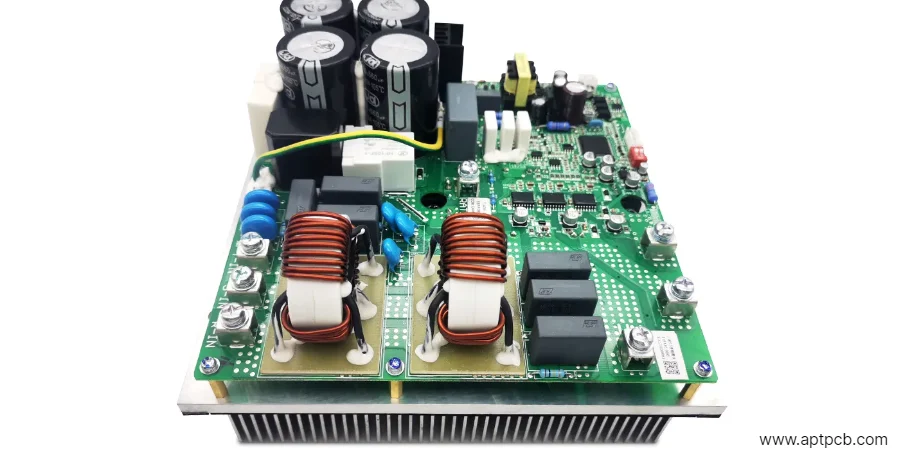
An inverter gate driver PCB translates PWM control signals into controlled gate voltage and current while protecting high-power switching devices from overcurrent, short circuit, undervoltage, and common-mode transient failures.
A reliable design connects three decisions together:
- The power semiconductor choice: IGBT, silicon MOSFET, or SiC MOSFET.
- The gate-drive architecture: isolation, bias supply, protection, and timing.
- The PCB implementation: loop inductance, creepage, clearance, thermal design, and validation.
A gate driver that works on a laboratory bench can still fail inside a complete inverter if switching parasitics, isolation stress, or protection timing are not validated.
What should be decided before designing an inverter gate driver PCB?
Before schematic capture and layout, define:
| Design input | Required information |
|---|---|
| Power topology | Half bridge, full bridge, three-phase inverter, multilevel topology |
| Switching device | Exact semiconductor part number, package, gate charge, voltage rating |
| Electrical conditions | DC bus voltage, load current, switching frequency, PWM method |
| Gate requirements | Turn-on voltage, turn-off voltage, gate resistor range, maximum current |
| Protection targets | UVLO, DESAT, VDS sensing, overcurrent, soft shutdown, interlock |
| Isolation requirements | Working voltage, surge voltage, insulation class, pollution degree |
| Validation scope | Double-pulse testing, fault testing, thermal testing, EMC testing |
The exact device data sheet should define gate voltage limits, short-circuit capability, and protection thresholds.
How do you choose the right inverter gate driver architecture?
Different switching devices require different gate-drive priorities.
| Device type | Typical design focus | Important PCB decisions |
|---|---|---|
| Silicon MOSFET | Fast switching efficiency and low conduction loss | Compact gate loop, controlled ringing, Miller management |
| IGBT | Short-circuit protection and controlled turn-off | DESAT protection, soft shutdown, gate voltage control |
| SiC MOSFET | Very high switching speed and low parasitic inductance | Kelvin source routing, CMTI margin, low-inductance loops |
The gate driver, isolation barrier, power supply, and protection circuits should be selected as one system rather than independent components.
How should the gate loop be routed on an inverter gate driver PCB?
The gate loop is the highest-priority routing area because switching speed makes small parasitic inductances significant.
Place the gate driver, gate resistor network, local bypass capacitors, and power device connection as close together as possible. Route the gate output and return as a compact current loop.
| Layout decision | Electrical benefit | Failure mode when poorly implemented |
|---|---|---|
| Kelvin source/emitter return | Separates gate reference from load current path | False turn-on, unstable switching, increased ringing |
| Separate turn-on and turn-off resistance | Allows independent switching control | Excessive switching loss or overshoot |
| Local driver bypass capacitor | Provides high-current gate pulses locally | Gate voltage droop and oscillation |
| Short protection sensing path | Reduces noise pickup and delay | False trips or delayed shutdown |
| Controlled switch-node spacing | Reduces capacitive coupling | Logic upset and isolation stress |
The relationship V = L × di/dt explains why a few nanohenries of unwanted inductance can create significant voltage error during fast switching.
Measure actual gate-source waveforms using appropriate differential probes before finalizing gate resistance, snubbers, or switching speed targets.
Why is a Kelvin source connection important for gate driver PCB layout?
A Kelvin source or Kelvin emitter connection provides a dedicated gate return path that is separated from the high-current power path.
Without this separation, voltage generated by package and PCB inductance appears in series with the gate signal. During high current transitions, this can reduce effective gate voltage, increase switching losses, or create unwanted turn-on behavior.
The Kelvin connection should run directly between the driver return and the device Kelvin terminal without sharing the power current path.
How do isolation and CMTI affect inverter gate driver PCB reliability?
Isolation design must consider the complete insulation system:
- Working voltage
- Surge and impulse requirements
- Creepage distance
- Clearance distance
- Pollution degree
- Material group
- Altitude
- Product safety standard
Common-mode transient immunity (CMTI) is not only an isolator specification. The complete PCB influences performance through:
- Primary-to-secondary capacitance
- Transformer coupling
- Copper overlap
- Ground-plane arrangement
- Measurement setup
A high-CMTI isolator can still fail if the PCB creates excessive transient current paths.
How should isolated gate-driver power supplies be selected?
The bias supply must support the required gate current throughout the switching cycle.
Bootstrap supplies can work for many high-side applications when:
- The capacitor can recharge during the switching pattern.
- Leakage current is acceptable.
- Gate charge demand is within the available energy budget.
- Voltage droop remains within device limits.
An isolated supply is typically preferred when the high-side switch remains on for extended periods or when continuous gate-drive energy is required.
What protection circuits should an inverter gate driver PCB include?
Protection selection depends on device capability, inverter energy, and fault response requirements.
| Protection function | Design inputs | Validation method |
|---|---|---|
| UVLO | Required gate voltage and safe shutdown state | Supply ramp and dropout testing |
| DESAT protection | Device short-circuit behavior, blanking time, sensing layout | Controlled fault testing |
| VDS sensing | MOSFET voltage monitoring requirements | Fault waveform capture |
| Shunt or Hall overcurrent | Current range and response delay | Injected current testing |
| Miller clamp | Device capacitance and dv/dt environment | False turn-on testing |
| Negative gate bias | Device maximum gate ratings and noise environment | Gate waveform validation |
| Soft shutdown | Fault energy and overshoot limits | Controlled shutdown capture |
| Interlock and dead time | Driver propagation delay and temperature variation | Timing measurement |
What are common inverter gate driver PCB failure modes?
| Failure mode | Root cause | Engineering verification |
|---|---|---|
| Gate ringing | Excess loop inductance or insufficient damping | Oscilloscope measurement at the device gate |
| False turn-on | Miller coupling or poor return routing | Opposite-switch dv/dt testing |
| Driver reset during switching | Poor CMTI margin or supply noise | High-voltage switching test |
| DESAT nuisance trips | Noisy sensing path or incorrect blanking | Controlled fault simulation |
| Device damage during shutdown | Protection delay too slow | Low-energy fault testing |
| Excessive EMI | Large current loops or poor switching-node control | EMC pre-compliance testing |
How should an inverter gate driver PCB be validated?
A controlled validation sequence reduces risk before full-power operation.
- Verify PCB assembly, polarity, component values, isolation spacing, and solder quality.
- Test driver supply rails, enable signals, reset behavior, and fault reporting without the power stage energized.
- Connect a dummy capacitive load and verify gate voltage levels and timing.
- Connect the exact switching device using current-limited, low-energy conditions.
- Perform double-pulse testing to measure switching behavior and tune gate resistance.
- Test protection functions using controlled fault energy.
- Repeat testing across voltage, temperature, load, and dv/dt conditions.
- Validate the complete inverter for EMC, thermal performance, and product requirements.
What should be included in an inverter gate driver PCB RFQ package?
A supplier should receive enough information to reproduce the intended electrical behavior.
Inverter gate driver PCB supplier checklist
| Category | Required RFQ information |
|---|---|
| Power stage | Topology, bus voltage, current, switching frequency, modulation method |
| Semiconductor | Exact device/module part number and package details |
| Gate drive | Gate voltage, charge, resistor targets, timing requirements |
| Protection | UVLO, DESAT, VDS sensing, shutdown behavior, reset logic |
| Isolation | Creepage, clearance, insulation requirements, safety standard |
| PCB construction | Layer count, materials, copper thickness, impedance requirements |
| Mechanical | Connector locations, mounting holes, heatsink interfaces |
| Manufacturing | Assembly requirements, coating, cleanliness, traceability |
| Testing | Functional test, waveform capture, fault testing, inspection scope |
Use turnkey PCB assembly, industrial control PCB and testing and quality, then submit the package through the PCB quotation page.
What standards apply to inverter gate driver PCB design?
Common references include:
- IEC 60664-1 — Insulation coordination
- IEC 61800-5-1 — Adjustable-speed electrical power drive systems safety
- IEC 62109-1 — Safety of power converters for photovoltaic systems
- IEC 60747 series — Semiconductor devices
- IEC 61000-4 series — EMC immunity tests
- IPC J-STD-001 and IPC-A-610
The applicable requirements depend on the final inverter application. The gate-driver PCBA supports inverter safety compliance but does not independently certify the complete system.
Inverter gate driver PCB FAQ
Why use a Kelvin source or emitter connection?
A Kelvin connection separates the gate return path from load current, reducing common-inductance feedback into the gate voltage.
Is negative gate bias always required?
No. It should only be applied when supported by the device specification and justified by switching behavior.
Does a higher CMTI isolator solve all transient problems?
No. PCB parasitics, isolated supply capacitance, copper geometry, and measurement methods also affect common-mode immunity.
When is bootstrap gate-driver power unsuitable?
Bootstrap operation becomes unsuitable when the high-side switch remains on too long for capacitor recharge or when gate-drive energy exceeds the available supply budget.
Can a PCB supplier perform inverter short-circuit testing?
Only when the fixture, energy limits, safety procedures, and test responsibility are clearly defined. High-energy fault testing requires specialized equipment.
Simulate switching transients and gate charge dynamics in our circuit simulator.