
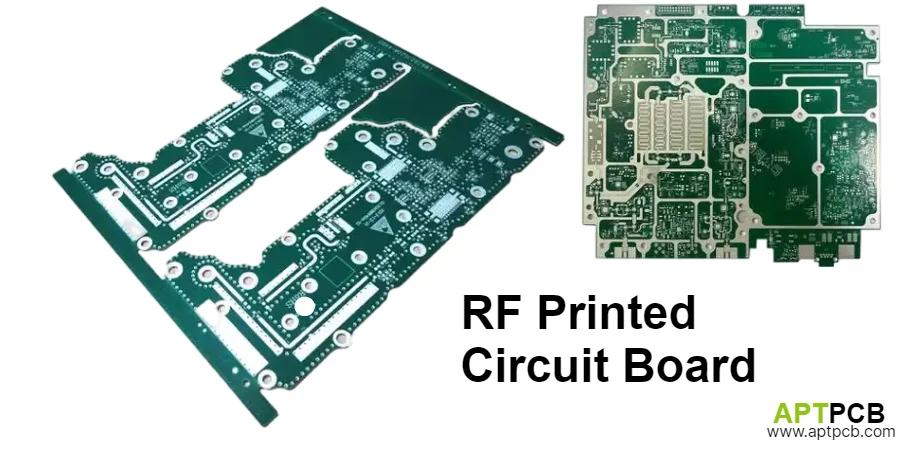
An RF printed circuit board is not simply a platform that connects electronic components. At radio frequencies, the PCB becomes part of the electrical system. Copper traces behave as transmission lines, dielectric materials determine propagation characteristics, and small geometric variations can change impedance, phase, insertion loss, and radiation behavior.
Unlike conventional digital PCB designs, RF PCB performance depends on coordinated decisions across:
- transmission line geometry,
- PCB stackup,
- dielectric properties,
- grounding strategy,
- shielding structure,
- component placement,
- fabrication tolerance,
- RF testing.
This guide explains the engineering decisions required to design and manufacture reliable RF printed circuit boards for wireless communication, IoT, automotive radar, microwave systems, and other high-frequency applications.
What makes an RF printed circuit board different from a standard PCB?
At low frequencies, PCB traces can often be treated as simple conductors. At RF frequencies, electrical wavelength becomes comparable to physical dimensions, causing traces, vias, pads, and connectors to influence circuit behavior.
An RF PCB must control:
- Characteristic impedance to prevent reflections
- Insertion loss to preserve signal power
- Phase response for timing-sensitive systems
- Electromagnetic coupling between circuits
- Return current paths through controlled grounding
Most RF systems use 50Ω transmission lines because RF components such as antennas, amplifiers, filters, and connectors are commonly designed around this impedance standard.
A successful RF PCB design therefore requires both electromagnetic simulation and manufacturing control.
How do RF PCB transmission lines control signal performance?
Every RF trace functions as a transmission line with defined electrical characteristics.
The most common RF transmission structures include:
| Structure | Configuration | Typical Application |
|---|---|---|
| Microstrip | Surface trace with ground plane below | Antennas, wireless modules, general RF routing |
| Stripline | Trace between two ground planes | High-isolation RF paths |
| Coplanar waveguide | Signal trace with adjacent ground regions | RF modules and compact designs |
Characteristic impedance depends on:
- trace width,
- copper thickness,
- dielectric thickness,
- dielectric constant (Dk),
- conductor surface roughness.
For microstrip structures:
Z₀ ≈ f(trace width, dielectric height, copper thickness, Dk)
A small geometry variation can significantly affect RF performance. Maintaining impedance consistency usually requires controlled fabrication processes and stackup verification.
How should RF PCB materials be selected?
Material selection determines signal loss, phase stability, temperature behavior, and production cost.
RF PCB Material Selection Matrix
| Application Frequency | Typical Material Choice | Key Requirement |
|---|---|---|
| Below 3 GHz cost-sensitive RF | FR-4 with controlled stackup | Acceptable loss and availability |
| 3–30 GHz wireless/microwave | Rogers RO4350B or similar low-loss laminates | Stable Dk and low dissipation factor |
| Above 30 GHz/mmWave | Rogers RO5880, PTFE, ceramic-filled materials | Minimum dielectric loss |
| High-power RF | Low-loss laminate with thermal design | Heat spreading and stability |
Important material parameters include:
- Dk (dielectric constant): Controls electrical length and impedance
- Df (dissipation factor): Determines dielectric loss
- Copper roughness: Influences conductor loss at high frequency
- Thermal stability: Maintains performance across temperature changes
Specify exact laminate grade, thickness, and manufacturer-controlled dielectric values rather than relying only on nominal material families.
How does impedance matching affect RF PCB performance?
Impedance mismatch causes reflected energy, reducing transmitted power and creating standing waves.
RF PCB matching strategies include:
Quarter-wave transformers
Quarter-wave sections transform impedance using:
Zin = Z₀² / Zload
For example, transforming a 50Ω system to a 100Ω load requires approximately a 70.7Ω transmission line section.
These structures require:
- accurate electrical length,
- controlled dielectric properties,
- consistent trace geometry.
Stub matching networks
PCB traces can form reactive matching elements:
- open stubs,
- shorted stubs,
- stepped impedance sections.
Their performance depends directly on physical dimensions.
Practical RF matching requirements
| Parameter | Typical Requirement |
|---|---|
| Impedance target | 50Ω common RF standard |
| Impedance tolerance | ±5% for demanding RF designs |
| Trace geometry control | Based on stackup calculation |
| Electrical length control | Required for phase-sensitive circuits |
| Verification | TDR and RF measurement |
How should RF PCB grounding and shielding be designed?
Grounding is one of the most important factors in RF performance.
RF return currents follow the path of least impedance, usually directly beneath the signal trace. Any interruption forces current to travel through a longer path, increasing inductance and radiation.
RF grounding principles
- Maintain continuous reference planes beneath RF traces.
- Prevent RF routes crossing ground-plane splits.
- Place ground vias close to RF component grounds.
- Minimize unnecessary layer transitions.
Via fences create electromagnetic boundaries between RF sections.
Typical design considerations:
- Via spacing ≤ λ/20 at the highest operating frequency
- Dense grounding around shield-can footprints
- Additional isolation between transmitter and receiver sections
Shielding effectiveness depends on:
- enclosure design,
- via density,
- grounding quality,
- frequency range,
- internal compartment layout.
What RF PCB layout decisions improve reliability?
At RF frequencies, every physical feature contributes parasitic effects.
Typical contributors include:
- trace inductance,
- via inductance,
- pad capacitance,
- connector transitions.
A 1 nH parasitic inductance creates approximately:
X = 2πfL
At 1 GHz:
X ≈ 6.3Ω
This demonstrates why short interconnections and optimized grounding are essential.
Recommended RF placement practices include:
- Position RF components close together.
- Place ground vias immediately beside RF ground pads.
- Minimize unnecessary bends and transitions.
- Separate high-power RF outputs from sensitive receiver inputs.
- Provide tuning access for prototype optimization.
What are common RF PCB manufacturing failure modes?
| Failure Mode | Root Cause | Design or Manufacturing Control |
|---|---|---|
| High VSWR | Impedance mismatch | Controlled impedance stackup and TDR verification |
| Excess insertion loss | High-loss laminate or rough copper | Low-loss material selection and copper control |
| Frequency shift | Incorrect dielectric properties | Verified Dk/Df values |
| Poor isolation | Weak grounding or insufficient shielding | Via fences and continuous planes |
| Prototype tuning difficulty | No adjustment provisions | Add tuning pads and measurement points |
| Production variation | Process inconsistency | RF coupons and statistical process control |
How should RF PCB manufacturing be validated?
RF performance must be verified through both fabrication inspection and electrical testing.
Recommended validation includes:
Impedance verification
Use production coupons and TDR measurement to confirm:
- characteristic impedance,
- trace geometry,
- stackup consistency.
RF parameter testing
For critical designs verify:
- insertion loss,
- return loss,
- VSWR,
- S-parameters.
Material verification
Confirm:
- laminate grade,
- dielectric thickness,
- Dk/Df characteristics,
- copper roughness requirements.
Manufacturing review
Before production, confirm:
- trace width capability,
- minimum spacing,
- via structures,
- plating capability,
- surface finish compatibility.
Functional testing capabilities validate complete RF assemblies meet system-level specifications.
For comprehensive manufacturing information, see our guide on high frequency PCB manufacturing.
RF PCB Supplier Qualification Checklist
Before selecting an RF PCB manufacturing partner, evaluate:
| Evaluation Area | Supplier Requirement |
|---|---|
| RF materials | Experience with Rogers, PTFE, and low-loss laminates |
| Impedance control | Documented impedance testing capability |
| Stackup engineering | Ability to optimize dielectric thickness and routing |
| RF inspection | TDR, S-parameter, and coupon testing support |
| Manufacturing tolerance | Proven capability for fine RF geometries |
| Process control | Traceability and production consistency |
A reliable RF PCB supplier should participate during stackup planning rather than only manufacture finalized Gerber files.
Building repeatable RF PCB performance
Reliable RF printed circuit boards are created when electrical design and manufacturing decisions are aligned from the beginning.
The strongest RF designs combine:
- correct material selection,
- controlled impedance structures,
- stable grounding,
- optimized shielding,
- manufacturable tolerances,
- measurable validation methods.
When these elements are managed together, RF PCB production becomes predictable—from first prototype through high-volume manufacturing.