
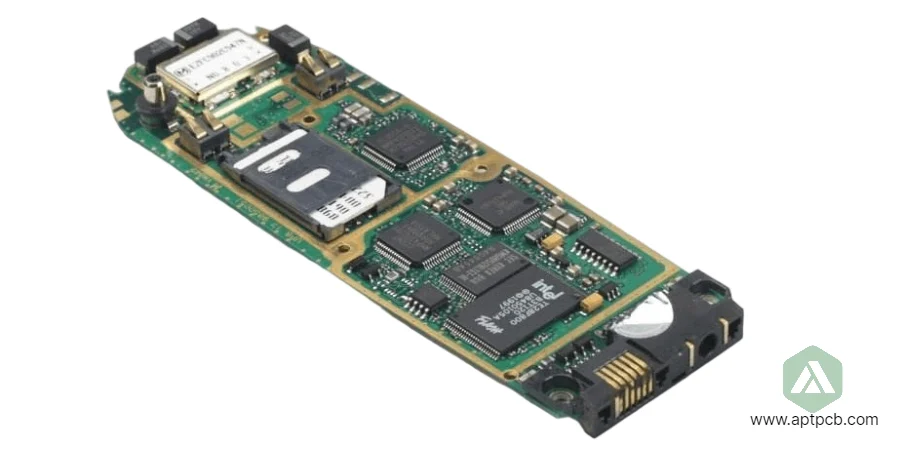
Smartphone PCB assembly is a high-density manufacturing challenge that combines advanced HDI structures, fine-pitch component placement, RF performance control, thermal management, and long-term reliability validation.
A mobile device PCB supplier must support more than SMT placement. Modern smartphone boards integrate:
- Application processors and memory packages.
- 5G, WiFi, Bluetooth, NFC, and GPS RF systems.
- Camera interfaces and high-speed digital links.
- Power management circuits.
- Battery charging and protection systems.
- Thermal solutions inside extremely limited mechanical space.
Selecting the right smartphone PCB assembly partner requires evaluating engineering capability, manufacturing controls, inspection coverage, and production readiness.
APTPCB provides smartphone PCB assembly services using HDI manufacturing approaches, high-speed signal routing practices, and testing processes including box build assembly integration.
What should you evaluate when selecting a smartphone PCB assembly supplier?
The most important supplier decisions involve five technical areas:
- HDI manufacturing capability — Can the supplier support required layer counts, microvias, fine traces, and thin board structures?
- RF manufacturing control — Can the supplier maintain impedance, shielding, and antenna-related performance?
- Thermal reliability — Can the assembly manage heat generated by processors and power systems?
- Inspection and testing — Can hidden solder joints, electrical connections, and functional requirements be verified?
- Production scalability — Can the supplier transition from prototypes to stable mass production?
The following selection matrix helps match smartphone requirements with supplier evidence.
| Design requirement | Manufacturing challenge | Required capability | Evidence to request |
|---|---|---|---|
| Ultra-thin mobile PCB | Routing density and warpage control | HDI stackup, sequential lamination, microvia processing | Stackup documents, DFM review, reliability records |
| Processor and memory packages | Hidden solder defects and thermal stress | Fine-pitch SMT, via-in-pad, X-ray inspection | X-ray reports, process validation data |
| 5G and wireless systems | Signal loss and EMI interference | Controlled impedance routing and RF validation | Impedance reports, RF test results |
| High-performance processors | Local heat concentration | Copper planes, thermal interfaces, heat spreading design | Thermal analysis and validation results |
| Long product lifecycle | Mechanical and environmental stress | Reliability testing and traceability | Test reports and production records |
How does HDI technology support smartphone PCB assembly?
Smartphones require high wiring density because semiconductor packages continue to increase functionality while device thickness decreases.
Typical smartphone HDI assemblies may include:
- 8-16 layer PCB structures.
- Two to three build-up layers per side.
- Laser-drilled microvias.
- Via-in-pad technology.
- Fine traces around 50-75μm.
- Fine-pitch BGAs around 0.35mm pitch.
- 01005 passive components.
HDI allows designers to route dense processor, memory, camera, and RF connections inside compact board dimensions.
Which HDI features matter most for mobile device reliability?
Key HDI manufacturing capabilities include:
- Any-layer HDI construction: Supports dense routing for advanced processor and memory packages.
- Via-in-pad technology: Reduces routing limitations by placing microvias directly within component pads.
- Sequential lamination: Enables complex multilayer structures with reliable build-up layers.
- Fine-pitch SMT assembly: Supports compact semiconductor packages.
- Microvia inspection: Verifies critical interconnect structures.
HDI reliability depends on controlled fabrication processes, including laser drilling accuracy, copper filling quality, layer registration, and thermal cycling performance.
For electrical validation and debugging support, production programs may require ICT test and flying probe testing depending on board complexity and volume.
How should smartphone PCB suppliers handle RF and 5G requirements?
Smartphone RF performance depends on PCB materials, routing geometry, grounding strategy, shielding, and assembly consistency.
Wireless systems commonly include:
- 5G sub-6GHz communication.
- 5G mmWave designs.
- LTE cellular.
- WiFi 6E/7.
- Bluetooth.
- NFC and GPS.
RF sections require controlled electrical characteristics throughout manufacturing.
| RF requirement | Manufacturing consideration | Validation method |
|---|---|---|
| 50Ω RF transmission lines | Controlled trace width, dielectric selection, impedance control | Impedance measurement |
| High-speed differential signals | Length matching and return-path control | Signal integrity testing |
| EMI control | Ground planes and shielding structures | EMI validation |
| Antenna performance | Matching networks and assembly accuracy | TRP/TIS testing |
For high-frequency designs, suppliers should provide material information, stackup data, impedance measurements, and RF validation results before production release.
How is thermal management handled in smartphone PCB assembly?
Modern mobile processors create significant thermal challenges because computing performance continues increasing while enclosure size remains limited.
Thermal design must address:
- Processor heat generation.
- Power management losses.
- Battery temperature exposure.
- User surface temperature limits.
- Long-term component reliability.
Common thermal solutions include:
- Copper thermal planes.
- Graphite heat spreaders.
- Thermal interface materials.
- Vapor chambers.
- Thermal-aware component placement.
High-performance mobile systems may generate approximately 5-8W of processor heat depending on workload and design. Thermal validation should combine PCB analysis with mechanical enclosure testing because assembly inspection alone cannot verify final thermal behavior.
What inspection methods should smartphone PCB assembly suppliers provide?
Smartphone boards contain components and interconnects that cannot always be verified through visual inspection.
A qualified supplier should define inspection coverage before mass production.
| Failure mode | Cause | Manufacturing control | Verification evidence |
|---|---|---|---|
| BGA solder failure | Hidden solder defects or thermal cycling stress | Optimized reflow process and X-ray inspection | 2D/3D X-ray records |
| RF performance loss | Impedance variation or EMI problems | Controlled routing and shielding | RF measurement data |
| Component placement defects | Fine-pitch assembly errors | SPI and AOI inspection | Inspection reports |
| Microvia reliability failure | Poor filling or registration | HDI process control | Reliability testing |
| Field reliability problems | Environmental and mechanical stress | Qualification testing | Test documentation |
Additional inspection processes may include SPI inspection and quality inspection procedures.
Which reliability tests are important for smartphone PCB programs?
Smartphone assemblies must survive repeated thermal, mechanical, and environmental stress throughout product life.
Typical validation programs may include:
Electrical testing
- Functional testing.
- RF performance verification.
- Charging and power-management validation.
- High-speed interface testing.
Environmental and mechanical validation
- Temperature cycling from approximately -20 to +60°C when required.
- Thermal shock testing.
- Drop testing from approximately 1.2-1.8m when applicable.
- Product-specific environmental testing.
Reliability planning should begin during supplier qualification rather than after production problems appear.
What should buyers request during smartphone PCB supplier qualification?
Before approving a supplier, request documentation matching the product development stage.
Smartphone PCB supplier qualification checklist
| Supplier capability | Qualification question |
|---|---|
| HDI manufacturing | Can the supplier support required layer count, microvia structures, and stackup requirements? |
| SMT capability | Can production equipment handle fine-pitch BGAs and 01005 components? |
| RF support | Can the supplier provide impedance and RF validation results? |
| Inspection coverage | Are SPI, AOI, X-ray, ICT, and flying probe options available? |
| NPI capability | Is engineering support available before mass production? |
| Change control | Are revisions and process changes traceable? |
| Reliability support | Are qualification reports available? |
For an RFQ, provide:
- PCB design files.
- BOM and approved component information.
- Assembly drawings.
- Stackup requirements.
- Testing requirements.
- Production volume.
- Expected lifecycle.
How does smartphone PCB assembly move from prototype to mass production?
Mobile device programs require controlled transitions between engineering builds and production manufacturing.
A capable supplier supports:
NPI stage
- DFM and DFA review.
- Prototype assembly.
- Process optimization.
- First article validation.
Production stage
- Stable SMT processes.
- Statistical process control.
- Component supply management.
- Engineering change management.
- Production traceability.
The supplier should maintain consistent quality while supporting design updates, component substitutions, and increasing production volume.
FAQ: Smartphone PCB Assembly Service
What PCB technology is used in smartphones?
Most advanced smartphones use multilayer HDI PCB structures with microvias, fine routing, and dense component placement.
Why is X-ray inspection required for smartphone boards?
Processor and memory packages often contain hidden solder connections. X-ray inspection verifies solder quality that cannot be confirmed visually.
Can smartphone PCB assembly support 5G designs?
Yes. Successful 5G assembly requires controlled impedance, RF-aware layout, appropriate materials, shielding, and validation testing.
What information is required for a smartphone PCB assembly quote?
Suppliers typically require PCB files, BOM data, assembly drawings, testing requirements, quantity, and production schedule information.
How should companies reduce smartphone PCB manufacturing risk?
The most effective approach is qualifying suppliers using measurable evidence: manufacturing capability, inspection coverage, reliability testing, and production documentation.
Conclusion: Choosing the right smartphone PCB assembly partner
Smartphone PCB assembly requires coordinated control of HDI fabrication, SMT precision, RF performance, thermal design, inspection, and reliability validation.
The strongest manufacturing partners provide more than component placement. They provide engineering collaboration, measurable process data, inspection records, and a controlled path from prototype development to high-volume production.