
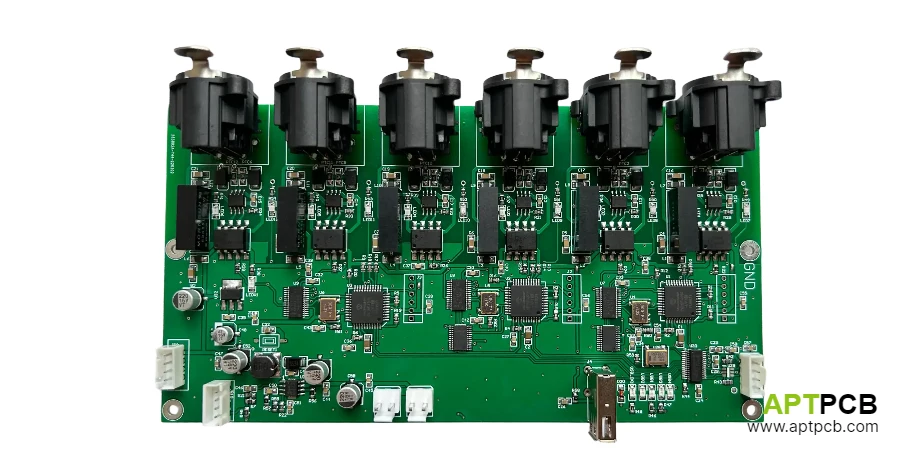
Game consoles represent the intersection of PC-class computing performance with consumer electronics cost and reliability requirements. Custom APUs integrating CPU and GPU cores demand high-bandwidth GDDR memory interfaces, substantial power delivery systems exceeding 200W, and thermal solutions that maintain performance during hours of sustained gaming. The PCB design must achieve workstation-level electrical performance while meeting consumer electronics manufacturing cost targets.
This guide examines the PCB challenges specific to game console design: implementing custom APU packages with extreme pin counts, GDDR6 memory interfaces operating at 14-18 Gbps, NVMe storage interfaces for fast loading, power delivery for high-TDP processors, and thermal management enabling sustained performance in compact enclosures.
In This Guide
- Custom APU Implementation and BGA Routing
- GDDR6 Memory Interface Design
- High-Speed Storage and Peripheral Interfaces
- Power Delivery for High-TDP Systems
- Thermal Management for Sustained Gaming
- Manufacturing and Reliability Requirements
Custom APU Implementation and BGA Routing
Console APUs from AMD integrate 8+ CPU cores, powerful GPU compute units, and various I/O functions into massive BGA packages exceeding 1500 pins. These custom silicon designs push PCB capabilities—fine pitch (typically 0.65-0.8mm), high pin count, and diverse signal types (high-speed memory, PCIe, USB, low-speed control) all emanating from a single package.
Successful APU routing requires careful layer stack planning, via strategy for signal escape, and power delivery integration. The routing density around APU packages often determines overall board layer count, with current consoles typically requiring 10-14 layer constructions.
APU Routing Strategies
- Package Analysis: Characterize all APU signals by type (high-speed differential, single-ended high-speed, low-speed, power); group routing by requirements.
- Escape Routing: Inner pins require via escape through outer pin field; plan via locations to avoid blocking adjacent signal routing.
- Layer Assignment: Dedicate specific layers to memory interface, others to PCIe, others to low-speed; prevents crossing incompatible signal types.
- Power/Ground Planning: APU has dozens of power and ground pins; via arrays to internal power/ground planes must not block signal escape.
- Reference Plane Integrity: High-speed signals need uninterrupted reference; plan routing to avoid crossing plane splits or via fields.
- Decoupling Placement: Ceramic capacitors distributed around APU periphery; placement competes with signal routing for board area.
APU implementation represents the most challenging aspect of console PCB design—success requires HDI PCB fabrication capabilities for the resulting complex multilayer boards.
GDDR6 Memory Interface Design
Console GDDR6 interfaces operate at 14-18 Gbps per pin, with 256-bit or 384-bit bus widths creating aggregate bandwidths exceeding 500 GB/s. These speeds demand meticulous attention to signal integrity and high-speed PCB design—trace impedance, length matching, crosstalk, and via optimization all significantly impact achievable data rates.
Unlike DDR4 point-to-point topologies, GDDR6 uses multiple memory devices connected through careful topology planning. The interface operates without DQS strobes used in DDR4; instead, data is clocked by synchronized clock forwarding, requiring precise skew control between clock and data.
GDDR6 Routing Requirements
- Impedance Targets: Single-ended signals typically 40-50Ω; verify against APU and GDDR6 device specifications—tolerance ±10% typical.
- Length Matching: Clock-to-data skew critical; match data signals to associated clock within 2-3mm; match across data groups to prevent timing variation.
- Crosstalk Mitigation: Adjacent data lines couple at 14+ Gbps; maintain 3× spacing or interleave ground traces between signals.
- Via Optimization: Every via adds impedance discontinuity and loss; minimize layer transitions, use back-to-back vias when transitions necessary.
- Power Integrity: GDDR6 supplies require clean, low-impedance delivery; local decoupling at each memory IC plus bulk at converter output.
- Thermal Consideration: GDDR6 devices dissipate significant power (several watts each); copper fills and thermal vias assist heat spreading.
GDDR6 interface design benefits from signal integrity simulation to verify timing margins before fabrication—the high speeds leave minimal margin for design error.
High-Speed Storage and Peripheral Interfaces
Modern consoles feature custom NVMe storage solutions delivering 5-10 GB/s read speeds—enabled by PCIe Gen4 x4 interfaces with proprietary compression acceleration. The PCB must route these high-speed interfaces from APU to custom storage controllers or directly to flash storage, maintaining signal integrity at 16 GT/s per lane.
Beyond storage, consoles require numerous peripheral interfaces: HDMI 2.1 for 4K120 or 8K60 output, USB 3.x for controllers and peripherals, Ethernet for networking, and optical audio. Each interface has specific routing requirements that must coexist on the same board.
Interface Implementation
- PCIe Gen4 Routing: 16 GT/s requires low-loss materials for traces exceeding 100mm; differential impedance 85Ω typical; adequate via-to-via and via-to-trace spacing.
- HDMI 2.1 Requirements: 12 Gbps per lane supporting 48 Gbps aggregate; similar loss sensitivity to PCIe—keep traces short or use enhanced materials.
- USB 3.x Routing: USB 3.2 Gen2 at 10 Gbps manageable with standard practices; Type-C adds signal multiplexing complexity.
- Ethernet Interface: Gigabit or 2.5G Ethernet uses magnetics at connector; differential routing from PHY to magnetics with appropriate impedance.
- Connector Placement: Rear I/O connector placement drives board outline and routing lengths; optimize placement for shortest high-speed paths.
- ESD Protection: All external interfaces require ESD protection; protection device placement at connector with short paths to ground.
Multiple high-speed interfaces create routing congestion—layer count and stackup planning must accommodate all interfaces without compromise.
Power Delivery for High-TDP Systems
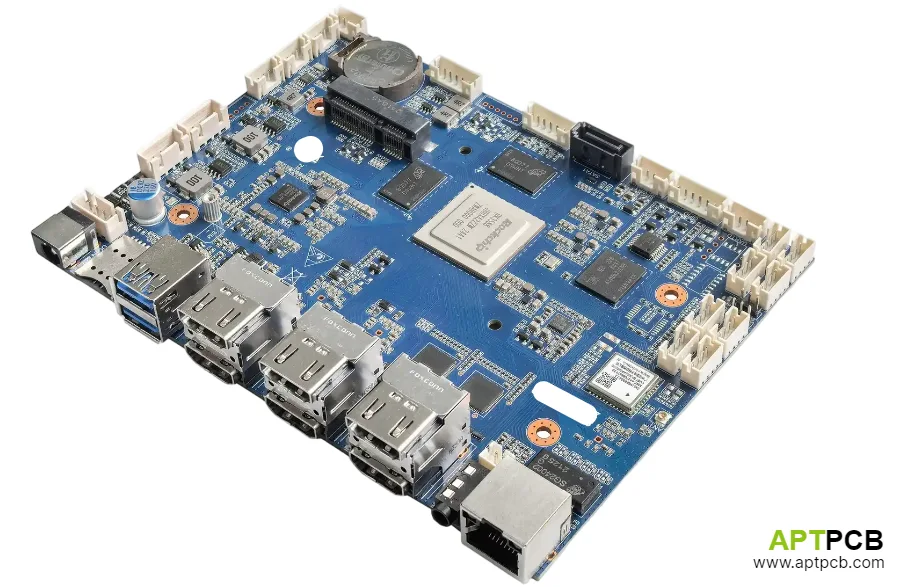
Console APUs operate at 150-200W+ TDP during gaming, requiring power delivery systems rivaling high-end desktop PCs. Multi-phase VRM designs (8-12 phases for core voltage) convert 12V input to sub-1V core voltage at currents exceeding 200A during transient loads. The PCB power delivery network must minimize inductance and resistance between VRM output and APU power pins.
Power delivery efficiency directly affects thermal design—every percent of efficiency loss at 200W becomes 2W of additional heat. The PCB contribution includes both resistive losses in traces/planes and inductance affecting transient response.
Power Delivery Design
- Phase Count: Multi-phase interleaved converters reduce output ripple and distribute thermal load; 8-12 phases typical for console APUs.
- VRM Placement: Power stage components as close to APU as thermal constraints permit; shorter delivery paths reduce parasitic inductance.
- Copper Weight: 2oz minimum on power layers; 3oz or 4oz where layer count and cost permit—current density determines temperature rise.
- Plane Design: Solid VCORE plane beneath and around APU; minimize via penetrations in power delivery area.
- Decoupling Network: Bulk capacitors (polymer/ceramic, 100s of μF) near VRM output; high-frequency ceramics (100nF-10μF) distributed around APU.
- Current Sensing: Accurate current sensing for power monitoring and protection; DCR sensing common for efficiency.
Console power delivery requires heavy copper PCB techniques to handle sustained high currents without excessive voltage drop or temperature rise.
Thermal Management for Sustained Gaming
Unlike PCs where users often accept fan noise for cooling, console thermal designs must balance cooling performance against acoustic requirements. The thermal solution must dissipate 150-200W continuously during demanding games while maintaining acceptable noise levels in living room environments.
The PCB serves as a critical element in the thermal chain—heat from APU and VRM transfers through board to heat spreaders and ultimately to heat pipes or vapor chambers. Board-level thermal design determines how effectively heat reaches the primary cooling system.
Thermal Management Approach
- Thermal Via Arrays: Dense arrays beneath APU (0.3mm drill, 0.5mm pitch) conduct heat to bottom surface; filled vias maximize thermal conductivity.
- Copper Pour Maximization: All available copper area on inner layers contributes to heat spreading; design rules should maximize pour coverage.
- Heat Spreader Interface: APU package typically contacts metal spreader through TIM; PCB bottom may contact chassis for additional heat path.
- VRM Thermal Design: Power stage components generate significant heat; thermal vias and copper pours provide heat path to enclosure.
- Component Placement: Spread heat-generating components across board area; avoid clustering that creates thermal interaction.
- Airflow Consideration: Fan placement in console determines airflow across board; orient components to benefit from airflow path.
Thermal performance directly affects sustained gaming capability—insufficient cooling causes throttling that impacts game performance during extended sessions.
Manufacturing and Reliability Requirements
Console manufacturing combines PC-class board complexity with consumer electronics volumes—millions of units annually with cost targets requiring manufacturing optimization. Quality requirements exceed typical consumer products given the expectation of years of reliable operation under demanding thermal and power conditions.
The complex multilayer PCBs with fine-pitch components require advanced manufacturing capabilities, yet cost pressure demands efficiency. This balance drives supplier selection and design optimization decisions.
Manufacturing Considerations
- Layer Count Management: 10-14 layers typical; each additional layer pair adds cost—optimize routing to minimize layers while meeting performance.
- HDI Decisions: Microvias may be required for APU fanout; evaluate cost impact versus through-hole alternatives.
- Material Selection: Standard FR-4 where possible; enhanced materials only for critical high-speed sections to control cost.
- Panel Optimization: Large console boards have limited panel utilization; panel design optimization reduces waste.
- Test Strategy: Complex boards require comprehensive testing; flying probe or ICT for electrical, functional test for operation verification.
- Reliability Standards: Thermal cycling, HALT/HASS testing during qualification; ongoing production monitoring maintains quality.
Console programs represent significant manufacturing volumes justifying mass production optimization investments that reduce per-unit costs while maintaining quality.
Technical Summary
Game console PCB design challenges approach workstation complexity while meeting consumer electronics cost and reliability targets. The custom APU with high-pin-count BGA, ultra-high-speed GDDR6 memory, and substantial power delivery requirements combine to create demanding board designs that push manufacturing capabilities.
Key success factors include APU routing strategy (layer allocation and escape routing), GDDR6 signal integrity (impedance control and length matching), power delivery adequacy (current capacity and transient response), and thermal design (heat extraction enabling sustained performance).
Manufacturing partnerships must balance advanced capability (complex multilayer, fine-pitch assembly) against cost competitiveness and quality systems adequate for high-reliability consumer electronics.
If you’re evaluating a console PCB build, start with our PCB manufacturing capabilities and then map stack-up, HDI needs, and test strategy to your performance targets.