Design Best Practices
Impedance Control Design Guidelines
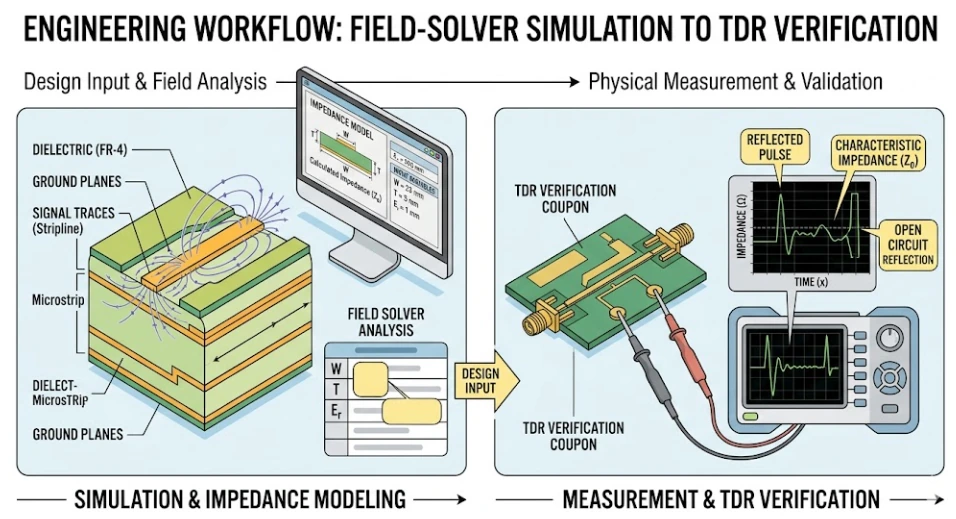
Successful impedance control starts at the schematic and layout stage — long before the board reaches the factory. Engineers should define impedance targets for each signal class in their constraint manager and communicate these requirements clearly on the fabrication drawing. A well-documented impedance table listing the layer, structure type, target value, tolerance, and trace width/spacing intent prevents ambiguity and reduces DFM iterations.
Trace Routing Practices
Maintain consistent trace width along the entire impedance-controlled net. Avoid necking down differential pairs at via transitions unless absolutely necessary, and when you must, keep the necked region as short as possible (ideally under 50 mil). Route differential pairs with matched length within ±5 mil per pair, and maintain at least 3× the trace width as clearance from adjacent signals to minimize crosstalk coupling.
Reference Plane Integrity
Every impedance-controlled trace needs a continuous, unbroken reference plane directly adjacent. Splits, slots, or excessive via anti-pads in the reference plane create impedance discontinuities that no amount of trace-width tuning can fix. When a signal must cross a plane split, bridge it with stitching capacitors and accept that impedance will be degraded in that region. For multilayer stack-ups, dedicate full planes to ground rather than splitting power and ground on the same layer.
Via Transitions
Through-hole vias introduce a capacitive discontinuity in impedance-controlled paths. For signals above 10 Gbps, use back-drilled vias or blind/buried microvias to eliminate the via stub. Place ground vias adjacent to signal vias (within 10 mil) to maintain the return-current path. In differential pairs, keep via-to-via spacing identical to the trace-to-trace spacing to preserve the differential impedance through the transition.
Documentation for Your Fabricator
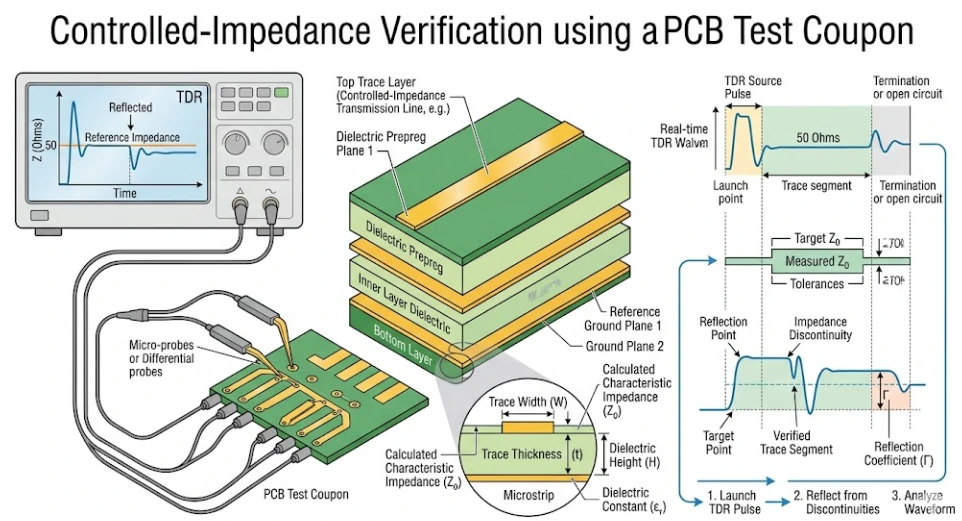
Include a clear impedance control table on your fab drawing specifying: layer number, structure type (microstrip/stripline/CPWG), single-ended or differential, target impedance in Ohms, tolerance (±5/8/10%), and reference layer. Also note any layers where solder mask should be opened over impedance traces. This documentation enables our CAM team to run accurate simulations and propose trace-width adjustments before production — reducing your time to first-article approval.