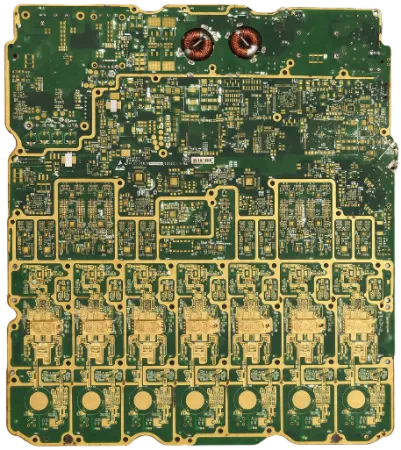
APTPCB high layer count PCB manufacturing samples

High Layer Count PCB Manufacturing

Complex Multilayer PCBs Up to 64 Layers

From 12-layer HDI boards to 64-layer backplanes for AI servers and 5G infrastructure — precision lamination, advanced via technology, and ±5% impedance control for mission-critical electronics.

Get an Instant Quote

64LMax Layer Count
±5%TDR Impedance
20:1Max Aspect Ratio
99.2%First-Pass Yield
10.0 mmMax Board Thickness
≤15 μmRegistration Accuracy
±0.15 mmBackdrill Tolerance
2/2 milMin Trace / Space
0.075 mmMin Laser Drill
<24 hDFM Turnaround
64LMax Layer Count
±5%TDR Impedance
20:1Max Aspect Ratio
99.2%First-Pass Yield
10.0 mmMax Board Thickness
≤15 μmRegistration Accuracy
±0.15 mmBackdrill Tolerance
2/2 milMin Trace / Space
0.075 mmMin Laser Drill
<24 hDFM Turnaround

Pain Points We Solve

Solving the Toughest High-Layer PCB Manufacturing Challenges

As layer counts grow beyond 16, complexity increases exponentially. Each additional layer introduces tighter tolerances, more process steps, and greater cumulative defect risk.

CHALLENGE 01

Delamination & Resin Voids

Multiple lamination cycles demand precise resin flow control. Inadequate pressure uniformity or incorrect thermal profiles cause micro-delamination and internal voids that only surface during assembly reflow.

Dynamic vacuum press + optimized prepreg
CHALLENGE 02

Layer-to-Layer Misregistration

A single 25μm misalignment cascades to over 100μm cumulative error in 30+ layer stacks — enough to break BGA connections or create shorts across adjacent layers.

CCD optical + X-ray alignment ≤15μm
CHALLENGE 03

Signal Loss from Via Stubs

Through-hole vias create unterminated stubs generating reflections, insertion loss, and impedance discontinuities — devastating for 25Gbps+ serial links.

Precision backdrilling ±0.15mm depth
CHALLENGE 04

High Aspect Ratio Plating Defects

Deep vias in thick boards (ratios above 10:1) suffer uneven copper deposition — thin plating at barrel center leads to micro-cracks and thermal cycling failures.

PPR pulse plating + X-ray verification
CHALLENGE 05 — 06

Board Warpage & Impedance Instability

Asymmetric copper distribution creates internal stress causing severe warpage. Meanwhile, dielectric thickness variations across dozens of layers make impedance control extremely difficult — especially in hybrid material stackups.

Symmetrical stackup engineering100% TDR verification per panel
High layer count high-frequency PCB

The Expertise Behind Complex Multilayer PCBs

Reliable high layer count manufacturing demands deep process knowledge, material mastery, and an engineering-first culture.

Senior Engineering Team — 15+ Years

Every project gets a dedicated engineer who reviews stackup, impedance, and DFM challenges. A direct engineering partner, not a ticket number.

Advanced Lamination Mastery

Dynamic temperature-profiling vacuum presses with multi-zone control enable flawless lamination of 64-layer stacks with mixed-dielectric materials.

State-of-the-Art Registration

CCD optical alignment, laser direct imaging, and X-ray target drilling achieve ≤15μm layer-to-layer registration for dense BGA breakout.

Deep Premium Material Inventory

Ready stock of Megtron 6/7, Isola Tachyon, Rogers RF laminates, and high-Tg FR4 — no material lead time delays.

99.2% First-Pass Yield

Strict in-process controls from inner layer AOI through microsection analysis catch defects early. Yield on 20+ layer boards exceeds benchmarks.

NPI to Volume — One Source

Prototypes through production on the same qualified line with identical process parameters. Zero re-qualification surprises.

Advanced Manufacturing Technologies

Cutting-edge fabrication techniques validated across thousands of complex production lots.

PCB backdrilling microsection with μm measurements

Signal Integrity

Controlled Depth Backdrilling

Through-hole vias in thick boards create unused stubs below the target signal layer. These stubs generate reflections, increase insertion loss, and degrade eye diagrams. Backdrilling surgically removes them.

  • Minimizes signal attenuation and EMI
  • Depth tolerance controlled within ±0.15mm
  • Critical for 10Gbps+ to 112G PAM4 designs
  • Reduces insertion loss by up to 3dB at 20GHz
24-layer PCB cross-section with blind and buried vias

High-Density Interconnect

VIPPO (Via-in-Pad Plated Over)

For fine-pitch BGAs below 0.8mm, VIPPO places vias directly under pads, fills them with specialized resin, and plates flat with copper — maximizing routing density.

  • Direct BGA-to-inner-layer connections
  • Prevents solder wicking during reflow
  • Excellent thermal dissipation paths
  • Meets IPC-4761 Type VII fill requirements
Complex high layer count PCB with HDI structure

Complex Architectures

Sequential Lamination & Any-Layer HDI

Multiple controlled lamination cycles build complex architectures with laser-drilled microvias, increasing routing density by over 40% versus conventional designs.

  • 3+N+3 to any-layer HDI structures
  • Laser-drilled microvias down to 0.075mm
  • Stacked and staggered microvia configurations
  • Precise dielectric control across all press cycles

Material Expertise

Premium Material Mastery

Stable Dk/Df characteristics, multiple lamination cycle survivability, and lead-free reflow compatibility.

High-speed server PCB
Ultra-Low Loss

High-Speed Digital

For 25G/56G/112G serial links, AI accelerator boards, and data center switch fabrics.

Megtron 4Megtron 6Megtron 7Tachyon 100GI-SpeedTU-872 SLK
RF microwave PCB
RF & Microwave

RF & Hybrid Laminates

Mixed-dielectric stackups combining PTFE-based RF laminates with FR4 for balanced performance.

Rogers 4350BRogers 4003CRogers 3003Taconic TLYArlon 25N
High-Tg reliability PCB
High-Tg / Reliability

Extreme Environment

High-Tg substrates resist Z-axis expansion through multiple reflow cycles and harsh conditions.

Isola 370HRS1000-2MIT180AEM-827Tg 170–210°C

Quality Verification

Uncompromising Quality Control for Mission-Critical Reliability

IPC Class 3 compliant quality laboratory validates every board before shipment.

Microsection Analysis

Cross-sectioning validates copper thickness, registration, dielectric integrity, and catches hidden voids in via barrels.

TDR Impedance Testing

Tektronix/Polar TDR equipment verifies every impedance net meets ±5% tolerance with full documentation.

IST & Thermal Reliability

Interconnect Stress Testing subjects vias to hundreds of thermal cycles simulating years of operation.

Inner Layer AOI

High-resolution optical inspection catches trace defects on every inner layer before lamination.

X-Ray Inspection

Automated X-ray verifies via registration and buried via alignment on completed boards.

100% Electrical Test

Every board undergoes full netlist connectivity and isolation testing — flying probe or fixture-based.

Technical Capabilities

ParameterAPTPCB Capability
Maximum Layer CountUp to 64 Layers
Maximum Board ThicknessUp to 10.0mm
Impedance Control±5% (TDR Verified)
Maximum Aspect Ratio20:1 (Pulse Plating)
Min Trace / Space2/2 mil (50/50 μm)
Min Mechanical Drill0.15mm (6mil)
Min Laser Drill0.075mm (3mil)
HDI Structures3+N+3 to Any-Layer
Backdrilling Tolerance±0.15mm
Advanced FeaturesVIPPO, Backdrilling, Blind/Buried Vias, Edge Plating, Cavity
Surface FinishesENIG, ENEPIG, OSP, Immersion Tin/Silver, Hard Gold
Quality StandardsIPC Class 3, IPC-6012, IATF 16949, ISO 9001

Industries Served

Where Our High-Layer PCBs Excel

Trusted by engineering teams worldwide to power the most demanding electronic systems.

AI Servers & Data Centers

Backplanes, GPU accelerator modules, and switch fabrics with 112G PAM4 channels across 32–64 layer boards.

5G & Telecommunications

Optical transceivers, core routers, and mmWave modules with hybrid Rogers/FR4 stackups.

Aerospace & Defense

Avionics, phased array radar, satellite comms built to IPC Class 3 and AS9100 standards.

Medical Electronics

High-density imaging systems where miniaturization and long-term reliability are critical.

Industrial Automation

Motion controllers, industrial networking, and vision systems requiring rugged multilayer boards.

High-Performance Computing

Supercomputer interconnects, FPGA boards, and test equipment demanding maximum routing density.

End-to-End Support

Engineering Partnership, Not Just Manufacturing

Pre-Production

Free DFM Review & Stackup Optimization

Senior CAM engineers analyze your Gerber data, optimize stackups, calculate impedance models using field-solver simulation, and recommend material alternatives — all before production begins.

Production & Delivery

100% Quality Documentation & Traceability

Every board ships with complete electrical test reports, impedance data, and full material traceability. Microsection photos on request. 99.2% first-pass yield means zero costly re-spins.

Technical Guide

High Layer Count PCB Design & Manufacturing Guide

What Defines a High Layer Count PCB?

In the PCB industry, boards with 16 or more conductive layers are classified as high layer count PCBs. Advanced applications in AI computing, telecom infrastructure, aerospace avionics, and high-performance networking frequently require 24, 32, or even 64 layers to accommodate dense routing requirements of modern processors, FPGAs, and ASICs.

The fundamental driver is routing density. Modern BGA packages contain thousands of pins at pitches below 0.8mm, each requiring signal, power, and ground connections. When a processor needs 2,000+ nets routed, the only way to achieve this within acceptable dimensions is to add routing layers. Additional layers also provide dedicated ground and power planes for signal integrity, EMI reduction, and controlled impedance.

Critical Manufacturing Challenges

Lamination Process Control

Lamination complexity escalates dramatically with layer count. Each cycle bonds cores and prepreg under controlled temperature and pressure. For 64-layer boards requiring sequential lamination, outermost layers undergo four or more press cycles — each introducing cumulative stress that can cause dimensional shifts, resin flow irregularities, and delamination.

Success depends on precisely matching prepreg resin content to copper density, carefully profiling temperature ramp rates, and calibrating pressure zones for consistent dielectric thickness across the full panel.

Layer Registration Accuracy

IPC-A-600 Class 3 allows 50μm registration error per layer, but in 30+ layer stacks, small deviations accumulate into total misregistration exceeding annular ring tolerances. Inner layer cores expand and contract during lamination based on copper density, glass weave orientation, and moisture content. Solutions include CCD optical alignment, pin-less lamination, and X-ray target drilling referencing internal marks.

Via Formation and Plating

Complex designs require through vias, blind vias, buried vias, and laser-drilled microvias. A 6.0mm board with 0.3mm holes produces 20:1 aspect ratio, making uniform copper plating extremely difficult. PPR pulse plating promotes more uniform deposition, but void-free plating at extreme ratios remains demanding.

Thermal Management

During reflow at 250°C+, differential expansion between copper (17 ppm/°C) and FR4 (60–70 ppm/°C Z-axis) creates enormous stress on via barrels — the primary cause of barrel cracking. Mitigation requires high-Tg substrates with low Z-axis CTE, reinforced glass weave, and filled via structures.

Stackup Design Principles

Symmetry and Copper Balance

The fundamental principle is symmetry about the center plane. Asymmetric stackups create unbalanced stress causing bow or twist. Copper balancing often requires non-functional fill patterns to equalize density across all layers.

Signal Integrity Planning

Each signal layer must reference an adjacent ground or power plane. Differential pairs for 112G PAM4 links require 85Ω or 100Ω ±5% impedance, demanding precise trace width, spacing, and dielectric control.

Hybrid Material Integration

Many designs combine Megtron 6 for high-speed signals with standard FR4 for power distribution. This optimizes cost but introduces complexity from different CTE values and lamination requirements. APTPCB has extensive experience qualifying hybrid stackups across all major material families.

DFM — The Key to Success

Design for Manufacturing review is essential. Issues tolerable in a 4-layer board become critical at 32 or 64 layers. APTPCB's DFM process includes stackup feasibility analysis, impedance modeling, drill aspect ratio verification, registration tolerance analysis, copper balance evaluation, and material assessment.

Frequently Asked Questions

Answers to the questions we hear most from hardware teams.

My 32-layer backplane design uses a mix of Megtron 6 and standard FR4. What lamination risks should I expect?

Hybrid stackups introduce CTE mismatch between the Megtron layers (CTE ~12 ppm/°C X/Y) and FR4 (CTE ~14–16 ppm/°C). During multiple lamination cycles, this differential creates internal stress at material boundaries that can cause micro-delamination or impedance drift. APTPCB mitigates this by selecting prepreg bonding layers with intermediate CTE properties, optimizing press cycle ramp rates per material zone, and performing post-lamination thermal stress testing (IST) to verify interface integrity before proceeding to drilling.

At what layer count does sequential lamination become necessary, and how does it affect my design rules?

Sequential lamination is typically required once you exceed ~20 layers with blind/buried via structures, or when HDI microvias are needed. Each additional lamination sub-cycle tightens your registration budget — APTPCB allocates ≤15μm per layer registration, but cumulative error across 3–4 sequential presses means your annular ring design must account for 60–80μm total potential shift. We recommend a minimum annular ring of 100μm (4mil) for sequentially laminated boards, and we run X-ray alignment verification after each press cycle to catch drift before it propagates.

I'm designing 56G PAM4 channels on a 28-layer board. When should I specify backdrilling versus blind vias to manage stub length?

For 56G PAM4 (28 GHz Nyquist), via stubs longer than ~10mil (~254μm) begin to create measurable resonance and insertion loss degradation. If your signal transitions from an outer layer to an inner layer within the top third of the stackup, backdrilling (with our ±150μm depth tolerance) is typically sufficient and more cost-effective. However, if the signal route requires mid-stack layer transitions or the board exceeds 5mm thickness, blind vias or sequential build structures eliminate stubs entirely and are the better engineering choice — though at higher cost and longer lead time. We recommend providing your channel simulation data so our SI engineers can advise on the optimal approach for your specific loss budget.

Our 48-layer server board failed thermal cycling at the assembly house — barrel cracks in high-aspect-ratio vias. What should we change?

Barrel cracking in thick boards (typically >4mm with aspect ratios above 12:1) is caused by Z-axis CTE mismatch during reflow. Three actionable changes: First, switch to a high-Tg, low-CTE material (e.g., Isola 370HR with Tg 180°C and Z-CTE < 3.0% at 260°C) instead of standard FR4. Second, specify via fill (VIPPO) for critical through-vias — the cured resin plug mechanically reinforces the barrel against expansion. Third, work with your assembly partner to optimize the reflow profile — slower ramp rates above 200°C reduce thermal shock on high-aspect vias. APTPCB validates via reliability using IST testing to 500+ cycles before shipment on boards with aspect ratios above 15:1.

How does APTPCB handle impedance control consistency when dielectric thickness varies between inner and outer layer lamination cycles?

Dielectric thickness in sequentially laminated boards is affected by copper density (resin displacement), prepreg resin content, and press pressure. We address this in three steps: During DFM review, we run field-solver impedance modeling using actual material Dk values at your operating frequency — not nominal datasheet values. We then adjust trace widths per layer to compensate for predicted dielectric variations (inner layers typically have thinner dielectric than outer layers due to higher copper density). Finally, every production panel includes TDR test coupons for both single-ended and differential impedance, verified against your ±5% tolerance. If any panel drifts beyond spec, it is rejected — not shipped.

We need to prototype a 40-layer board with 0.8mm pitch BGA and VIPPO. What design data should we provide to APTPCB for DFM?

For an efficient DFM review on a complex board like this, please provide: (1) Gerber files (RS-274X or ODB++) with drill files and netlists; (2) your target stackup with impedance requirements (single-ended and differential targets, reference layers); (3) material preference or constraints (e.g., "Megtron 6 for signal layers, standard high-Tg for power"); (4) any backdrilling requirements with target signal layers; (5) board thickness target and tolerance; (6) surface finish requirement. Our CAM team will return a full DFM report within 24 hours covering registration margin analysis, aspect ratio feasibility, impedance simulation results, and material/stackup optimization recommendations — all before you commit to production.

What is APTPCB's typical lead time and MOQ for a 24-layer HDI prototype with Megtron 6 material?

For a 24-layer HDI board with Megtron 6, prototype lead time is typically 15–20 working days from Gerber sign-off, depending on HDI build complexity (number of sequential lamination cycles) and whether backdrilling or VIPPO is required. MOQ for prototypes is 5 pieces. If you need expedited delivery, we offer a fast-track option at 10–12 working days with priority scheduling. For production quantities (100+ pcs), lead time is typically 20–25 working days. We maintain Megtron 6 prepreg and core in stock to avoid the 6–8 week material procurement delay that affects many competitors.

Ready to Build Your High Layer Count PCB?

Submit your Gerber files for a detailed quotation with free DFM review — typically within 24 hours. Secure Upload · NDA Available · 24-Hour Quoting · Free DFM Review.