
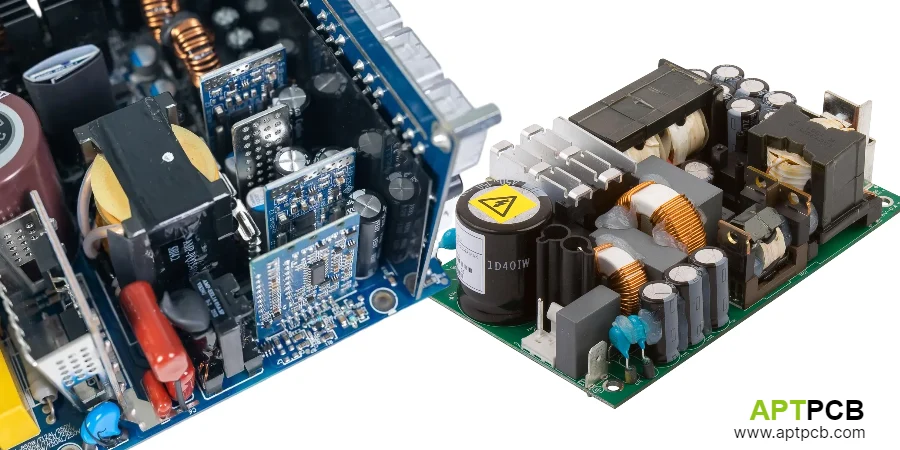
An industrial power supply PCB converts and regulates power for machinery, control cabinets, automation equipment, instruments, drives, and distributed industrial electronics. A production-ready board must connect the electrical architecture to hot-loop layout, insulation, thermal and mechanical integration, EMC, assembly, test, traceability, and change control.
This guide helps hardware engineers and buyers create a controlled PCB and PCBA release package. It does not replace end-equipment qualification.
Key takeaways
- Define the source, outputs, load dynamics, faults, environment, interfaces, and applicable standards before selecting PCB construction.
- Partition power conversion, sensing, control, communication, and connector zones by current flow and noise behavior.
- Minimize the topology's high-di/dt hot loops; do not rely on a large ground plane to repair poor component placement.
- Plan inspection, controlled bring-up, calibration, functional test, and traceability before layout freeze.
- Quote from a complete requirement and evidence package, not Gerber files alone.
Contents
- Define the industrial power supply boundary
- Build a requirement-to-evidence matrix
- Partition the architecture
- Control hot loops, returns and sensing
- Plan thermal and mechanical integration
- Prepare fabrication and assembly
- Plan validation and production test
- Review failure evidence
- Understand cost drivers
- Prepare the RFQ
What does an industrial power supply PCB include?
Industrial power supplies are not one board class. The input source, isolation boundary, output behavior, cabinet installation, and end-equipment standard determine the dominant risks.
| Board context | Primary design questions | Closest content boundary |
|---|---|---|
| Mains-input AC-DC supply | Hazardous voltage, isolation, inrush, rectification, PFC where required, leakage and protective earth | Use the dedicated AC-DC power supply PCB guide for the isolation-barrier review |
| Control-cabinet DC-DC supply | Bus range, reverse connection, surges, grounding, load steps and field wiring | This guide's main scope |
| Multi-output or backplane supply | Sequencing, cross-regulation, shared returns, remote sense and connector current | Freeze rail ownership and interface limits before layout |
| Motor, solenoid or actuator auxiliary supply | Regenerative energy, high current steps, conducted noise and shared-bus faults | Coordinate power and industrial-control interfaces |
| Battery-backed or UPS module | Charge/discharge modes, battery protection, switchover and stored-energy hazards | Define each power-flow state and test it separately |
If the board includes PLC-adjacent I/O, fieldbus, relays, or supervisory control, coordinate it with the industrial control PCB architecture. Do not force every function onto one PCB when a separate power and control board gives cleaner thermal, EMC, service, or test boundaries.
Industrial power supply requirement-to-evidence matrix
This matrix is the most useful handoff between system engineering, PCB design, manufacturing, quality, and purchasing. Every pass limit should point to an approved requirement, customer specification, risk analysis, or applicable standard.
| Requirement area | Design input to freeze | Evidence before release |
|---|---|---|
| Input source | AC or DC range, frequency, source impedance, transients, reverse connection and grounding | Interface specification, corner analysis and protection tests |
| Output rails | Voltage, current, tolerance, ripple, noise, sequencing and remote-sense behavior | Load matrix, transient captures and acceptance limits |
| Power and duty cycle | Continuous, peak, startup and fault power with ambient and airflow | Loss model, derating and temperature-rise results |
| Topology and isolation | Conversion stages, isolation purpose, working voltage and power-flow states | Schematic review, insulation plan and mode map |
| Dynamic behavior | Startup, shutdown, load steps, line steps, hold-up and recovery | Waveforms against product requirements |
| Protection | Overvoltage, overcurrent, short circuit, overtemperature, brownout and reverse energy | Fault-injection plan, response logs and damage inspection |
| Measurement and control | Accuracy, bandwidth, references, calibration, thresholds and firmware ownership | Error budget, correlation data and controlled firmware record |
| EMC | Emissions, immunity, ESD, cable/harness and grounding configuration | Approved test plan, pre-scan data and formal results where required |
| Safety | End-equipment category, insulation, protective earth, accessible energy and fault allocation | Safety plan and system-level evidence assigned by the product owner |
| Thermal and mechanics | Enclosure, heatsinks, airflow, mounting, heavy parts, vibration and service access | Correlated thermal data and mechanical review |
| PCB and assembly | Stackup, copper, holes, finish, cleanliness, coating, mixed technology and workmanship | Approved build specification and first-article records |
| Programming and test | Firmware, calibration, fixtures, loads, limits, coverage and data retention | Controlled test package, golden-unit control and result records |
| Traceability and change | Lots, revisions, alternates, site/process changes and requalification triggers | Genealogy, notification rules and customer approval route |
How should an industrial power supply PCB be partitioned?
Partition by current flow, switching energy, reference sensitivity, heat, insulation, and service access. The schematic's functional blocks are a starting point, but physical current loops determine the layout.
Input and protection zone
Keep input connectors, current limiting, reverse-polarity protection, surge suppression, inrush control, and filtering close to the entry point. Define the route for normal and fault current.
Power-conversion zone
Group the switching devices, local ceramic and bulk capacitors, gate drive, transformer or inductor, rectification, and current-return paths around the topology's smallest practical loops. Analog Devices AN-139 and Texas Instruments AN-1149 both emphasize that high-di/dt loops and component placement drive switching-supply EMI and functional behavior.
Sensing and control zone
Keep feedback, current sense, voltage dividers, references, compensation, ADC inputs, reset, and clock circuits away from switch-node copper and gate-drive loops. Route sensing from the intended measurement points, not from whichever copper is easiest to reach. Kelvin connections, differential sensing, and controlled return paths matter when copper drop or ground movement is comparable with the measurement budget.
Output and field-interface zone
Separate power outputs from status, communication, remote sense, and low-level control connectors. Confirm polarity, keying, spacing, current rating, cable exit, torque access, labeling, and fixture access in the final mechanical state.
Power supply PCB layout priorities
Identify the hot loop for the actual topology
The hot loop is the path whose current switches rapidly between states. Draw the current path for each switching state, then minimize the geometric difference between those paths.
Place local decoupling at the switching devices, keep gate-drive loops short, control switch-node copper area, and use a close reference plane where compatible. A plane cannot compensate for poor component placement.
Separate power return from measurement intent
“Ground” is not one ideal node on a working converter. Power return, gate-drive return, control ground, chassis or protective earth, shield termination, and isolated secondary reference have different current content and safety roles. Define where they connect and which currents are allowed through each path.
Avoid universal advice to split every ground plane. An uncontrolled split can force return current around a long path. Use the topology, controller vendor guidance, isolation architecture, and measured current flow to define the reference structure.
Size copper from electrical and thermal requirements
Trace width depends on copper thickness, allowed temperature rise, adjacent copper, layer position, airflow, duty cycle, terminals, vias, manufacturing tolerance, and the complete thermal path. IPC-2152 provides current-versus-temperature-rise guidance, but a calculator output is not a finished product rating; for a first-pass IPC-2221 estimate use the PCB trace width calculator.
Heavy copper can reduce resistance or carry current, but it also changes etching, spacing, lamination, drilling, soldering heat capacity, copper balance, and cost. Use the heavy copper PCB route only when the model and factory review justify it.
Derive spacing from the end equipment
Creepage and clearance depend on working voltage, transient voltage, insulation type, pollution degree, material group, altitude, coating assumptions, and the applicable safety standard. Do not copy one spacing table from a blog into a fabrication drawing. The product's safety owner should supply the required distances and test allocation.
How do thermal and mechanical requirements affect the board?
Thermal design must follow the assembled heat path from semiconductor junctions, magnetics, rectifiers, shunts, capacitors, copper and solder joints into air, a heatsink, baseplate, enclosure, or cold plate.
| Design option | Use it when | Evidence still required |
|---|---|---|
| Wider copper or more copper layers | Conduction loss and spreading need improvement | Current sharing, temperature rise, manufacturability and copper balance |
| Thermal via field | Heat must reach internal or opposite-side copper | Via construction, solder interaction and final interface effectiveness |
| Board-to-heatsink interface | The enclosure or baseplate is the main heat sink | Flatness, pressure, insulation, interface material and fastening controls |
| High-thermal or metal-core PCB | A compatible planar heat path dominates the architecture | Dielectric performance, routing limits, assembly and system thermal test |
| Fan or forced air | Airflow is controlled in the installed equipment | Minimum airflow, blockage, fan-fault response and maintenance assumptions |
Thermal results should cover the relevant input, output, ambient, airflow, enclosure, mounting orientation, and duty cycle. A single full-load room-temperature image does not prove the operating envelope.
Mechanical review should include terminal insertion and torque, heavy transformers and inductors, electrolytic capacitors, heatsinks, connector strain, board support, depanel stress, cabinet vibration, transport, and service handling. Staking, brackets, tie-downs, or compliant support should follow a mechanical assessment and qualified assembly process rather than a blanket rule for every large component.
Industrial power supply PCB DFM and assembly controls
Industrial power boards often combine small control packages with terminals, magnetics, heatsinks, and through-hole parts. Define the assembly route before those features block inspection, soldering, fastening, coating, or test.
Release at least:
- Controlled fabrication data, stackup, material properties, copper, holes, profiling, finish, tolerances and controlled nets
- BOM/AVL, placement, assembly drawings, paste, variants, polarity, hardware, torque and special-process notes
- Mixed SMT/THT sequence, selective or wave solder constraints, hand-install operations, cleaning and coating route where applicable
- Inspection requirements for visible and hidden joints, heavy parts, high-current connections and insulation boundaries
- Programming, calibration and functional-test package with safe power-up, loads, limits, fixtures and stored results
- Traceability, firmware identity, approved alternates and change-notification rules
AOI, X-ray, ICT, flying probe, hipot, insulation-resistance, burn-in, and functional test answer different questions. Select only the methods that fit the risks and product requirements. Use PCBA testing and quality to align evidence, and run a DFM review before the release package is frozen.
What should industrial power supply testing prove?
Testing should be layered so each stage catches faults at the lowest practical cost without claiming more than it measures.
| Stage | Main purpose | Typical evidence |
|---|---|---|
| Bare PCB | Connectivity, shorts, construction and specified coupons | Electrical test and requested fabrication records |
| Assembly inspection | Placement, polarity, solder joints, hardware and cleanliness | AOI, visual, X-ray or process records as assigned |
| Unpowered electrical test | Shorts, resistance, isolation paths and programming readiness | Fixture measurements against controlled limits |
| Controlled bring-up | Startup current, bias rails, switching waveforms and protection state | Safe power sequence and captured checkpoints |
| Functional test | Output rails, sequencing, status, control, calibration and fault response | Logged results tied to serial, hardware and firmware revision |
| Thermal and load test | Losses, hot spots, derating and cooling assumptions | Temperature and efficiency map across assigned corners |
| EMC and environmental | End-equipment emissions, immunity and environmental allocation | Pre-compliance and qualification reports where required |
Production functional test should state the source, load, harness, settling time, measurement uncertainty, test limits, fault handling, retest rule, fixture verification, golden-unit control, and data retention. A board that “powers on” has not necessarily demonstrated regulation, dynamic response, protection, communication, or calibration.
Industrial power supply PCB failure-mode table
| Symptom | Possible contributors | Evidence to collect | Preventive control |
|---|---|---|---|
| Startup oscillation or repeated restart | Source impedance, soft-start interaction, undervoltage threshold, bias collapse or overload | Input/output waveforms, controller states and source-current log | Corner analysis and controlled startup tests |
| Output ripple or load-step failure | Hot-loop inductance, capacitor ESR/ESL, compensation, sensing point or connector drop | Frequency and transient captures at defined probe points | Loop review, correct probing and load-matrix validation |
| Conducted or radiated emissions failure | Large hot loop, filter bypass, common-mode path, cable resonance or enclosure bonding | Near-field scan, LISN/current-probe data and operating-state log | Source suppression, return-path control and system EMC review |
| Local overheating | Switching/conduction loss, magnetics, copper neck-down, via or terminal resistance, poor interface | Thermal data, loss breakdown, resistance and cross-section evidence | Correlated model, margin review and controlled construction |
| Intermittent fault after transport or vibration | Heavy-part motion, cracked solder, connector fretting, board strain or loose hardware | Event log, inspection, X-ray and mechanical data | Support design, fastening control and assigned mechanical test |
| Insulation or leakage failure | Spacing, contamination, residue, coating defect, damaged slot or wrong material | Surface inspection, process records and assigned electrical tests | Safety-owned spacing, cleanliness and validated coating process |
| Field reset during switching loads | Shared return, transient coupling, inadequate hold-up or protection interaction | Rail, reset and ground-reference captures | Power/control partitioning and fault-state validation |
| Lot-to-lot output drift | Component substitution, reference drift, calibration, process or fixture change | Lot genealogy, calibration trend and measurement-system data | Approved alternates, change control and fixture verification |
What drives industrial power supply PCB cost?
Cost follows the production route and evidence burden more than the “industrial” label.
| Cost driver | Why it changes the quote | What to clarify |
|---|---|---|
| Copper and stackup | Thick copper, more layers and special materials change imaging, lamination and drilling | Required current/thermal result versus preferred construction |
| Special holes or via treatment | Filled/capped vias, large slots, press-fit or high aspect ratio add processes | Function, tolerance, acceptance and inspection |
| Mixed technology and hardware | THT, selective solder, heatsinks, busbars and fasteners add operations | Assembly order, fixtures, torque and inspection |
| Coating, bonding or potting | Materials, masking, cure, coverage and rework add controls | Exact material, keep-outs, thickness or coverage evidence |
| Test coverage | Fixtures, programmable sources/loads, calibration and data capture add NRE and cycle time | Test limits, volume, reuse and data-retention needs |
| Traceability and documentation | Serialization, reports, retention and customer approvals add handling | Required granularity and shipment evidence |
The lowest quoted bare-board price may not be the lowest delivered cost if assembly, fixture, validation, rework, or change-control requirements are missing.
Industrial power supply PCB RFQ checklist
Electrical and system inputs
- Input source range, frequency where applicable, grounding, source impedance, transients and reverse/fault conditions
- Output rails, continuous and peak current, tolerance, ripple/noise, sequencing, remote sense and load dynamics
- Topology, isolation purpose, switching-frequency range, protection, control and communication requirements
- Operating modes, duty cycle, ambient, airflow, enclosure, mounting and service conditions
- Applicable end-equipment safety, EMC, environmental and customer requirements with editions and limits
Manufacturing files
- Gerber X2, ODB++ or accepted fabrication data; NC drill/rout; netlist; stackup; fabrication drawing and controlled notes
- BOM/AVL, centroid, assembly drawings, paste, variants, firmware and programming instructions
- Mechanical drawings for heatsinks, terminals, busbars, fasteners, enclosure and board support
- Coating, potting, bonding, selective-solder, cleaning and other special-process definitions
Quality and commercial inputs
- Acceptance class, inspection, coupons, reports, programming, calibration and functional-test requirements
- Quantities, forecast, panel ownership, first article, serialization, traceability and record retention
- Approved sites and alternates, supplier-adjustment authority, change notification and requalification triggers
- Packaging, labels, shipment evidence and target schedule
Submit the controlled package through the PCB quote form. If supplier selection is the main task, use the power supply PCB manufacturer evaluation guide to compare process and evidence readiness.
Why involve APTPCB before release?
APTPCB can compare the proposed fabrication and assembly package with the intended board construction, mixed-technology route, inspection, programming, calibration and functional test. The review can identify missing stackup or current-path inputs, thermal-process conflicts, unsupported heavy parts, unclear coating or insulation requirements, inaccessible test points, and revision-control gaps.
This manufacturing review does not replace converter design, control-loop analysis, product safety engineering, EMC design, enclosure thermal analysis, machinery integration, or final qualification. Confirm capability, acceptance criteria, records, site, volume and schedule for the exact revision before ordering. Broader application context is available on the power and energy PCB page.
Relevant standards and technical references may include:
- IEC 62477-1 — IEC
- IEC 61000-6-2 — IEC
- IEC 61000-6-4 — IEC
- IEC 61000-4 series — IEC
- IEC 61010-1 — IEC, where the end equipment is within scope
- IEC 60204-1 — IEC, where the power supply is part of machinery electrical equipment
- IPC-2221 — IPC
- IPC-2152 — IPC
- IPC-6012 — IPC
- IPC-A-600 — IPC
- J-STD-001 — IPC
- IPC-A-610 — IPC
- AN-139 Power Supply Layout and EMI — Analog Devices
- AN-1149 Layout Guidelines for Switching Power Supplies — Texas Instruments
Use only the editions, classes, tests and customer-specific clauses invoked by the approved product program.
Frequently asked questions
What is an industrial power supply PCB?
It is a printed circuit board assembly that converts and regulates power for industrial equipment while supporting the required input range, outputs, protection, control, thermal path, interfaces and production test. It may be AC-DC, DC-DC, multi-output or battery-backed.
How is an industrial power supply PCB different from a general power PCB?
The circuit principles may be similar, but an industrial release usually has defined cabinet interfaces, duty cycle, field wiring, EMC environment, thermal installation, service needs, traceability and change-control requirements. Those system inputs must be reflected in the board and test package.
What is the most important power supply PCB layout rule?
Identify and minimize the topology's high-di/dt hot loop. Place the switching devices and local capacitors around that loop, control the return path and switch-node area, then keep sensing and control circuitry outside the noisy region.
Should power and control grounds always be split?
No. Define return paths from actual current flow and controller guidance. A deliberate connection between power and measurement references may be needed, while an arbitrary plane split can create a longer, noisier return path.
Does an industrial power supply PCB always need heavy copper?
No. Select copper from current, loss, temperature rise, geometry, layers, vias, terminals and the final cooling path. Wider copper, more layers, busbars or chassis coupling may be better than a blanket heavy-copper specification.
How are creepage and clearance selected?
The product safety owner derives them from working and transient voltage, insulation type, pollution degree, material group, altitude, coating assumptions and the applicable end-equipment standard. They should be controlled requirements, not copied from a generic PCB guide.
When should conformal coating or potting be used?
Use it when the environmental, insulation or mechanical analysis requires it. Material compatibility, masking, coverage, cure, stress, thermal effect, inspection, repair and process control must then be qualified for the actual assembly.
What production tests are useful for an industrial power supply PCBA?
Use the smallest set that covers the assigned risks: fabrication electrical test, assembly inspection, unpowered checks, programming, calibration, controlled bring-up and functional test. Add insulation, thermal, EMC, burn-in or environmental tests only when the product requirements assign them.
What files are needed for an accurate industrial power supply quote?
Provide fabrication and assembly data, BOM/AVL, stackup, electrical and thermal requirements, mechanical interfaces, firmware/programming package, test limits, quantities, traceability, special processes and change-control expectations.
Can a PCB manufacturer certify the finished industrial power supply?
Not through PCB fabrication alone. The finished equipment's owner and applicable certification route remain responsible for safety, EMC, thermal, functional and system compliance. A PCB/PCBA supplier provides the contracted manufacturing and test evidence within its defined scope.
Release one controlled build definition
The strongest industrial power supply release is not a generic “high-reliability PCB” specification. It is one controlled definition connecting electrical limits, current paths, insulation, thermal and mechanical installation, manufacturing, firmware, test, traceability and change approval.
Send APTPCB the current board package, BOM, source and load envelopes, enclosure and cooling information, assembly route, test requirements, quantities and required records. Engineering review can then focus on the concrete issues that affect quotation, first article and repeat production.