
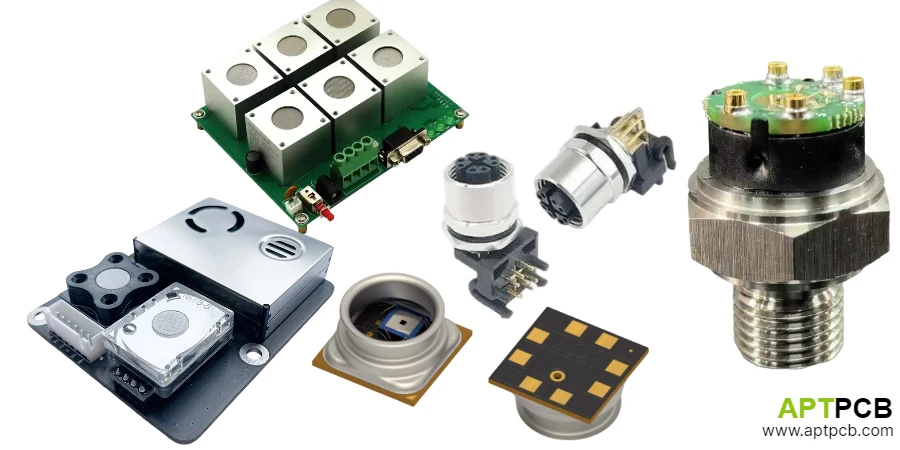
An industrial sensor PCB converts a physical sensor output into an accurate, protected and communicable measurement for a control system. It may condition microvolt or millivolt signals, excite a resistive bridge or RTD, drive a 4-20 mA loop, add HART or digital communication, and survive noise, surge, temperature, moisture and hazardous-area constraints.
Key takeaways
- Start with a measurement error budget covering the sensing element, excitation, analog front end, reference, ADC, temperature drift, linearization and calibration.
- Place protection and filtering so external interference is diverted before it reaches high-impedance or low-level nodes.
- In a loop-powered transmitter, calculate operation from the minimum available loop voltage and current after cable, receiver, barrier and protection drops.
- HART communication must coexist with the analog current signal; verify the complete loop impedance, coupling and waveform.
- Intrinsic safety is a certified system design under standards such as IEC 60079-11, not a coating, spacing value or component label that can be added late.
- Production testing should simulate the sensor, temperature/reference inputs, loop load, communication, calibration and defined faults.
Define the sensor and output architecture first
| Sensor/interface | Front-end need | Common PCB risk |
|---|---|---|
| Thermocouple | Low-offset amplification, cold-junction compensation, linearization | Thermal gradients and input leakage |
| RTD | Stable excitation and 2/3/4-wire lead compensation | Self-heating and lead resistance |
| Strain/pressure bridge | Low-noise excitation, instrumentation amplifier and ratiometric ADC | Microvolt noise, drift and connector thermoelectric effects |
| Piezoelectric/charge sensor | Very high input impedance or charge amplifier | Leakage, contamination and cable capacitance |
| Capacitive sensor | Stable excitation and guarding | Parasitics, moisture and shielding |
| 4-20 mA input/output | Precision sense/current drive and loop protection | Compliance voltage and surge energy |
| Digital industrial sensor | Isolated transceiver or PHY and protocol support | Ground offset, common-mode events and connector EMC |
Freeze measurement range, resolution, accuracy, update rate, sensor cable, power source, output protocol, grounding, installation category, temperature and required calibration before the schematic is released.
Build a measurement error budget
ADC resolution is not measurement accuracy. A 24-bit converter cannot correct a noisy reference, unstable excitation, thermocouple gradient, bridge nonlinearity or poor PCB leakage control.
| Error source | How it enters | Control method |
|---|---|---|
| Sensor tolerance/nonlinearity | Physical sensing element | Characterization and calibration |
| Excitation error | RTD/bridge current or voltage | Stable source and ratiometric measurement |
| Amplifier offset/drift | Analog front end | Low-drift device, gain plan and calibration |
| Reference drift/noise | ADC and DAC scale | Filtering, placement and temperature review |
| Resistor ratio/tolerance | Gain, filters and current loop | Matched networks and correct voltage rating |
| Leakage/contamination | High-impedance inputs | Guarding, cleanliness, coating and spacing |
| Thermal gradient | Thermocouple junctions and precision parts | Isothermal layout and heat-source separation |
| Quantization/digital filtering | Conversion and processing | Bandwidth and noise trade-off |
State the error budget by operating condition, not only at room temperature. Separate calibrated systematic error from random noise and long-term drift.
Precision analog PCB layout
Place the sensor connector, input protection, filters and front-end components as a deliberate signal chain. Keep switching converters, relays, radios, displays and fast digital buses away from the first gain stage.
- Route differential sensor inputs together with a defined return environment.
- Keep both sides of a differential filter electrically and physically balanced.
- Use Kelvin connections for shunts and precision excitation resistors.
- Prevent digital or load current from flowing through analog reference returns.
- Guard high-impedance nodes where leakage is significant.
- Keep thermocouple connector and cold-junction sensor in a controlled thermal region.
- Put protection close to the external connector with a short path to chassis or the intended return.
- Avoid plane splits beneath signal paths; partition by placement and current flow.
- Provide test access that does not add harmful stubs or leakage.
Filtering must fit the process bandwidth. Slow temperature or pressure measurement can accept aggressive low-pass filtering; vibration or position control may require wider bandwidth and a different noise strategy.
Design a 4-20 mA loop from the available voltage budget
The 4-20 mA convention provides a non-zero “live zero,” allowing the receiver to distinguish a low measurement from some open-circuit or power-loss conditions. The transmitter must still operate across the specified supply, cable resistance, receiver load, safety barrier and protection drops.
Use this budget:
Available transmitter voltage = minimum loop supply − maximum cable drop − receiver/shunt drop − barrier/protection drop.
Then verify that the transmitter can regulate the commanded current at the worst-case high output, temperature and component tolerance while leaving margin for startup and transient recovery.
For loop-powered designs:
- budget quiescent current for the sensor, AFE, MCU, reference and communications;
- define startup behavior as loop voltage rises slowly;
- select reverse-polarity and surge protection with acceptable voltage loss;
- prevent digital activity from modulating the analog output beyond its error limit;
- check current-sense resistor self-heating and voltage rating;
- verify compliance at minimum supply and maximum loop resistance;
- define fault-current behavior and diagnostic signaling according to the system requirements.
Add HART without degrading the analog measurement
HART overlays Bell 202 frequency-shift-keyed communication using 1200 Hz and 2200 Hz tones on the 4-20 mA loop. The digital signal has no intentional DC component, allowing analog and digital communication to coexist when the loop impedance and coupling network are correct.
Analog Devices and other semiconductor vendors publish reference circuits for HART-enabled current inputs and transmitters. Follow the selected modem and AFE guidance, then validate:
- transmit amplitude and waveform at the specified calibration plane;
- receive sensitivity across loop impedance and noise;
- coupling capacitor, filter and current-driver interaction;
- analog output error while HART is active;
- startup, sleep and communication power budget;
- modem clock and digital noise coupling into the sensor front end;
- surge/ESD protection capacitance and leakage;
- interoperability with the intended host, barrier and cable.
Do not assume a bench connection proves field performance. Test the minimum and maximum allowed loop resistance, supply and cable condition.
Isolation, surge and industrial EMC
Industrial cables can carry ESD, EFT, surge and ground-potential differences. Protection is a current-path design, not a collection of TVS symbols.
| Interface | Main risk | PCB response |
|---|---|---|
| Sensor leads | Common/differential interference and surge | Balanced filters, protection and shielding plan |
| 4-20 mA loop | Surge, reverse connection and ground offset | Rated protection and compliance-voltage review |
| RS-485/CAN | Common-mode range, EFT and termination | Transceiver protection, optional isolation and topology control |
| Ethernet | Cable surge and common-mode current | Magnetics, shield/chassis strategy and controlled pairs |
| Relay/solenoid output | Inductive transients and shared supply noise | Suppression at the load/current loop and separated returns |
Calculate creepage and clearance from working voltage, transient category, pollution degree, material group, insulation function and altitude under the applicable safety standard. Slots and coating may affect the insulation design only when the standard and certified construction allow them.
Hazardous locations and intrinsic safety scope
Intrinsic safety limits electrical and stored energy so specified faults do not ignite the target explosive atmosphere. IEC 60079-11 addresses intrinsically safe apparatus, but certification depends on the complete circuit, component ratings, fault analysis, separation, encapsulation where used, temperature class, gas/dust group and associated apparatus.
For an intrinsically safe sensor project, provide:
- target zone/division, gas or dust group and temperature class;
- protection concept and certification route;
- entity or system parameters and associated barrier;
- maximum capacitance and inductance, including cable and PCB contributions;
- infallible or safety-critical component requirements;
- controlled spacing, coating/encapsulation and assembly constraints;
- fault analysis and temperature-rise limits;
- approved substitutions and notification rules;
- certification-body drawings and production tests.
PCB fabrication and assembly suppliers should build to the controlled certified documentation. They should not independently choose generic “intrinsic safety spacing” or substitute energy-limiting components.
Environmental protection and mechanical design
Conformal coating, potting and sealing solve different problems.
| Method | Useful for | Important trade-off |
|---|---|---|
| Conformal coating | Humidity and contamination | Masking, cleanliness, coverage and repair |
| Silicone or soft encapsulant | Moisture/vibration with lower stress | Permeability and mechanical support |
| Epoxy potting | Strong environmental and tamper protection | Heat, cure stress and poor repairability |
| Sealed enclosure | Dust/water ingress control | Condensation, venting, connector and gasket design |
Validate measurement drift after coating or potting. Added leakage, dielectric loading, cure temperature and mechanical stress can change high-impedance or precision circuits.
Industrial sensor PCBA production test
- Bare-board electrical and dimensional inspection
- SPI/AOI and targeted X-ray based on package geometry
- Safe power-up, rail and current checks
- Sensor simulation at zero, span and intermediate points
- Multi-point calibration and temperature compensation where required
- 4-20 mA compliance and fault-current tests across loop conditions
- HART or digital communication tests with controlled host/load
- Isolation, dielectric or protective tests specified by the design
- Coating/encapsulation coverage and cure verification
- Environmental, EMC and hazardous-location qualification at product level
Store calibration coefficients, firmware version, component/material lots and test results against the unit serial number when the quality plan requires traceability.
Industrial sensor PCB RFQ checklist
- Measurement: Sensor type, range, accuracy, resolution, bandwidth, calibration and temperature compensation
- Installation: Cable, grounding, supply, loop/load, hazardous area, EMC and environmental profile
- Interfaces: 4-20 mA, HART, RS-485, CAN, Ethernet, IO-Link, wireless or custom protocol
- PCB data: Gerber X2, ODB++ or IPC-2581; netlist; stack-up; impedance; drill; slots; profile and revisions
- Assembly: Controlled BOM/alternates, placement, connectors, coating/potting, cleaning and special handling
- Firmware/calibration: Images, programming, calibration references, coefficients, data format and serialization
- Test: Sensor simulator, loop loads, host/modem, surge/isolation requirements, pass limits, sampling and reports
- Compliance: Standards, certification drawings, controlled safety components, change notification and traceability
- Commercial: Prototype/production quantities, fixture ownership, first article, lifecycle and schedule
Submit these files through the PCB quotation page. If coating is required, include a controlled mask drawing and coverage acceptance criteria for the conformal coating process.
Standards and reference documents
- IEC 60079-11 — Explosive atmospheres, equipment protection by intrinsic safety “i”
- IEC 61326-1 — Electrical equipment for measurement, control and laboratory use, EMC requirements
- IEC 61000-4 series — EMC immunity test methods
- IEC 60529 — Degrees of protection provided by enclosures
- NAMUR NE 43 — Signal level for failure information in digital transmitters with analog output signal
- HART Field Communication Protocol specifications
- IPC-2221, IPC-6012, J-STD-001 and IPC-A-610
Confirm current editions, market requirements and the product's certification route.
Industrial sensor PCB FAQ
Why is 4 mA used as the low end of a 4-20 mA signal?
The non-zero low end provides a live-zero convention and can power a two-wire transmitter. The control system still needs defined diagnostics for open circuit, short circuit and out-of-range current.
Can a 24-bit ADC guarantee high sensor accuracy?
No. ADC resolution is only one term. Sensor tolerance, excitation, reference, amplifier drift, noise, leakage, thermal gradients, linearization and calibration all contribute to accuracy.
What frequencies does HART use?
HART uses Bell 202 FSK tones at 1200 Hz and 2200 Hz superimposed on the analog current loop. The coupling network and loop impedance must support both communication and measurement requirements.
Does conformal coating make a PCB intrinsically safe?
No. Intrinsic safety requires a certified energy-limiting design and fault assessment. Coating may be part of an approved construction but is not a substitute for the required analysis and certification.
How should an industrial sensor PCBA be calibrated?
Use traceable stimulus and reference equipment at defined conditions, apply zero/span or multi-point correction as required, store coefficients under revision control and verify the result against released limits.
What files are needed for an industrial sensor PCB quote?
Provide controlled PCB and assembly files plus sensor/output specifications, loop and interface conditions, calibration/test procedures, environmental and compliance requirements, quantities and traceability needs.