
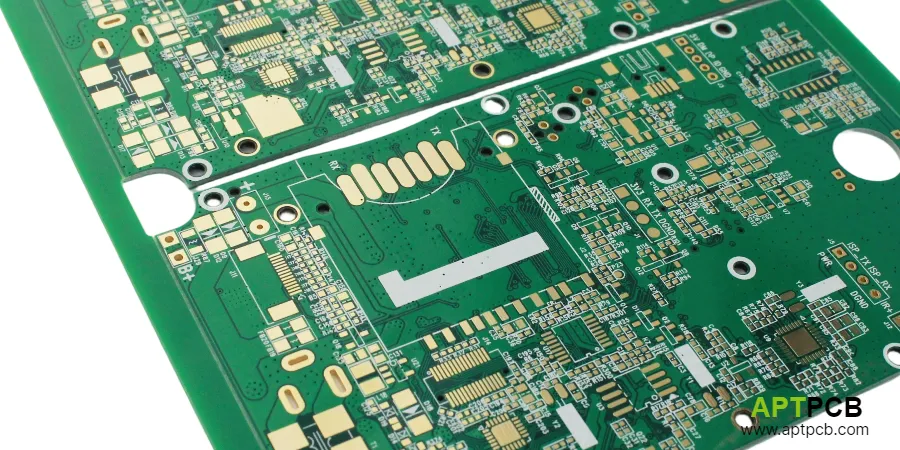
KB-6160F and KB-6160LC represent two distinct approaches to improving the standard KB-6160 platform for lead-free assembly, each targeting different failure modes. KB-6160F adds inorganic filler particles to reduce Z-axis CTE and improve drill accuracy. KB-6160LC (and its lead-free enhanced version KB-6160LC(C)) takes a different approach with resin modifications that specifically target low Z-axis expansion. Both materials maintain the cost efficiency of the standard Tg platform while addressing the reliability gaps that standard KB-6160 leaves open in lead-free assembly.
Looking for KB-6160 or KB-6160C instead? This guide covers only the filled (F) and low-CTE (LC) variants. The base laminate's datasheet values and the KB-6160 vs KB-6160C comparison are in the KB-6160 and KB-6160C guide. The "KB" prefix stands for Kingboard Laminates. For the whole KB material line on one page, start with the Kingboard laminate selection guide.
For production engineers evaluating these materials, the key question is: does the application need filled material benefits (better dimensional stability, reduced drill wander) or purely low thermal expansion? And is the modest additional cost justified versus upgrading directly to the more capable KB-6164?
In This Guide
- Understanding the KB-6160 Variant Family
- KB-6160F Technical Specifications: What Fillers Change
- KB-6160LC and KB-6160LC(C) Specifications
- How Inorganic Fillers Improve PCB Reliability
- KB-6160F vs KB-6160LC vs KB-6164: Which Variant to Choose
- Prepreg Compatibility and Stackup Design Considerations
- Manufacturing Process Differences from Standard KB-6160
- Target Applications for Each Variant
- Cost Comparison and Volume Pricing Considerations
- Order from APTPCB
Understanding the KB-6160 Filled Variant Family: KB-6160F, KB-6160LC, and KB-6160LC(C)
Kingboard's KB-6160 family includes five variants built on the same standard-Tg DICY/phenolic epoxy platform, each optimized for a different balance of cost, thermal reliability, and mechanical properties:
| Variant | Key Modification | Primary Benefit |
|---|---|---|
| KB-6160 | Base material (unfilled, DICY) | Lowest cost |
| KB-6160A | UVB-blocking, double-sided optimized | Double-sided board production |
| KB-6160C | Thermal endurance enhanced | Lead-free compatible |
| KB-6160F | Inorganic filler added | Lower CTE, better drilling |
| KB-6160LC / LC(C) | Low CTE resin formulation | Minimum Z-axis expansion |
On a fabrication drawing, every one of these is an FR-4 PCB material. The suffix only matters if the drawing names it, so call out "KB-6160F" or "KB-6160LC(C)" explicitly when you need the filled or low-CTE behavior.
The naming convention follows Kingboard's standard system: "F" denotes filled, "LC" denotes low CTE, "C" denotes lead-free compatible, and combinations like "LC(C)" indicate low CTE with lead-free enhancement. This systematic approach allows designers to select exactly the properties needed without paying for unnecessary performance.
KB-6160F Technical Specifications: What Fillers Change
KB-6160F specifications are estimated based on Kingboard's filler technology pattern observed across verified datasheets for KB-6164 (filled) and KB-6165F (filled). Note: official KB-6160F datasheet values should be confirmed with Kingboard for production qualification.
| Property | KB-6160 (Verified ✓) | KB-6160F (Estimated) | Change |
|---|---|---|---|
| Tg (DSC) | 135°C | ~135°C | No change |
| Td (TGA) | 305°C | ~310°C | +5°C |
| Z-CTE Alpha 1 | 60 ppm/°C | ~50 ppm/°C | -17% |
| Z-CTE 50–260°C | 4.3% | ~3.8% | -12% |
| Dk @ 1 GHz | 4.25 | ~4.4 | +4% (filler raises Dk) |
| Df @ 1 GHz | 0.018 | ~0.017 | -6% |
| Moisture Absorption | 0.19% | ~0.12% | -37% |
| Drill Tool Life | Baseline | Reduced 10–15% | Filler abrasion |
The addition of inorganic fillers creates three notable property changes. First, Z-axis CTE decreases because the low-CTE filler particles mechanically constrain resin expansion. Second, the dielectric constant increases slightly because most inorganic fillers (silica, alumina) have higher Dk than pure epoxy resin. Third, moisture absorption decreases because filler particles displace hydrophilic resin volume.
The tradeoff is increased drill bit wear. Inorganic particles are harder than epoxy resin and accelerate carbide drill bit erosion. For high-volume drilling operations, this translates to 10–15% more frequent bit changes and slightly higher per-hole drilling costs.
KB-6160LC and KB-6160LC(C) Technical Specifications and Performance Data
KB-6160LC takes a different approach to CTE reduction. Rather than adding fillers, it modifies the resin formulation to achieve inherently lower thermal expansion. KB-6160LC(C) further enhances this with lead-free compatibility, similar to how KB-6160C enhances KB-6160.
| Property | KB-6160LC (Estimated) | KB-6160LC(C) (Estimated) |
|---|---|---|
| Tg (DSC) | ~135°C | ~135°C |
| Td (TGA) | ~305°C | ~310°C |
| Z-CTE Alpha 1 | ~50 ppm/°C | ~50 ppm/°C |
| Z-CTE 50–260°C | ~3.8% | ~3.8% |
| T-260 | Not guaranteed | >10 min |
| T-288 | Not guaranteed | >5 min |
| Anti-CAF | No | No |
| Dk @ 1 GHz | ~4.3 | ~4.3 |
| Filled | No | No |
The key difference between KB-6160F (filled) and KB-6160LC (unfilled low CTE): KB-6160F achieves CTE reduction through mechanical filler constraint, while KB-6160LC achieves it through resin chemistry modification. The practical implications are that KB-6160LC maintains standard drill tool life and has slightly lower Dk (no filler contribution), while KB-6160F offers marginally better dimensional stability and potentially lower moisture absorption.
Both achieve similar Z-CTE targets (~3.8%), so the choice often depends on secondary requirements: choose KB-6160F when drilling quality and dimensional stability are priorities; choose KB-6160LC when maintaining the lowest possible Dk is important.
How Inorganic Fillers Improve PCB Reliability
Understanding the role of inorganic fillers helps clarify why filled materials like KB-6160F, KB-6164, KB-6165F, and KB-6167F dominate high-reliability applications.
Inorganic filler particles—typically silica (SiO₂) with particle sizes in the 1–5 µm range—are dispersed throughout the epoxy resin matrix. These particles have a coefficient of thermal expansion approximately 10× lower than epoxy resin (0.5 ppm/°C for silica versus 50–60 ppm/°C for cured epoxy). When the composite material is heated, the rigid filler particles resist the expansion of the surrounding resin, resulting in lower net CTE.
The benefits extend beyond CTE reduction. Fillers improve dimensional stability during etching and lamination by constraining in-plane resin flow. They reduce resin recession during the drill smear removal (desmear) process, resulting in cleaner via walls. They also decrease the coefficient of moisture expansion (CME), which reduces warpage caused by moisture absorption gradients.
However, the same hardness that makes fillers effective at constraining expansion also makes them abrasive to drill bits. Production engineers must balance the reliability benefits of filled materials against the increased drilling cost. For designs with fewer than 10,000 drill hits per panel, the cost difference is negligible. For very high hole-count designs (>50,000 hits per panel), drill cost can become a meaningful factor.
KB-6160F vs KB-6160LC vs KB-6164: Which Variant to Choose
| Criterion | KB-6160F | KB-6160LC(C) | KB-6164 ✓ |
|---|---|---|---|
| Z-CTE 50–260°C | ~3.8% | ~3.8% | 3.5% |
| T-260 | Limited | >10 min | >60 min |
| Anti-CAF | No | No | Yes |
| Dk @ 1 GHz | ~4.4 | ~4.3 | 4.6 |
| Filled | Yes | No | Yes |
| Drill Tool Impact | +10–15% wear | None | +10–15% wear |
| Cure Chemistry | DICY/Phenolic | DICY | Phenolic |
| Cost vs KB-6160 | ~1.05× | ~1.05× | ~1.10× |
✓ = Verified from official Kingboard datasheet
Our recommendation: In most scenarios, KB-6164 is the better choice. For approximately 5% more cost than KB-6160F or KB-6160LC(C), KB-6164 provides dramatically better T-260 (>60 min vs limited or >10 min), anti-CAF capability (which neither KB-6160 variant offers), lower Z-CTE (3.5% vs ~3.8%), and a comprehensive prepreg system with verified Dk/Df data for 17 glass style/RC combinations.
KB-6160F and KB-6160LC remain relevant for applications where existing qualifications mandate specific part numbers, or where the exact KB-6160 prepreg system must be used for stackup compatibility. New designs should strongly consider KB-6164 as the default standard-Tg lead-free material.
Prepreg Compatibility and Stackup Design Considerations
KB-6160F uses the KB-6060F prepreg system (filled variant of KB-6060). KB-6160LC uses the standard KB-6060 prepreg system or a low-CTE variant depending on the specific stackup requirements.
For impedance-controlled designs, the critical consideration when switching from unfilled KB-6060 to filled KB-6060F prepreg is the Dk increase. Filled prepregs typically measure 0.1–0.3 higher Dk than their unfilled equivalents at the same resin content and glass style. This means trace widths calculated for unfilled KB-6060 prepreg will produce slightly different impedances on KB-6060F, requiring recalculation.
If migrating an existing KB-6160 design to KB-6160F, request updated impedance modeling from your multilayer PCB manufacturer using the KB-6060F prepreg Dk values. A 5–7% impedance shift is typical and may or may not require trace width adjustment depending on the impedance tolerance specified.
For KB-6160LC, the standard KB-6060 prepreg data (verified from Kingboard's official datasheet) applies directly, since the low-CTE modification is in the laminate resin rather than the prepreg.
Manufacturing Process Differences from Standard KB-6160
KB-6160F manufacturing notes:
Lamination parameters are similar to standard KB-6160: heat-up rate 1.0–2.5°C/min, cure time >45 min at >175°C, pressure 25±5 kgf/cm² (approximately 350 PSI). The filler content does not significantly change the lamination window.
Drilling requires attention to bit wear monitoring. Implement automatic drill bit quality inspection or reduce hit count limits by 10–15% compared to unfilled material baselines. Use backup boards rated for filled materials. Entry boards with aluminum foil construction reduce top-side burring caused by filler particles deflecting the drill bit at entry.
Desmear processing may require extended permanganate cycles to fully remove filled resin smear from via walls. Standard permanganate desmear at 15–20 g/L KMnO₄ for 8–12 minutes is typically adequate, but validation on first-article panels is recommended.
KB-6160LC manufacturing notes:
Processing is essentially identical to standard KB-6160. No drilling modifications are needed. Lamination parameters follow the standard KB-6160 profile. The low-CTE resin modification is transparent to the manufacturing process.
Target Applications: Consumer Electronics, Telecom, and Industrial PCBs
KB-6160F is best suited for:
- Boards with high via counts (>20,000 holes per panel) where CTE reduction justifies the drilling cost increase
- Designs requiring improved dimensional registration for fine-pitch component placement
- Multi-up panel designs where panel-to-panel dimensional consistency is critical
- Applications where existing customer qualification specifies filled standard-Tg material
KB-6160LC(C) is best suited for:
- Designs prioritizing low CTE without accepting the drill wear penalty of filled material
- Applications where impedance design uses KB-6060 prepreg data and cannot tolerate the Dk shift of filled prepreg
- Upgrade path from KB-6160/KB-6160C where minimal process change is desired
- High hole-count designs where drill cost is a significant budget item
Both variants share these application domains:
- Consumer electronics: PCB assembly for smartphones, tablets, wearables, and IoT devices
- Networking equipment: routers, switches, and wireless access points
- LED lighting: driver boards and power supply modules
- General industrial: measurement, control, and data acquisition boards
Cost Comparison and Volume Pricing Considerations
| Material | Cost Index | Lead-Free | Z-CTE | Anti-CAF | Best For |
|---|---|---|---|---|---|
| KB-6160 | 1.00× | No | 4.3% | No | Lowest cost, no lead-free |
| KB-6160C | 1.05× | Yes | 4.3% | No | Cheapest lead-free |
| KB-6160F | ~1.05× | Limited | ~3.8% | No | CTE + drilling quality |
| KB-6160LC(C) | ~1.05× | Yes | ~3.8% | No | CTE without filler |
| KB-6164 | ~1.10× | Yes | 3.5% | Yes | Best value overall |
At production volumes, the raw material cost differences between KB-6160F, KB-6160LC(C), and KB-6164 are small—typically less than $3 per panel for standard 18"×24" construction. The total cost of ownership calculation should include drilling costs (higher for filled materials), yield impacts (potentially lower with better CTE materials), and field reliability costs.
For new product designs without legacy material qualifications, APTPCB recommends standardizing on KB-6164 as the default lead-free standard-Tg material. The incremental cost is minimal, and the reliability benefits—particularly anti-CAF and superior T-260—significantly reduce risk.
If your design is not tied to Kingboard, equivalent filled standard-Tg grades exist from other PCB material manufacturers. Compare them on Z-CTE, T-260 and prepreg Dk data, not on Tg alone. For metal core, flex or package substrate material choices, see the substrate material selection guide.
How to Order KB-6160F and KB-6160LC PCBs from APTPCB
APTPCB supports all KB-6160 family variants including KB-6160F and KB-6160LC(C). Our engineering team can evaluate your specific design requirements and recommend the optimal material variant, factoring in layer count, via density, assembly profile, and budget constraints.
Upload your design files for a comprehensive DFM review and material-specific quotation. For designs currently on KB-6160 or KB-6160C that may benefit from a material upgrade, we provide comparative analysis at no additional charge.