
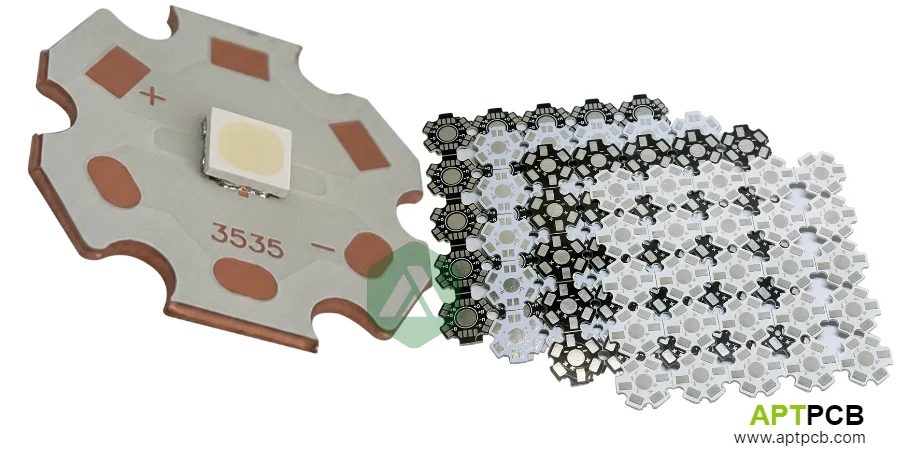
LED lighting has fundamentally transformed illumination technology, but the LED itself represents only part of the system. The printed circuit board connecting, powering, and cooling LEDs determines whether a lighting product achieves its performance potential or fails prematurely due to thermal stress, electrical issues, or manufacturing defects.
LED lighting PCB design differs significantly from general electronics. Where typical PCBs primarily route signals between components, LED boards must simultaneously manage substantial heat loads, maintain precise current delivery, and often meet optical requirements for light distribution. These demands create design challenges that standard PCB approaches cannot adequately address.
This guide provides comprehensive coverage of LED lighting PCB fundamentals—thermal management principles, substrate technologies, electrical design considerations, and application-specific requirements that determine lighting product success.
Understanding LED Thermal Management Fundamentals
Heat management represents the defining challenge of LED lighting PCB design. Despite efficiency advantages over incandescent and fluorescent technologies, LEDs still convert 40-60% of input power to heat—heat that must transfer through the PCB to external heatsinking before reaching the LED junction and degrading performance.
Junction temperature directly determines LED lifetime, color stability, and light output. Operating a quality LED at 85°C junction temperature might yield 50,000 hours to L70 (70% lumen maintenance), while the same LED at 105°C might achieve only 25,000 hours. This exponential relationship makes thermal design the primary determinant of LED product reliability.
Thermal Design Principles
- Thermal Path Analysis: Heat flows from LED junction through die attach, LED package thermal slug, solder joint, PCB substrate, thermal interface material, and heatsink to ambient. Each element contributes thermal resistance that accumulates through the path.
- Junction Temperature Budgeting: Work backward from target junction temperature: allocate thermal budget across path elements, then select materials and designs meeting each allocation. For high thermal conductivity substrates, typical allocations allow 0.3-0.8°C/W for the PCB element.
- Power Density Calculation: Determine watts per square centimeter to guide substrate selection. Below 0.5 W/cm², FR-4 with thermal vias may suffice; above 2 W/cm², metal core PCB technology becomes necessary.
- Thermal Spreading Requirements: Heat must spread laterally before conducting through substrate thickness. Copper weight and substrate thermal conductivity both affect spreading effectiveness.
- Environmental Considerations: Account for maximum ambient temperature, enclosure effects, and altitude (reduced convection). Design for worst-case conditions, not laboratory benchtop.
- Reliability Margin: Include 10-15°C margin between calculated junction temperature and maximum rating to accommodate manufacturing variation and aging effects.
Selecting Substrate Technology for LED Applications
Substrate selection establishes the thermal performance ceiling for LED lighting products. The choice between FR-4, metal-core PCB, and specialty substrates depends on power density, thermal budget, and cost constraints—decisions that significantly impact both performance and manufacturing approach.
Standard FR-4's thermal conductivity of approximately 0.3 W/m·K limits heat extraction capability. Through a typical 1.6mm board, FR-4 provides roughly 5-6°C·cm²/W thermal resistance—acceptable for low-power indicators but inadequate for illumination-grade LEDs without enhancement through thermal via arrays.
Substrate Options and Applications
- Standard FR-4: Suitable for power densities below 0.5 W/cm² with thermal vias, or indicator-level applications. Lowest cost option leveraging mature PCB fabrication processes and broad supplier availability.
- FR-4 with Thermal Vias: Dense via arrays under LED pads reduce effective thermal resistance by 50-70%. Cost-effective enhancement for moderate power applications, requiring proper via design and drilling specification.
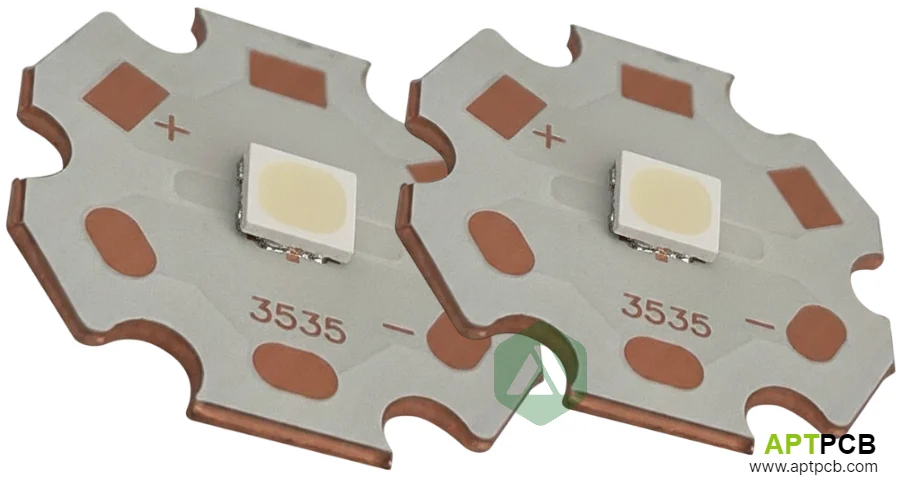
- Aluminum MCPCB (1.0-1.5 W/m·K): Standard choice for commercial LED lighting. Provides approximately 1.0°C·cm²/W thermal resistance—5× better than plain FR-4. Suitable for most indoor and moderate outdoor applications.
- Enhanced MCPCB (2.0-3.0 W/m·K): Premium dielectric formulations for demanding applications: outdoor fixtures, enclosed luminaires, automotive lighting. Cost premium of 1.5-2× standard MCPCB often justified by reliability improvement.
- Copper Core MCPCB: Superior thermal spreading for concentrated heat sources. Consider when aluminum spreading proves insufficient despite adequate dielectric thermal conductivity.
- Ceramic Substrates: Maximum thermal performance for extreme applications. Ceramic PCB technology offers direct thermal paths without polymer dielectric bottleneck, but at 3-10× cost premium over MCPCB.
Designing LED Electrical Circuits
Electrical design for LED lighting encompasses current regulation, string configuration, protection circuits, and driver integration. Proper electrical architecture ensures LEDs operate at intended current levels while protecting against fault conditions that could cause safety hazards or premature failure.
LED drive topology fundamentally affects circuit complexity, efficiency, and cost. Constant-current drivers maintain stable LED current regardless of voltage variation, temperature effects, or LED forward voltage drift—essential for consistent light output and color over operating life.
Electrical Design Elements
- String Configuration: Series strings simplify current matching (same current through all LEDs) but require higher driver voltage. Configure string voltage to utilize driver compliance range efficiently while leaving margin for LED Vf variation.
- Current Regulation Approach: Dedicated LED driver ICs provide precise current control with efficiency features. For cost-sensitive applications, simple resistor limiting may suffice for indicator LEDs but lacks regulation accuracy for illumination applications.
- Parallel String Balancing: When multiple parallel strings are necessary, implement current balancing through matched string impedance, ballast resistors, or active balancing circuits. Unbalanced strings create brightness variation and differential aging.
- Thermal Derating: Implement thermal foldback that reduces LED current as temperature rises, protecting against thermal runaway in confined or poorly-cooled installations.
- Protection Circuitry: Include reverse polarity protection, overcurrent limiting, and overvoltage clamping appropriate to application environment. Outdoor and industrial applications require more robust protection than indoor residential products.
- EMC Considerations: LED drivers generate switching noise requiring filtering for compliance with EMC requirements. Design appropriate filtering and grounding from project start rather than adding mitigation later.
Integrating Driver Electronics
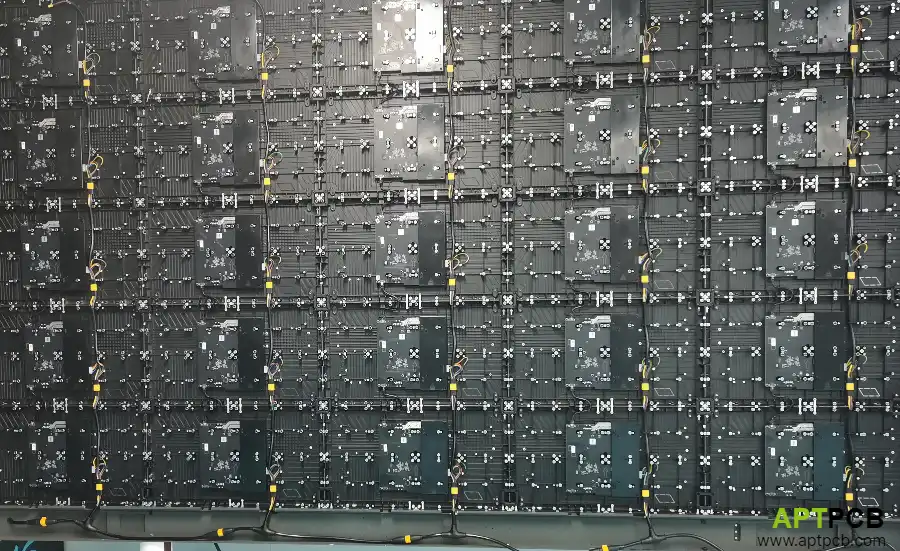
Driver integration strategy affects LED lighting PCB complexity, cost, and serviceability. On-board drivers simplify system integration but add PCB complexity and thermal load; external drivers enable driver replacement without luminaire disassembly but require additional wiring and connector provisions.
The driver integration decision cascades through numerous design choices: power conversion efficiency affects thermal budget, driver switching frequency influences EMI filtering requirements, dimming interface determines control wiring. These interdependencies require considering driver integration early in the design process.
Driver Integration Approaches
- On-Board Linear Drivers: Simplest implementation for low-power applications. Efficiency equals Vf/Vsupply, making linear regulation acceptable only when voltage differential is small or power level low.
- On-Board Switching Drivers: Higher efficiency (85-95%) across wide voltage range justifies added complexity for battery-powered or higher-power applications. Requires attention to inductor placement and EMI management.
- External Driver Connection: Separates driver from LED board, simplifying LED PCB design but requiring connector provisions. Enables driver replacement for serviceability and technology updates.
- Driver Thermal Management: On-board drivers add to LED board thermal load. Account for driver power dissipation (typically 5-15% of output power) in thermal budget calculations.
- Dimming Interface Design: Support intended dimming methods (0-10V, PWM, DALI, phase-cut) with appropriate interface circuitry and isolation where required.
- Safety Isolation: Mains-powered drivers require appropriate creepage, clearance, and isolation per applicable safety standards. Design PCB layout to maintain required separation distances.
Addressing Application-Specific Requirements
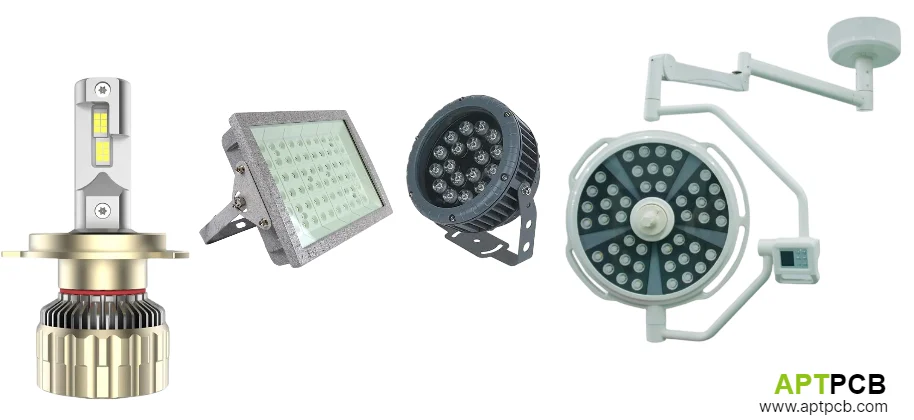
LED lighting applications span diverse environments with distinct requirements—indoor residential emphasizing color quality and dimming compatibility, commercial demanding efficiency and longevity, industrial requiring ruggedness and reliability, outdoor withstanding environmental exposure. Understanding application requirements guides design decisions throughout development.
Application Categories
- Residential Lighting: Emphasis on color rendering (CRI>90), dimming compatibility with existing infrastructure, compact form factors fitting standard fixtures. Cost sensitivity typically high; reliability expectations moderate (25,000+ hours).
- Commercial Lighting: Efficiency and maintenance cost reduction drive specification. Higher reliability requirements (50,000+ hours), often with specific controls integration (DALI, networked lighting). Color consistency across installations important for architectural applications.
- Industrial Lighting: Ruggedness, reliability, and specific environmental ratings (IP, temperature range, vibration) take priority. Higher power levels common; heavy copper PCB construction may be warranted for high-current applications.
- Outdoor Lighting: Environmental exposure demands appropriate protection: conformal coating, sealed enclosures, UV-stable materials. Wide temperature range operation requires attention to material selection with appropriate Tg and component ratings.
- Automotive Lighting: Stringent qualification requirements per automotive standards. Vibration, thermal shock, and reliability testing exceed typical commercial specifications. Automotive-grade manufacturing capability essential.
- Specialty Applications: Horticultural lighting with specific spectral requirements, medical lighting with color accuracy needs, emergency lighting with battery backup integration—each requiring application-specific design considerations.
Implementing Manufacturing-Ready Design
Design decisions determine manufacturing feasibility, yield, and cost. Design-for-manufacturing (DFM) principles applied during LED lighting PCB development prevent production problems that are expensive to correct after design release.
Manufacturing Considerations
- Substrate Processability: MCPCB requires modified drilling, routing, and handling versus FR-4. Verify selected fabricator has appropriate metal PCB capability before finalizing substrate selection.
- Assembly Process Compatibility: LED packages have specific reflow requirements and thermal sensitivity. Define assembly requirements early to ensure compatibility with SMT and assembly processes.
- Thermal Pad Design: Large thermal pads require subdivided stencil apertures to prevent solder voiding. Include stencil design guidance in assembly documentation.
- Test Point Provisions: Include test points enabling production electrical testing and debug. Define test requirements during design to ensure testability.
- Panelization Efficiency: Design board outline and features supporting efficient panelization. Appropriate profiling and breakaway design affects both cost and handling.
- Documentation Completeness: Complete fabrication and assembly documentation prevents manufacturing interpretation that may not match design intent. Specify all requirements affecting board quality and function.
Summary
LED lighting PCB design integrates thermal management, electrical design, driver integration, and application-specific requirements into manufacturable products. Thermal design dominates the challenge—substrate selection, copper weight, and thermal interface design determine whether LEDs achieve their reliability potential.
Success requires systematic approach: establish thermal budget from application requirements, select substrate technology meeting thermal allocation, design electrical systems for reliable LED operation, and implement manufacturing-ready designs that production partners can execute consistently.
The investment in proper LED lighting PCB design pays dividends through product reliability, customer satisfaction, and reduced warranty costs compared to designs that cut corners on thermal management or electrical protection.