
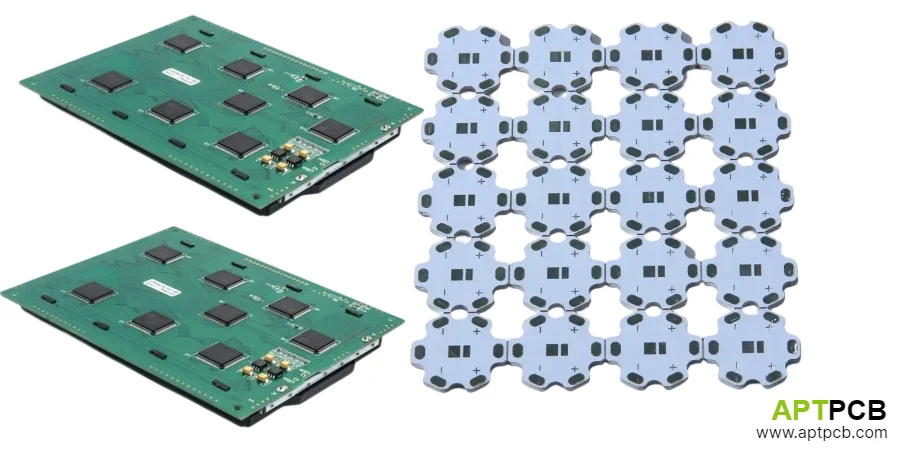
LED module PCBs define more than the electrical connection between LEDs and a driver. They determine thermal performance, optical accuracy, manufacturing repeatability, and how easily a lighting product can scale across multiple models.
For lighting manufacturers, the key decision is not simply which LED board to purchase. The engineering decision is how much of the lighting system should be integrated into the module and how the module will interact with the driver, heat sink, optics, enclosure, and production process.
A reliable LED module design aligns five areas:
- Electrical interface compatibility
- Thermal path performance
- Optical positioning accuracy
- Mechanical integration
- Manufacturing and supplier capability
What Is an LED Module PCB and When Should You Use One?
An LED module PCB is a pre-engineered LED assembly that combines LEDs, PCB technology, and defined interfaces for integration into a larger lighting product.
Compared with a fully custom LED PCB, a module can reduce development time by providing:
- Tested LED layouts
- Defined mounting interfaces
- Known electrical characteristics
- Controlled optical positioning
- Repeatable manufacturing processes
The module boundary determines engineering flexibility.
A simple LED-only board gives the luminaire designer more freedom but requires additional work for driver selection, thermal validation, and optical alignment.
A complete LED light engine simplifies product development by combining LED, driver, and interface requirements, but reduces customization options.
How Do You Choose the Right LED Module Architecture?
The correct architecture depends on production volume, customization requirements, and product strategy.
LED Module Architecture Selection Matrix
| Architecture | Advantages | Limitations | Best Applications |
|---|---|---|---|
| LED-only module | Maximum driver flexibility, lower module complexity | Requires external driver selection | Commercial lighting, custom luminaires |
| Driver-integrated module | Simplified system integration | Less flexibility and higher module complexity | Consumer lighting, compact products |
| Complete LED light engine | Fastest luminaire development | Reduced optical/electrical customization | Standardized lighting products |
| Application-specific module | Optimized performance for one product | Limited reuse | Downlights, panels, industrial lighting |
| Scalable module family | Supports multiple SKUs and platforms | Requires initial architecture planning | Product families and lighting platforms |
Industry standards such as Zhaga define interchangeable LED module interfaces covering mechanical, electrical, optical, and thermal requirements.
Before selecting a module architecture, define:
- Target wattage range
- Required lifetime
- Driver strategy
- Optical system
- Expected product variants
- Certification requirements
What Electrical Specifications Should an LED Module PCB Define?
Electrical compatibility is one of the most important integration decisions because a mismatch between module and driver can create overheating, unstable brightness, or shortened lifetime.
A module specification should define:
Input Voltage or Current Requirements
LED modules typically operate using:
Constant-voltage systems
Examples:
- 12V DC
- 24V DC
- 48V DC
Constant-current systems
Specifications should include:
- Rated LED current
- Operating current range
- Required compliance voltage
- Maximum power rating
The driver must provide the electrical conditions required by the LED array.
What Dimming Interfaces Should Be Supported?
Modern lighting systems may require:
- PWM dimming
- Analog dimming
- Digital lighting controls
- Smart control interfaces
The module datasheet should define minimum stable dimming levels and supported control methods.
How Should LED Module Connectors Be Selected?
Connector selection affects reliability during installation and operation.
Evaluate:
- Current rating
- Temperature rating
- Wire compatibility
- Mating cycles
- Vibration resistance
- Environmental exposure
Industrial-grade connectors are preferred where modules experience repeated installation or harsh operating conditions.
Industrial-grade connectors improve reliability in demanding lighting environments.
What Electrical Protection Should Be Included?
Depending on application requirements, LED modules may include:
- Reverse polarity protection
- Surge protection
- Over-current protection
- ESD protection
Safety design should include appropriate clearance and creepage distances.
How Does Thermal Design Determine LED Module Reliability?
Thermal performance is often the primary lifetime limitation in LED systems.
LED junction temperature affects:
- Light output
- Color stability
- Lumen maintenance
- Component lifetime
The thermal path must be designed as a complete system:
LED junction → LED package → solder interface → PCB copper → dielectric → metal core or thermal structure → heat sink → ambient environment
LED Module Thermal Design Parameters
| Parameter | Design Requirement |
|---|---|
| PCB substrate | Match thermal capability to LED power density |
| Thermal resistance | Specify junction-to-mounting resistance (Rth j-mtg) |
| Mounting surface | Maintain flat contact area with heat sink |
| TIM interface | Define material and application method |
| Mechanical mounting | Provide consistent contact pressure |
| Thermal testing | Validate at operating power and ambient conditions |
How Do You Select an LED PCB Material?
Common choices include:
| PCB Technology | Typical Use |
|---|---|
| FR-4 | Low-power LED applications |
| Aluminum MCPCB | General lighting and higher-power modules |
| Copper-core PCB | High thermal loads |
| Ceramic PCB | High-temperature or specialized applications |
Metal-core PCB (MCPCB) selection depends on:
- LED power density
- Thermal resistance target
- Cost requirements
- Mechanical constraints
Metal-core substrate selection should be based on thermal calculations rather than material preference alone.
How Should Optical Requirements Affect LED Module PCB Design?
LED modules are optical components as much as electrical assemblies.
PCB manufacturing accuracy directly affects:
- Beam pattern
- Lens alignment
- Light uniformity
- Product appearance
What Optical Data Should a Module Supplier Provide?
A qualified module supplier should provide:
- LED coordinate data
- Light-emitting surface (LES) information
- LED height reference
- Optical reference points
- Recommended lens interface information
How Does PCB Manufacturing Affect Light Output?
LED placement variation can change optical performance.
Important controls include:
- Accurate LED positioning
- Consistent board dimensions
- Controlled solder mask appearance
- Clean optical surfaces
White solder mask is commonly used where PCB reflectivity contributes to optical efficiency.
What Manufacturing Decisions Matter Before LED Module Production?
A successful LED module must be designed for repeatable manufacturing, not only prototype performance.
LED Module Manufacturing Validation Checklist
| Area | Supplier Evaluation Point |
|---|---|
| PCB fabrication | Material control, thickness tolerance, surface finish |
| SMT assembly | Placement accuracy and solder process control |
| Thermal pads | Stencil design and void management |
| Testing | Electrical and optical verification |
| Components | Availability and approved alternatives |
| Documentation | Complete manufacturing specifications |
How Should LED Modules Be Prepared for Mass Production?
Production planning should include:
Panelization
PCB geometry affects:
- Material utilization
- Assembly throughput
- Manufacturing cost
Thermal solder process control
Thermal pads require attention to:
- Stencil aperture design
- Reflow profile
- Solder void control
Stencil Design should be reviewed specifically for thermal pad performance.
Production testing
Testing should verify:
- LED current
- Electrical function
- Brightness consistency
- Assembly quality
Production testing becomes more efficient when test access is considered during PCB layout.
What Are the Most Common LED Module PCB Failure Modes?
| Failure Mode | Root Cause | Prevention Method |
|---|---|---|
| LED overheating | Insufficient thermal path | Improve MCPCB design and heat-sink integration |
| Brightness variation | LED bin variation or placement error | Control LED sourcing and optical tolerances |
| Flicker | Driver/module incompatibility | Validate electrical interfaces |
| Solder failure | Poor thermal assembly process | Optimize stencil and reflow parameters |
| Optical mismatch | LED position variation | Control PCB manufacturing accuracy |
| Connector failure | Incorrect interface selection | Match connector rating to operating environment |
How Should You Evaluate an LED Module PCB Supplier?
Supplier selection should evaluate engineering capability, manufacturing control, and documentation quality.
LED Module Supplier Evaluation Checklist
| Category | Verification Item |
|---|---|
| Engineering capability | LED module experience, thermal design support, application references |
| PCB capability | MCPCB production, material control, dimensional accuracy |
| Assembly capability | SMT process control, inspection methods, solder quality |
| Testing capability | Electrical, optical, thermal validation |
| Documentation | Drawings, specifications, reports, change control |
| Supply capability | Component sourcing, production capacity, lifecycle support |
A qualified supplier should provide:
- PCB fabrication data
- Assembly specifications
- Thermal information
- Electrical specifications
- Test documentation
Fabrication and assembly specifications should define critical requirements before production approval.
How Can LED Module Families Reduce Product Development Time?
Many lighting companies create module families instead of isolated designs.
A scalable module platform can share:
- Mechanical mounting interfaces
- Driver compatibility
- Optical systems
- PCB manufacturing processes
This approach supports:
- Different wattages
- Multiple color temperatures
- Indoor and industrial products
- Future product revisions
Common module family options include:
- Standard CCT modules
- Tunable white modules
- High-efficiency modules
- High-temperature industrial modules
Industry-specific considerations should be included when designing modules for specialized applications.
Final LED Module PCB Selection Checklist
Before approving an LED module design, confirm:
✓ Electrical interface matches the driver ✓ Thermal resistance supports operating temperature requirements ✓ PCB material matches LED power density ✓ Optical positioning meets lens requirements ✓ Manufacturing process is validated ✓ Testing requirements are documented ✓ Supplier supports production volume and lifecycle needs
LED module PCB design succeeds when electrical, thermal, optical, and manufacturing decisions are engineered together.
A structured module selection process reduces redesign cycles, improves production reliability, and creates lighting platforms that can scale across future products.