
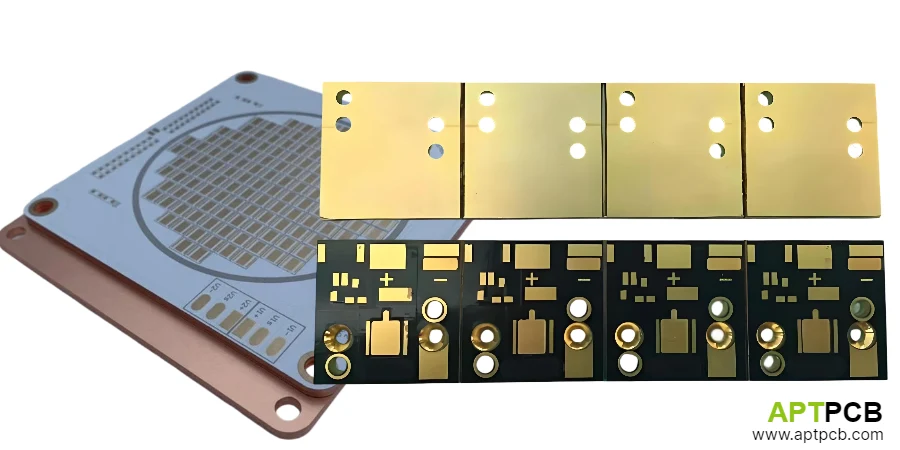
Selecting an LED metal core PCB (MCPCB) requires more than comparing aluminum and copper conductivity values. The correct substrate depends on the complete thermal path, including the LED package, solder joint, copper layer, dielectric, metal core, TIM, heatsink, enclosure, airflow, and ambient environment.
Aluminum MCPCBs are the standard choice for most LED lighting products because they provide a strong balance of thermal performance, weight, availability, and cost. Copper core MCPCBs become valuable when heat concentration, spreading resistance, or a limited mechanical envelope creates a measurable thermal constraint.
Key takeaways for choosing an LED metal core PCB
- Evaluate the complete junction-to-ambient thermal path before selecting aluminum or copper.
- The dielectric layer often controls PCB thermal resistance because it sits directly in the heat path while maintaining electrical isolation.
- Copper improves heat spreading, but the benefit depends on LED geometry, dielectric performance, and heatsink design.
- Direct thermal path (DTP) structures can reduce dielectric resistance under the LED pad when electrical and manufacturing requirements allow.
- Thermal validation must include the real assembly: solder, TIM, mounting pressure, enclosure, airflow, and operating conditions.
- Supplier quotes should define stackup, materials, tolerances, testing, and documentation requirements.
How does an LED MCPCB transfer heat?
An LED MCPCB moves heat through a series of interfaces:
LED junction → package thermal pad → solder joint → circuit copper → dielectric → metal core → TIM → heatsink/housing → ambient
The metal core provides spreading and structural support. It does not remove heat by itself. A copper core with poor interface conditions may perform worse than an optimized aluminum design with a better dielectric, solder connection, and heatsink.
The main thermal contributors are:
- LED package thermal resistance
- Solder joint quality and thermal pad voiding
- Circuit copper spreading area
- Dielectric thickness and thermal conductivity
- Metal core spreading capability
- TIM thickness and compression
- Heatsink capacity and airflow
A first-pass dielectric resistance estimate is:
Rθ,diel = t / (k × A)
where:
t= dielectric thickness in metresk= through-plane thermal conductivity in W/m·KA= effective heat-transfer area in square metres
This equation helps compare constructions but does not represent the final LED junction temperature because it excludes spreading resistance, solder voids, interfaces, and environmental conditions.
Aluminum vs copper core PCB: which material fits LED applications?
The best choice depends on the heat source distribution and thermal margin.
| Decision factor | Aluminum-core MCPCB | Copper-core MCPCB | Engineering decision |
|---|---|---|---|
| Distributed LED array | Commonly provides sufficient thermal performance | Adds cost and weight where spreading may not be limiting | Validate the complete thermal stack before upgrading |
| Small concentrated LED source | Can work with optimized dielectric and heatsink | Stronger lateral spreading can reduce local hotspots | Compare thermal maps using identical conditions |
| Weight-sensitive products | Lower density helps | Higher density increases board mass | Include PCB, heatsink, fasteners, and enclosure weight |
| Compact thermal envelope | May require more area or cooling changes | Better spreading can help when space is limited | Compare copper, DTP, inlays, and mechanical changes |
| Cost-sensitive lighting | Usually the preferred solution | Higher material and processing cost | Compare total system cost, not core material price only |
| Thermal-critical systems | Requires careful stackup selection | Provides additional spreading capability | Use measurement or simulation to justify selection |
Copper has higher bulk thermal conductivity than aluminum, but the finished MCPCB performance depends on the entire construction. The dielectric, interface resistance, and cooling system frequently determine whether the copper advantage appears in the final product.
When should an LED design use copper core MCPCB?
A copper core PCB uses a solid copper base (instead of aluminum) under the dielectric and circuit layer. Copper's higher thermal conductivity spreads heat sideways before it crosses into the heatsink, at the price of more weight and cost. Copper core MCPCBs are commonly considered when:
- LED heat sources are highly concentrated.
- The available board area is restricted.
- Junction temperature margin is very small.
- Thermal spreading through the base is a demonstrated limitation.
- Product value justifies increased cost and weight.
Examples include compact high-power LED modules, demanding industrial lighting, and applications where reliability requirements leave little thermal margin.
Copper is not automatically the best choice for every high-power LED. If the dielectric remains the dominant resistance, changing the base metal may produce limited improvement. A higher-performance dielectric, improved solder process, larger thermal pad, better TIM interface, or improved heatsink can provide greater benefit.
What dielectric specifications matter for LED MCPCB performance?
The dielectric performs two critical functions:
- Transfers heat from the circuit copper to the metal core.
- Electrically isolates the circuit from the conductive base.
Specify the complete dielectric construction, including:
- Finished dielectric thickness and tolerance
- Through-plane thermal conductivity
- Thermal conductivity test method
- Breakdown voltage conditions
- Working voltage requirement
- Temperature rating
- Bond reliability information
- Approved material substitutions
A conductivity number without thickness, test method, and construction details is not enough for comparing suppliers.
Typical LED MCPCB dielectric systems are much more thermally conductive than FR-4, but the exact performance depends on the material family and manufacturing process.
Should an LED use standard IMS or direct thermal path MCPCB?
Standard insulated metal substrate (IMS) construction places a dielectric layer between the LED circuit and metal core.
| Construction | Heat path | Suitable applications | Design considerations |
|---|---|---|---|
| Standard IMS | LED pad → solder → copper → dielectric → metal core | Most LED arrays and general lighting products | Dielectric performance, flatness, solder quality, and interface control |
| Direct thermal path (DTP) | LED thermal pad → metal feature → core | High heat flux where dielectric resistance limits performance | Electrical potential, isolation, fabrication, inspection, and soldering |
| Copper inlay or coin | Local thermal conductor integrated into another structure | Concentrated heat removal with complex routing needs | Bonding, coplanarity, plating, and manufacturability |
DTP requires careful review of the LED package thermal pad. Some pads are electrically neutral while others connect internally to an electrode. Confirm the package datasheet before selecting a conductive thermal path.
How should LED MCPCB designs be validated?
Thermal validation should reproduce the real product condition.
The test setup should define:
- LED current and duty cycle
- Ambient temperature
- Enclosure condition
- Orientation
- Airflow
- Heatsink design
- TIM material and thickness
- Mounting pressure
- Operating duration
Common measurement methods include:
- Thermocouples for controlled surface measurements
- Forward-voltage thermometry where calibration and device variation are controlled
- Infrared imaging with proper emissivity correction
Infrared images show surface temperature, not junction temperature. LED package thermal data must be applied using the reference points defined by the manufacturer.
What are common LED MCPCB failure modes?
| Symptom | Likely contributors | Verification method |
|---|---|---|
| Hotspot despite high-conductivity core | Dielectric limitation, solder voids, poor TIM contact, insufficient heatsink | Thermal imaging, cross-section, interface inspection |
| Uneven brightness or color shift | LED temperature imbalance, current variation, assembly defects | Optical measurement, current verification, thermal mapping |
| Cracked solder joints | Mechanical stress, thermal cycling, uneven mounting | Reflow records, strain review, sectioning |
| Dielectric breakdown or leakage | Insufficient isolation, edge damage, contamination | Voltage testing, spacing review, cleanliness checks |
| Delamination or blistering | Material mismatch, moisture, excessive thermal stress | Cross-section, process records, material review |
| High board-to-heatsink temperature difference | Warpage, incorrect TIM application, uneven torque | Flatness measurement and contact inspection |
How should an LED MCPCB RFQ be specified?
A complete RFQ helps suppliers quote the same engineering requirement.
PCB construction information
Include:
- Gerber or ODB++ files
- Mechanical drawing
- Stackup requirement
- Core material and thickness
- Dielectric material and thickness
- Copper weight
- Surface finish
- DTP or inlay requirements
Thermal requirements
Include:
- LED package model
- LED current
- Heat load estimate
- Junction-temperature target
- Ambient condition
- Heatsink or housing interface
- TIM specification
- Thermal validation requirements
Electrical and mechanical requirements
Include:
- Working voltage
- Dielectric test requirement
- Creepage and clearance requirements
- Board flatness
- Hole and edge requirements
- Mounting method
- Assembly process
Quality documentation
Request:
- Material certificates
- Thermal material data
- Electrical test records
- Dimensional inspection
- Microsection or coupon data when required
- Traceability information
What drives LED metal core PCB cost?
Major cost factors include:
- Aluminum or copper base material
- Core thickness
- Dielectric specification
- Copper weight
- DTP or embedded structures
- Machining requirements
- Flatness requirements
- Panel utilization
- Inspection and documentation scope
Aluminum generally provides the best cost-performance balance for mainstream LED products. Copper should be selected when the thermal improvement has measurable product value.
Related resources:
- high-thermal PCB overview
- heavy copper PCB guidance
- PCB surface finish
- metal core PCB manufacturer page
- metal PCB capabilities for dielectric grades, base materials, and thicknesses
- aluminum PCB guide for aluminum-only LED board basics
- PCB quality overview
LED metal core PCB selection checklist
Before releasing an LED MCPCB design, confirm:
- Thermal path is modeled from junction to ambient
- Aluminum versus copper choice is supported by thermal analysis
- Dielectric thickness and conductivity are specified
- LED package thermal pad requirements are confirmed
- DTP electrical compatibility is reviewed when applicable
- TIM and mounting conditions are defined
- Thermal validation method is documented
- Supplier quotation includes materials, tolerances, and reports
FAQ
Is copper core PCB always better than aluminum PCB for LEDs?
No. Copper provides better spreading capability, but the final result depends on dielectric performance, LED geometry, solder quality, heatsink design, and system conditions.
What is a copper core PCB used for?
Copper core PCBs are used where heat is concentrated in a small area: compact high-power LED modules, laser and UV sources, power modules, and RF power stages. The copper base spreads heat faster than aluminum, which lowers hotspot temperature when the base, not the dielectric, is the limiting resistance.
Why is aluminum the most common LED MCPCB material?
Aluminum provides a practical balance of thermal performance, low weight, cost, manufacturing availability, and mechanical compatibility for most LED lighting products.
What is the most important LED MCPCB thermal specification?
The complete stackup matters. Specify dielectric thickness, thermal conductivity, test method, isolation requirements, and the metal core construction together.
When is a direct thermal path MCPCB useful?
DTP is useful when the dielectric layer is limiting heat transfer beneath the LED. The LED package electrical configuration and manufacturing requirements must support the design.
How do I compare LED MCPCB supplier quotes?
Provide identical stackup, material requirements, tolerances, testing requirements, and documentation expectations so suppliers quote comparable constructions.
Request an LED MCPCB review
Send the LED package information, thermal requirements, proposed stackup, mechanical interface, quantities, and validation requirements. APTPCB can review manufacturability and quotation alignment for aluminum, copper, IMS, and advanced thermal PCB constructions.
Contact APTPCB for an LED MCPCB quotation review.
Standards and references
- IPC-2221 — Generic Standard on Printed Board Design
- IPC-6012 — Qualification and Performance Specification for Rigid Printed Boards
- IPC-A-600 — Acceptability of Printed Boards
- IPC-TM-650 — Test Methods Manual
- JEDEC JESD51-51 — Electrical test method for thermal resistance and impedance measurement of LEDs with an exposed cooling surface
- IEC 60598-1 — Luminaires, general requirements and tests
- LED package manufacturer's thermal application data
- IMS laminate manufacturer's declared thermal and electrical test methods