
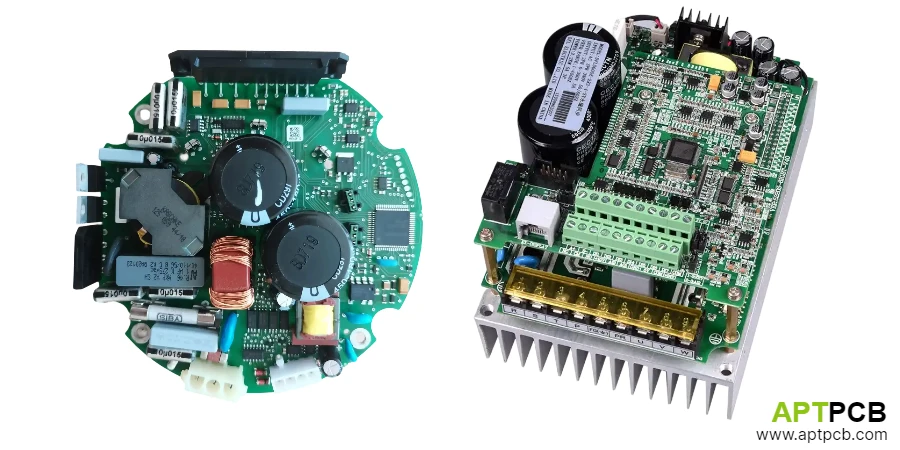
A motor controller PCB is rarely delayed by one isolated schematic issue. Production problems usually appear when power switching, sensing, thermal paths, mechanical interfaces, assembly processes, and functional test expectations have not been reviewed as one manufacturing system.
Teams preparing an industrial build release need to answer a more practical question:
Is this motor controller PCB ready to become a repeatable assembly, or is it still a prototype that depends on engineering intervention?
If the project is mainly focused on machine integration, begin with industrial control PCB builds. If the main challenge is switching current, power conversion, or thermal stress, review power and energy PCB builds. If the release blocker is powered verification, fixture access, or production bring-up, include FCT test preparation before pilot production.
Quick Answer
Review a motor controller PCB before build release by verifying five boundaries: power versus control separation, sensing visibility, thermal path definition, manufacturing accessibility, and functional-test readiness. A board that passes schematic review can still fail production when high-current loops, connectors, thermal interfaces, or test points were not designed around the actual assembly process.
What Should Be Reviewed Before Releasing A Motor Controller PCB?
A production release review should confirm:
| Review Area | Decision Question | Release Evidence |
|---|---|---|
| Power stage | Are switching loops compact and controlled? | Layout review, current-loop analysis, power component placement |
| Control boundary | Are MCU, communication, and feedback circuits protected from switching noise? | Grounding strategy and signal routing review |
| Thermal path | Does heat leave through the intended mechanical structure? | Thermal model, heatsink/baseplate interface, via strategy |
| Assembly | Can the PCB be built and inspected consistently? | DFM review, assembly process plan |
| Functional test | Can the finished board be powered, measured, and diagnosed? | Fixture concept and test-point map |
A motor controller PCB should enter industrial production only after these decisions are visible in the release package.
How Should The Power Stage Be Reviewed On A Motor Controller PCB?
Motor controllers combine high-current switching devices with sensitive control electronics. The first layout review should identify the complete power path:
- DC input
- bulk capacitors
- switching devices
- gate drivers
- motor outputs
- current measurement elements
- protection circuits
The switching region should remain compact. High di/dt current loops create both electrical noise and thermal concentration, so the review should confirm:
- power devices are physically grouped together
- gate-drive paths are short
- switching nodes do not run beside sensitive feedback signals
- return paths are clearly defined
For industrial drives, the power stage should be treated as a controlled electrical zone rather than simply a collection of components.
How Do You Check Motor Controller PCB Sensing And Feedback Paths?
Current sensing, temperature monitoring, encoder inputs, Hall sensors, and fault feedback signals often determine whether a controller is stable in production.
The review should verify:
- current shunts or sensors have clean measurement references
- analog feedback does not cross noisy switching regions
- external feedback connectors have protection and service access
- calibration points remain reachable after assembly
A design that hides sensing nodes under mechanical hardware may pass laboratory testing but create long debug cycles during production.
Motor Controller PCB Failure Modes To Review Before Release
| Failure Mode | Root Cause | Production Impact |
|---|---|---|
| False current measurement | Poor separation between power return and sensing reference | Unstable control response |
| MOSFET overheating | Incomplete thermal path or poor via implementation | Power-stage failure under load |
| Connector rework | Interface placement ignores harness and mechanical constraints | Assembly delay |
| Difficult debugging | Test points blocked after assembly | Longer factory diagnosis |
| EMI failure | Large switching loops or uncontrolled return paths | Compliance redesign |
The purpose of review is not only to improve electrical performance. It is to reduce uncertainty during pilot build.
How Should Thermal Design Be Validated For Motor Controller PCBs?
Thermal review should start with the actual mechanical heat path:
- PCB copper spreading
- thermal vias
- heatsink connection
- enclosure interface
- airflow conditions
- mounting pressure
High thermal PCB structures are useful when the PCB itself is part of the heat-transfer solution. They are not a substitute for mechanical thermal design.
That is where high thermal PCB builds become relevant.
For exposed-pad MOSFET packages such as DFN, TO-Leadless, or similar power packages, thermal via design requires coordination between PCB fabrication and SMT assembly.
Thermal vias placed below exposed pads can improve heat transfer, but uncontrolled open vias may pull solder away during reflow. The result can be poor thermal contact, excessive voiding, and reduced power-device reliability.
The thermal review should therefore include:
- via plugging or filling strategy
- stencil design
- solder-volume control
- inspection requirements
- expected operating load conditions
How Should Connectors And Mechanical Interfaces Be Reviewed?
Motor controller PCBs connect to:
- motor phases
- DC power input
- braking systems
- communication interfaces
- sensors
- cabinet wiring
Connector review should confirm:
- high-current interfaces have appropriate mechanical support
- low-level signals are separated from power connections
- cable routing does not interfere with thermal hardware
- service access remains possible after installation
A connector decision is also a manufacturing decision because it affects:
- assembly sequence
- inspection access
- fixture design
- repair workflow
What Manufacturing Checks Are Needed Before RFQ Release?
Before requesting production pricing, the PCB package should already answer manufacturing questions.
The supplier review package should include:
| Item | Purpose |
|---|---|
| Gerber or ODB++ files | Fabrication review |
| BOM with alternates | Supply-risk evaluation |
| Stackup information | Electrical and thermal assessment |
| Assembly drawings | Mechanical build review |
| Connector specifications | Interface validation |
| Test requirements | Fixture and process planning |
Motor controller boards often combine fine-pitch processors, large power packages, terminals, shields, and mechanical parts. Assembly feasibility must therefore be reviewed before production quantities are discussed.
How Should Functional Test Be Included In The Release Process?
A motor controller PCB is not production-ready when it only powers on.
The assembly-to-test handoff should define:
- startup behavior
- fault conditions
- expected current readings
- temperature monitoring points
- communication checks
- motor-load simulation requirements
If powered verification is required after assembly, include FCT test preparation during release planning.
The test strategy should identify what belongs to:
- bare PCB inspection
- SMT inspection
- assembly verification
- powered functional testing
This prevents factory teams from discovering missing test access after the first pilot units are assembled.
When Should A Motor Controller PCB Move To Production?
A motor controller PCB is ready for industrial build release when:
- power and control zones are clearly defined
- sensing paths are observable and protected
- thermal routes match the mechanical design
- connectors support assembly and service needs
- DFM review is complete
- functional test requirements are documented
The board should move into quotation only after those decisions are stable.
Prepare The RFQ Package After Engineering Review
A supplier can provide a more accurate manufacturing recommendation when the release package contains:
- finalized layout data
- BOM and approved substitutes
- stackup requirements
- thermal notes
- assembly requirements
- test expectations
At that stage, move to the quote request flow.
Next Steps: Request A Motor Controller PCB DFM Review
For industrial servo drives, motor inverters, and high-power-density controllers, a manufacturing-focused review can identify layout, thermal, assembly, and test risks before pilot production.
Send the PCB package through motor controller PCB review request with Gerber or ODB++, stackup requirements, current specifications, and assembly expectations.
Summary
A motor controller PCB review before industrial build release is a manufacturing readiness process. The strongest designs combine controlled power-stage layout, protected sensing, realistic thermal planning, accessible interfaces, and a defined assembly-to-functional-test path.
The goal is not only a board that works in the laboratory. The goal is a controller PCB that can be built, tested, serviced, and scaled reliably.
Related Pages & Tools
Industrial Control PCB For machine-control and industrial integration requirements.
Power & New Energy PCB For switching power, energy conversion, and high-current applications.
FCT Test For production bring-up and functional verification planning.
High Thermal PCB For PCB structures where thermal management depends on board construction.
Public References
Texas Instruments, "AN-1149 Layout Guidelines for Switching Power Supplies" Supports switching-loop and feedback-layout considerations.
Infineon, "PCB Design Guidelines For Switching Power Supplies" Provides guidance for power-stage PCB implementation.
Keysight, "Functional Test Systems for Electronics Manufacturing" Supports production functional-test planning.
OMRON, "Hall Effect Sensors for Position and Speed Detection" Supports feedback interface considerations.
Author and Review Information
- Author: APTPCB motion-control content team
- Technical review: PCB manufacturing, PCBA process, motor-control layout, and functional-test engineering team
- Last updated: 2025-02-23