
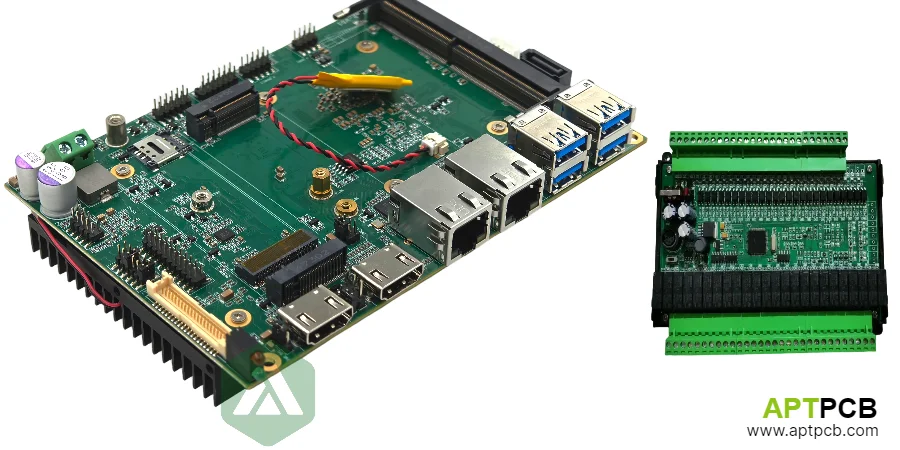
A PLC PCB is not defined only by its processor or circuit density. It is defined by the industrial environment it must survive: field wiring, switching loads, electrical noise, temperature, maintenance expectations, and required proof of reliability.
A reliable PLC PCB design starts by identifying the module function, electrical boundaries, failure consequences, manufacturing requirements, and validation evidence before schematic and layout work begin.
Key PLC PCB design decisions
- Select the board architecture based on whether the module is CPU, power, digital I/O, analog I/O, communication, or backplane.
- Define isolation boundaries from working voltage, transient environment, pollution degree, insulation requirements, and system architecture.
- Design EMC protection around connectors, cables, return paths, chassis connections, and recovery behavior.
- Match PCB materials, copper weight, thermal design, coating, and assembly controls to actual operating conditions.
- Create production tests that prove the released function, not only that components were assembled correctly.
PLC PCB module selection matrix
| Module type | Primary design challenge | Required engineering evidence |
|---|---|---|
| CPU/controller | Processor integrity, memory retention, reset behavior, communications | Boot testing, watchdog validation, power interruption testing, firmware control |
| Power module | Input protection, conversion efficiency, heat, abnormal conditions | Rail testing, startup analysis, overload testing, thermal validation |
| Digital input | Thresholds, isolation, noise immunity, field transients | Input sweeps, disturbance testing, channel fault checks |
| Digital output | Load switching, inductive energy, short circuits | Load matrix, waveform capture, overload and thermal testing |
| Analog I/O | Accuracy, noise, calibration, drift | Error budget, calibration records, temperature testing |
| Communication module | Signal integrity, shielding, grounding | Physical-layer testing, cable validation, EMC testing |
| Backplane | Power distribution, connectors, bus integrity | Loaded bus testing, insertion testing where applicable |
What does a PLC PCB need to support?
A PLC system may contain multiple boards with different reliability requirements. A field-facing I/O module sees long cables and electrical disturbances. A CPU board must protect data integrity and maintain deterministic operation. A communication board must preserve signal quality while handling industrial noise.
The PCB design should begin with:
- Module role and safety relevance.
- Power input range and fault conditions.
- Field interface types.
- Cable lengths and shielding approach.
- Environmental profile.
- Required standards and customer acceptance criteria.
A safety PLC requires more than a special PCB material or isolation component. Functional safety depends on the complete architecture, diagnostics, fault assumptions, verification process, and product-level validation.
How should PLC PCB I/O isolation be designed?
Isolation must be selected according to the function of the barrier.
Common isolation goals include:
- Protecting logic from field disturbances.
- Breaking ground loops.
- Handling different field potentials.
- Containing faults between channels.
- Meeting equipment insulation requirements.
IEC 60664-1 provides insulation coordination principles, but creepage and clearance depend on working voltage, transient voltage, pollution degree, material group, altitude, insulation function, and construction details.
The isolation barrier includes the complete PCB structure:
- Copper spacing.
- Internal layers.
- Vias.
- Slots.
- Connectors.
- Test points.
- Coatings.
- Mechanical hardware.
A digital isolator, optocoupler, transformer, relay, or isolated transceiver should be selected from required speed, lifetime, power consumption, common-mode transient immunity, and insulation performance.
PLC PCB EMC design: what should engineers validate?
Industrial EMC failures usually enter through interfaces. The connector, cable, protection device, filter, chassis connection, and return path form one system.
A PLC PCB EMC review should cover:
- ESD paths from exposed connectors.
- EFT/burst immunity from switching equipment.
- Surge energy handling.
- Conducted RF susceptibility.
- Radiated interference.
- Reset and recovery behavior after disturbances.
Protection components must be placed close to entry points, with controlled current paths and minimum loop area.
A bare PCB functional test cannot prove EMC performance. EMC validation should use representative:
- Enclosures.
- Cable harnesses.
- Loads.
- Grounding arrangements.
- Backplanes.
- Firmware behavior.
How should PLC PCB power design be approached?
Power design begins with the complete electrical environment.
Define:
- Input voltage range.
- Reverse polarity conditions.
- Brownout behavior.
- Inrush current.
- Surge exposure.
- Output load profile.
- Fault duration.
- Allowed temperature rise.
Copper thickness, vias, connectors, and thermal paths should be sized from actual current and duty cycle.
A heavy copper PCB can support high-current applications, but it is not automatically required for every PLC board. Current paths, connector ratings, thermal spreading, fabrication capability, and assembly constraints must be considered together.
What matters in PLC backplane and communication PCB design?
Backplanes combine power distribution, communication signals, and mechanical constraints.
Before routing, define:
- Connector pin assignment.
- Module spacing.
- Power budget.
- Bus topology.
- Shield strategy.
- Fault behavior.
- Hot-swap requirements.
Hot swap requires more than staggered connector pins. It may require:
- Controlled inrush.
- Power sequencing.
- Reset handling.
- Bus recovery.
- Loaded insertion testing.
Communication interfaces such as Ethernet, RS-485, CAN, or fieldbus require validation with the actual connector, cable, termination, isolation method, and EMC protection.
A multilayer PCB should preserve signal return paths and maintain separation between noisy power sections and sensitive analog or communication circuits.
How should thermal and environmental risks be managed?
PLC PCB temperature depends on the complete installed system.
Evaluate:
- Cabinet ambient temperature.
- Airflow.
- Module spacing.
- Neighboring heat sources.
- Duty cycle.
- Component temperature limits.
Validate critical components including:
- Power devices.
- Capacitors.
- Magnetics.
- Connectors.
- Isolators.
High-Tg laminate supports reliability but does not define equipment operating temperature.
Conformal coating can improve resistance to contamination and corrosion when properly specified. A qualified coating process should define:
- Material.
- Cleaning requirements.
- Keep-out areas.
- Thickness.
- Cure conditions.
- Inspection criteria.
- Repair process.
The PCB conformal coating page provides process considerations for industrial assemblies.
PLC PCB failure-mode and validation matrix
| Field symptom | Investigation areas | Validation evidence |
|---|---|---|
| Random reset | Supply disturbance, grounding, watchdog, EMC coupling, overheating | Power interruption tests, EMC tests, thermal cycling, reset logs |
| False input switching | Cable coupling, threshold margin, filtering, common-mode noise | Input threshold tests, cable disturbance tests, waveform review |
| Output failure | Inrush, inductive loads, overload, thermal stress | Load testing, switching waveform review, protection testing |
| Analog measurement drift | Reference stability, contamination, temperature effects | Calibration records, temperature testing, accuracy analysis |
| Communication loss | Termination, shielding, grounding, EMC recovery | Network testing, cable tests, disturbance testing |
| Module insertion fault | Backplane power disturbance, sequencing, connector behavior | Loaded insertion testing when hot swap is required |
How should a PLC PCB supplier RFQ be prepared?
A strong RFQ connects requirements to measurable manufacturing evidence.
Product requirements
Include:
- Module type and function.
- Safety relevance.
- Installation environment.
- Operating and storage conditions.
- Lifecycle expectations.
- Production volume.
Electrical requirements
Provide:
- Power specifications.
- Field I/O details.
- Isolation boundaries.
- Communication interfaces.
- Load profiles.
- Backplane requirements.
- EMC responsibilities.
Manufacturing package
Supply:
- Gerber or ODB++ files.
- Fabrication drawing.
- Stackup requirements.
- Material requirements.
- BOM with approved alternatives.
- Assembly drawings.
- Programming files.
- Test specifications.
Quality and acceptance requirements
Define:
- IPC requirements where applicable.
- AOI/SPI scope.
- X-ray requirements.
- ICT or flying probe coverage.
- Functional test limits.
- Traceability requirements.
- First article documentation.
- Change control process.
Use testing and quality control to align inspection, electrical testing, functional testing, and reporting with the product risk.
PLC PCB standards and responsibility boundaries
Relevant standards may include:
- IEC 61131-2 — Programmable controller equipment requirements and tests.
- IEC 60664-1 — Insulation coordination.
- IEC 61000-4 series — EMC immunity methods.
- IEC 61010-2-201 — Control equipment safety requirements.
- IEC 61508 series — Functional safety.
- IEC 60068 series — Environmental testing.
- IPC-2221 — PCB design.
- IPC-6012 — Rigid PCB qualification.
- IPC-A-610 — Electronic assembly acceptability.
- J-STD-001 — Soldered assembly requirements.
The PCB supplier manufactures and tests according to approved requirements. The PLC manufacturer remains responsible for system architecture, firmware, safety functions, enclosure performance, certification, and application validation.
PLC PCB FAQ
What makes a PCB a PLC PCB?
A PLC PCB is defined by its industrial control role, field interfaces, environmental requirements, diagnostics, lifecycle expectations, and validation requirements.
Does every PLC I/O channel require isolation?
No. Isolation depends on electrical boundaries, fault containment, noise environment, common-mode conditions, and product requirements.
Are all PLC boards designed for 24 VDC?
No. Many industrial systems use 24 VDC, but the actual design depends on the released electrical specification.
Is IPC Class 3 mandatory for PLC PCBs?
No. IPC class is selected according to contract and product requirements. Reliability depends on design margin, materials, manufacturing control, and validation.
Is conformal coating required for every PLC assembly?
No. Coating is selected when environmental conditions justify it and must be supported by a controlled process.
What tests should a PLC PCB receive?
Testing may include PCB electrical test, assembly inspection, programming, functional testing, calibration, insulation testing, EMC testing, thermal validation, and environmental qualification.
Request a PLC PCB/PCBA review
Provide the board files, module type, field interfaces, power requirements, isolation requirements, environment, quantities, and test expectations. APTPCB can review PCB fabrication, assembly, sourcing, test strategy, and quotation requirements.