
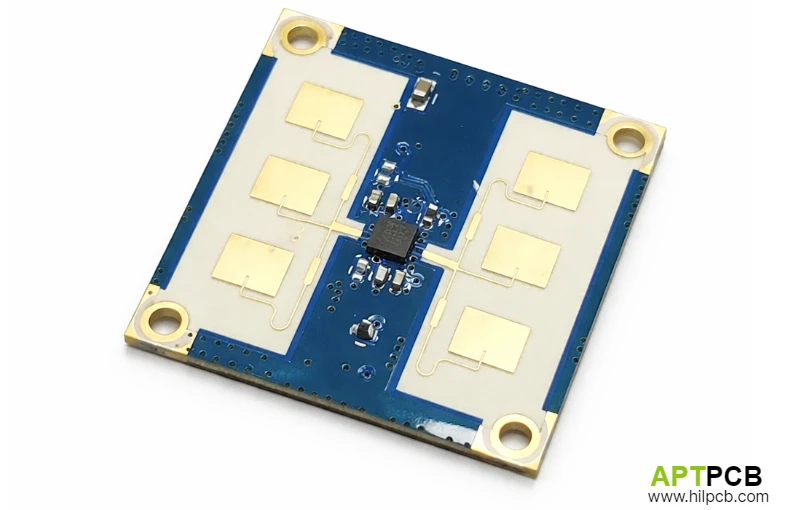
Rogers RO3003 is a ceramic-filled PTFE laminate used in microwave and RF circuits. Its published typical process dielectric constant is 3.00 ± 0.04, typical dissipation factor is 0.0010 at 10 GHz, and water absorption is 0.04%. Those properties support low-loss RF design, but they do not define the SMT process. Assembly settings must follow the complete PCB construction, surface finish, solder paste, components, package geometry, and validation plan.
Key takeaways
- Separate bare-board fabrication requirements from assembly requirements. RO3003 hole preparation and metallization are fabrication controls; stencil, reflow, cleaning, and X-ray are assembly controls.
- Do not mandate pre-bake or nitrogen by material name alone. Use the board construction, finish, storage history, paste, component limits, and qualified process data.
- Hybrid RO3003/FR-4 builds can introduce thermal-mass, warpage, and interface behavior that a simple two-layer RF board does not share.
- Define bottom-terminated component voiding and coverage by package function and measurement method. A universal percentage is not a complete acceptance rule.
- Verify RF performance after assembly when connectors, shields, solder volume, cleaning, rework, or thermal exposure can change the measured channel.
What changes when RO3003 enters assembly?
RO3003 is compatible with lead-free processing, but the assembled board may contain bonding materials, FR-4 layers, solder masks, finishes, plated holes, filled vias, and components with narrower temperature limits. The production recipe must satisfy the weakest element in that system.
| Construction | Main assembly concern | Release evidence |
|---|---|---|
| Two-layer RO3003 RF board | Thin-board handling, connector coplanarity, low thermal mass | Carrier need, reflow data, RF test |
| Multilayer RO3003 | Via structures, copper distribution, total thermal mass | Stackup, coupon data, profile map |
| RO3003/FR-4 hybrid | Material/interface behavior, bow/twist, asymmetric heating | Construction drawing, flatness and thermal validation |
| RF module with exposed-pad devices | Paste distribution, package seating, voiding, heat path | Stencil drawing, SPI/X-ray, thermal correlation |
| Board with soldered RF connectors or shields | Launch alignment, ground continuity, mechanical load | Fixture, solder inspection, VNA result |
The supplier should receive the approved stackup and material callouts, not only the word “Rogers.” For related fabrication scope, see Rogers PCB manufacturing.
Incoming and storage controls
Confirm the board revision, material/construction evidence, surface finish, dimensions, flatness, electrical-test result, impedance or RF coupon result where specified, and packaging condition before assembly.
Moisture handling should be construction-specific. RO3003 itself has low published water absorption, but solder mask, bonding layers, packaging, storage exposure, and moisture-sensitive components can still govern the process. Bake only under an approved condition that will not oxidize the finish, distort the board, or exceed component/packaging rules.
Record time out of controlled packaging for moisture-sensitive devices and follow the relevant component handling requirements. Do not use a board bake as a substitute for MSL control.
Stencil and paste design for RF packages
RF power amplifiers, transceivers, mixers, and regulators often use bottom-terminated packages with a central ground or thermal pad. Paste design must balance electrical grounding, heat transfer, package seating, flux escape, and acceptable void distribution.
Review:
- stencil thickness relative to fine-pitch perimeter pads and the center pad;
- segmented window-pane apertures for large pads;
- via-in-pad fill/cap condition and whether open vias can wick solder;
- solder-mask-defined or non-solder-mask-defined geometry from the component guidance;
- placement force, package warpage, board flatness, and coplanarity; and
- the X-ray measurement method and project-specific acceptance limits.
SPI confirms the deposited paste before placement. X-ray can show hidden solder distribution after reflow. Neither proves the RF impedance or thermal performance without the corresponding electrical or thermal test.
Develop the reflow profile from the actual assembly
Start with the solder-paste technical data sheet, component reflow limits, PCB construction, finish, and production oven. Attach thermocouples at representative hot and cold locations: a large ground pad, dense RF package, connector/shield area, board edge, and hybrid-material transition where relevant.
Use the production panel and carrier. A heavy pallet or shield frame changes airflow and thermal lag. Record ramp, soak, time above liquidus, peak, conveyor speed, atmosphere, and measured component/board temperatures.
Nitrogen can improve wetting or reduce oxidation for some finishes and process windows, but it is not universally required because a board contains RO3003. Qualify the atmosphere against the selected paste, finish, package, solderability, voiding, and defect evidence.
Reprofile after changes to paste, finish, panel, carrier, large components, shields, oven, or board construction.
Protect RF launches and ground structures during assembly
At microwave frequencies, a soldered connector transition is part of the RF circuit. Pad geometry, ground-via placement, connector pin height, solder volume, board-edge geometry, and fixture load can shift return loss or insertion loss.
Assembly drawings should define:
- connector seating datum and allowable tilt;
- ground-tab and center-pin solder requirements;
- board-edge or launch dimensions controlled by fabrication;
- keep-outs for metal tools, coating, labels, and adhesive;
- shield-frame flatness and solder continuity; and
- torque or mechanical support applied after assembly.
Use a fixture when connector alignment cannot be held by the land pattern alone. Do not allow the coaxial cable or test adapter to load the solder joint during RF measurement.
Cleaning, coating, and rework
Flux residue and cleaning chemistry can affect high-impedance nodes, corrosion risk, coating adhesion, and RF behavior around narrow gaps. Define the paste/flux, cleaning method, cleanliness requirement, drying, masking, and post-clean inspection as one process.
Coating or underfill changes dielectric loading near RF structures. Keep it out of resonators, filters, antennas, connector launches, tuning elements, and other sensitive regions unless the design has been modeled and validated with that material present.
Rework adds a second thermal history and can disturb pads, vias, connector alignment, and nearby tuning structures. Require an approved rework procedure and repeat the relevant inspection and RF test after repair.
Inspection and RF validation plan
| Evidence | What it answers |
|---|---|
| SPI | Was the intended paste volume and position printed? |
| AOI | Are visible parts, polarity, joints, and placement correct? |
| X-ray | Are hidden pads bridged, misaligned, or affected by unacceptable solder distribution? |
| Electrical test | Are intended nets free of opens and shorts under the test condition? |
| TDR or impedance coupon | Did the fabricated transmission-line geometry meet the defined target? |
| VNA measurement | Does the assembled RF path meet insertion loss, return loss, phase, or isolation limits at the calibrated reference plane? |
| Thermal test | Does the package-to-board-to-housing heat path meet the defined operating condition? |
Define calibration method, fixtures, cables, de-embedding, reference plane, frequency range, power, temperature, and pass/fail limits. Otherwise two suppliers can produce different “passing” RF reports from the same board.
RFQ checklist for RO3003 PCB assembly
Provide:
- Gerber or ODB++, drill, netlist, complete material stackup, impedance and fabrication drawings;
- BOM, approved alternates, centroid, assembly drawings, 3D model, and package data;
- surface finish, paste/alloy, stencil, via-in-pad, cleaning, coating, and rework requirements;
- RF connector/shield fixtures, mechanical datums, torque, and handling restrictions;
- SPI, AOI, X-ray, electrical, impedance, VNA, thermal, and functional-test limits;
- golden sample or reference data where available; and
- prototype volume, forecast, traceability, report, and change-control needs.
APTPCB can review whether the fabrication, assembly, and RF-test handoff is internally consistent before build.
Reference standards and documents
- Rogers RO3003 laminate data sheet and RO3000 series fabrication guidance
- Solder-paste, component, connector, and coating supplier technical data
- IPC-6018 — Qualification and Performance Specification for High Frequency (Microwave) Printed Boards
- IPC-7525 — Stencil Design Guidelines
- IPC J-STD-001 and IPC-A-610 — Soldered-assembly requirements and acceptability
- IPC-TM-650 — Applicable material and printed-board test methods
FAQ
Does every RO3003 PCB need to be baked before assembly?
No. Make the decision from the complete board construction, packaging and storage history, surface finish, component MSL controls, and an approved process—not the laminate name alone.
Is nitrogen reflow mandatory for RO3003?
No. Atmosphere selection depends on paste, finish, solderability, oxidation, voiding, and the qualified process window. Verify it with assembly evidence.
Can AOI inspect the center pad under an RF package?
No. AOI cannot see a hidden bottom-terminated joint. Use X-ray or another suitable method, then correlate solder evidence with thermal and RF performance where needed.
Does passing TDR prove the assembled RF module will pass?
No. TDR or coupons assess defined interconnect behavior. Components, connectors, solder, shields, fixtures, and tuning still affect the assembled RF response.
Should coating be applied over RF traces?
Only when the design includes the coating's dielectric effect and the process is validated. Sensitive launches, filters, resonators, antennas, and tuning areas commonly require keep-outs.
Qualify the assembly that will be measured
RO3003 assembly is predictable when construction, finish, stencil, reflow, connector mechanics, cleanliness, and RF validation share one controlled release. Send the complete board-and-test package for a build-specific review and quote.