
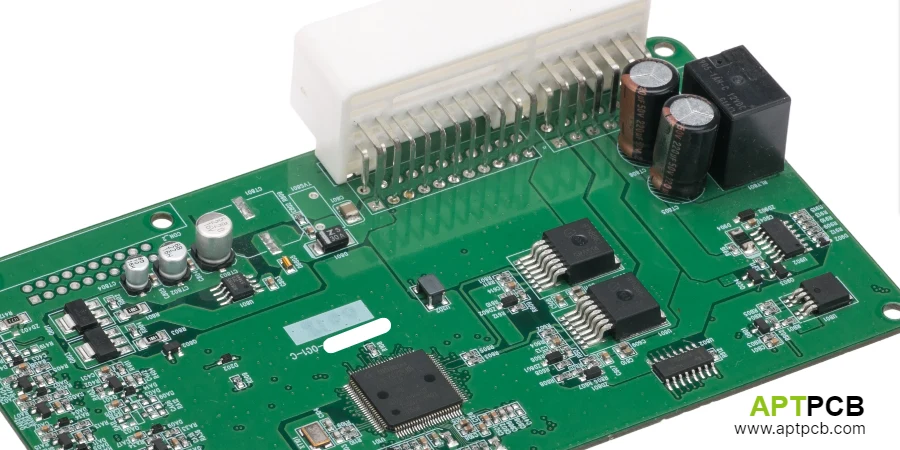
A robotics controller PCB manufacturer reviews more than the circuit artwork. The board-level review determines whether the design package can move from engineering release into stable PCB fabrication and PCBA production.
The review usually covers:
- controller board family and manufacturing requirements
- stackup and layout handoff quality
- mixed-signal partitioning and grounding boundaries
- connector, enclosure, and mounting integration
- assembly process capability
- coating, inspection, and test access
- completeness of fabrication and assembly documentation
Quick Answer
A robotics controller PCB manufacturer reviews whether each board can be fabricated, assembled, inspected, and serviced without avoidable ambiguity. The review focuses on board role, stackup feasibility, layout partitioning, connector reliability, mechanical constraints, assembly controls, coating requirements, and test readiness.
For the broader industry context, start with Robotics PCB. The board-level review then narrows into PCB and PCBA decisions that can be quoted, manufactured, and validated.
In This Guide
- Which robotics controller boards need separate manufacturing reviews?
- What does a manufacturer check in the PCB stackup and layout?
- How do connectors and mechanical constraints affect PCB production?
- What assembly and test decisions should be reviewed before release?
- What should be included in a robotics PCB manufacturing handoff package?
- Robotics controller PCB supplier review checklist
- FAQ
Which robotics controller boards need separate manufacturing reviews?
A robotics platform usually contains several PCB families. Each board creates different fabrication, assembly, and inspection requirements.
| Board class | Primary review focus | Manufacturing decisions |
|---|---|---|
| Main control board | Multilayer stackup, processor density, mixed-signal routing | Layer structure, reference planes, package escape, test access |
| Drive-interface or servo board | Power paths, connectors, high-current interfaces | Copper distribution, terminal mounting, assembly sequence |
| Sensor or I/O board | Analog signals, communication interfaces, connectors | Signal separation, return paths, shielding boundaries |
| Backplane/interconnect board | Board mating and alignment | Connector coplanarity, mechanical tolerance, fixture support |
| Power-distribution board | Thermal and assembly robustness | Copper balance, thermal spreading, heavy-component support |
The first supplier discussion should identify the exact board family. A sensor interface PCB and a motor-control interface PCB may belong to the same robot, but they require different manufacturing reviews.
What does a manufacturer check in the PCB stackup and layout?
The stackup and layout review determines whether electrical intent has been translated into a manufacturable board structure.
Key review areas include:
| Review item | Manufacturer decision point |
|---|---|
| Layer stackup | Whether layer count, dielectric structure, and copper distribution support fabrication requirements |
| Reference planes | Whether return paths remain continuous through sensitive areas |
| Mixed-signal partitioning | Whether analog sensing, digital processing, communication, and power sections are clearly separated |
| Via structures | Whether selected via technology matches fabrication capability |
| Component density | Whether packages, footprints, and inspection methods are practical |
A robotics controller PCB manufacturer typically reviews:
- digital processing areas
- analog sensing zones
- communication interfaces
- power routing regions
- shielding locations
- grounding boundaries
- connector placement
The manufacturing question is:
Can this PCB stackup and layout be built, assembled, and inspected consistently from the released data package?
If the layer plan is still being developed, PCB Stack Up provides additional guidance for layer planning and manufacturable density.
How do connectors and mechanical constraints affect PCB production?
Robotics controller boards operate inside moving equipment, cabinets, compact modules, and serviceable electronics assemblies. Mechanical details directly influence assembly quality.
A board-level manufacturer reviews:
- connector orientation and cable access
- locking mechanisms and insertion forces
- mounting holes and enclosure keepouts
- heatsink and shield clearances
- component height restrictions
- board-edge requirements for depanelization
- service and rework access
Robotics controller PCB mechanical risk review
| Design area | Manufacturing concern | Review output |
|---|---|---|
| Large capacitors and inductors | Solder-joint stress under vibration | Reinforcement or mechanical support decision |
| Vertical connectors | Mechanical loading during cable insertion | Retention and mounting review |
| Shield interfaces | Coating and assembly conflicts | Masking and assembly sequence definition |
| Board mounting points | Stress transfer into PCB | Hole, clearance, and fixture review |
Heavy components and high-force connectors deserve special attention because vibration can create solder fatigue or pad stress over time. Mechanical staking, adhesive support, coating keep-outs, and reinforcement requirements should be defined during DFM review.
What assembly and test decisions should be reviewed before release?
A robotics controller PCB review should connect layout decisions with assembly and production verification.
Important assembly topics include:
- fine-pitch component placement
- hidden solder joint inspection requirements
- thermal imbalance during reflow
- solder paste and stencil considerations
- connector installation sequence
- cleanliness requirements
- conformal coating boundaries
Testing should focus on manufacturing verification rather than complete robot-system validation.
Typical board-level test planning includes:
- AOI inspection
- X-ray inspection where required
- flying probe testing
- ICT fixture planning
- programming access
- first-article inspection
Related manufacturing resources:
What should be included in a robotics PCB manufacturing handoff package?
The quality of the manufacturing review depends on the completeness of the release package.
A supplier should receive:
| Package area | Required information |
|---|---|
| PCB fabrication | Gerber or ODB++, drill files, stackup, thickness, finish requirements |
| Assembly | BOM, centroid data, assembly drawings, polarity information |
| Mechanical | Enclosure limits, mounting details, connector direction, height restrictions |
| Process | Coating masks, reinforcement notes, cleaning requirements |
| Test | Test points, fixture requirements, programming access, inspection expectations |
A complete package allows the manufacturer to review real production risks instead of spending time resolving missing design intent.
Robotics controller PCB supplier review checklist
Before approving a PCB or PCBA supplier, confirm that the review covers:
| Decision area | Questions to confirm |
|---|---|
| Board scope | Has each controller board family been identified separately? |
| Stackup | Are material, layer count, copper distribution, and impedance requirements defined? |
| Layout | Are sensitive signals, power areas, and return paths documented? |
| Mechanical fit | Are connectors, mounting points, and enclosure interfaces reviewed? |
| Assembly | Are inspection methods and assembly constraints understood? |
| Coating | Are coated and uncoated regions clearly defined? |
| Testing | Are test points, fixtures, and programming access planned? |
| Documentation | Do fabrication and assembly files match the released revision? |
Next steps: Request a Mechanical Integration & Assembly Reliability Review
If your robotics controller PCB includes mixed-signal partitioning, vibration-sensitive components, complex connectors, or coating and shielding requirements, provide the manufacturing package before committing to a pilot build.
Send Gerber or ODB++, BOM, assembly drawings, and mechanical notes through Quote or contact [email protected].
APTPCB's PCBA process and DFM engineering team reviews board manufacturability, assembly readiness, mechanical integration, and test planning before production release.
FAQ
Does a robotics controller PCB review include robot motion validation?
No. This review focuses on PCB and PCBA manufacturing topics such as fabrication, assembly, inspection, and test readiness.
What is the difference between a main controller board and a sensor interface board?
A main controller board usually requires deeper review of processing density, stackup, package escape, and test access. A sensor interface board typically requires stronger focus on analog routing, connectors, shielding, and signal cleanliness.
Should every robotics controller PCB use conformal coating?
No. Coating depends on environmental exposure, contamination requirements, connector access, service needs, masking requirements, and rework considerations.
Why are connectors reviewed during PCB manufacturing?
Connector location and mechanical loading affect assembly yield, solder reliability, enclosure fit, and long-term serviceability.
When should DFM review happen?
The most effective review occurs before final production release, when stackup, layout, BOM, mechanical constraints, and test requirements can still be adjusted.
Public references
Analog Devices, "MT-031: Grounding Data Converters and Solving the Mystery of AGND and DGND"
Keysight, "ICT vs Flying Probe: Best Method for High-Volume Manufacturing"
Related APTPCB pages
Author and review information
- Author: APTPCB industry solutions content team
- Technical review: PCB manufacturing, PCBA process, and DFM review team
- Last updated: 2025-01-03