
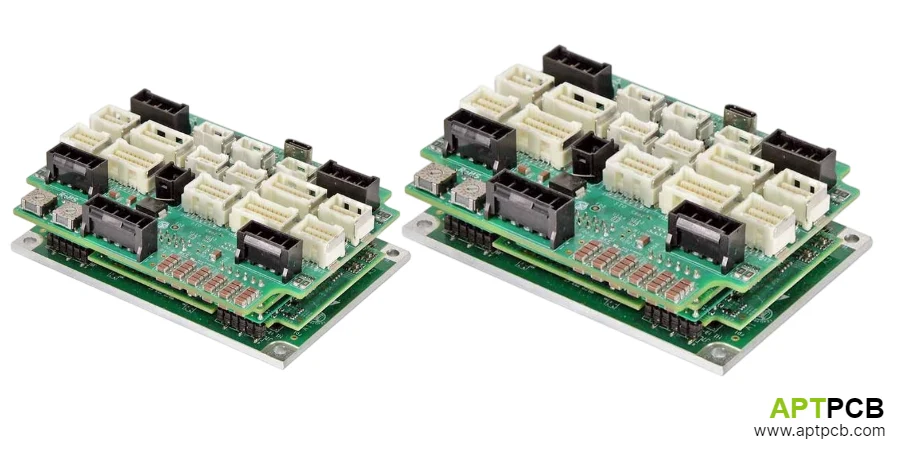
A servo drive PCB is the electrical foundation of a closed-loop motion system. It must convert position commands into precise motor torque while maintaining encoder accuracy, current regulation stability, electromagnetic compatibility, and long-term reliability.
Unlike general motor control boards, servo controller circuit boards combine high-current switching, precision analog measurement, high-speed communication, and safety circuits on the same assembly. A successful design balances control bandwidth, power density, thermal behavior, and manufacturing requirements from the beginning.
This guide explains the engineering decisions that determine servo drive PCB performance in CNC equipment, robotics, semiconductor tools, industrial automation, and precision motion platforms.
In This Guide
- How should a servo drive PCB architecture be selected?
- How are encoder feedback interfaces designed for accuracy?
- What PCB requirements determine current loop performance?
- How should servo power stages be designed?
- How do EMC and signal integrity affect servo accuracy?
- How are thermal and safety requirements engineered?
- What should engineers evaluate in a servo PCB supplier?
How should a servo drive PCB architecture be selected?
Servo drive PCB architecture depends on motor voltage, current range, control bandwidth, feedback type, communication protocol, and safety requirements. The board must separate three electrical domains:
| PCB Domain | Primary Function | Key Design Requirements |
|---|---|---|
| Power stage | Motor phase switching and regeneration | Low-inductance current paths, thermal capacity, isolation spacing |
| Control section | DSP, MCU, FPGA, ADC processing | Low-noise power rails, deterministic timing, controlled clocks |
| Feedback and communication | Encoder, EtherCAT, fieldbus interfaces | Signal integrity, isolation, EMC immunity |
A high-performance servo system typically uses fast inner current loops, slower velocity loops, and position loops that coordinate the complete mechanical system. The PCB layout must support the latency requirements of each control layer.
A typical selection matrix:
| Application Requirement | PCB Design Priority |
|---|---|
| CNC spindle or axis drive | High-current power layout, encoder accuracy, thermal cycling |
| Robot joint actuator | Compact multilayer stack-up, low latency, vibration resistance |
| Semiconductor equipment | Ultra-low noise feedback routing, repeatability, contamination control |
| Packaging automation | Fast acceleration cycles, regenerative energy handling |
How are encoder feedback interfaces designed for accuracy?
Encoder feedback determines how accurately the servo system knows motor position. Incremental encoders, absolute encoders, resolvers, and analog sensors each create different PCB requirements.
High-resolution incremental encoders commonly use differential signaling above 10MHz. The PCB receiver stage must preserve edge timing and reject common-mode industrial noise.
Absolute encoder protocols such as BiSS, EnDat, and Hiperface may operate at rates up to 10Mbps. These interfaces require careful routing between connectors, isolation barriers, and processing devices.
The high-speed PCB design approach used for servo feedback should include:
- Differential termination matched to the receiver interface.
- Controlled impedance routing for high-speed pairs.
- Encoder cable shield connection near the chassis entry point.
- Filtering that removes noise without reducing signal bandwidth.
- Hardware monitoring for communication faults and signal loss.
Encoder interface selection should consider:
| Requirement | Design Parameter |
|---|---|
| Position resolution | Encoder bit depth and signal integrity margin |
| Cable length | Noise immunity and isolation architecture |
| Multi-axis synchronization | Clock quality and communication latency |
| Safety motion functions | Redundant feedback processing |
What PCB requirements determine current loop performance?
The current loop is the fastest servo control layer and directly affects torque response. Standard servo drives commonly operate current loops at 10–20kHz, while advanced systems may exceed 50kHz.
Current measurement accuracy depends on the complete sensing chain: shunt resistor, amplifier, ADC, reference voltage, processor timing, and PCB layout.
Typical high-performance requirements include:
- Current measurement accuracy around ±0.5%.
- Sensor settling time below 1μs for fast current response.
- Common-mode transient immunity above 50kV/μs for isolated measurement systems.
- Low-inductance shunts below 5nH where high transient performance is required.
The signal processing PCB layout must keep analog measurement paths isolated from switching noise sources.
| Design Parameter | Effect on Servo Performance |
|---|---|
| Shunt placement | Determines measurement noise and response time |
| ADC trigger timing | Controls repeatability of current sampling |
| Ground strategy | Prevents switching currents corrupting measurements |
| Digital latency | Limits achievable control bandwidth |
How should servo power stages be designed?
Servo power stages must support acceleration, deceleration, reversing torque, and regenerative energy flow. Unlike simple motor controllers, servo drives frequently operate in four-quadrant modes.
The multilayer PCB stackup must minimize parasitic inductance in high-current loops while maintaining isolation between power and control circuits.
Important power-stage considerations include:
- DC bus capacitors selected for switching ripple current.
- Brake chopper circuits designed for regenerative energy.
- Gate drive loops minimized for switching stability.
- Hardware overcurrent protection designed for rapid fault response.
- PWM frequency selected based on efficiency and control bandwidth requirements.
Servo power stages commonly use PWM frequencies in the 10–20kHz range. Increasing frequency can improve current response but increases switching losses and thermal load.
How do EMC and signal integrity affect servo accuracy?
Servo PCB design requires simultaneous management of high-energy switching nodes and sensitive feedback signals. PWM edges, motor currents, and cable interfaces can introduce noise that appears as position error, jitter, or unexpected faults.
Critical EMC design practices include:
- Maintaining separation between switching nodes and encoder traces.
- Using appropriate isolation barriers between voltage domains.
- Routing differential pairs with consistent geometry.
- Providing clean return paths for high-speed signals.
- Filtering external interfaces without reducing required bandwidth.
Position commands may arrive through EtherCAT, PROFINET IRT, SERCOS, ±10V analog inputs, or pulse-direction interfaces. Industrial communication interfaces require careful clock, PHY, and grounding decisions.
EtherCAT systems may require sub-microsecond synchronization performance through distributed clock operation, making PCB timing quality important for multi-axis coordination.
How are thermal and safety requirements engineered?
Servo motors experience dynamic loads rather than constant power demand. Acceleration events may create peak currents 3–5 times higher than continuous operating current.
Thermal management PCB design must account for motion profiles, switching losses, and repeated thermal cycling.
| Failure Mode | PCB Cause | Engineering Control |
|---|---|---|
| Position instability | Encoder noise coupling | Differential routing, filtering, isolation |
| Overheating during motion | Insufficient transient thermal design | Copper optimization, thermal modeling, temperature sensing |
| Power device failure | Excess switching stress | Gate drive optimization and protection circuits |
| Safety shutdown failure | Incomplete isolation design | Redundant monitoring and diagnostic coverage |
Functional safety features such as Safe Torque Off (STO), Safe Stop 1 (SS1), Safe Speed Monitoring, and Safe Direction require PCB implementations that support safety certification evidence.
Safety-focused designs commonly include:
- Dual-channel monitoring.
- Isolated safety inputs.
- Hardware shutdown paths independent of software execution.
- Diagnostic circuits for fault detection.
- Documentation supporting IEC 61800-5-2 compliance activities.
What should engineers evaluate in a servo PCB supplier?
Servo drive PCB sourcing requires more than checking fabrication capability. The supplier must demonstrate experience handling mixed-signal, high-current, and safety-critical assemblies.
A supplier evaluation checklist:
| Evaluation Area | Evidence to Request |
|---|---|
| High-current capability | Copper weight, thermal data, power PCB examples |
| Signal integrity | Impedance control documentation and stack-up control |
| Assembly quality | AOI, X-ray inspection, process traceability |
| Functional validation | Servo load testing and communication verification |
| Safety manufacturing | Isolation inspection and documentation control |
| Production readiness | DFM review, test fixtures, repeatability data |
A reliable servo PCB manufacturing process connects schematic intent, PCB layout, assembly quality, and final functional testing. The design package should include controlled drawings, approved materials, test requirements, and clear performance limits.
Summary
Servo drive PCB engineering requires coordinated decisions across feedback accuracy, current-loop bandwidth, power conversion, EMC control, thermal performance, and functional safety.
The strongest designs begin with measurable requirements: encoder resolution, current accuracy, switching frequency, operating temperature, isolation needs, and expected motion profile. Translating those requirements into PCB architecture and supplier verification criteria creates motion systems that deliver repeatable precision from prototype through production.