
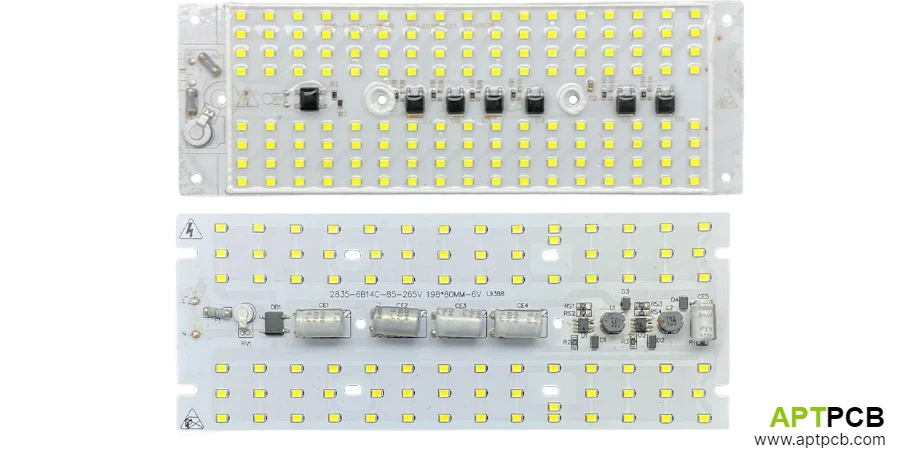
LED PCB thermal management controls the complete heat path from the LED junction through the package, solder, board, interface material, heatsink or housing, and finally to ambient. The best board is not automatically the one with the highest advertised conductivity. It is the construction that meets electrical, optical, mechanical, manufacturing, and temperature limits in the real product.
Key takeaways
- Start with allowable junction or reference-point temperature, dissipated power, ambient, airflow, enclosure, orientation, duty cycle, and lifetime objectives.
- Use only the thermal resistance defined for the LED package and its stated reference point.
RθJA,RθJB, andRθJCare not interchangeable. - Choose FR-4 with thermal vias, IMS/MCPCB, direct thermal path, ceramic, or a local metal feature from the dominant bottleneck—not from a generic power threshold.
- Control every interface. Solder voids, dielectric thickness, board flatness, TIM bond line, screw loading, heatsink size, and airflow can outweigh a substrate upgrade.
- Measure the assembled product under defined worst-case conditions. An infrared image, a bare-board coupon, or a low board-surface temperature alone does not prove junction temperature or LED life.
- Freeze the thermal model, PCB construction, LED land pattern, stencil, assembly process, mounting method, sensors, limits, sampling, and change rules before production.
Table of Contents
- What does LED PCB thermal management control?
- How should the LED thermal path be modeled?
- Which LED PCB platform should be selected?
- How should thermal vias and copper be designed?
- What assembly and mechanical controls matter?
- How should LED temperature be validated?
- Failure modes and evidence
- Cost and lead-time drivers
- RFQ checklist
- Standards and responsibility boundary
- FAQ
What does LED PCB thermal management control?
An LED board may carry emitters, current drivers, protection, connectors, sensors, and control circuits. Its thermal job is to move heat out of each source without creating excessive temperature differences, solder stress, electrical-isolation risk, optical drift, or an assembly process that cannot be repeated.
The design inputs should be released as conditions, not slogans:
| Required input | Why it changes the board and validation plan |
|---|---|
| LED part number and package | Defines land pattern, thermal pad, allowed junction temperature, thermal reference point, reflow, handling, and measurement guidance |
| Drive current, waveform, dimming, and duty cycle | Determines electrical loss, peak heating, transient response, and operating state for test |
| LED count, spacing, and optical target | Controls whether sources behave independently or as a dense thermal array |
| Driver and other component losses | Prevents the model from treating LEDs as the only board heat sources |
| Ambient, solar load, airflow, enclosure, and orientation | Defines the real boundary for convection, conduction, and radiation |
| Heatsink, housing, TIM, and mounting | Determines how heat exits the PCB and whether contact remains stable |
| Temperature and optical limits | Sets acceptance criteria and the margin needed for tolerances and aging |
| Environment and product class | Drives cycling, moisture, vibration, corrosion, insulation, safety, and reliability work |
An indicator board, an indoor luminaire, a horticulture array, a UV-curing head, a headlamp module, and a high-density display do not share one universal stack-up or temperature limit.
How should the LED thermal path be modeled?
Start with the entire chain:
junction → package thermal path → solder or attach → PCB copper/thermal feature → dielectric or substrate → TIM/contact → heatsink or housing → ambient
Each segment adds resistance, and heat spreads in three dimensions. A simple series model can organize assumptions, but detailed layouts may need spreading-resistance analysis, compact thermal models, transient simulation, or correlated FEA/CFD.
Define heat input correctly
Electrical input is not automatically equal to heat. Where suitable optical-output data exists, estimate dissipated power from the defined operating point. Include the LED driver, current-setting parts, protection devices, connectors, and nearby electronics when they warm the same enclosure or cooling path.
For pulsed or PWM operation, distinguish peak, average, and transient conditions. A low average power can still create short junction-temperature excursions that a steady-state model hides.
Use package thermal data from the correct reference point
A first-pass steady-state relation may be written as:
Tj ≈ Tx + Pd × RθJ-X
where Tx is the temperature at the exact reference point used by the LED manufacturer, Pd is dissipated power under the stated condition, and RθJ-X is the corresponding thermal resistance. The equation is useful only when the reference point, mounting condition, heat path, and test method match the application.
Do not insert a datasheet RθJA into a custom heatsink model or substitute a board temperature for a specified solder-point or case temperature. Parallel heat paths, dense arrays, nearby sources, temperature-dependent power, and transient behavior may require a more complete model.
Allocate a thermal budget
| Thermal segment | Design question | Evidence to release |
|---|---|---|
| Junction to package reference | Which vendor value and mounting condition apply? | Current datasheet, application note, compact model, and reference-point definition |
| Package to PCB | Does land pattern, solder coverage, attach, and voiding support the assumed path? | Approved footprint, stencil, process window, inspection method, and correlated sample data |
| Through or across PCB | Is the bottleneck copper spreading, vias, dielectric, substrate, inlay, or geometry? | Stack-up, material data, finished dimensions, model, coupon or cross-section where useful |
| PCB to heatsink/housing | Are flatness, TIM, contact area, pressure, and fasteners controlled? | Mechanical drawing, TIM specification, bond-line or compression control, and assembly record |
| Heatsink/housing to ambient | Does the product reject heat at worst-case orientation and airflow? | Thermal model and representative enclosure test with defined ambient boundary |
Which LED PCB platform should be selected?
Select the simplest platform that meets the complete electrical and thermal budget with production margin.
| PCB platform | Best fit | Main limitations to resolve | Useful release evidence |
|---|---|---|---|
| FR-4 with copper spreading | Lower heat flux, larger board area, or a secondary mechanical heat path | Low through-thickness conductivity and local hotspots | Copper geometry, layer stack, measured temperature map, and assembly boundary |
| FR-4 with thermal vias | Local heat must cross an organic board into a spreader or chassis | Via resistance, solder wicking, routing, fill/cap, and board thickness | Via geometry, plating, position, fill/cap process, cross-section, and thermal correlation |
| Standard IMS/MCPCB | A mostly planar circuit can transfer heat through a dielectric into a metal base | Dielectric resistance, limited routing, isolation, CTE, flatness, and board-to-sink interface | Exact dielectric, thickness, base, copper, isolation, flatness, and TIM/mounting specification |
| Direct thermal path MCPCB | The local IMS dielectric is the demonstrated bottleneck | Thermal-pad electrical potential, custom fabrication, tolerances, soldering, and inspection | LED pad definition, DTP geometry, isolation boundary, section, and measured benefit |
| Ceramic substrate | High temperature, isolation, dimensional stability, or cycling needs justify it | Brittleness, metallization, attachment, size, cost, and mechanical integration | Ceramic family, thickness, metallization, finish, attachment, mechanical support, and qualification plan |
| Copper coin, inlay, or local spreader | A concentrated source needs local extraction while the board retains multilayer routing | Coin bond, coplanarity, plating, isolation, registration, and inspection | Drawing-defined feature, datum, height, bond, cross-section, and assembly correlation |
FR-4 is not automatically disqualified by LED power, and MCPCB is not automatically sufficient. A well-designed via path into a chassis may outperform an IMS board with a poor dielectric or loose heatsink contact. Conversely, adding vias cannot compensate for a board architecture that lacks a viable exit path.
For a focused comparison of aluminum and copper bases, standard IMS, and direct thermal path, use the metal core PCB for LED guide. A ceramic PCB or high-thermal PCB should be evaluated only when its construction fits the product boundary.
How should thermal vias and copper be designed?
Thermal vias conduct mainly through their plated copper walls. Their benefit depends on finished hole geometry, plating, quantity, position relative to the heat source, board thickness, copper connection, spreading area, and what contacts the opposite side.
Via decisions to freeze
- Place vias from the LED package and field distribution, not a universal pitch or via count.
- Define drill, finished diameter, finished plating, pad, clearance, tenting, fill, cap, and acceptance.
- Use filled and capped via-in-pad when assembly needs a flat solder surface and controlled wicking; do not require it where ordinary off-pad vias meet the thermal and assembly need.
- Prevent open vias in a thermal pad from draining solder or creating backside solder features unless the released process intentionally controls them.
- Connect vias to useful copper and a real receiving surface. A dense via field that ends at an isolated small pad cannot reject heat.
- Verify manufacturability, current return, electrical isolation, solder mask, and inspection access together.
Copper spreading should follow heat-flux distribution, current paths, etching limits, component clearances, optical layout, and board strain. More copper can improve spreading but may increase thermal mass, solder imbalance, warpage, routing difficulty, and cycle stress. Use heavy copper PCB guidance only when electrical current or spreading analysis justifies it.
For IMS, compare the finished dielectric product, through-plane property, thickness, isolation, bond reliability, and test method. Bulk metal conductivity alone does not predict board thermal resistance. A thin dielectric can reduce resistance but may reduce electrical margin or process tolerance; the design must satisfy both.
What assembly and mechanical controls matter?
The thermal model is only valid if production preserves its interfaces.
LED attach and solder voiding
Use the package manufacturer's land pattern and assembly guidance. Freeze stencil thickness and apertures, paste, placement, reflow profile, board support, thermal-pad acceptance, inspection method, rework, and sampling.
There is no universal void percentage that proves thermal acceptability. Define whether the requirement applies to total void area, the largest void, location, edge coverage, image threshold, or another metric. Correlate the limit with the package, heat flux, solder geometry, measurement repeatability, and thermal result. X-ray can reveal hidden solder distribution but does not directly measure thermal resistance.
Board-to-heatsink interface
TIM conductivity is only one input. Control:
- Material identity, thickness, compression or bond line, coverage, storage, and cure where applicable
- PCB and mating-surface flatness, roughness, cleanliness, and damage limits
- Fastener locations, washers, supports, torque, sequence, and relaxation
- Electrical isolation, exposed metal, edge clearance, and hardware paths
- Pump-out, dry-out, creep, delamination, corrosion, vibration, and thermal-cycle behavior where relevant
An excessively thick TIM layer can add resistance; excessive pressure can bow the board, tilt LEDs, crack ceramic packages, squeeze out material, or load solder joints. Review thermal interface material selection with the mechanical design, not as a purchasing decision made after the PCB is complete.
Reflow, CTE, and process repeatability
IMS, ceramic, thick copper, and metal inserts change heat capacity, warpage, support, profiling, and cooling behavior. A profile developed on a standard FR-4 coupon may not transfer. CTE differences between the LED package, solder, PCB, metal base, ceramic, and housing can drive fatigue during power or environmental cycling.
An early DFM review should include the PCB, stencil, carrier, heatsink interface, fasteners, enclosure, and test access.
How should LED temperature be validated?
Test the complete thermal boundary at the worst credible combination of drive, duty cycle, LED tolerance, driver loss, ambient, orientation, airflow, enclosure state, solar or neighboring heat, TIM condition, and mounting variation.
| Method | Strong use | Important limitation |
|---|---|---|
| Package thermal-sensing parameter | Estimates junction temperature using a vendor-defined electrical method | Requires calibration, timing, low measurement current, switching control, and the correct package procedure |
| Thermocouple at case/solder point/board | Repeatable temperature at a defined accessible location | Wire size, adhesive, placement, contact, and routing can disturb or bias the result |
| Infrared imaging | Finds surface hotspots, spreading patterns, and unit-to-unit differences | Measures surface temperature; emissivity, reflections, focus, coatings, and hidden junctions can mislead |
| Thermal transient measurement | Separates time constants and can help locate interface changes | Requires suitable equipment, models, fixtures, and interpretation |
| FEA or CFD correlation | Explores geometry, airflow, interfaces, and design sensitivity | Accuracy depends on material properties, contact resistance, power, mesh, and boundary conditions |
| Optical and electrical monitoring | Shows temperature-related output, color, voltage, or efficiency changes | Must use controlled instruments, stabilization, drive, geometry, and package-specific interpretation |
Define the measurement point, instruments, calibration, emissivity treatment, ambient location, stabilization or transient window, sample size, tolerance, data format, and pass/fail limit before testing.
Board thermal validation does not by itself prove lumen maintenance, color maintenance, photobiological safety, ingress rating, automotive qualification, or luminaire compliance. Those conclusions require the relevant package, optical, environmental, safety, and product-level evidence.
LED PCB thermal failure modes and evidence
| Symptom | Possible contributor | Evidence to request |
|---|---|---|
| LED junction or reference point exceeds limit | Wrong loss assumption, weak package attach, board bottleneck, poor TIM contact, undersized sink, restricted airflow | Power audit, thermal map, package-point measurement, X-ray where useful, interface and airflow inspection |
| One LED or cluster runs hotter | Placement density, current imbalance, local void, via/copper difference, housing contact variation | Per-string current, X-ray, local temperature map, copper/via inspection, contact-pressure pattern |
| Color or output becomes nonuniform when hot | Junction-temperature differences, current variation, optical binning, driver behavior, package sensitivity | Stabilized optical, electrical, and thermal measurements with LED lot and calibration data |
| Intermittent open or cracked joint | Board flex, CTE mismatch, thermal cycling, package tilt, rework, mounting strain | Warpage/strain review, joint inspection or sectioning, reflow and cycling history |
| IMS board is hot above the LED but sink stays cool | Dielectric, TIM, contact pressure, flatness, contamination, or mounting gap | Temperatures across interfaces, stack-up verification, flatness, TIM coverage and fastener record |
| Thermal result changes between lots | Material substitution, dielectric thickness, copper/plating, paste, voiding, TIM, torque, LED lot, fixture, or calibration changed | Lot genealogy, certificates, cross-section, process data, deviation history, calibration and repeat test |
| Dielectric or insulation fails | Wrong construction, thin/damaged dielectric, metal-edge exposure, burr, contamination, spacing or test misuse | Material and drawing review, edge/hole inspection, cleanliness, controlled electrical test and failure analysis |
What drives LED thermal PCB cost and lead time?
Main drivers include exact laminate or IMS dielectric, base metal, copper, layer count, tight finished thickness, via fill/cap, DTP features, coins or inlays, ceramic processing, machining, flatness, surface finish, panel utilization, LED availability and binning, stencil/process development, X-ray, thermal fixtures, measurement equipment, documentation, traceability, and qualification builds.
Reduce cost by selecting the simplest validated heat path, standardizing released materials where possible, separating necessary production screening from engineering qualification, and defining only evidence that changes an acceptance decision. Generic multipliers for MCPCB, copper, ceramic, voiding, or thermal testing are not reliable quotation inputs.
LED thermal PCB RFQ checklist
Product and thermal boundary
- Product type, target market, enclosure, installation, orientation, airflow, ambient range, solar or nearby heat, ingress and service conditions
- LED and driver part numbers, approved alternates, LED bins, current, waveform, dimming, duty cycle, power and temperature limits
- Heatsink or housing drawing, TIM, mounting surfaces, fasteners, torque, flatness, support and electrical-isolation requirements
- Thermal model, dissipated-power assumptions, reference points, sensors, test conditions, acceptance limits and margin
PCB and assembly data
- Gerber or ODB++/IPC-2581, drill/rout, netlist, fabrication drawing, stack-up, dimensions, panel and revision readme
- FR-4, IMS, DTP, ceramic, coin or inlay construction; exact materials, thicknesses, copper, vias, fill/cap, finish and substitutions
- BOM/AVL, centroid, assembly drawing, LED land pattern, stencil, solder paste, reflow, board support, cleaning, coating and rework rules
- Void definition, X-ray or section method, sample size, image analysis, acceptance and failure disposition where required
Validation and production evidence
- Bare-board electrical, dielectric, dimensional, flatness, material, microsection or coupon requirements as applicable
- SPI, AOI, X-ray, electrical, functional, burn-in, thermal, optical, environmental or cycling coverage as applicable
- Fixtures, calibration, reference points, ambient control, stabilization, uncertainty, samples, data files, images and retained records
- Prototype, pilot and production quantities, forecast, schedule, approved deviations, PCN/change notification and requalification triggers
APTPCB can review board construction, assembly manufacturability, interface controls, inspection scope, and quotation alignment. Use the testing and quality overview to define manufacturing evidence, then submit the released package through the metal core PCB thermal review request.
Standards and responsibility boundary
References that may apply include:
- IPC-2221 — Generic Standard on Printed Board Design
- IPC-2152 — Standard for Determining Current-Carrying Capacity in Printed Board Design (a first-pass IPC-2221 check runs in the PCB trace width calculator)
- IPC-6012 — Qualification and Performance Specification for Rigid Printed Boards
- IPC-A-600 and IPC-A-610 — Acceptability of printed boards and electronic assemblies
- J-STD-001 — Requirements for Soldered Electrical and Electronic Assemblies
- IPC-TM-650 — Test Methods Manual
- JEDEC JESD51 family — Semiconductor thermal measurement methods; select the method that matches the LED package and cooling surface
- ANSI/IES LM-80 and TM-21 — LED package/module/array maintenance testing and projection; these do not establish PCB manufacturing life
- IEC 60598 series — Luminaire requirements and tests where applicable
- LED, solder, TIM, PCB material, heatsink, and enclosure manufacturers' current technical guidance
Confirm the revision, product scope, test method, fixture, precedence, and acceptance criteria invoked by the project. PCB and PCBA evidence cannot certify LED lifetime, optical performance, safety, EMC, environmental durability, or final product compliance without representative system validation.
LED PCB Thermal Management FAQ
What is LED PCB thermal management?
It is the design and validation of the complete path that moves heat from LED junctions and other board sources through the package, solder, PCB, interface, heatsink or housing, and into the operating environment.
Do all high-power LED boards need an MCPCB?
No. FR-4 with a controlled via and chassis path may work, while some products need IMS, direct thermal path, ceramic, or a local metal feature. Select the platform from the complete thermal, routing, isolation, mechanical, assembly, and cost boundary.
How is LED junction temperature estimated?
Use the LED manufacturer's defined thermal reference point and matching resistance or compact model, together with dissipated power and the measured or modeled application boundary. Do not interchange RθJA, RθJB, and RθJC.
Are more thermal vias always better?
No. Benefit depends on via position, finished plating, hole geometry, board thickness, copper connection, receiving surface, solder behavior, and spreading. After another interface becomes dominant, extra vias add cost and routing constraints with little thermal gain.
Is the highest-conductivity dielectric always the best choice?
No. Compare the exact product, finished thickness, through-plane property and test method, electrical isolation, bond reliability, temperature behavior, process window, availability, and measured board performance.
When should a direct thermal path MCPCB be used?
Consider it when testing or analysis shows the local dielectric is the limiting resistance and the LED thermal pad is electrically compatible. Resolve isolation, geometry, tolerances, soldering, inspection, supplier capability, and measured benefit before release.
What solder-void limit should be specified under an LED thermal pad?
Use a package- and risk-specific limit that defines measurement method, total and largest voids if relevant, location, sample size, and acceptance. Correlate it with thermal and reliability evidence; there is no universal percentage for every LED assembly.
Can an infrared camera measure LED junction temperature directly?
Usually not. It measures visible surface radiation and can identify hotspots, but emissivity, reflections, coatings, focus, and hidden package layers affect accuracy. Use the package manufacturer's junction or reference-point method for the final limit.
Does a cool PCB prove the LED will meet L70 or product lifetime?
No. Lumen maintenance and product life also depend on the LED package, drive, optical materials, environment, mechanical stress, contamination, and the applicable test and projection methods. Board temperature is only one input.
What should be included in an LED thermal PCB quote request?
Provide released PCB and assembly data, LED and driver parts, operating power and duty, enclosure and heatsink drawings, TIM and mounting controls, thermal assumptions and limits, inspection and test definitions, quantities, records, change rules, and schedule.
Request a manufacturability and thermal-path review
Send the PCB data, BOM, LED package information, operating conditions, mechanical cooling stack, and acceptance plan. A useful review should identify unresolved interfaces, risky substitutions, assembly constraints, and missing evidence before prototype or production release.