
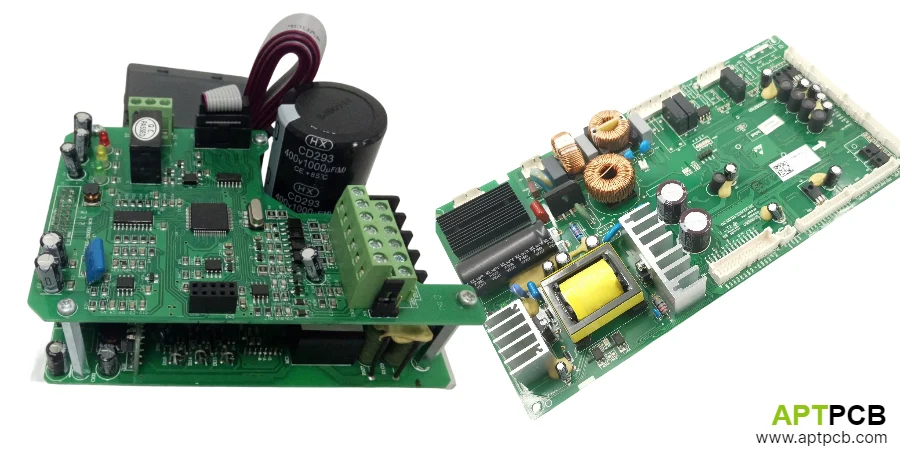
A VFD PCB is a power-electronics board used in a variable frequency drive to rectify AC input, support the DC link, switch a controlled three-phase output, sense electrical conditions, and run protection and control functions. Here, VFD means variable frequency drive, not vacuum fluorescent display.
This guide helps power-electronics, controls, quality, and procurement teams convert drive ratings and installation requirements into defensible PCB, PCBA, safety, thermal, EMC, and verification requirements.
Key takeaways
- Freeze input, DC-link, motor, overload, switching, cable, braking, environment, and compliance requirements before selecting PCB construction.
- Minimize the commutation and gate loops, but verify the result with switching waveforms.
V = L × di/dtexplains overshoot; it does not justify a universal parasitic-inductance limit. - Select isolation components and creepage/clearance from the actual working voltage, transient category, pollution degree, material group, insulation function, altitude, and product standard.
- Treat sensing, protection, EMC, thermal, mechanics, firmware, motor, cable, enclosure, and grounding as one system. PCB layout alone cannot establish compliance.
- Define manufacturing evidence before release: stack-up, materials, assembly limits, tests, traceability, and change control.
- Safe Torque Off is a functional-safety function. A pair of isolated inputs on a PCB does not by itself establish SIL or PL performance.
What does a VFD PCB control?
A typical drive contains input protection and rectification, precharge, a DC-link capacitor bank, a braking or regenerative path where applicable, a three-phase inverter, isolated gate drives, sensing, control, communications, and auxiliary power. These functions may be divided among control, gate-driver, and power boards, busbars, and power modules.
Each block creates a different PCB risk: surge and inrush at the input; ripple and discharge energy at the DC link; overshoot and common-mode current at the inverter; false turn-on at the gate drive; transient error in sensing; and resets or interface damage in control electronics.
PCB construction is architecture-specific. A drive may combine standard multilayer FR-4 control boards, heavy-copper PCB power sections, busbars, insulated metal substrates, direct-bonded substrates, or integrated power modules. Do not select copper weight or substrate from power rating alone.
Requirements to freeze before VFD PCB layout
Start the design review with operating boundaries, not trace-width rules. Link every input to a PCB control and acceptance evidence.
| Requirement | PCB or assembly control | Verification evidence |
|---|---|---|
| Input supply, earthing, and fault conditions | Protection, spacing, conductors, connector and fuse interfaces | Rated schematic and abnormal-condition plan |
| Transient environment | Impulse ratings, insulation coordination, surge paths | Standard basis, surge level and criteria |
| DC-link operating range and ripple | Capacitor selection, bus geometry, discharge and precharge circuits | Ripple-current/temperature calculation, startup and shutdown waveforms |
| Motor current, overload, and duty | Semiconductor, copper, connector, sensor, and cooling limits | Current profile, derating and thermal test |
| Topology, device type, and switching behavior | Commutation loop, gate loop, snubber provision, layer allocation | Double-pulse or representative switching waveforms |
| Isolation function and working voltage | Isolator rating, barrier spacing, slotting, coating restrictions | Insulation-coordination worksheet and dielectric test plan |
| Electrical and thermal measurement | Sensor, bandwidth, filtering, routing, calibration | Error budget and limit tests |
| Braking or regenerative energy | Brake chopper, resistor interface, active front end, fault handling | Overvoltage scenario and energy-path validation |
| Motor cable and grounding | Output filtering, shield termination, common-mode path | Motor-terminal waveform and EMC test |
| EMC market and installation class | Input/output filter, chassis bonding, cable interfaces, layout zones | Conducted/radiated emissions and immunity test plan |
| Environment and cooling | Derating, creepage correction, coating, support, airflow | Environmental profile and qualification plan |
| Safety and STO target | Independent safety architecture, diagnostics, separation, test access | Safety requirements, FMEDA/validation evidence as applicable |
| Traceability and change control | Serialized build data, approved materials and alternates | First-article record, revision genealogy, change-notification agreement |
Power-stage, DC-link, and gate-loop layout
The highest-priority path is the commutation loop formed by the switches and local high-frequency DC-link capacitance. Its inductance creates overshoot according to V = L × di/dt; its area affects radiated and coupled noise. Minimize the loop, then measure overshoot, ringing, loss, and device stress across current, bus voltage, temperature, and gate settings.
Keep high-dV/dt switch-node copper no larger than current, thermal, and manufacturing needs require. Excess area increases capacitive coupling. Place any snubber at the loop it damps and tune it from measurements.
The gate loop includes the driver, gate resistor, device gate, and Kelvin source/emitter return. Place driver bypass capacitors at the supply pins. Derive gate voltage/current, resistance, Miller clamp, short-circuit protection, dead time, and shutdown from the semiconductor data and fault-energy limits.
For gate-driver isolation, check working and transient voltage, CMTI, isolation capacitance, delay/skew, lifetime model, isolated supply, package spacing, and undervoltage behavior. No single CMTI or delay figure fits every VFD.
Use a multilayer PCB where adjacent power/return structures, reference planes, shielding, or density justify it. Parallel devices also require dynamic current-sharing verification.
Sensing, protection, and control integrity
Current sensing may use shunts, current transformers, Hall-effect devices, fluxgate sensors, or module-integrated sensing. Select by DC response, bandwidth, isolation, loss, accuracy, common-mode behavior, calibration, cost, and fault response.
Build an error budget for the sensor, scaling network, reference, amplifier, ADC, temperature, filtering, timing, and common-mode transients. Route differential paths together, away from switch nodes, with a defined return. Validate bandwidth and transient response instead of applying a fixed filter corner.
Protection normally coordinates several layers:
- Hardware overcurrent or short-circuit response suitable for the devices
- DC-link and gate-driver voltage protection
- Semiconductor, heatsink, magnetics, capacitor, and ambient temperature limits
- Required phase, ground-fault, stall, communication, and sensor checks
- Controlled shutdown, restart inhibition, fault logging, and diagnostics
Field I/O needs protection based on its cable environment. Ethernet, RS-485, 24 V inputs, analog references, encoders, and service ports have different insulation and surge requirements. Keep chassis, earth, shield, power return, control, and safety references explicit.
STO belongs to the product's functional-safety architecture. PCB separation, diagnostics, components, and tests support it but do not independently prove IEC 61800-5-2 or target SIL/PL compliance.
EMC filtering, grounding, and motor-cable effects
VFD switching currents return through parasitic capacitance, earth, heatsinks, motor windings, shields, and the enclosure. Separate noisy and sensitive zones while preserving intentional return paths; arbitrary ground splits can worsen them.
Design input filters against source/load impedance, leakage limits, tolerances, damping, saturation, faults, and regulatory limits. Separate filtered and unfiltered sides to prevent bypass coupling, and rate every component for its electrical and environmental stress.
Long motor cables can increase reflected-wave voltage and common-mode current. Output filtering depends on bus voltage, edge rate, cable, motor insulation, switching frequency, grounding, and loss. Measure the motor-terminal waveform with the intended cable and motor rather than applying a universal dV/dt limit.
Validate EMC with the real enclosure, cables, shields, motor, grounding, line impedance, operating points, and firmware modes. A bare-board result is not an IEC 61800-3 product result.
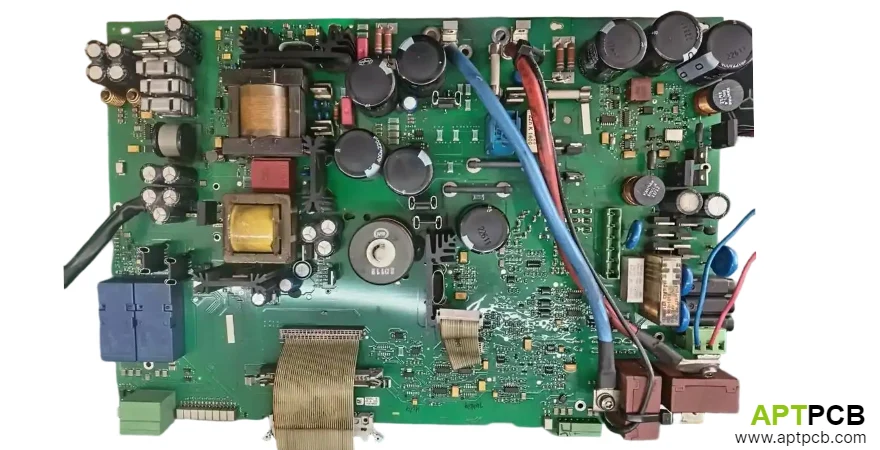
Thermal, mechanical, and insulation design
Model losses in semiconductors, capacitors, magnetics, rectifiers, sensors, connectors, copper, and supplies. Validate hotspots at worst-case ambient, load, overload, switching frequency, airflow, altitude, enclosure, and tolerance.
Power semiconductors often transfer heat through the package to a heatsink or cold plate; the PCB may mainly carry current and signals. Thermal vias help only when the complete path supports them. A metal-core PCB suits selected assemblies, not every drive.
Review component mass, busbar force, terminal torque, heatsink attachment, board deflection, vibration support, coating keep-outs, service clearance, and airflow. Measure connector temperature rise under intended current and mating conditions.
Creepage and clearance depend on working voltage, overvoltage category, pollution degree, CTI, insulation type, altitude, and product standard. Credit slots, coating, barriers, or potting only where the standard and controlled process allow. Release an insulation-coordination worksheet.
VFD PCB manufacturing and verification matrix
| Risk | Manufacturing control | Acceptance evidence |
|---|---|---|
| Heavy-copper feature variation | Fabricator-reviewed stack-up, etch compensation, conductor and spacing rules | Cross-section, finished-copper and feature measurements |
| Power-pad solder voiding | Stencil, via-in-pad treatment, reflow profile, package-specific process | SPI, targeted X-ray and agreed acceptance criteria |
| Isolation-barrier contamination | Controlled routing, cleaning, handling, coating and inspection | Visual/automated inspection and ionic-cleanliness evidence if specified |
| Wrong or substituted power component | Approved BOM and alternates, identity and lot control | Incoming records, serialization and revision traceability |
| Assembly damage to large parts | Support tooling, insertion and torque controls, selective-solder profile | Work records, joint inspection and mechanical checks |
| Open, short, or net error | Bare-board electrical test and assembly test strategy | Netlist test, ICT/flying probe where suitable |
| Gate-drive or protection error | Safe low-energy bring-up, interlock and fault injection | Gate waveforms, trip thresholds, shutdown timing |
| Power-stage stress | Controlled energized test with suitable fixtures and guarding | Switching, bus, phase-current and thermal records |
| Production drift | First article, golden-unit comparison, calibrated fixtures, limits | Test-data trend, failure reaction and change records |
PCBA testing and quality planning should separate bare-board, unpowered, low-voltage, energized, load, thermal, dielectric, and system tests. High-energy testing requires controlled fixtures, interlocks, discharge checks, guarding, and trained personnel.
VFD PCB failure and reaction matrix
| Symptom | Likely contributors | First evidence to inspect |
|---|---|---|
| Device overvoltage or ringing | Commutation-loop inductance, capacitor placement, gate speed, snubber | Switching waveform at worst-case bus/current/temperature |
| False turn-on or shoot-through | Miller coupling, gate return inductance, timing, driver supply transient | Both gate waveforms, switch-node waveform, dead time |
| Nuisance overcurrent trip | Sensor transient, filter/timing, threshold, grounding, actual overload | Raw sensor signal, ADC sample timing, trip log |
| DC-link overvoltage | Regeneration, brake path, control response, input condition | Bus waveform, motor deceleration profile, brake command |
| Communication reset | Common-mode current, supply dip, reference shift, cable transient | Rail/reset log, interface waveform, grounding and shield path |
| Hot capacitor or connector | Ripple/current sharing, ESR, contact resistance, airflow | Current, voltage drop, temperature and assembly condition |
| EMC failure | Loop area, filter bypass, shield termination, enclosure return path | Frequency signature, current paths and installation configuration |
| Dielectric or tracking failure | Spacing, contamination, altitude, coating defect, transient stress | Insulation worksheet, residue, damage path and test history |
VFD PCB RFQ checklist
- Drive definition: Input, DC-link, motor, overload, duty, speed, switching, braking, cable and motor data
- Environment and compliance: Market, installation category, earthing, altitude, temperature, humidity, contamination, vibration, cooling, enclosure, EMC, safety and functional-safety targets
- PCB package: Gerber, ODB++, or IPC-2581; netlist; stack-up; materials/CTI; copper; impedance; drill; profile; slots; drawings and revisions
- Assembly package: BOM with approved alternates, placement data, power-module and heatsink interfaces, torque requirements, soldering limits, coating/potting, programming and calibration files
- Verification: Bare-board, SPI/AOI/X-ray, ICT/flying probe, dielectric, bring-up, fault, load, switching, EMC, thermal and environmental criteria
- Quality and supply: First article, serialization, lot traceability, golden unit, test-data retention, substitution control, failure analysis, change notification, packaging, quantities and delivery target
Use the DFM guidelines to close fabrication and assembly data gaps. For an engineering review and controlled build quotation, submit the package through the PCB quotation page.
Standards, references, and scope
Relevant references may include:
- IEC 61800-3 — Adjustable speed electrical power drive systems, EMC requirements
- IEC 61800-5-1 — Safety requirements for adjustable speed electrical power drive systems
- IEC 61800-5-2 — Functional safety requirements
- IEC 60664-1 — Insulation coordination for equipment within low-voltage systems
- IEC 61000-4 series — EMC immunity test methods
- UL 61800-5-1 — Adjustable Speed Electrical Power Drive Systems
- IPC-2221 — Generic Standard on Printed Board Design
- IPC-6012 — Qualification and Performance Specification for Rigid Printed Boards
- IPC-A-600 — Acceptability of Printed Boards
- J-STD-001 — Requirements for Soldered Electrical and Electronic Assemblies
- IPC-A-610 — Acceptability of Electronic Assemblies
Confirm the applicable editions, market, voltage class, installation and overvoltage category, motor/cable system, environmental conditions, safety target, and certification-body requirements. PCB fabrication and assembly support the product design; they do not independently establish motor-drive safety, EMC, functional safety, or certification.
VFD PCB FAQ
What does VFD mean in VFD PCB?
In this guide, VFD means variable frequency drive: a power-electronics system that controls motor speed and torque by producing a variable-frequency, variable-voltage output. It does not mean vacuum fluorescent display.
What PCB material is best for a VFD?
There is no universal material. Many drives combine FR-4 control boards, heavy-copper power boards, busbars, power modules, or insulated substrates. Select the construction from voltage, current, switching, thermal, routing, insulation, mechanical, and manufacturing requirements.
How much copper does a VFD PCB need?
Copper weight alone does not determine current capacity. Use the current waveform, conductor geometry, layer environment, terminal interfaces, temperature-rise limit, cooling, etching capability, fault duty, and applicable design standard to size the conductors.
How can voltage overshoot be reduced in a VFD inverter?
Reduce commutation-loop inductance, place local DC-link capacitance correctly, control gate switching, and add a measured snubber when needed. Verify the result at worst-case bus voltage, current, temperature, and device tolerance.
How are VFD PCB creepage and clearance calculated?
They depend on working voltage, transient category, pollution degree, material group or CTI, insulation type, altitude, and the governing product standard. Use a documented insulation-coordination analysis rather than a generic spacing table.
Does a VFD always need an output dV/dt filter?
No. The decision depends on DC-bus voltage, switching edge rate, cable length and type, motor insulation, grounding, common-mode behavior, losses, and the motor-terminal waveform. Some installations need a reactor, dV/dt filter, common-mode solution, or sine filter; others do not.
Which current sensor is best for a VFD?
Choose among shunts, current transformers, Hall-effect, fluxgate, or integrated sensors using isolation, DC response, bandwidth, loss, accuracy, common-mode behavior, calibration, package, fault response, and cost requirements.
Can a PCB design make a VFD IEC 61800-3 compliant?
PCB design strongly affects emissions and immunity, but compliance is verified on the applicable drive system and installation configuration, including enclosure, filters, cables, shields, grounding, motor, firmware modes, and operating points.
Is an isolated input enough to implement Safe Torque Off?
No. STO requires a defined functional-safety architecture, independence, diagnostics, failure analysis, component and PCB controls, validation, and product-level evidence for the target SIL or PL.
What files are needed for a VFD PCB quotation?
Provide controlled PCB and assembly data plus the electrical ratings, motor and cable system, operating profile, environment, compliance targets, insulation requirements, cooling and mechanics, test limits, traceability, quantities, and change-control expectations.