
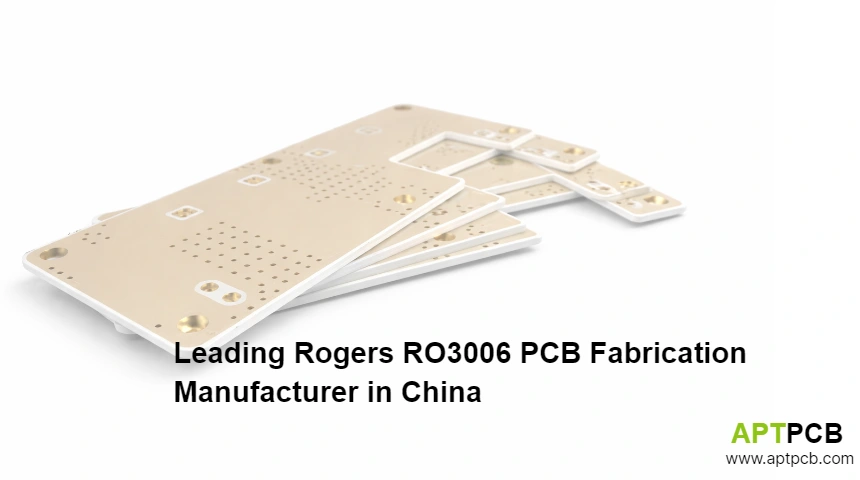
When a radar module runs out of board real estate before it runs out of frequency budget, the substrate becomes part of the solution. Rogers RO3006 sits in the RO3000 series at Dk 6.15—more than twice the dielectric constant of RO3003—and that number has a direct physical consequence: every antenna element, every resonator, every transmission line section is shorter and narrower on RO3006 than the same circuit on any lower-Dk substrate at the same frequency.
That size reduction is not free. RO3006's dissipation factor of 0.0020 is twice that of RO3003's 0.0010. The material is a trade—compactness against insertion loss—and knowing when that trade favors RO3006 requires understanding exactly what the numbers mean in practice.
Where RO3006 Sits in the RO3000 Family
Rogers Corporation's RO3000 series is a family of ceramic-filled PTFE (polytetrafluoroethylene) composite laminates. The ceramic loading varies across members of the series, and that variation is what sets the dielectric constant. The three primary members:
| Material | Dk @ 10GHz | Df @ 10GHz | Primary Design Driver |
|---|---|---|---|
| RO3003 | 3.00 ± 0.04 | 0.0010 | Minimum insertion loss, 77GHz radar, 5G mmWave |
| RO3006 | 6.15 ± 0.15 | 0.0020 | Compact circuits, miniaturized antennas |
| RO3010 | 10.2 ± 0.30 | 0.0022 | Maximum miniaturization, high-Dk embedding |
RO3006 occupies the mid-range: more compact than RO3003, lower loss than RO3010. For applications operating between S-band and Ku-band where physical footprint is constrained rather than insertion loss, this combination is often the correct selection.
Unlike general high-frequency substrates, the RO3000 series uses PTFE as its polymer matrix, which gives all members low moisture absorption (0.04%) and baseline compatibility with standard PTFE fabrication processes. What distinguishes RO3006 from RO3003 within that process framework is the higher ceramic loading density—a difference that affects not just the electrical properties but also the drilling wear rate and trace geometry requirements during fabrication.
The Compactness Calculation: What Dk 6.15 Actually Delivers
The guided wavelength at any frequency on a microstrip structure is approximately:
λ_guided ≈ λ₀ / √Dk_eff
where Dk_eff ≈ (Dk + 1)/2 for a first estimate. Comparing RO3003 and RO3006 at 10 GHz on a 10 mil core:
- RO3003: Dk_eff ≈ 2.00, so √Dk_eff ≈ 1.41 → λ_guided ≈ 21.3 mm
- RO3006: Dk_eff ≈ 3.58, so √Dk_eff ≈ 1.89 → λ_guided ≈ 15.9 mm
A quarter-wave resonator at 10 GHz is 5.3 mm on RO3003 and approximately 4.0 mm on RO3006—about 25% shorter. For a microstrip patch antenna, the resonant length scales similarly:
- Patch resonant at 10GHz on RO3003: approximately 8.5 mm
- Patch resonant at 10GHz on RO3006: approximately 6.0 mm
That is a 30% reduction in linear dimension. In a 4×4-element array, the entire array aperture shrinks by roughly 50% in area. For a module where the antenna must fit within a defined enclosure—a vehicle-mounted sensor, an embedded radar—this footprint reduction can be the difference between a viable design and one that doesn't fit.
The 50Ω microstrip trace width also narrows with higher Dk. On a 10 mil RO3006 core with 1 oz copper, the 50Ω trace is approximately 5–7 mil wide, compared to 9–11 mil on RO3003. This narrower trace geometry requires tighter etch control during fabrication—a consequence addressed directly in the RO3006 PCB fabrication guide.
Insertion Loss on RO3006: Quantifying the Trade
The dielectric loss per unit length:
α_d (dB/inch) ≈ 2.3 × f(GHz) × √Dk × Df
Applying this to both materials across the frequency range where RO3006 is most commonly used:
| Frequency | RO3006 α_d | RO3003 α_d | Loss Ratio |
|---|---|---|---|
| 5 GHz (C-band) | ~0.057 dB/inch | ~0.020 dB/inch | ~2.9× |
| 10 GHz (X-band) | ~0.114 dB/inch | ~0.040 dB/inch | ~2.9× |
| 18 GHz (Ku-band) | ~0.205 dB/inch | ~0.072 dB/inch | ~2.9× |
The per-inch loss ratio is approximately constant at 2.9× across frequencies because the formula scales identically for both materials. However, because RO3006 circuits are shorter, the actual loss through the same functional structure (a quarter-wave transformer, a coupled-line resonator element) is roughly 2× higher than the equivalent circuit on RO3003—not 2.9×.
That difference—a factor of two in insertion loss through a given circuit function—is the engineering trade. For a receive-path filter with a tight noise figure budget, it may be unacceptable. For a transmit-path matching network where a 3dB insertion loss difference is within margin, and where the size reduction is structurally necessary, RO3006 is the right substrate.
Temperature Stability: A Design Variable, Not an Assumption
All RO3000 series materials use ceramic-filled PTFE, but their thermal coefficient of dielectric constant (TcDk) differs across the series due to the different ceramic loading profiles. RO3003's TcDk of −3 ppm/°C is engineered to be exceptionally stable—the ceramic type and loading fraction are calibrated specifically for that stability.
RO3006, with its higher ceramic loading, has a TcDk that is larger in magnitude. For resonator and filter designs where the center frequency must track tightly across an operating temperature range—microwave bandpass filters used from −40°C to +85°C, for example—this TcDk difference changes the design. Filter center frequencies will shift more over temperature on RO3006 than on RO3003.
The specific TcDk value for RO3006 is published in the current Rogers Corporation RO3000 Series datasheet. Designers should obtain the current datasheet and model the temperature-dependent frequency shift before finalizing resonator dimensions. For antenna applications where a moderate center frequency drift is acceptable within a wide operating band, TcDk is less critical.
Applications Where RO3006 Is the Right Choice
Compact phased-array elements and unit cells. Array element spacing is constrained by grating lobe requirements, not material selection—but the matching network, feed, and phase shifter within each unit cell must fit within the allocated cell area. Higher Dk allows more electrical functionality in the same physical space.
Miniaturized microwave filter assemblies. Filter banks for satellite receivers, electronic warfare, and radar signal processing stack multiple resonator elements in a small housing. Each resonator on RO3006 is approximately 25–30% shorter than on RO3003, directly reducing the module height that determines rack density.
Compact baluns and 90° hybrids at lower microwave frequencies. At 3–8 GHz, half-wavelength and quarter-wavelength structures on RO3003 produce physically large circuits. On RO3006, those same structures fit in roughly 70% of the linear dimensions.
Antenna-in-package designs with constrained aperture. Where the antenna must fit within a predefined package footprint—automotive corner radar sensors, embedded array elements in structural panels—RO3006's smaller patch dimensions may be the only way to achieve the target resonant frequency within the available area.
For antenna PCB applications specifically, using RO3006 changes the trace geometry at every copper layer but does not change the fundamental process requirements: plasma desmear, IPC Class 3 via plating, and controlled surface finish are all equally necessary.
Dk Tolerance: ±0.15 and What It Means for Production
RO3006's Dk tolerance of ±0.15 is wider than RO3003's ±0.04 in absolute terms, and wider as a percentage: ±2.4% vs. ±1.3%. For resonator designs where center frequency must be consistent across production lots, this wider tolerance translates into a broader filter passband shift lot-to-lot.
In practical terms: a Dk variation of ±0.15 at 10 GHz shifts a patch antenna resonant frequency by approximately:
Δf ≈ f × (ΔDk / (2 × Dk)) ≈ 10 GHz × 0.15 / (2 × 6.15) ≈ ±122 MHz
For a broadband antenna operating over a 1 GHz passband, this shift is within the band. For a narrowband filter with a 100 MHz passband, the center frequency shift from lot variation alone may exceed the passband width—requiring either trimming or wider design margins.
This is not a disqualifying property but a design-stage input: narrow-band circuits on RO3006 need to be designed with Dk variation modeled explicitly.
Surface Finish and Assembly Considerations
The surface finish recommendations for RO3006 RF layers follow the same logic as RO3003:
- Immersion Silver (ImAg) is preferred for RF performance—the 0.1–0.2 μm deposit is electromagnetically transparent, preserving the low-roughness copper surface that minimizes conductor loss at high frequencies.
- ENIG (Electroless Nickel Immersion Gold) adds a 3–5 μm nickel underlayer that increases conductor loss measurably above 10 GHz. For lower-microwave-frequency applications, the penalty is smaller and ENIG's longer shelf life may justify the choice.
For SMT assembly on RO3006 hybrid boards, the same moisture pre-bake protocol applies as for RO3003: the FR-4 inner layers of a hybrid construction absorb moisture that must be driven out before reflow to prevent steam delamination at the PTFE/FR-4 bonding interface.
RO3006 Material Availability and Fabrication Considerations
Rogers RO3006 is a specialty material within the already-specialized RO3000 series. Fabricators who hold RO3003 inventory may not stock RO3006 in all thicknesses. Before committing to a program schedule, confirm with your fabricator whether they hold the specific RO3006 core thickness your stackup requires—and whether their LDI process has been calibrated for RO3006's narrower trace geometries, not just borrowed from RO3003 process parameters.
The latter point matters more than it might appear. A fabricator running RO3003-calibrated etch compensation factors on a 5–7 mil RO3006 trace will produce systematic impedance errors that aren't visible until TDR testing. The narrow trace geometry of Dk 6.15 is the single most distinctive fabrication constraint relative to RO3003, and it requires its own characterized process—not a translation of an existing one.
APTPCB processes RO3006 on dedicated PTFE fabrication lines with in-house vacuum plasma capability and LDI imaging calibrated specifically for RO3006's trace geometry. Current core thickness inventory and DFM review for compact RF or microwave programs are available through the contact page.
Normative References
- Dk, Df specifications from Rogers Corporation RO3000® Series Circuit Materials Datasheet (current revision).
- Dielectric loss calculation per IPC-2141A Design Guide for High-Speed Controlled Impedance Circuit Boards.
- Moisture absorption test per IPC-TM-650 2.6.2.1.
- PTFE process requirements per IPC-6012 Class 3.