
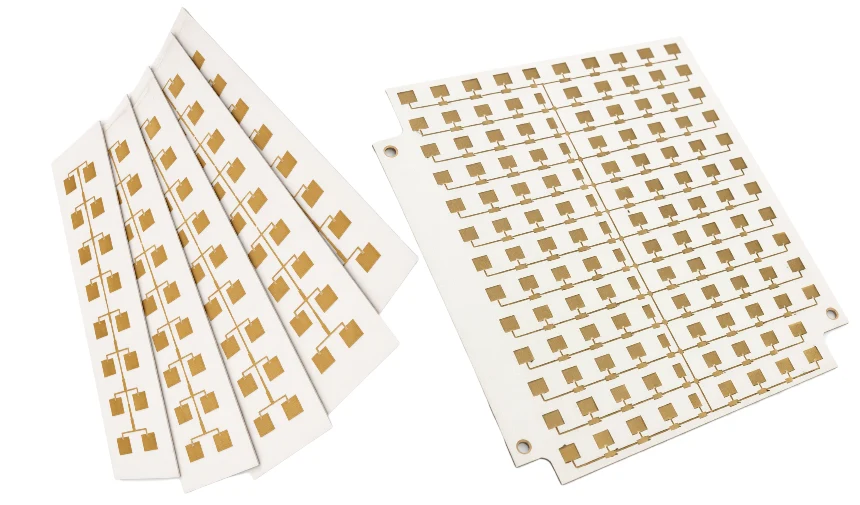
Finding a PCB manufacturer who lists "Rogers RO3006" on their capability page is not difficult. Finding one who can actually build a reliable RO3006 board—with plasma-activated via walls, LDI-accurate narrow traces, and documented process control on a material that sees less volume than RO3003—is a much shorter list.
The qualification challenge with RO3006 is layered: the material requires the same PTFE-specific process infrastructure as RO3003 (vacuum plasma chambers, modified drilling protocols, controlled hybrid lamination cooling), and it adds an additional fabrication constraint that RO3003 programs don't share as acutely: the narrower trace widths produced by Dk 6.15 have less margin for etch variation, making LDI process capability not just helpful but essential.
This guide provides the specific verification questions and documentation requests that separate manufacturers with a genuine RO3006 process from those running FR-4 protocols on the wrong material.
The Capability Gap Is Narrower Than for RO3003
Fewer commercial programs run on RO3006 than on RO3003. The 77GHz automotive radar market—which drives most RO3003 demand—uses Dk 3.00 for its low loss and phase stability. RO3006's higher Dk is selected for compactness, not for minimum insertion loss, and the applications where that trade is favorable (compact filter banks, miniaturized array elements, size-constrained antenna modules) represent a smaller volume than the automotive radar market.
The consequence for manufacturer selection: a larger fraction of fabricators who claim RO3006 capability have not built the process volume necessary to validate their claimed parameters. A fabricator who built one RO3006 prototype two years ago is not a qualified production supplier for your program.
The same qualification framework applies here as for RO3003—with the critical addition of the LDI trace-width verification requirement described below. If you've already worked through the RO3003 PCB manufacturer qualification criteria covering IATF 16949 verification, PPAP capability, and ESS reliability testing, treat those as your baseline and add Gates 2 and the reliability testing section below as RO3006-specific extensions.
Gate 1: In-House Vacuum Plasma Desmear
This is the first and most diagnostic capability question for any RO3006 manufacturer. Ask directly: Do you have vacuum plasma desmear capability in-house, or do you outsource it?
RO3006's PTFE matrix has a surface energy of approximately 18 dynes/cm—too low for alkaline permanganate wet desmear chemistry to activate the via wall for copper plating. Without plasma activation, electroless copper deposition on PTFE via walls is incomplete: wedge voids, partial barrel coverage, or fully bare zones that survive incoming inspection and fail under thermal stress.
A qualified RO3006 manufacturer must have:
- In-house vacuum plasma reactor (not a service contract with an external plasma facility)
- CF₄/O₂ gas chemistry documented for ceramic-PTFE substrates—not just O₂ plasma, which is used for photoresist stripping and is insufficient for PTFE surface activation
- Process logs from recent RO3006 production lots: chamber pressure, gas ratios, RF power parameters, treatment duration
- Correlation data linking plasma process parameters to microsection copper coverage results
If a manufacturer cannot show in-house plasma equipment and process records, the qualification discussion should stop. Outsourced plasma treatment—sending drilled panels to an external facility—breaks process traceability and shifts accountability for a critical quality step outside the manufacturer's control.
Gate 2: LDI Process Capability for Narrow RF Traces
The 50Ω microstrip trace on a 10 mil RO3006 core is approximately 5–7 mil wide. The same impedance on a 10 mil RO3003 core is approximately 9–11 mil. That 4 mil difference in trace width dramatically changes the tolerance requirements:
- On a 10 mil RO3003 trace, ±1 mil of etch variation is ±10%—at the boundary of acceptable impedance tolerance
- On a 6 mil RO3006 trace, ±1 mil of etch variation is ±17%—outside the ±10% impedance specification for most RF programs
Standard UV phototool exposure cannot reliably hold ±10% trace width on 6 mil traces. Phototool registration variation, lamp aging, and panel bow accumulate tolerances that are acceptable on wider FR-4 traces but fail on RO3006 RF geometry.
Laser Direct Imaging (LDI) eliminates the phototool intermediate and achieves ±10% trace width process capability standard, with ±5% achievable on tight-tolerance RF layers when etch compensation is calibrated to the measured copper undercut.
What to verify:
- Is LDI in production use for all RF outer layers on RO3006 programs—not just available as an option?
- Does the manufacturer have Cpk data for trace width on RO3006? Ask for trace width measurements from a recent production lot, compared against target. Cpk ≥1.33 for ±10% tolerance is the minimum acceptable process capability.
- Is the etch compensation factor calibrated specifically for the copper foil type and weight used on RO3006, or does the manufacturer apply RO3003-calibrated compensation factors without recalibration?
A manufacturer without documented LDI Cpk data on RO3006 RF traces cannot verify that their process holds the RF impedance specification your design requires.
Gate 3: Authentic Rogers RO3006 Material Sourcing
Rogers Corporation is the sole manufacturer of RO3006 laminate. There are no genuine equivalents—a generic PTFE composite with a nominal Dk near 6.15 will not have the specific ceramic loading profile that controls the dielectric constant tolerance, moisture absorption, and Z-axis CTE of authentic RO3006.
Substitute materials circulate in the spot market and may not be distinguishable visually or by simple Dk measurement. A substitute with the same nominal Dk at room temperature may show significantly different lot-to-lot variation, different TcDk behavior, and different via reliability under thermal cycling.
Verification requirements:
- Certificate of Conformance (COC) with Rogers lot number. Every authentic Rogers material shipment generates a COC referencing the specific lot number and date code traceable to Rogers manufacturing records. Request a sample COC from a recent RO3006 lot. If the fabricator cannot produce a COC with a verifiable Rogers lot number, they are not sourcing authentic material through authorized channels.
- Named sourcing channel. Ask specifically: do you buy RO3006 from Rogers Corporation directly or from a named Rogers-authorized distributor? Any answer involving brokers, spot market sources, or an inability to name the procurement channel is a disqualifying finding.
- Panel-level MES traceability. The Rogers COC lot number should be linked in the manufacturer's production system to every panel cut from that lot. If a field failure occurs, the manufacturer should be able to retrieve—from the board serial number—the exact Rogers lot, plasma chamber parameters, and process history within hours.
Gate 4: Hybrid Lamination Capability
Most commercial RO3006 programs use a hybrid construction: RO3006 on outer RF layers, high-Tg FR-4 on inner layers. The hybrid lamination process for RO3006/FR-4 introduces the same challenges as RO3003/FR-4 hybrid construction:
- Low-flow, high-Tg bonding film at the RO3006/FR-4 interface (standard FR-4 prepreg flows too aggressively under lamination pressure)
- Controlled isothermal cooling at ≤2°C per minute to prevent panel warpage from differential thermal contraction of PTFE and FR-4
- FR-4 inner layer copper density ≥75% for bow/twist management
What to request from the manufacturer:
- Bow/twist measurement results from recent hybrid RO3006 production lots. Results above 0.75% indicate inadequate cooling control.
- Solder float test results (288°C, three cycles per IPC-TM-650 2.6.7) with microsection photographs—specifically showing the RO3006/FR-4 bond line post-thermal-stress. Delamination at this interface is the primary failure mode of inadequate hybrid lamination.
- Name and specification of the bonding film used at the RO3006/FR-4 interface.
A manufacturer who cannot produce hybrid lamination test data from actual RO3006 programs has not validated this process for the material.
Gate 5: IPC Class 3 Plating Documentation
The Z-axis CTE of RO3006's PTFE matrix stresses via barrel copper during SMT reflow. IPC Class 3 plating—25 μm average copper in via barrels, zero wedge voids, ≤10 μm resin recession—provides the mechanical reserve for long-term via reliability.
Verification documents required:
- Microsection cross-section report from a recent RO3006 production or qualification lot: photographed via barrel sections with copper thickness measurements at top, middle, and bottom of multiple barrels; void classification; and visual evidence of plasma-treated PTFE interface with seamless copper adhesion
- IPC-6012 Class 3 process specification referenced in the manufacturer's quality documentation
A microsection report is the only physical evidence of IPC Class 3 compliance at the via level. A manufacturer who cannot produce one on request is asserting compliance without evidence.
Gate 6: Certifications for Automotive and Defense Programs
For RO3006 programs destined for automotive-grade radar modules, medical devices, or defense electronics, the quality management system requirements matter as much as the technical process parameters:
IATF 16949:2016 for automotive programs. Verify directly with the certifying body using the certificate number—an expired or scope-limited certificate disqualifies the manufacturer for automotive supply chains. The scope must explicitly cover PCB fabrication for the product category.
AS9100 for aerospace and defense programs. Same verification approach: request the certificate number and verify current status with the certifying body.
For programs that don't require IATF or AS9100, ISO 9001 establishes a baseline quality management system. Even for commercial programs, a manufacturer whose quality system cannot describe how they manage PTFE-specific process deviations is not operating the traceability needed for RF program qualification.
APTPCB's IATF 16949:2016 certification covers both PCB fabrication and assembly under a single quality management system. Program-specific qualification support including PPAP Level 3 documentation for automotive RO3006 programs is available through our automotive PCB engineering team.
Reliability Testing: ESS as Process Proof
Quality systems prevent defects in theory. Environmental Stress Screening proves the process works in practice. For a new RO3006 manufacturer qualification, request ESS data from a recent RO3006 program—not from RO3003 programs, since the higher ceramic loading of RO3006 produces different thermal stress distributions in via barrels.
Minimum ESS requirements for RO3006 automotive or high-reliability programs:
- Thermal cycling: −40°C to +125°C, 1,000 cycles with continuous daisy-chain via resistance monitoring per IPC-TM-650 2.6.7. Via resistance increase >10% from baseline indicates developing barrel fracture.
- Solder float (288°C, 3 cycles) with microsection documentation of the via copper and RO3006/FR-4 bond line.
A manufacturer who has not run ESS on RO3006 specifically cannot demonstrate that their PTFE process produces reliable boards under automotive operating conditions for this material.
Manufacturer Qualification Summary Checklist
Use this framework when evaluating a Rogers RO3006 PCB manufacturer:
Process Equipment (in-house only, not outsourced)
- In-house vacuum plasma chamber with CF₄/O₂ chemistry; process logs available
- LDI in production for all RF outer layers; Cpk data for trace width on RO3006 available
- Lamination press with ≤2°C/min controlled cooling; bow/twist data from hybrid RO3006 lots
Material
- Rogers COC with lot number provided as standard for every batch
- Sourcing channel identified as Rogers direct or named authorized distributor
- Panel-level MES traceability from COC lot to board serial number
Quality Documentation
- Active quality management certificate (IATF 16949, AS9100, or ISO 9001) verified with certifying body
- IPC Class 3 microsection reports from recent RO3006 production available on request
- ESS test data (thermal cycling, solder float) specific to RO3006—not borrowed from RO3003 programs
Hybrid Lamination
- Bonding film specification for RO3006/FR-4 interface documented
- Solder float delamination test at RO3006/FR-4 bond line documented
The checklist above is designed to be run sequentially: Gates 1 and 2 are binary capability gates—a "no" stops the qualification. Gates 3–6 are documentation gates where a manufacturer may have the capability but lack organized evidence. Established PTFE fabricators who genuinely process RO3006 in volume will satisfy all six without needing to retrieve documents from archive. For manufacturers who can't, the effort required to assemble that documentation reveals exactly how mature their RO3006 process actually is.
To request APTPCB's existing process documentation for RO3006 programs—including plasma process logs, LDI Cpk data, and hybrid lamination solder float results—use the Gerber file review tool for an initial DFM check alongside the documentation request, or contact our engineering team directly.
Normative References
- IATF 16949:2016 automotive quality management system requirements.
- IPC-6012 Class 3 plating acceptance criteria.
- IPC-TM-650 2.6.7 thermal cycling and solder float test methods.
- IPC-A-600K via plating and board acceptance.
- Rogers Corporation authorized distributor documentation for material traceability requirements.