
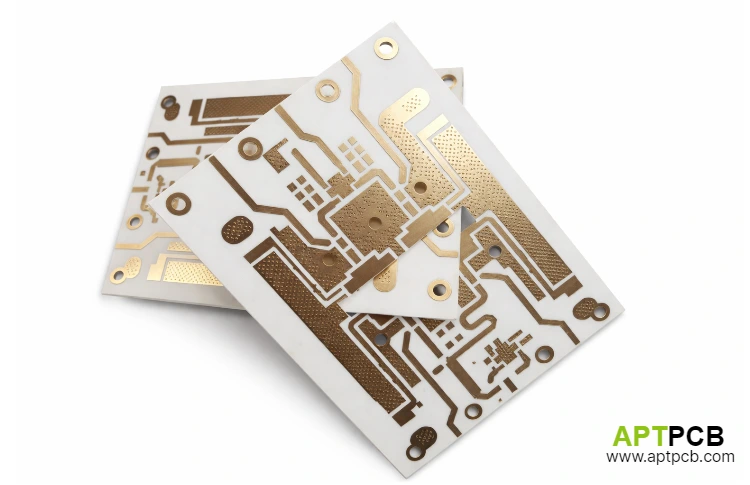
Choosing a Rogers RO3003 PCB manufacturer requires a different evaluation process than selecting a standard FR-4 supplier. RO3003 is a ceramic-filled PTFE laminate designed for microwave and millimeter-wave applications, including 77GHz automotive radar. Its electrical advantages come with manufacturing requirements that directly affect field reliability.
A supplier must control PTFE surface preparation, copper adhesion, hybrid lamination, impedance performance, material traceability, and reliability testing. A board that meets initial electrical inspection can still fail later from via fatigue, delamination, or impedance drift if the fabrication process is not properly controlled.
This guide provides a practical framework for qualifying a RO3003 PCB manufacturer using process capability, certification, and production evidence.
What capabilities should a Rogers RO3003 PCB manufacturer have?
A qualified RO3003 supplier should demonstrate that its manufacturing process was developed specifically for PTFE-based RF materials rather than adapted from conventional FR-4 production.
| Capability | Why it matters | Supplier evidence to request |
|---|---|---|
| Vacuum plasma treatment | PTFE has low surface energy and requires activation for reliable copper bonding | Plasma process records and equipment documentation |
| Laser Direct Imaging (LDI) | Fine RF traces require stable imaging control | LDI capability data and trace-width control results |
| Controlled hybrid lamination | RO3003 and FR-4 combinations require controlled thermal processing | Lamination recipes and stackup qualification reports |
| IPC Class 3 process control | Automotive radar applications require high reliability | IPC process documentation and microsection reports |
| RF impedance verification | 77GHz circuits are sensitive to geometry variation | TDR coupon data from production panels |
| Material genealogy | Authentic Rogers material must remain traceable | Rogers lot documentation and ERP/MES records |
The step-by-step RO3003 fabrication process explains how drilling, plasma activation, lamination, and plating parameters affect final reliability.
How do you evaluate a RO3003 PCB supplier before production?
Supplier qualification should focus on measurable manufacturing evidence rather than capability statements alone.
A production-ready supplier should be able to answer these questions:
| Evaluation area | Qualification question | Required evidence |
|---|---|---|
| Material sourcing | Can every board be traced to authentic Rogers laminate? | Certificate of Conformance with Rogers lot number |
| RF performance | How is impedance verified on production panels? | TDR reports with measured coupon data |
| Via reliability | How is PTFE copper adhesion validated? | Microsection images and plating measurements |
| Automotive quality | Can the supplier support PPAP requirements? | PPAP Level 3 examples and capability studies |
| Process control | How are variations detected before shipment? | SPC charts and corrective-action records |
| Reliability | Has the construction passed thermal stress testing? | ESS reports with raw test results |
Does a RO3003 PCB manufacturer need IATF 16949 certification?
For automotive radar, ADAS, and safety-related electronics, IATF 16949:2016 is the expected quality-management baseline. ISO 9001 alone does not demonstrate automotive-specific process control.
The IATF framework is important because RO3003 programs depend on preventing variation before it reaches the customer.
Key automotive Core Tools include:
APQP (Advanced Product Quality Planning)
The supplier should evaluate stackup design, material selection, thermal expansion differences, and production risks before manufacturing begins.
PFMEA (Process Failure Mode and Effects Analysis)
A RO3003 PFMEA should address risks including:
- PTFE surface activation failure causing copper adhesion problems
- Drill contamination affecting plated hole reliability
- Lamination variation causing warpage or interface separation
- Etch variation affecting RF impedance
SPC (Statistical Process Control)
Critical parameters such as plating thickness, impedance, and dimensional stability should be monitored using process control data.
PPAP (Production Part Approval Process)
For automotive programs, request PPAP Level 3 documentation including dimensional inspection, material certification, process capability studies, and reliability validation.
For RF impedance processes, a capable supplier should demonstrate process capability appropriate for the specified tolerance. Many automotive programs target a process capability index of Cpk ≥1.67 for critical characteristics.
Verify the IATF 16949 certificate number directly with the certification body. A supplier's automotive PCB page should provide supporting quality documentation.
What IPC Class 3 requirements matter for RO3003 radar boards?
IPC Class 3 reliability requirements are critical for RO3003 automotive boards because thermal cycling creates mechanical stress between copper structures and the PTFE-based dielectric.
During lead-free assembly cycles reaching approximately 245–260°C peak temperatures, the dielectric expansion behavior places stress on plated through holes. RO3003's Z-axis CTE is approximately 24 ppm/°C, making robust copper plating essential.
Required Class 3 plating standards:
| Parameter | IPC Class 2 | IPC Class 3 Required | APTPCB RO3003 Standard |
|---|---|---|---|
| Average hole wall copper | 20 μm | 25 μm | 25 μm |
| Minimum any single point | 18 μm | 20 μm | 20 μm |
| Resin recession | ≤25 μm | ≤10 μm | ≤10 μm |
| Wedge/barrel voids | ≤1 per hole | Zero tolerance | Zero tolerance |
| Wrap plating (POFV) | Optional | Required | 12 μm minimum |
Request microsection reports from production or qualification lots. A useful report should include:
- Multiple plated-hole cross sections
- Copper thickness measurements at different barrel locations
- Confirmation of no wedge voids
- Evidence of proper PTFE-to-copper interface quality
How does material traceability affect RO3003 PCB reliability?
Authentic Rogers material traceability is essential for RF and automotive applications. Substitute materials may appear similar while having different electrical and thermal behavior.
A qualified supplier should provide:
- Rogers Certificate of Conformance documentation
- Laminate lot number traceability
- Authorized sourcing records
- Panel-level manufacturing genealogy
ERP/MES tracking should connect each finished PCB to:
- Rogers material lot
- Drill process
- Plasma treatment record
- Lamination recipe
- Inspection results
This traceability becomes critical when investigating field failures in deployed automotive systems.
What reliability testing should a RO3003 manufacturer provide?
A quality system demonstrates process control. Reliability testing demonstrates that the manufactured board survives real operating conditions.
Thermal cycling and thermal shock testing
Typical automotive qualification includes:
- Temperature range: −40°C to +125°C
- Cycle count: 1,000 cycles
- Monitoring: Continuous resistance measurement
- Acceptance: Less than 10% resistance increase from baseline
This validates plated-hole reliability and hybrid construction stability.
Solder float testing
A qualified validation program may include:
- 288°C molten solder exposure
- 10-second immersion
- Three consecutive cycles
- Post-test microsection inspection
Inspection should confirm:
- No via barrel cracking
- No pad lifting
- No RO3003/FR-4 interface delamination
CAF testing
Conductive Anodic Filament testing evaluates insulation reliability under humidity and voltage stress.
Typical conditions:
- 130°C
- 85% relative humidity
- 168 hours
- Voltage bias across via structures
CAF resistance is especially relevant for automotive environments where boards operate under continuous electrical stress.
ESS results should include actual test data, not only pass/fail summaries. The RO3003 PCB assembly process controls address additional risks introduced during SMT manufacturing.
Which inspection methods should be included for RO3003 production?
Reliability testing validates the process. Non-destructive inspection confirms each production panel meets requirements.
TDR impedance testing
Time-Domain Reflectometry should verify controlled impedance structures on production panels.
Request:
- Target impedance value
- Actual measured values
- Coupon location
- Panel identification
3D AOI with laser measurement
RF performance depends on trace geometry. Advanced optical inspection helps verify conductor dimensions that influence millimeter-wave behavior.
4-wire Kelvin testing
Standard electrical testing detects opens and shorts but may miss early-stage via degradation.
Four-wire Kelvin measurement provides higher sensitivity for identifying resistance changes associated with developing barrel defects.
Rogers RO3003 PCB manufacturer selection checklist
Use this checklist when qualifying suppliers:
Certifications and quality systems
- Active IATF 16949:2016 certification verified with issuing organization
- IPC-6012 Class 3 process capability documented
- PPAP Level 3 capability demonstrated
- PFMEA includes RO3003-specific failure modes
PTFE manufacturing capability
- In-house vacuum plasma treatment capability
- CF₄/O₂ plasma process documentation
- LDI imaging capability
- Controlled lamination cooling process
- RF impedance measurement equipment
- Four-wire Kelvin electrical testing capability
Material control
- Rogers-authorized sourcing documented
- Rogers lot number included with production records
- ERP/MES genealogy available
- Material certificates supplied with production batches
Reliability validation
- Thermal cycling data available
- Solder float qualification completed
- Microsection reports available
- HAST/CAF testing available where required
APTPCB's PCB quality control documentation describes inspection, testing, and SPC practices used for high-reliability PCB programs.
Supplier capability also affects cost. Mature PTFE processing reduces scrap, improves yield, and lowers the hidden cost of field failures. The RO3003 PCB cost structure analysis explains why manufacturing maturity is a cost factor as well as a reliability factor.
For advanced RF programs including satellite terminal PCB applications, the same principles of traceability, material control, and validation extend across the complete electronics supply chain.
Contact APTPCB's engineering team to request RO3003 manufacturing capability information, quality documentation, PPAP support, or DFM consultation for a new RF or automotive radar program.
Normative References
- Automotive quality requirements per IATF 16949:2016 and AIAG Automotive Core Tools.
- Plating, inspection, and reliability requirements per IPC-6012 Class 3 and IPC-A-600K.
- Thermal cycling and solder testing methods per IPC-TM-650 2.6.7.
- Humidity bias testing conditions per JEDEC JESD22-A110.