
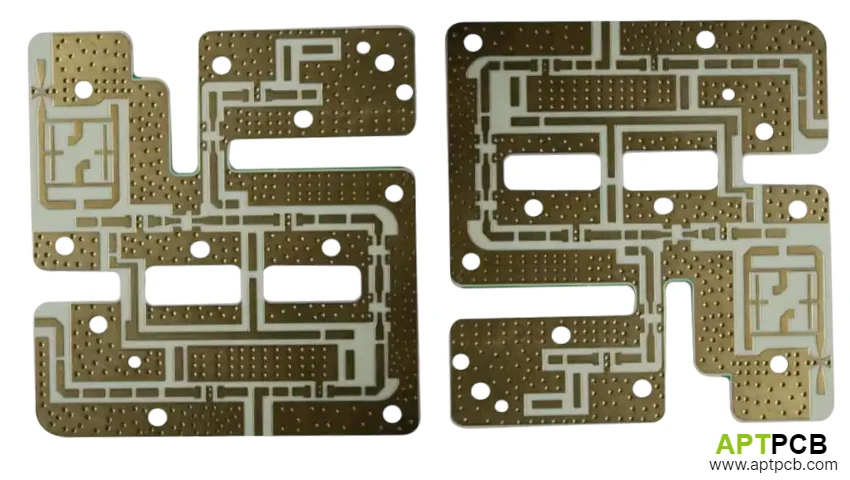
Rogers RO3003 is selected for applications where dielectric stability and low RF loss matter, including 77GHz automotive radar, microwave modules, antennas, and high-frequency communication systems. The same ceramic-filled PTFE structure that delivers stable electrical performance also creates manufacturing challenges that standard FR-4 processes cannot solve.
A successful RO3003 PCB build depends on controlling five linked decisions:
- PTFE-specific drilling and hole preparation.
- Plasma or chemical surface activation before plating.
- Hybrid RO3003/FR-4 lamination control.
- RF trace geometry and impedance verification.
- Production evidence proving reliability.
This guide explains the fabrication decisions that determine whether an RO3003 PCB performs as simulated or fails during assembly and thermal cycling.
Why does Rogers RO3003 require different PCB fabrication processes?
RO3003 is a ceramic-filled PTFE laminate engineered for stable electrical performance at microwave and millimeter-wave frequencies. Its typical dielectric constant is approximately 3.00 ±0.04, with low dissipation factor and strong temperature stability. Rogers specifies RO3000 series materials for high-frequency applications requiring controlled electrical behavior and specialized fabrication methods.
Three material characteristics drive fabrication changes:
| Material characteristic | Manufacturing impact | Required control |
|---|---|---|
| Low PTFE surface energy | Copper adhesion difficulty after drilling | Plasma or approved surface activation |
| Thermoplastic PTFE behavior | Heat-related smear during drilling | Reduced friction drilling process |
| Ceramic filler loading | Faster tool wear | Controlled drill life management |
RO3003's Z-axis CTE is approximately 24 ppm/°C, which supports plated-through-hole reliability but requires controlled copper plating for demanding thermal environments.
What are the critical RO3003 PCB fabrication steps?
1. PTFE drilling: how do manufacturers prevent hole-wall smear?
RO3003 cannot be drilled like conventional FR-4. Excessive heat generation softens the PTFE matrix and can create residue on via walls. Ceramic particles also accelerate carbide tool wear.
A production drilling strategy focuses on clean cutting rather than friction polishing.
Typical PTFE drilling controls:
| Parameter | RO3003 fabrication approach |
|---|---|
| Drill material | Sharp carbide tooling |
| Spindle speed | Approximately 60,000–80,000 RPM depending on drill size and equipment |
| Tool replacement | Shorter life than FR-4 because ceramic loading increases wear |
| Inspection | Microsection verification before metallization |
A worn drill creates rough, damaged hole walls that reduce plating reliability even after surface activation.
How is PTFE hole-wall activation performed before copper plating?
PTFE is chemically inert compared with epoxy-based PCB materials. Traditional FR-4 desmear chemistry does not provide the same surface preparation.
The fabrication route normally uses plasma activation or another qualified PTFE treatment process before electroless copper deposition.
The purpose of activation is to:
- Modify the PTFE surface.
- Increase adhesion capability.
- Allow catalyst coverage.
- Create reliable copper-to-substrate bonding.
A qualified RO3003 supplier should be able to explain:
| Supplier qualification question | Required evidence |
|---|---|
| How are PTFE holes activated? | Plasma or qualified chemical process description |
| Is activation performed internally? | Equipment and process records |
| How is adhesion verified? | Microsection and thermal reliability data |
| Is the process linked to production lots? | Traceability records |
Moving RO3003 panels between facilities for critical surface treatment increases handling risk and reduces process control.
What fabrication risks should engineers review before ordering RO3003 PCBs?
| Risk area | Failure mechanism | Verification method |
|---|---|---|
| Drilling | PTFE smear and poor copper adhesion | Hole-wall microsection |
| Plating | Barrel cracks or voids after thermal cycling | Copper thickness measurement |
| Lamination | Layer separation or panel distortion | Cross-section and bow/twist inspection |
| RF trace formation | Impedance shift from etch variation | TDR coupon testing |
| Material substitution | Simulation mismatch | Rogers COC and material traceability |
This decision matrix should be reviewed before prototype fabrication, not after a failed build.
How should RO3003 hybrid stackups be laminated with FR-4?
Many commercial RF products use hybrid constructions: RO3003 for RF layers combined with FR-4 for mechanical support, power distribution, and cost optimization.
The challenge is that the materials have different:
- Thermal expansion behavior.
- Resin flow characteristics.
- Bonding requirements.
- Mechanical stress response.
A successful hybrid stackup requires:
Balanced copper distribution
FR-4 inner layers provide mechanical stability during heating and cooling. Large copper imbalance can increase panel deformation.
APTPCB DFM review targets approximately 75–80% copper density on ground and power reference areas where hybrid structures require additional balance.
Compatible bonding materials
The bonding system must provide adhesion without excessive flow into RF structures.
Important factors include:
- Resin flow.
- Cure temperature.
- Glass transition temperature.
- RF dielectric impact.
Rogers fabrication guidance notes that RO3000 materials can be combined with multiple bonding systems, including thermoset and thermoplastic approaches, depending on electrical and manufacturing requirements.
Controlled cooling
Cooling rate directly affects internal stress.
A controlled press cycle with cooling at approximately ≤2°C per minute helps reduce stress accumulation between different materials.
Target inspection:
- IPC-A-600 bow and twist ≤0.75%.
- Production targets commonly require tighter control for SMT assembly compatibility.
How is impedance controlled on 77GHz RO3003 radar PCBs?
At millimeter-wave frequencies, small geometry changes create measurable RF performance shifts.
Critical controls include:
- Accurate stackup definition.
- Copper foil selection.
- Trace-width compensation.
- Controlled etching.
- Production impedance coupons.
Laser Direct Imaging (LDI) improves registration consistency because the circuit pattern is generated directly from digital data rather than relying on traditional phototools.
For 77GHz radar boards, impedance validation should include:
- TDR testing.
- Coupon correlation.
- Trace-width verification.
- Stackup confirmation.
The final board should demonstrate that manufactured geometry matches the electromagnetic model.
What IPC Class 3 plating requirements apply to RO3003 PCBs?
High-reliability RO3003 applications often require IPC Class 3 manufacturing controls because thermal cycling places mechanical stress on plated vias.
APTPCB RO3003 plating targets:
| Parameter | IPC Class 2 Baseline | APTPCB RO3003 Standard |
|---|---|---|
| Average hole wall copper | 20 μm | 25 μm minimum |
| Any single measurement | 18 μm minimum | 20 μm minimum |
| Resin recession | ≤25 μm | ≤10 μm |
| Wedge voids | ≤1 per hole | Zero tolerance |
For via-in-pad structures, wrap plating quality and copper adhesion become especially important because RF packages concentrate thermal and mechanical stress around pad structures.
A production release package should include:
- Microsection images.
- Copper thickness measurements.
- Void inspection results.
- Material certificates.
Which surface finish is suitable for RO3003 RF boards?
| Finish | 77GHz suitability | Key consideration |
|---|---|---|
| Immersion Silver (ImAg) | Excellent | Maintains a flat RF surface |
| ENIG | Good | Nickel layer may introduce additional RF considerations |
| HASL | Not recommended | Surface unevenness affects fine RF geometry |
For high-frequency RF layers, a flat finish that preserves conductor geometry is generally preferred.
What should be included in an RO3003 PCB supplier RFQ checklist?
A qualified supplier should receive complete manufacturing requirements:
Material information
- Exact Rogers RO3003 thickness.
- Copper weight.
- Bonding system.
- Certificate of Conformance requirements.
Fabrication requirements
- PTFE drilling capability.
- Plasma or qualified activation process.
- Hybrid lamination experience.
- IPC Class 3 requirements.
Validation requirements
- TDR impedance report.
- Microsection report.
- Electrical test results.
- Thermal stress testing.
Production traceability
- Material lot records.
- Process history.
- Inspection records.
A supplier that cannot provide process evidence should not be qualified for radar or millimeter-wave production.
How should engineers validate an RO3003 PCB before production release?
Before approving production, validate:
- TDR impedance results against design targets.
- Thermal stress performance.
- Via barrel integrity.
- Hybrid interface adhesion.
- Material traceability.
Recommended release documentation:
- Rogers material certificate.
- Stackup drawing.
- Impedance test report.
- Microsection report.
- Electrical test report.
This evidence connects the fabricated PCB to the original RF design intent.
For a broader supplier evaluation framework covering IATF 16949 verification, PTFE process capability, and manufacturing traceability, see the RO3003 PCB manufacturer qualification guide.
The RO3003 material properties overview provides additional dielectric and mechanical information before stackup selection.
For hybrid construction decisions, review the custom hybrid RO3003 stackup guidance.
HDI and via-in-pad requirements can be evaluated through the HDI PCB capability guide.
Submit your RO3003 Gerber files to APTPCB for a DFM review covering drilling, stackup, impedance control, and IPC Class 3 fabrication requirements.
Normative References
- RO3000 series material data and fabrication guidelines from Rogers Corporation.
- IPC-6012 Class 3 reliability requirements.
- IPC-A-600 acceptance criteria for printed boards.
- Production PTFE fabrication controls including drilling, activation, plating, and impedance verification.