
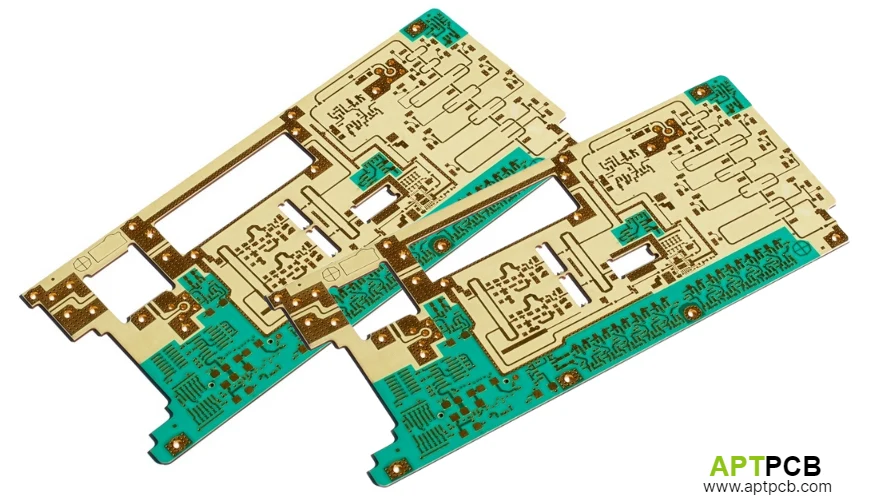
A Rogers RO3003 custom PCB is not created by simply selecting a low-loss laminate and sending Gerber files to a fabricator. For RF front ends, phased-array antennas, automotive radar modules, and mmWave communication systems, the PCB stackup becomes part of the electrical design model.
Every RO3003 program requires decisions around:
- dielectric thickness and copper profile
- full RO3003 versus hybrid construction
- controlled impedance targets
- via transition structures
- thermal management
- fabrication capability
The goal is not only to manufacture a PCB that matches drawings, but to produce hardware that behaves like the RF simulation.
The electrical baseline of RO3003 includes Dk 3.00 ±0.04 at 10 GHz, Df 0.0010, TcDk −3 ppm/°C, and Z-axis CTE of 24 ppm/°C. These properties make RO3003 suitable for stable microwave and mmWave designs, but manufacturing variation must still be controlled.
For additional background, the fundamental electrical and mechanical properties of Rogers RO3003 define the material behavior used during RF simulation and stackup planning.
What RO3003 Custom PCB Stackup Should You Choose?
The stackup is the first engineering decision because it determines:
- characteristic impedance
- insertion loss
- thermal behavior
- via complexity
- fabrication cost
- assembly yield
A custom RO3003 PCB normally follows one of two architectures.
| Stackup Type | Structure | Best Fit | Main Consideration |
|---|---|---|---|
| Full RO3003 | Entire RF board uses RO3003 | Precision antenna arrays, multi-layer RF routing | Highest material cost |
| Hybrid RO3003/FR-4 | RO3003 RF layers + FR-4 digital/power layers | Commercial RF modules | Requires validated mixed-material lamination |
Hybrid construction is widely used because RF performance remains concentrated where it matters while reducing total PCB cost. However, the supplier must have proven capability with PTFE-based materials and hybrid bonding processes.
As described in the RO3003 PCB supplier guide, hybrid stackup selection depends directly on fabricator experience, not only laminate availability.
How Does RO3003 Core Thickness Affect Impedance Design?
RO3003 core thickness directly changes trace width, field distribution, and manufacturability.
| Core Thickness | Approximate 50Ω Microstrip Width (1 oz Cu) | Application |
|---|---|---|
| 5 mil (0.127mm) | ~4–5 mil | Dense phased-array feed networks |
| 10 mil (0.254mm) | ~9–11 mil | General mmWave RF routing |
| 20 mil (0.508mm) | ~18–22 mil | Lower-frequency RF and higher power structures |
The 10 mil core is commonly selected because it balances:
- impedance control
- trace manufacturability
- assembly robustness
- via capability
Thinner dielectric layers can improve density but require tighter etching control and more careful via design.
Which Copper Foil Should Be Specified for RO3003 mmWave PCB?
Copper surface roughness becomes increasingly important as frequency increases.
At mmWave frequencies, current flows primarily near the conductor surface because of skin effect. Rough copper increases effective current path length and contributes to conductor loss.
For high-frequency RO3003 designs, specify copper construction during material ordering:
- low-profile ED copper
- reverse treated foil (RTF)
- controlled surface roughness documentation
Standard ED copper with RMS roughness around 5–7 μm can create measurable RF loss compared with smoother copper surfaces.
The copper foil selection must be part of the laminate specification, not treated as a fabrication correction after layout completion.
How Should RO3003 Hybrid PCB Materials Be Combined?
Hybrid RO3003/FR-4 boards require more than choosing two compatible materials.
The bonding layer between materials affects:
- dielectric thickness
- impedance calculation
- lamination stability
- dimensional accuracy
For hybrid structures:
- use validated low-flow bonding materials
- confirm high-Tg performance
- verify lamination cycle compatibility
- include the actual stackup in RF simulation
A supplier should confirm that the exact RO3003 and bonding material combination has already passed production validation.
How Is Impedance Controlled on a Custom RO3003 PCB?
Controlled impedance requires agreement between design simulation and fabrication reality.
The fabrication package should define:
- target impedance
- impedance tolerance
- trace geometry
- reference plane
- test coupon structure
- measurement method
Typical RF structures include:
Microstrip
Microstrip places the RF trace on an outer layer with a reference plane below.
Advantages:
- simple antenna feed integration
- easy electromagnetic modeling
- accessible routing
Considerations:
- surface finish affects RF performance
- solder mask influence must be modeled
For mmWave microstrip applications, Immersion Silver is often selected because its thin, flat surface avoids the RF impact associated with thicker nickel layers in ENIG finishes.
Stripline
Stripline places the signal between reference planes.
Advantages:
- better electromagnetic shielding
- reduced radiation loss
- stable impedance environment
Considerations:
- more complex via transitions
- requires careful launch modeling
For phased-array systems requiring matched path lengths, stripline structures may provide better phase consistency.
What Impedance Validation Should an RO3003 PCB Include?
A production RO3003 PCB should include fabrication validation structures.
Required checks:
- TDR impedance measurement
- single-ended impedance coupon
- differential impedance coupon where applicable
- microsection analysis
- finished copper verification
Differential RF structures require separate validation. A 50Ω single-ended report does not confirm a 100Ω differential pair design.
What Via Structures Are Used in RO3003 RF PCB Design?
Via design becomes critical above microwave frequencies because unused via length creates resonances.
POFV for RFIC Thermal Pads
RF transceiver packages often require plated over filled vias beneath exposed thermal pads.
Key requirements:
- controlled filling process
- flat copper surface
- solder paste volume consistency
- X-ray void inspection compatibility
The thermal management challenges specific to RO3003 PCB manufacturing explain why thermal via design must be considered together with RFIC reliability.
Blind Vias for High-Frequency Transitions
Blind vias reduce unwanted via stubs.
For designs above 60GHz:
- minimize unused barrel length
- simulate via transitions
- control drill diameter and plating quality
PTFE materials require tighter process control than standard FR-4 because hole wall preparation and plating behavior are different.
What DFM Checks Are Required Before Manufacturing RO3003 PCB?
A reliable RO3003 production process includes DFM review before fabrication.
RO3003 DFM Supplier Checklist
| Check Item | Why It Matters |
|---|---|
| Exact laminate grade confirmed | Ensures simulation matches production material |
| Copper foil profile documented | Controls RF insertion loss |
| Hybrid bonding validated | Prevents lamination defects |
| Impedance coupons included | Confirms manufactured electrical performance |
| Via aspect ratio reviewed | Maintains plating reliability |
| PTFE processing capability verified | Reduces yield risk |
Pre-Gerber review should confirm:
- core thickness
- copper weight
- impedance requirements
- thermal via design
- minimum trace/space capability
Post-Gerber review should confirm:
- coupon placement
- etch compensation
- stackup documentation
- manufacturing tolerances
Why Is RO3003 Different From Generic PTFE PCB Materials?
“Rogers circuit board” and generic PTFE laminate are not interchangeable for precision RF designs.
RO3003 uses ceramic-filled PTFE technology to achieve stable dielectric performance. A substitute material with a similar nominal Dk may not reproduce:
- temperature stability
- manufacturing consistency
- RF phase behavior
For antenna arrays and beamforming systems, small dielectric variations can shift electrical length and reduce calibration accuracy.
Rogers Corporation manufactures RO3003 laminate. A custom PCB supplier should confirm:
- material source
- certificate of conformance
- production lot information
- delivery availability
What Information Is Needed for a RO3003 Custom PCB Quote?
A complete RFQ package should include:
- Layer stackup with dielectric thickness and copper specification
- Gerber or ODB++ files
- Controlled impedance requirements
- Via structure requirements
- Surface finish specification
- IPC class requirement
- Prototype or production quantity
A qualified supplier should review the stackup before material purchase, not after fabrication problems appear.
Contact APTPCB's RF engineering team to begin a custom RO3003 DFM review or request a stackup consultation before your layout is finalized.
References
- Rogers Corporation RO3000® Series Circuit Materials Datasheet.
- IPC-6012 Qualification and Performance Specification for Rigid Printed Boards.
- IPC-2141A Design Guide for High-Speed Controlled Impedance Circuit Boards.
- High-frequency PTFE PCB fabrication process guidelines.