
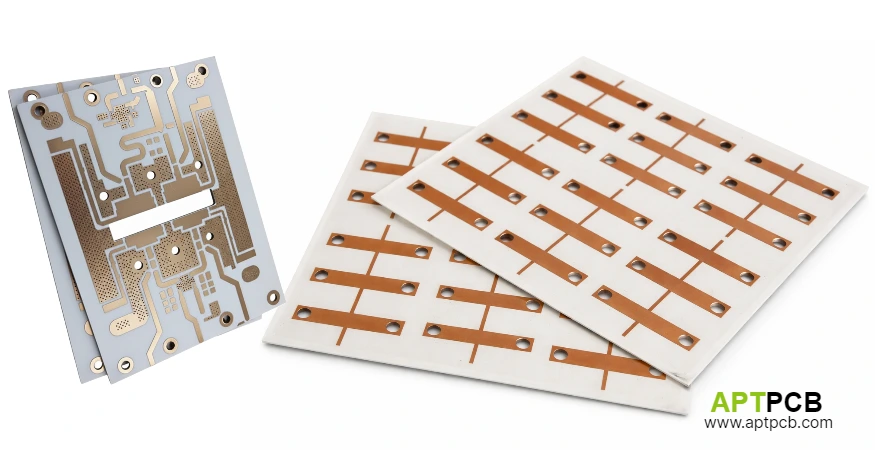
Procurement teams that approach RO3003 sourcing the same way they handle FR-4 orders consistently run into the same problems: longer-than-expected lead times, sticker shock on bare board pricing, and the occasional delivery of boards that pass incoming inspection but fail in field reliability testing.
This guide is written for the buyer or supply chain manager who needs a realistic picture of what RO3003 sourcing actually looks like—where the costs come from, how to manage lead times structurally, how to verify you're getting authentic Rogers material, and what a supplier audit should cover.
The Supply Chain Reality for RO3003
Rogers RO3003 is not a commodity. Understanding why that matters for procurement requires a clear look at the supply chain structure.
Material is single-sourced. Rogers Corporation is the sole manufacturer of RO3003 laminate. There is no "equivalent" that passes a tier-1 automotive supply chain audit. A generic PTFE composite with a similar nominal Dk may look identical visually, but it won't have the ceramic loading profile that controls Z-axis CTE—and that difference causes via barrel failures during the first winter of automotive operation.
Distribution is controlled. Authentic RO3003 moves through Rogers-authorized regional distributors or directly from Rogers manufacturing facilities. The gray market exists, and counterfeit or "equivalent" materials do circulate in it, especially during periods of supply constraint.
Raw material lead times are long. Standard Rogers material delivery from order to a PCB fabricator is 8–12 weeks. This is the single most important number for procurement planning. A fabricator that orders material per job will have a minimum total lead time of 10–14 weeks from order placement to bare board delivery. A fabricator that stocks pre-purchased Rogers material can deliver in 3–4 weeks.
The practical implication: when you evaluate RO3003 PCB suppliers, the most important supply chain question to ask is not about price. It's about what material they currently have in stock.
Where the Cost Comes From
"Why is my 8-layer RO3003 board so much more expensive than FR-4?" is the most common first question from engineering teams encountering RO3003 pricing for the first time. The cost structure has two components:
Raw material: PTFE is manufactured using high-temperature fluoropolymer chemistry. The ceramic fillers required to stabilize the dielectric constant are costly to produce and disperse uniformly. RO3003 laminate costs approximately 8–12× more per square foot than equivalent high-Tg FR-4.
Process tooling amortization: RO3003's ceramic fillers wear carbide drill bits in under 500 hits (vs. 2,000+ for FR-4). Vacuum plasma desmear uses expensive CF₄ gas. Low yields on hybrid lamination from inexperienced factories get passed on in pricing. All of this shows up in the per-board cost even before you account for material.
A fabricator with high yields, in-house plasma capability, and optimized hybrid lamination recipes will price RO3003 lower than a facility that's applying FR-4 economics to a material that doesn't respond to them. Supplier capability is a cost lever, not just a quality lever. The detailed breakdown of RO3003 PCB cost drivers—including the three stackup strategies that reduce total board cost by 30–45%—is worth reviewing before you benchmark supplier quotes.
The 30–45% Cost Reduction: Hybrid Stackup Economics
For most commercial 77GHz radar programs, the answer to high RO3003 cost is the hybrid stackup.
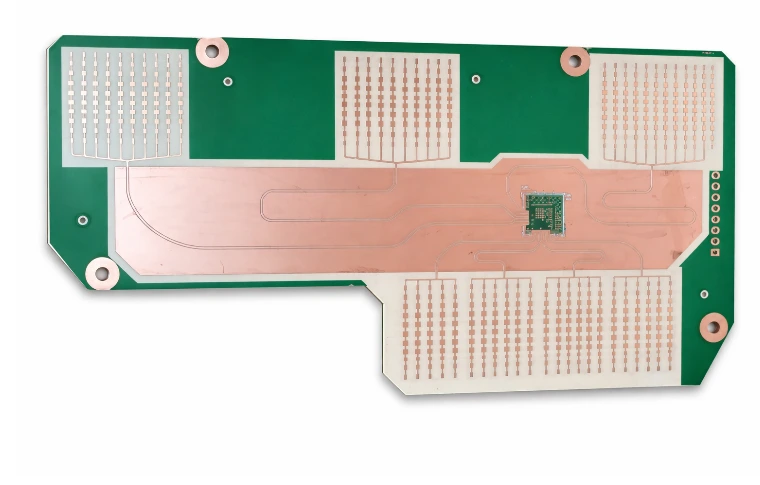
The principle: use RO3003 only on the outer layers where the RF traces and antenna elements actually are. Use high-Tg FR-4 for the internal signal routing and power distribution layers. The electromagnetic performance on the critical layers is unchanged; the raw material volume of premium laminate drops from 100% to 15–30% of the total board.
| Configuration | Cost Impact |
|---|---|
| Monolithic RO3003 (all layers) | 100% baseline |
| Hybrid: 2 RO3003 outer + 4 FR-4 inner | ~60–65% of baseline |
| Hybrid: 2 RO3003 outer + 6 FR-4 inner | ~55–60% of baseline |
The 30–45% cost reduction is real and routinely achieved in production programs. What it requires from the fabricator is genuinely more demanding than pure FR-4 construction: specialized bonding films, controlled lamination cooling rates, and inner layer copper density management. But for a supplier equipped to execute it, hybrid construction is the standard commercial approach to RO3003 cost optimization.
When briefing engineering on the hybrid strategy, it's useful to frame it precisely: the RF performance of the outer RO3003 layers is preserved in full. The cost saving comes entirely from the inner layer material. The only tradeoff is fabrication complexity—which falls on the supplier, not the design.
Lead Time Management: Three Structural Options
The 8–12 week Rogers raw material lead time is the dominant supply chain constraint. There are three ways to structure around it:
Option 1: Fabricator-Held Inventory
Work with a supplier that stocks the most common RO3003 core thicknesses—5 mil (0.127mm), 10 mil (0.254mm), and 20 mil (0.508mm)—in pre-purchased inventory on their factory floor.
When material is in stock, prototype NPI lead times drop to 3–4 weeks (fabrication time only). This is the most important supply chain benefit for early-stage programs where engineering is iterating on stackup and layout. The RO3003 quick-turn prototype guide covers what that 3–4 week window realistically covers and what DFM front-loading steps prevent schedule extensions.
How to verify: ask the prospective supplier directly which core thicknesses they currently stock and approximately how many panels. A confident, specific answer ("we hold 60 panels of 10 mil RO3003 with 1 oz low-profile copper as a standard strategic stock") is a good sign. A non-answer is not.
Option 2: VMI (Vendor-Managed Inventory)
For high-volume automotive production programs, integrate your demand forecasting data with the supplier's procurement process. If your program calls for 50,000 hybrid radar boards in Q3, the supplier secures Rogers raw material in Q1.
VMI transfers the inventory investment to the supplier and eliminates the raw material lead time risk from your schedule. You carry a purchase commitment; the supplier carries the stock. This model is standard practice for tier-1 automotive suppliers managing high-volume, continuous-flow programs.
Setup requirements: ERP integration or a structured rolling forecast process, minimum volume commitment thresholds, and a defined safety stock level agreed between buyer and supplier. For mature programs with stable demand profiles, VMI reduces both cost per unit (through bulk purchasing) and schedule risk simultaneously.
Option 3: Buyer Safety Stock
For lower-volume programs, negotiate a pre-allocated raw material reserve at the supplier. The supplier holds X weeks of Rogers material pre-committed to your program and replenishes automatically.
This is less capital-efficient than VMI but provides meaningful buffer against Rogers supply disruptions, which do occur for specialty thickness cores during periods of high industry-wide demand (particularly automotive radar production ramps).
Verifying Authentic Rogers Material
Counterfeit or substitute PTFE materials are a documented risk in the supply chain, particularly during tight allocation periods. The consequences for a 77GHz automotive radar program are severe: a board that passes incoming electrical test but has incorrect ceramic loading will fail thermally in the field.
Three verification requirements for authentic RO3003:
Certificate of Conformance (COC) with Rogers Lot Number. Every authentic Rogers material shipment generates a COC that includes the manufacturer part number, lot number, date code, and IPC-4103 slash sheet compliance statement. Require this document as a standard deliverable with every production batch. The lot number should be cross-referenceable with Rogers' authorized distributor records.
Panel-level ERP/MES traceability. The COC lot number must be linked in the supplier's manufacturing execution system to every panel that was cut from that lot. When you receive boards, you should be able to ask "which Rogers lot was used for this batch?" and receive a documented answer with an audit trail—not an assertion.
Sourcing channel documentation. Ask prospective suppliers where they buy RO3003. Acceptable answers: Rogers Corporation directly, or a named Rogers-authorized regional distributor. Any mention of brokers, spot market sources, or inability to name the procurement channel is disqualifying for automotive programs.
Surface Finish and Shelf Life: Practical Procurement Considerations
Surface finish selection has meaningful supply chain implications that are often overlooked at the design stage. The electrical case for ImAg at 77GHz comes down to skin-effect current path: its thin, flat deposit is electromagnetically transparent in a way ENIG's nickel underlayer is not. But ImAg also carries the tightest shelf-life and handling constraints of any surface finish, which means surface finish selection is a supply chain decision as much as a performance one.
Immersion Silver (ImAg)—preferred for 77GHz RF performance:
- Shelf life in sealed moisture-barrier bag: 12 months from packaging date
- After MBB opening: must be assembled within 5 working days
- Requires sulfur-free packaging paper to prevent tarnishing
- Not suitable for long-term buyer warehouse inventory
ENIG—preferred when boards will be held in inventory:
- Shelf life: 12 months, more tolerant of handling and storage variation
- Marginal insertion loss penalty at 77GHz (~0.1–0.2 dB/inch vs. ImAg)
- Acceptable for 24GHz designs, lower-frequency RF layers, or programs where assembly timing is uncertain
For programs that specify ImAg but face uncertain assembly timing, the cleanest supply chain approach is to keep boards at the fabricator in sealed MBB storage until they are needed at the assembly line. This keeps the shelf-life clock from running while the boards are idle, and maintains the humidity-controlled storage conditions that the FR-4 inner layers require.
Where bare board fabrication and SMT assembly are co-located under one roof, most of these surface finish shelf-life risks disappear—boards go from fabrication to assembly line without a shipping and storage cycle in between. The integrated manufacturing overview describes how that model works in practice for RO3003 programs.
Supplier Audit Checklist for RO3003
Standard FR-4 supplier questionnaires miss the process-specific questions that matter for RO3003. Use this framework when qualifying a new Rogers RO3003 PCB supplier. For the full technical audit protocol—covering IATF 16949 verification steps, ESS reliability test documentation requirements, and the specific NDI equipment an automotive-grade PTFE fabricator must operate in-house—the RO3003 PCB manufacturer qualification guide provides the detailed verification steps used in actual supplier audits.
Material Sourcing
- Procures RO3003 exclusively from Rogers Corporation or named authorized distributors
- Provides Rogers COC with lot number as standard documentation for every batch
- Can demonstrate material inventory: which thicknesses are currently in stock?
- Documented incoming inspection procedure for Rogers material lot verification
PTFE-Specific Fabrication Capability
- In-house vacuum plasma chamber (CF₄/O₂); not outsourced to a subcontractor
- Modified PTFE drilling protocol documented (reduced spindle speed, hit count ≤500)
- RO3003/FR-4 hybrid lamination capability with documented bow/twist data (<0.75%)
- LDI imaging in production; process capability (Cpk) data for trace width available
Quality Management
- Active IATF 16949:2016 certification (verify directly with certifying body)
- IPC-6012 Class 3 compliance in process specifications (25 μm average via copper, zero voids)
- PPAP Level 3 capability available for new automotive programs
Testing and Evidence
- TDR impedance testing on production panels; sample reports available
- Micro-section cross-section reports provided with each production batch
- 288°C solder float thermal stress data (3-cycle) available from recent RO3003 qualification lot
- Thermal cycling ESS data (−40°C to +125°C, 1,000 cycles) available
Traceability and Logistics
- ERP/MES board-level tracking from Rogers COC lot through shipment
- Can demonstrate live MES query: retrieve full manufacturing genealogy for a shipped board serial number in <5 minutes
- IPC-1601 compliant packaging: sulfur-free interleaving, vacuum-sealed MBB, desiccant, HIC
- Clear shelf-life documentation provided by surface finish type
What to Ask APTPCB Specifically
APTPCB is an IATF 16949:2016-certified manufacturer with in-house vacuum plasma capability and dedicated RO3003 hybrid lamination processes. For procurement teams evaluating us against this checklist, the exact material source, current availability, COC and lot-document scope, VMI requirements, and delivery schedule are confirmed during RFQ review rather than assumed in advance.
The most useful first conversation for a new RO3003 program is a current material stock check and a preliminary hybrid stackup cost estimate based on your layer count and board dimensions. Both can be done before Gerbers exist. Use the Gerber viewer if you already have files for an initial DFM pass, or reach out directly to discuss procurement structure and current material availability.
References
- Automotive quality management per IATF 16949:2016 and AIAG Automotive Core Tools.
- Material handling and shelf-life guidelines per IPC-1601 Printed Board Handling and Storage Guidelines.
- Board acceptance criteria per IPC-A-600K Acceptability of Printed Boards, Class 3.
- Material properties and standard configurations per Rogers Corporation RO3000® Series Circuit Materials Datasheet (Rev 11.2023).
- Solder voiding limits per IPC-A-610H Acceptability of Electronic Assemblies, Class 3.