
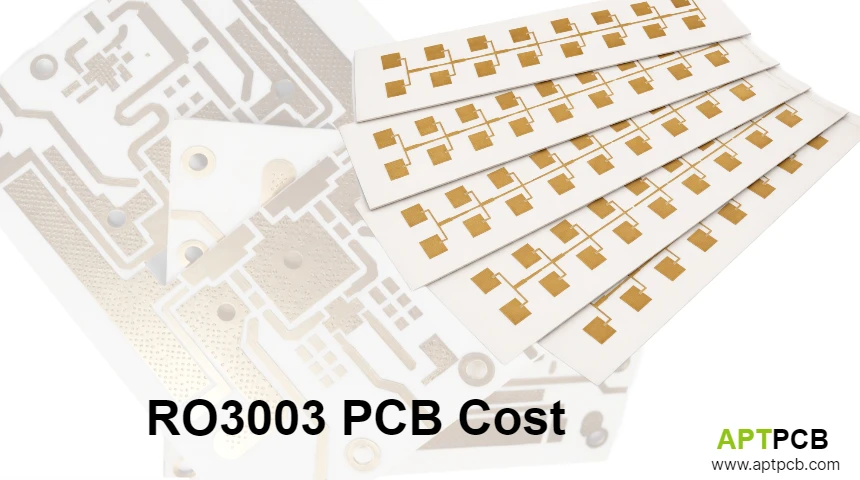
RO3003 PCB cost is the result of material usage plus a specialized manufacturing and verification route. Rogers RO3003 is a ceramic-filled PTFE laminate with tightly controlled RF properties, but two boards using the same material can have very different prices because of panel yield, hybrid construction, layer count, via structures, tolerances, finish, testing, documentation, and quantity.
Key takeaways
- Compare quotes only after normalizing material designation, thickness, copper, stackup, panel assumptions, finish, tests, quantity, tooling, documentation, and shipping terms.
- Material price matters, but yield loss and process complexity often decide the final unit cost.
- A hybrid stackup can reduce RO3003 usage, yet added bonding, lamination, registration, and via requirements can offset part of the saving.
- The safest savings come from removing unnecessary constraints, improving panel utilization, using available constructions, and stabilizing the release package.
- Do not reduce cost by accepting an undefined “equivalent” laminate or deleting RF/quality evidence that the product actually needs.
What makes up an RO3003 PCB quote?
| Cost block | Typical drivers | Buyer action |
|---|---|---|
| RF laminate and copper | Grade, thickness, copper type/weight, sheet availability | Specify exact construction and approved alternates |
| Material utilization | Board outline, rails, coupons, spacing, array and order quantity | Let the fabricator propose panelization |
| Stackup and lamination | Full RO3003 or hybrid, layers, bonding system, sequential cycles | Freeze only the layers that need RF material |
| Drilling and vias | Hole count/size, aspect ratio, blind/buried vias, fill/cap, backdrill | Simplify structures where electrical design permits |
| PTFE preparation and plating | Material-specific drilling, hole treatment, metallization | Use a qualified supplier and complete material callouts |
| Imaging and etching | Fine lines, tight gaps, controlled couplers/filters | Apply realistic geometry tolerances |
| Finish and final process | ENIG, immersion silver, tin, hard gold, edge plating, routing | Select from assembly/RF needs, not habit |
| Verification | Electrical test, impedance, TDR, S-parameters, coupons, microsections | Define the evidence and sampling plan |
| Commercial scope | Quantity, expedite, reports, traceability, packaging, freight | Normalize inclusions before comparing unit price |
A low unit price that excludes test coupons, material evidence, tooling, or expedite fees may not be the lower total quote.
Material thickness, copper, and availability
RO3003 is sold in defined laminate constructions. Price and lead time change with thickness, copper cladding, sheet size, regional stock, and order quantity. A nonstandard or locally unavailable construction may require a larger material purchase than the net board area suggests.
Ask the supplier to identify:
- exact Rogers material designation and thickness;
- copper type and finished copper requirement;
- stock status and material procurement assumption;
- whether the quoted quantity shares a production panel or consumes dedicated sheets; and
- the permitted material-lot and substitution controls.
Do not select a thickness only because it is inexpensive. The RF geometry, impedance, conductor loss, mechanical stiffness, connector launch, and power handling must still meet the design.
Full RO3003 versus hybrid stackup
A full RO3003 stackup may be appropriate when RF structures span multiple layers or consistent material behavior is essential. A hybrid stackup can place RO3003 only on RF layers and use another qualified material for digital, control, or structural layers.
| Option | Potential advantage | Cost/risk to review |
|---|---|---|
| Full RO3003 | Simpler material family and predictable RF-layer relationship | Higher RF-laminate usage |
| RO3003 outer RF layer plus FR-4 core | Lower RO3003 area in some designs | Bonding, CTE, thickness, via, and registration compatibility |
| Multiple RF cores in hybrid multilayer | Supports complex RF routing | More material interfaces and lamination control |
| Separate RF and digital boards | Independent optimization and easier redesign | Connectors, assembly, enclosure area, and system loss |
Model and qualify the chosen construction. A hybrid is not automatically cheaper once sequential lamination, special bonding, filled vias, or low-yield geometry are included.
Yield and tolerance are hidden price multipliers
The supplier prices expected good boards, not only the theoretical process steps. Tight line/gap, annular ring, registration, board outline, dielectric thickness, impedance, and RF-response limits can increase inspection, sorting, coupon use, and scrap risk.
Separate requirements into three groups:
- Function-critical: directly tied to RF, power, safety, assembly, or fit.
- Process-control: needed to demonstrate a stable manufacturing window.
- Preference: inherited or cosmetic limits without a verified product impact.
Keep the first two and challenge the third. Relaxing a noncritical tolerance often saves more safely than changing the laminate.
Cost-reduction moves that preserve engineering intent
Use production-available constructions
Ask which RO3003 thicknesses and copper constructions are routinely stocked and qualified. If the electrical model can accept one of them, material procurement and minimum-buy exposure may fall.
Improve panel utilization
Allow the fabricator to rotate or nest the board where grain, RF orientation, tooling, and cosmetic requirements permit. Review rails, breakaway method, coupons, and test structures before fixing the array.
Simplify the via architecture
Blind vias, stacked microvias, fill/cap, backdrilling, edge plating, and small mechanical holes add separate process controls. Use them only where routing, launch, grounding, or package escape requires them.
Match testing to risk
Electrical test is not the same as impedance, TDR, insertion-loss, phase, or finished RF functional test. Specify the minimum evidence that proves the requirement, including frequency, fixture, reference plane, sampling, and report format.
Freeze clean data before expedite
Stackup contradictions, missing drill pairs, ambiguous finish, and unapproved substitutions cause engineering holds. A complete release package can protect schedule and cost without changing the board design.
Where cost reduction becomes false economy
Avoid:
- replacing RO3003 with an undefined “equivalent” based only on nominal Dk;
- using a fabricator without a qualified PTFE drilling, hole-treatment, and plating process;
- deleting coupons or RF testing needed to control the product;
- shrinking capture pads, spacing, or panel rails below a stable process window;
- changing copper profile or surface finish without updating the RF model; and
- buying a prototype construction that cannot transition to production.
The cheapest first lot is not economical if the design must be requalified after material, stackup, or process changes.
How to compare RO3003 quotes
Create a comparison sheet with identical assumptions:
- material designation, thickness, copper and stackup revision;
- board dimensions, quantity, panelization and overage;
- via types, fill/cap, backdrill, edge process and tolerances;
- finish, mask, legend, routing and packaging;
- electrical, impedance, RF, coupon, microsection and documentation scope;
- tooling, engineering, expedite, minimum material buy and NRE;
- quoted fabrication days, clock-start condition and material availability; and
- freight, tax/duty term, quote validity, and change-control conditions.
Ask questions when one quote is materially lower. The difference may be a useful process advantage—or a missing requirement.
RFQ checklist for accurate RO3003 pricing
Provide:
- Gerber or ODB++, drill, netlist, fabrication drawing and board outline;
- exact RO3003/hybrid stackup, thickness, copper and approved material-alternate policy;
- impedance and RF requirements with frequency, tolerance, fixture, reference plane and sampling;
- via structures, fill/cap, backdrill, edge plating and controlled dimensions;
- surface finish, solder mask, assembly exposure and packaging needs;
- quantity breaks, prototype/production relationship, delivery destination and target schedule; and
- material certificates, coupons, microsections, reports, traceability and change-control needs.
APTPCB can return a quote with open assumptions identified for engineering review. See Rogers PCB manufacturing for material scope and quick-turn PCB for schedule inputs.
Reference standards and documents
- Rogers RO3003 laminate data sheet and RO3000 series fabrication guidance
- IPC-6018 — Qualification and Performance Specification for High Frequency (Microwave) Printed Boards
- IPC-2221 and IPC-2222 — Generic and rigid printed-board design standards
- IPC-TM-650 — Applicable printed-board test methods
- Supplier material quotation, panelization, fabrication, and test assumptions
FAQ
Is there a standard price per square inch for RO3003 PCB?
No reliable universal price applies. Material construction, panel yield, layers, vias, finish, tolerances, tests, quantity, reports, and schedule can change the cost substantially.
Is a hybrid RO3003 stackup always cheaper?
No. It can reduce RF-laminate usage, but bonding, lamination, registration, via, testing, and yield may offset the saving.
Why does prototype unit cost look much higher than production?
Engineering, tooling, material minimums, coupons, setup, and reporting are spread across fewer boards. Production pricing also depends on stable yield and forecast.
Can a different low-loss laminate be used to reduce cost?
Only through an approved equivalency process that covers dielectric behavior, loss, copper, thickness, thermal/mechanical properties, fabrication, and RF revalidation.
What is the fastest way to improve quote accuracy?
Send a complete, internally consistent stackup, drill/via definition, RF test requirement, quantity table, and material-alternate policy.
Reduce uncertainty before reducing the laminate
RO3003 pricing becomes manageable when the quote exposes material, yield, process, testing, and commercial assumptions. Send the complete construction and acceptance package for a comparable, engineering-ready quotation.