
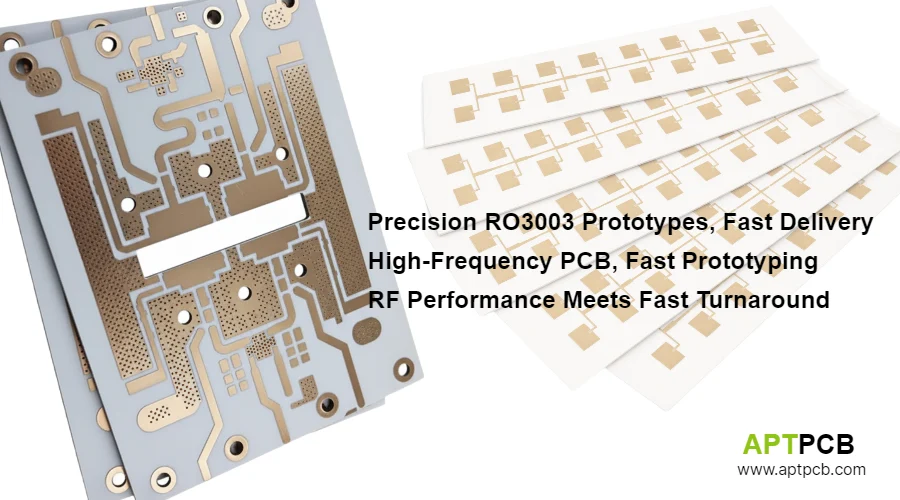
A quick-turn RO3003 PCB is an expedited RF board built with Rogers RO3003 ceramic-filled PTFE laminate. The achievable schedule depends on material availability, approved stackup, PTFE-specific fabrication steps, via complexity, surface finish, testing, capacity, and how quickly engineering questions are closed. “Quick turn” should therefore be defined by scope and clock-start conditions, not by a headline number.
Key takeaways
- Confirm the exact RO3003 thickness and copper stock before treating any date as committed.
- Start the fabrication clock only after data, stackup, tolerances, material, DFM questions, purchase order, and test requirements are approved.
- PTFE drilling, hole treatment, metallization, lamination, and inspection cannot be safely removed from the route to save time.
- Use a production-representative RF construction when prototype data will support qualification or tuning.
- Separate bare-board fabrication, assembly, component procurement, RF testing, shipping, and calendar time in the schedule.
What controls RO3003 lead time?
| Schedule gate | What must be resolved | Common delay |
|---|---|---|
| Material | Exact grade, thickness, copper, sheet size and stock | Nonstock construction or unclear substitute policy |
| Engineering | Stackup, impedance/RF geometry, tolerances, panel, coupons | Contradictory drawing and Gerber data |
| Lamination | Full RO3003 or hybrid bonding sequence | Unqualified material combination or multiple cycles |
| Drilling/plating | Hole sizes, aspect ratio, blind vias, fill/cap, backdrill | Missing drill pairs or difficult via structure |
| Imaging/etching | Fine lines, couplers, filters, controlled gaps | Limits beyond a stable expedited process window |
| Finish/profile | Finish, edge plating, routing, controlled depth | Special finish availability or complex mechanical work |
| Verification | Electrical, impedance, TDR, RF, microsection, reports | Undefined fixtures, limits, sampling or coupons |
| Logistics | Review time, packaging, freight and customs | Confusing fabrication days with delivery date |
The longest gate controls the order. Expediting imaging does not help if material has not arrived or the RF test fixture is undefined.
Ask the material-stock question first
RO3003 comes in specific laminate thicknesses and copper constructions. The supplier should confirm whether the required material is:
- physically in stock and allocated to the order;
- available from a distributor within the quoted schedule;
- subject to a minimum sheet or panel purchase;
- qualified with the proposed bonding and plating process; and
- replaceable only under a defined engineering-approval path.
“Rogers material available” is not enough. RO3003, RO3003G2, other RO3000 grades, and RO4000-series materials are not interchangeable names. Verify the exact designation and construction.
Freeze the quick-turn data package
Send one revision-controlled release containing:
- Gerber or ODB++, NC drill and route data, IPC-356 netlist and board outline;
- material stackup, finished thickness, copper, bonding layers and controlled impedance;
- RF-critical dimensions, tolerances, copper profile assumptions and reference artwork;
- blind/buried via pairs, fill/cap, backdrill, plated-edge and depth-routing definitions;
- surface finish, mask, legend, panel rails, breakaway, coupons and markings; and
- test methods, frequency range, fixtures, reference planes, limits, sampling and reports.
Approve the fabricator's stackup and DFM response promptly. A rushed order with unresolved notes simply moves the delay into production—or creates a nonconforming prototype.
Full RO3003 or hybrid for the prototype?
Choose the construction that answers the engineering question.
| Prototype objective | Preferred direction |
|---|---|
| Validate final RF channel or filter behavior | Use production-representative material, copper, stackup and finish |
| Prove mechanical fit or low-frequency control | A simplified build may be acceptable if clearly nonqualifying |
| Compare full RO3003 and hybrid options | Build controlled coupons or variants with identical measurement setup |
| Tune connector launch | Preserve edge geometry, layer references, copper and connector process |
| Demonstrate assembly only | Confirm any material change does not invalidate reflow, flatness or fixture behavior |
A cheaper or faster surrogate can be useful, but label the evidence it cannot provide. Do not use FR-4 RF results to approve a production RO3003 channel.
PTFE-specific steps that remain on the critical path
Rogers fabrication guidance calls for controlled drilling with suitable entry/backup materials and sharp tools, material-appropriate hole preparation, and a qualified sodium or plasma treatment before metallization. Multilayer constructions add bonding and lamination requirements, including construction-specific preparation.
These steps protect hole-wall adhesion, registration, copper integrity, and finished RF behavior. The shortest defensible route is the supplier's already-qualified process for the selected construction—not an improvised route that skips controls.
Define what the quoted clock includes
Ask the supplier to state:
- quote issue date and validity;
- material-stock assumption;
- DFM approval and purchase-order clock start;
- fabrication working days;
- whether weekends/holidays are included;
- inspection and report time;
- assembly and component-procurement time, if applicable;
- shipping method, pickup cutoff, transit, and customs assumption; and
- conditions that reset the schedule, such as design changes or failed input data.
An “X-day PCB” may mean the board leaves fabrication in X working days. It does not necessarily mean assembled hardware arrives at the buyer in X calendar days.
Quick-turn risk reduction before release
- Use a stock, qualified RO3003 construction when the RF design permits.
- Keep drill structures and lamination cycles no more complex than the layout requires.
- Review panelization and coupons before placing the order.
- Define achievable impedance/RF and mechanical tolerances with the supplier.
- Approve one material-alternate policy instead of negotiating substitutions during production.
- Reserve RF fixtures, connectors, components, assembly tooling, and lab capacity at the same time as fabrication.
- Set a rapid technical-response owner on both sides.
For the broader commercial process, see quick-turn PCB and NPI assembly.
Prototype acceptance and production transition
A useful expedited lot records the actual material, stackup, copper, drilling, hole treatment, plating, finish, impedance/RF coupons, dimensions, and any deviations. After assembly, preserve reflow, connector, tuning, rework, and RF-test data.
Before production, review whether the prototype used:
- the same material source and construction;
- the same panel and process route;
- the same surface finish and copper profile;
- the same via, connector, shield, and assembly conditions; and
- statistically meaningful validation for the production risk.
Quick-turn success is not only receiving boards early. It is obtaining evidence that shortens the next design or production decision.
RFQ checklist for a quick-turn RO3003 PCB
Provide:
- complete fabrication data and one controlled drawing revision;
- exact RO3003/hybrid construction and approved material alternatives;
- RF/impedance requirements, coupons, fixtures, limits and reports;
- board quantity, spare/overage need, assembly quantity and delivery destination;
- component/connector availability and any customer-supplied material;
- required inspections, certificates, microsections and traceability; and
- requested ship date plus the actual system milestone it supports.
APTPCB can identify open assumptions and the process gates that control the achievable schedule before order release.
Reference standards and documents
- Rogers RO3003 laminate data sheet and RO3000 series fabrication guidance
- IPC-6018 — Qualification and Performance Specification for High Frequency (Microwave) Printed Boards
- IPC-2221 and IPC-2222 — Printed-board design standards
- IPC-TM-650 — Applicable printed-board test methods
- Approved fabrication stackup, DFM response, test plan and order terms
FAQ
What is a typical RO3003 quick-turn lead time?
There is no reliable universal number. Material stock, stackup, vias, finish, testing, capacity, approval time, assembly, and shipping determine the schedule.
Can an RO3003 quick-turn order start before DFM approval?
Material may sometimes be reserved, but irreversible fabrication should follow approval of the controlled data, stackup, tolerances, material, panel, and test requirements.
Is a full RO3003 board faster than a hybrid?
Sometimes, but not always. The answer depends on stock, qualified bonding flow, layer count, lamination cycles, vias, and the supplier's process.
Can RF testing be added after the boards are finished?
Only if suitable coupons, connectors, fixtures, reference planes, and limits already exist. Plan RF evidence before panelization and fabrication.
What is the best way to protect an expedited schedule?
Use available material, release complete data, reduce unnecessary process complexity, define the quote clock, and assign fast engineering approvals.
Expedite decisions, not omissions
The fastest reliable RO3003 prototype follows a known material and qualified process with complete engineering inputs. Send the construction, test scope, and milestone together for a schedule-specific review and quote.