
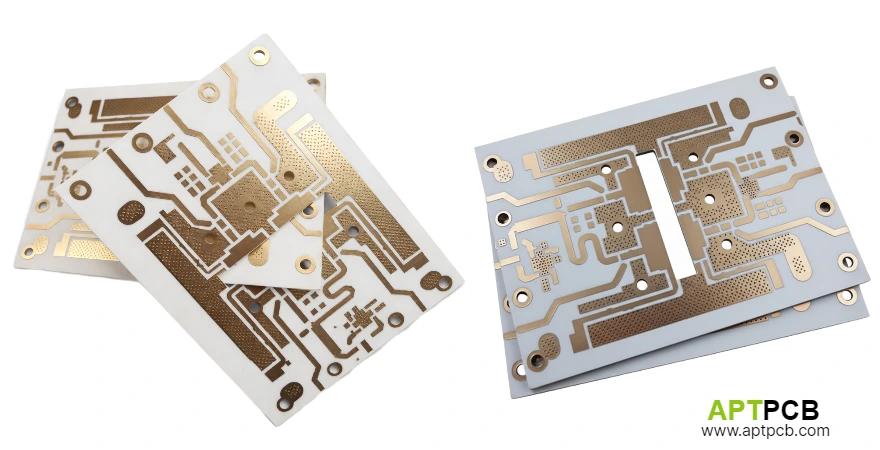
RO3003 PCB manufacturing requires more than selecting a low-loss laminate. The finished RF performance depends on the complete construction: dielectric thickness, copper profile, stackup geometry, drilling, hole-wall treatment, lamination, etching, plating, surface finish, and inspection plan.
Rogers RO3003 is a ceramic-filled PTFE laminate designed for RF and microwave applications where stable dielectric behavior and low loss are important. It is widely used for antenna feeds, radar modules, filters, phased-array systems, microwave circuits, and millimeter-wave designs.
Key RO3003 PCB manufacturing decisions
| Design decision | Why it matters |
|---|---|
| Material grade and dielectric thickness | Defines impedance geometry, phase behavior, and RF model accuracy |
| Copper type and roughness | Influences conductor loss at microwave and mmWave frequencies |
| Stackup construction | Determines RF layer placement, mechanical behavior, and cost |
| PTFE fabrication route | Controls drilling quality, plating reliability, and dimensional stability |
| Surface finish | Can affect RF conductor loss when applied to current-carrying structures |
| Inspection evidence | Confirms that the manufactured board matches the released design |
A quote that only states “RO3003 capable” does not define the final electrical construction.
What are the verified RO3003 material properties?
RO3003 is a ceramic-filled PTFE laminate from the Rogers RO3000 series. The published material values are laminate characteristics and should be applied using the correct test method and simulation model.
| Property | RO3003 published value | Manufacturing implication |
|---|---|---|
| Process dielectric constant | 3.00 ± 0.04 at 10 GHz | Used for material comparison and acceptance when the method applies |
| Design dielectric constant | 3.00 from 8–40 GHz | Starting value for supported RF modeling |
| Dissipation factor | 0.0010 at 10 GHz | Supports low-loss RF structures |
| TCDk | −3 ppm/°C from −50 to 150°C | Helps stabilize dielectric behavior over temperature |
| Thermal conductivity | 0.50 W/m·K | Thermal design still depends on copper and system structure |
| CTE X/Y/Z | 17 / 16 / 25 ppm/°C | Important for dimensional stability and plated-hole reliability |
| Moisture absorption | 0.04% | Does not replace storage controls for the complete material set |
The selected dielectric value should match the transmission-line structure, frequency range, copper model, and field solver assumptions.
How do you choose the right RO3003 stackup?
The stackup should be frozen before detailed RF routing because finished dielectric thickness, copper growth, bond materials, and manufacturing tolerances affect impedance.
| Stackup option | Best fit | Advantages | Items to confirm |
|---|---|---|---|
| Two-layer RO3003 | Antennas, filters, simple RF circuits | Short RF path and fewer construction variables | Limited routing density and shielding options |
| All-PTFE multilayer | Multiple RF layers and homogeneous structures | Consistent dielectric family | Higher material cost and more demanding fabrication |
| RO3003/FR-4 hybrid | RF plus digital, power, or control layers | Places premium material only where required | Bond compatibility, lamination, registration, and CTE behavior |
Hybrid construction can reduce cost by concentrating RO3003 on critical RF layers while using lower-cost materials for non-RF routing. The complete pressed construction must still be modeled and qualified.
What fabrication controls are required for RO3003?
RO3003 uses PTFE-based processing requirements that differ from ordinary FR-4 fabrication.
| Process area | Required control | Buyer evidence |
|---|---|---|
| Material identity | Grade, thickness, copper type, lot traceability | Material records and approved substitutions |
| Copper profile | Foil type, roughness, finished copper thickness | Copper specification matching RF model |
| Drilling | PTFE-specific tooling and parameters | Hole inspection and process capability information |
| Hole-wall preparation | Qualified PTFE activation before plating | Process description and microsection evidence |
| Lamination | Bond system, pressure, temperature, registration | Approved pressed stackup |
| Etching | Geometry compensation and RF feature control | Controlled dimensions and impedance coupons |
| Plating | Via copper thickness and finished construction | Microsections and plating records |
| Surface finish | Finish type, thickness, RF coverage | Finish specification and approval |
| Profiling | Edge quality and mechanical dimensions | Dimensional inspection report |
Controlled impedance is only meaningful when the supplier controls the actual trace geometry, dielectric structure, copper condition, and test method.
Which surface finish should be used for RO3003?
The correct finish depends on RF current distribution, assembly requirements, storage conditions, and reliability requirements.
| Finish | Typical use | Design consideration |
|---|---|---|
| Immersion silver | RF designs requiring a flat finish without nickel | Requires tarnish and handling controls |
| ENIG | General SMT assembly and exposed pads | Nickel layer may affect RF conductor loss |
| ENEPIG | Wire bonding or specialized assembly | Additional metal layers require RF evaluation |
| OSP | Thin protective coating | Requires controlled assembly and storage conditions |
For high-frequency conductors, include the finish in the RF model when it overlaps current-carrying structures.
What inspection reports should an RO3003 supplier provide?
A qualified supplier should define evidence based on the design risk.
| Evidence | Purpose |
|---|---|
| Material records | Confirms laminate grade and construction |
| Stackup report | Confirms pressed thickness and layer order |
| Microsections | Verify plating, registration, and dielectric thickness |
| Impedance report | Confirms controlled structures meet targets |
| Electrical test report | Confirms continuity and isolation |
| Dimensional inspection | Verifies critical mechanical features |
| RF validation report | Confirms defined RF metrics when required |
RF testing should define the fixture, calibration method, frequency range, reference plane, and acceptance limits.
What are common RO3003 PCB failure modes?
| Failure mode | Main contributors | Control method |
|---|---|---|
| Impedance shift | Incorrect Dk model, etch variation, copper changes | Freeze stackup and verify coupons |
| Increased insertion loss | Copper roughness, finish effects, geometry errors | Control conductor construction |
| Weak plated holes | Poor PTFE activation or drilling control | Use qualified PTFE processes |
| Registration errors | Lamination assumptions and hybrid mismatch | Review pressed construction |
| Delamination | Material incompatibility or thermal stress | Qualify full stackup |
| Damaged RF features | Routing, handling, finish encroachment | Define critical inspection areas |
What drives RO3003 PCB cost?
RO3003 pricing depends on the complete manufacturing route rather than laminate cost alone.
Primary cost drivers include:
- Number of layers.
- RO3003 material usage.
- Hybrid bonding requirements.
- Copper type and thickness.
- Minimum trace and spacing.
- Drill count and via complexity.
- Filled or capped vias.
- Tight thickness tolerances.
- Impedance coupons.
- Surface finish.
- RF testing.
- Documentation requirements.
- Quantity and schedule.
Cost optimization usually comes from using RO3003 only where RF performance requires it while maintaining the evidence needed for qualification.
RO3003 PCB RFQ checklist
Design package
Provide:
- Gerber or ODB++ files.
- NC drill and rout files.
- Fabrication drawing.
- Netlist.
- Approved stackup.
- Material grade and thickness.
- Copper weight and foil requirements.
- Controlled impedance targets.
- RF-critical dimensions.
- Surface finish requirements.
Manufacturing requirements
Define:
- Layer construction.
- Bond materials.
- Via structures.
- Finished hole sizes.
- Copper thickness.
- Finish boundaries.
- Solder mask requirements.
- Inspection standards.
- Approved deviation process.
Test and documentation
Specify:
- Electrical test coverage.
- Impedance coupon requirements.
- Microsection requirements.
- Material traceability.
- Certificate of Conformance requirements.
- RF validation method when applicable.
Commercial information
Include:
- Prototype quantity.
- Production forecast.
- Required delivery schedule.
- Qualification build requirements.
- Approved alternatives.
- Change-notification requirements.
Send the stackup and RF constraints early enough for a DFM review. Early review allows the fabricator to confirm material availability, panel utilization, via construction, and test requirements before layout release.
Standards and references
- Rogers Corporation — RO3000 Series Circuit Materials Data Sheet, including RO3003
- IPC-6018 — Qualification and Performance Specification for High Frequency (Microwave) Printed Boards
- IPC-6012 — Qualification and Performance Specification for Rigid Printed Boards
- IPC-2221 — Generic Standard on Printed Board Design
- IPC-4761 — Design Guide for Protection of Printed Board Via Structures
- IPC-A-600 — Acceptability of Printed Boards
FAQ
What is the dielectric constant of RO3003?
Rogers publishes a process Dk of 3.00 ±0.04 at 10 GHz and a design Dk of 3.00 from 8–40 GHz. The correct value depends on the simulation method and transmission-line structure.
Is RO3003 suitable for 77 GHz radar?
RO3003 is used for microwave and millimeter-wave applications including radar. Final performance depends on stackup, copper, transitions, finish, and manufacturing tolerance control.
Can RO3003 be combined with FR-4?
Yes. Hybrid RO3003/FR-4 constructions are common when RF layers require premium laminate performance while other layers handle digital, power, or mechanical functions.
Does RO3003 require special drilling and plating?
Yes. PTFE processing requires qualified drilling and hole-wall preparation before copper plating.
What should I send for an RO3003 PCB quote?
Provide fabrication files, material specifications, stackup, impedance requirements, via construction, finish, inspection requirements, quantity, and schedule.
Request an RO3003 manufacturing review
Send APTPCB your stackup, RF constraints, fabrication files, quantity, test requirements, and schedule. The review should confirm material, process, tolerance, inspection, and manufacturing assumptions before prototype release.
Contact APTPCB to request an RO3003 PCB DFM and quotation review.