
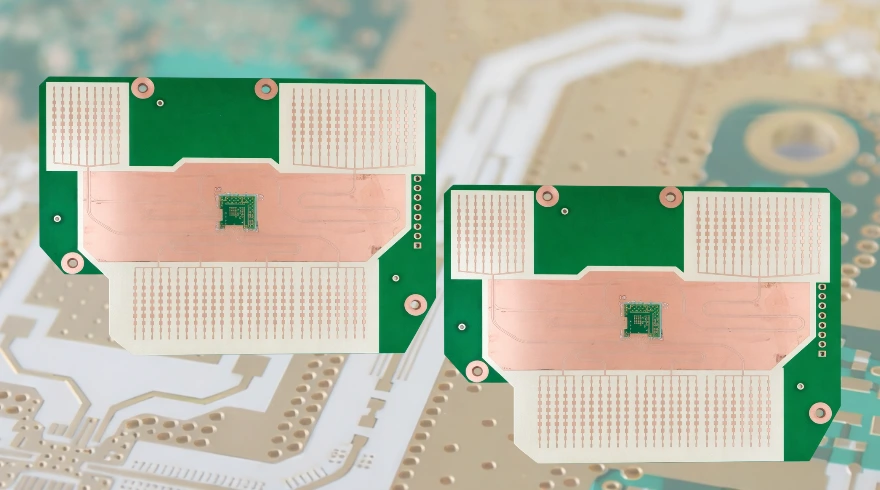
The first time an RF engineer opens an EM simulation tool with RO3006 loaded instead of RO3003, the trace widths look wrong. A 50Ω microstrip on a 10 mil core that would be 10 mil wide on RO3003 is 5–7 mil wide on RO3006. The quarter-wave sections are shorter. The patch antenna is smaller. Everything that scales with guided wavelength has shrunk by a predictable factor—and that factor is exactly what makes RO3006 useful for certain design problems and irrelevant for others.
This guide is for the RF engineer working with RO3006: how to correctly set up the transmission line geometry, how to budget insertion loss on a higher-loss-per-inch substrate, how via transitions behave differently in a shorter circuit, and what fabrication constraints the narrower traces impose on the design process.
Setting Up the Simulation Correctly for RO3006
The substrate parameters that enter an RF simulation for RO3006:
- Dk = 6.15 (use frequency-dependent values from the Rogers MWI-2000 calculator or the full Rogers datasheet for designs operating above 20 GHz)
- Df = 0.0020 at 10 GHz (again, consult the Rogers datasheet for frequency-specific values)
- Core thickness: Per the specific laminate you are ordering—confirm this with your fabricator before beginning the simulation, since standard RO3006 thicknesses may differ from the RO3003 thicknesses you're accustomed to
- Copper weight and foil type: Low-profile ED copper (Ra ≈ 1.5 μm) for RF outer layers where conductor loss matters; standard ED copper where only DC or low-frequency signals run
Do not use RO3003 parameters with RO3006. It sounds obvious, but simulation setups carried over from previous programs are a documented source of first-prototype hardware that doesn't match the model. Verify the substrate file before running any S-parameter simulation.
One important process note before layout: the etch compensation factor for RO3006 must be characterized on RO3006 specifically. A fabricator who applies RO3003-calibrated etch compensation to your 5–7 mil RO3006 traces will produce systematic impedance errors. Confirm this with your fabricator before Gerber submission—on 6 mil traces, a 1 mil etch variation is already a 17% impedance error.
Transmission Line Geometry: The Numbers for Dk 6.15
Approximate 50Ω microstrip trace widths for RO3006 (Dk = 6.15, 1 oz copper) across common core thicknesses:
| Core Thickness | ~50Ω Trace Width on RO3006 | ~50Ω Trace Width on RO3003 | Reduction |
|---|---|---|---|
| 5 mil (0.127mm) | ~2–3 mil | ~4–5 mil | ~40% |
| 10 mil (0.254mm) | ~5–7 mil | ~9–11 mil | ~40% |
| 20 mil (0.508mm) | ~9–12 mil | ~18–22 mil | ~40% |
The approximately 40% width reduction holds across all core thicknesses because the microstrip width-to-height ratio for 50Ω scales primarily with Dk. For a given impedance target on a fixed core thickness, higher Dk requires a narrower trace.
These are starting-point estimates from first-order analytical formulas. For the final trace widths used in production Gerbers:
- Use Rogers MWI-2000 or a full-wave EM solver with the actual RO3006 Dk and core thickness values
- Request the fabricator's etch compensation factor for your specific copper foil type and weight on RO3006—and confirm it was characterized from RO3006, not borrowed from RO3003 calibration data
- Specify ±10% impedance tolerance on the fabrication drawing with TDR test coupon verification on every production panel
For a 6 mil trace target on a 10 mil core, a ±0.6 mil etch variation tolerance represents ±10% of trace width. The LDI process at a qualified fabricator achieves this; standard phototool exposure cannot.
Differential Pairs and Ground Planes on RO3006
Modern RFICs for radar, 5G, and communication applications increasingly use differential RF ports. On RO3006, a 100Ω differential pair on a 10 mil core consists of two approximately 4–6 mil traces with 3–5 mil edge-to-edge spacing—narrow enough that inter-pair spacing consistency requires LDI registration accuracy.
The tighter absolute dimensions on RO3006 make the following differential pair design rules more critical than on RO3003:
Reference plane continuity is mandatory. Any slot or void in the reference plane beneath a differential pair increases the return current loop area and introduces a common-mode noise path. With narrower traces on RO3006, the return current is concentrated more directly beneath the trace—a slot beneath the pair has a proportionally larger effect on differential impedance than the same slot on a wider RO3003 pair.
Via return current paths. At every differential-to-single-ended transition via or layer-change via, adjacent ground return vias must be placed within approximately one trace pitch of the signal via. The closer spacing required by RO3006's narrower traces reduces the acceptable distance for return current ground vias.
Insertion Loss Budget on RO3006: Working From the RF Front End Back
Every RF PCB design starts from a link budget—a top-level accounting of signal gain and loss through the system. On RO3006, the substrate loss term is approximately 2.9× higher per unit length than on RO3003 at any given frequency, but the circuits are shorter. Working out the actual substrate loss through a specific functional block requires routing the insertion loss calculation through the physical dimensions.
Example: X-band (10 GHz) bandpass filter on RO3006
A coupled-line bandpass filter at 10 GHz with 3 resonator sections on RO3006 (Dk = 6.15) has coupled-line sections of approximately 4.0 mm per quarter-wave element (compared to approximately 5.3 mm on RO3003). Three coupled sections = approximately 12 mm of total coupled-line length = 0.47 inch.
Dielectric loss at 10 GHz on RO3006: α_d ≈ 0.114 dB/inch
Filter body dielectric loss: 0.47 inch × 0.114 dB/inch ≈ 0.054 dB (dielectric only)
This is a simplified estimate—actual filter loss includes conductor loss, coupling junction discontinuities, and end-effect corrections. But the directional point is clear: for a 10 GHz filter, the insertion loss through the resonator section itself is dominated by other effects; the size reduction of RO3006 doesn't come with a catastrophic loss penalty at X-band.
At higher frequencies the penalty grows: at 24 GHz, RO3006's dielectric loss is approximately 0.274 dB/inch vs. 0.095 dB/inch for RO3003. At these frequencies, the case for RO3006 depends more heavily on whether the size reduction justifies the loss budget.
Surface Finish for RO3006 RF PCBs
At RF and microwave frequencies, the surface finish on outer copper layers participates in the conductor loss budget. The same selection logic that applies to RO3003 RF PCBs applies to RO3006:
Immersion Silver (ImAg) is preferred for all RF layers operating above 3 GHz. The 0.1–0.2 μm silver deposit is electromagnetically transparent—RF current rides on the underlying copper surface. ImAg preserves the conductor loss advantage of low-profile copper foil specification. Shelf life in sealed packaging: 12 months; after opening: assemble within 5 working days.
ENIG adds a 3–5 μm nickel underlayer (resistivity approximately 4× higher than copper). At 10 GHz, this adds measurable conductor insertion loss. For RO3006 designs at S-band or lower where conductor loss is less significant, ENIG's longer shelf life tolerance may be preferable for programs with uncertain assembly timing.
One detail that matters more on RO3006 than on RO3003: because the RF traces on RO3006 are narrower, the relative conductor area occupied by ImAg or ENIG on the trace cross-section is a larger percentage of the total conductor. The surface finish conductor loss penalty scales more directly with the narrower trace geometry. ImAg's advantage over ENIG is marginally more significant on RO3006 than on RO3003 at the same frequency.
Via Transitions on RO3006: Resonance Considerations
At any RF frequency, a through-hole via connecting the outer RF layer to an inner reference plane includes a via stub below the last connected layer. The stub creates a transmission null at its quarter-wave resonant frequency.
On RO3006, the guided wavelength at any frequency is shorter than on RO3003 (by approximately 25–30%). This means:
Quarter-wave stubs are shorter in physical length on RO3006. For a given stub physical length, the resonant frequency is higher on RO3006 than on RO3003 in air but similar when the dielectric fills the stub. The exact resonance calculation depends on the dielectric filling the stub region.
Via transitions are proportionally larger relative to the guided wavelength. On a shorter-wavelength substrate, a given via geometry (0.3mm via, 0.3mm pad) represents a larger fraction of the guided wavelength. The parasitic inductance of the via barrel—approximately 0.5–1.0 nH for a 0.3mm via in a 0.25mm core—becomes more significant relative to the shorter circuit dimensions on RO3006.
For RF programs where via transition performance matters (above approximately 5–8 GHz on RO3006), blind vias from the outer RO3006 layer to the first inner reference plane eliminate the stub resonance entirely. The aspect ratio constraint for IPC Class 3 blind vias on PTFE is 0.8:1 (diameter:depth). For a 10 mil (0.254mm) core, the minimum blind via diameter is approximately 0.32mm.
Hybrid Stackup for RO3006 RF PCBs
For programs where cost matters, a hybrid RO3006/FR-4 stackup places the RO3006 material only on the RF outer layers, using high-Tg FR-4 for inner routing and power distribution. The cost reduction is proportional to how much of the board cross-section is FR-4 versus RO3006—the same economic logic that applies to RO3003 hybrid programs applies here, and the RO3003 PCB cost analysis covers that arithmetic in detail.
The critical design rule for hybrid RO3006 stackups that is more restrictive than for RO3003 hybrids: trace widths on the RO3006 outer layers are narrower, and the bonding film at the RO3006/FR-4 interface must not flow into these narrower trace channels during lamination. Low-flow, high-Tg prepreg at the PTFE/FR-4 interface is mandatory—not just recommended. A bonding film that flows 1 mil into a 10 mil RO3003 trace changes the effective trace width by 10%; the same 1 mil flow into a 6 mil RO3006 trace changes it by 17%.
DFM verification for hybrid RO3006 stackups should explicitly check:
- Bonding film specification and documented flow characteristics
- Bow/twist test data from the specific RO3006/FR-4 stackup being proposed
- Trace width confirmation on the RO3006 RF layers post-lamination (not just on pre-lamination coupons)
RF PCB Design Review Before Fabrication
For RO3006 RF PCBs, a structured DFM review before Gerber submission eliminates the most common first-prototype problems. APTPCB's 24-hour DFM review for RO3006 programs specifically checks:
- Trace widths verified against RO3006 Dk and actual core thickness (not RO3003-calibrated values)
- Via aspect ratios on any blind vias confirmed against PTFE IPC Class 3 limit of 0.8:1
- POFV notation on any thermal pad component footprints
- FR-4 inner layer copper density ≥75% on hybrid stackups (critical for bow/twist management)
- TDR test coupon placement on the panel for production impedance verification
The narrow trace geometry of Dk 6.15 is where most RO3006 first-prototype issues originate—either from simulation setups that used wrong Dk values or from etch compensation factors borrowed from RO3003 programs. Catching either of these before the panel is drilled saves a full prototype cycle. Submit Gerbers to APTPCB's engineering team to start the DFM process.