
01
Requirements and acceptance plan
Action: map functions, stimuli, loads, firmware, limits, and required records. Risk: testing an assumed behavior or undefined range. Evidence: approved test-plan revision and open-question closure.
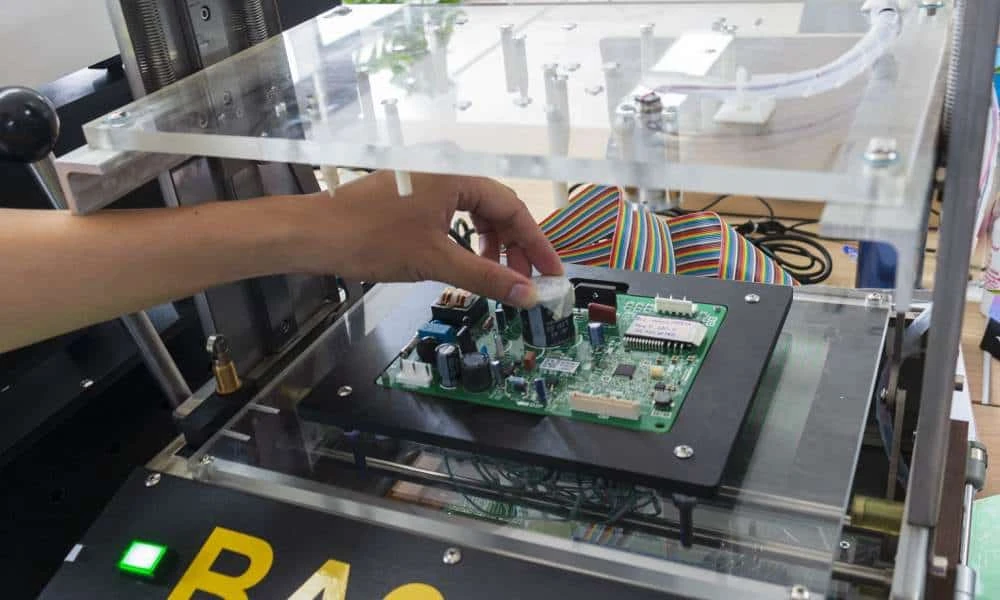
Functional Test Service
Confirm what will be powered, stimulated, measured, and recorded before the fixture is released. APTPCB builds the FCT setup around your approved firmware, loads, interfaces, limits, and production acceptance criteria.
Functional test
| Question | Answer |
|---|---|
| What is functional circuit test? | Functional circuit test (FCT) powers an assembled board and checks that it behaves as designed — firmware boots, interfaces communicate, sensors read within range and outputs drive their loads. |
| How is FCT different from ICT? | ICT checks components and nets while the board is unpowered and probe-accessible. FCT checks the working product, so it catches firmware, timing and system-level faults that ICT cannot reach. |
| When does FCT earn its cost? | When a board must be proven functional before shipment, when downstream assembly cost makes a late failure expensive, or when the product is safety- or mission-relevant. |
Coverage matrix
The released product requirements define the checks and limits. This matrix shows the information needed to turn a function into a repeatable production test.
| Product function | Typical FCT checks | Customer baseline | Possible result record |
|---|---|---|---|
| Power and startup | Rail presence, sequencing, reset, boot, inrush, and steady-state current | Nominal rails, timing, load state, and acceptance limits | Pass/fail, measured voltage or current, and failed step |
| Digital control and firmware | Firmware identity, boot state, GPIO, modes, commands, and fallback behavior | Approved image, programming method, expected states, and version rule | Firmware version, state result, error code, or response |
| Communication interfaces | UART, RS-232/485, I2C, SPI, CAN, LIN, USB, or Ethernet exchange where applicable | Protocol, command set, peer device, test data, termination, and timeout limits | Link status, response, data check, timeout, or failed transaction |
| Analogue and sensor paths | Stimulus, ADC reading, reference voltage, gain, offset, and range response | Stimulus source, calibration basis, test points, tolerance, and environment | Measured value, limit, channel, and pass/fail result |
| Outputs and loads | Relay, MOSFET, motor, fan, LED, display, buzzer, and other output behavior | Load or simulator, drive sequence, duration, expected output, and safe limits | Output state, measured level, timing, current, or failed step |
| User I/O and interlocks | Buttons, indicators, connectors, enable lines, and defined safety interlocks | Input sequence, expected feedback, fixture access, and acceptance criteria | Sequence status, response, operator prompt, or exception code |
A listed interface or function is not automatic coverage. Confirm the fixture, stimuli, peer devices, firmware, limits, sampling, and report fields for the actual order.
Engineering review to production release
Each gate closes a source of false rejects, missed failures, or untraceable results before the setup is used in volume production.
Action: map functions, stimuli, loads, firmware, limits, and required records. Risk: testing an assumed behavior or undefined range. Evidence: approved test-plan revision and open-question closure.
Action: define stable power, ground, connectors, test access, loads, simulators, and the golden board or approved reference behavior. Risk: contact, reference, or setup variation being mistaken for board failure. Evidence: fixture definition and reference approval. The fixture is designed, machined and assembled in-house rather than subcontracted.
Action: implement power-up, commands, measurements, comparisons, error codes, and result storage. Risk: an unversioned program or opaque pass/fail decision. Evidence: released software version and result-field definition.
Action: run representative boards, challenge known conditions, and review timing and thresholds. Risk: false rejects, escapes, or a cycle that does not match production handling. Evidence: pilot results, approved limits, and exception disposition.
Action: release the fixture, program, work instruction, reference, and retest flow under revision control. Risk: firmware, fixture, or criteria changing without synchronized approval. Evidence: released baseline and board- or lot-linked results as ordered.
In-house fixture and test program
APTPCB designs, machines and assembles the FCT fixture in-house and develops the matching test program, so fixture geometry, probe selection, program logic and acceptance limits stay under one revision-control process. The customer approves coverage, limits and reference behavior before the setup is released.
| Stage | APTPCB (in-house) | Customer | Evidence released |
|---|---|---|---|
| Requirements | Map functions, stimuli, loads, interfaces and required records to a test plan | Provide functional specification, expected outputs and limits | Approved test-plan revision |
| Fixture design | Mechanical and electrical fixture design, probe and connector selection, strain relief and access strategy | Confirm board orientation, connector definitions and handling constraints | Released fixture drawing and wiring schedule |
| Fabrication and assembly | Machine and assemble the fixture in-house; verify contact force, alignment and connector keying before the first board is loaded | Approve any deviation from the agreed fixture concept | Fixture build record and pre-load check |
| Test program | Develop power-up, stimulus, measurement, comparison and error-code logic, and define result storage | Supply the approved firmware image and programming method | Released program version tied to a firmware revision |
| Golden board baseline | Check the fixture against known-good behavior and tune timing and thresholds | Provide a golden board where available, or approve reference behavior in writing | Pilot results and limit justification |
| Release and change | Release fixture, program and work instruction under revision control | Approve coverage, limits and any later change | Production release package |
Where a fixture is customer-supplied or a legacy jig is reused, the same table applies — the responsible party changes, and that change is recorded in the quotation rather than assumed.
Behavioral failures
FCT complements inspection and node-level electrical tests by observing powered behavior under the approved test conditions.
A reset, sequencing, firmware, clock, current, or initialization problem can remain after visual inspection and continuity checks.
Protocol response, timing, termination, firmware state, peer-device behavior, or data integrity can be checked against a defined exchange.
The fixture can apply the approved load or simulator and evaluate output level, current, sequence, or response within stated limits.
Known stimuli can expose offset, gain, reference, channel, conversion, or firmware-scaling errors that are not visible in an unpowered check.
Test-method selection
These methods are complementary. A production plan can combine them when defect screening, hidden-joint inspection, node access, and powered behavior all matter.
| Method | What it primarily checks | Important boundary | Typical role |
|---|---|---|---|
| AOI | Visible component presence, polarity, placement, solder, and workmanship features | Cannot prove hidden joints or product function | In-line assembly inspection before later electrical or functional tests |
| X-ray inspection | Hidden solder-joint and internal assembly features within the defined inspection scope | An image does not prove circuit behavior | Inspection of BGA, QFN, bottom-terminated, or otherwise hidden features |
| ICT or flying probe | Accessible nets, continuity, shorts, and selected component relationships | Coverage depends on test access and does not replace powered product behavior | Electrical assembly-defect screening before or alongside FCT |
| FCT | Powered response to approved stimuli, loads, firmware, interfaces, and sequences | Only the released test plan, conditions, and limits are verified | Product-specific behavior verification and production release evidence |
Use the PCBA testing and quality hub to map inspection and test layers to design access, production volume, failure risk, and required evidence.
Functional test planning
Records and RFQ closure
A pass label without a controlled baseline or useful failure detail is weak production evidence. Agree the identity, fields, limits, retention, and disposition flow needed by engineering, quality, and procurement.
Send the design revision, schematic, BOM, connector and test-point details, firmware image and programming method, functional specification, stimuli, expected outputs, limits, loads or simulators, golden-board status, quantity, serialization method, and required report fields.
FCT verifies only the approved production test plan. It does not replace system-level qualification, environmental validation, regulatory testing, or safety certification unless a specific approved requirement is included in the order.
| Record field | Purpose |
|---|---|
| Board or lot identity | Connect the result to the agreed serial number or lot method |
| Test date and revision | Identify when the test ran and which released program or plan applied |
| Pass/fail and failed step | Show the disposition and isolate the point of failure |
| Measured value and limit | Retain parametric evidence where the approved test records it |
| Repair and retest status | Close the nonconforming-board flow under the order procedure |
Record availability, format, sampling, and retention depend on the released test plan and order.
Confirm fixture ownership, maintenance, spare strategy, expected volume, cycle-time target, firmware control, reference method, report format, and the approval path for changes.
Send the available schematic, BOM, firmware, functional specification, expected loads, acceptance limits, golden-board status, and reporting needs. We will confirm practical coverage and quote assumptions before tooling release.