
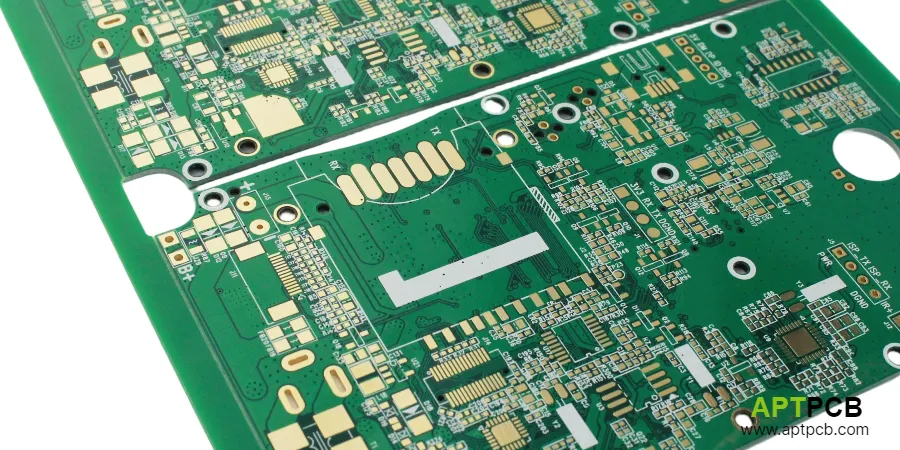
KB-6160 is the workhorse of Kingboard's FR-4 product family and one of the most widely produced laminates in the world. Designed specifically as a thin core laminate for multilayer board construction, it uses a conventional DICY-cured epoxy resin with E-glass reinforcement to deliver the processability, dimensional stability, and cost structure that high-volume production demands. With a typical Tg of 135°C and UVB/AOI compatibility, KB-6160 meets IPC-4101E/21 specifications.
KB-6160 datasheet at a glance: Tg 135°C (DSC), Td 305°C, Z-axis expansion 4.3% (50–260°C), Dk 4.25 and Df 0.018 at 1 GHz, UL94 V-0, IPC-4101E/21. Full tables, including the KB-6060 prepreg data, are below.
Understanding KB-6160's actual datasheet performance—and its limitations—is essential for making informed material decisions. This guide provides the complete verified specifications and honest assessment of where KB-6160 excels and where upgrading is necessary.
In This Guide
- KB-6160 Material System: DICY-Cured Epoxy with UVB and AOI Compatibility
- KB-6160 Verified Datasheet Specifications
- KB-6060 Prepreg System: Dk/Df Data by Glass Style
- Lamination Process Parameters and Cycle Advantages
- Lead-Free Assembly Compatibility Assessment
- Design Limitations: CTE, Aspect Ratio, and Thermal Budget
- Target Applications and Production Economics
- When to Upgrade to Higher-Grade FR-4
- KB-6160 vs KB-6160C
- How to Order KB-6160 PCBs from APTPCB
KB-6160 Material System: DICY-Cured Epoxy with UVB and AOI Compatibility
KB-6160 uses a DICY (dicyandiamide) cured epoxy resin system—the most common and cost-effective curing mechanism in the FR-4 industry. Key features highlighted by Kingboard include UVB and AOI (automatic optical inspection) compatibility for increased production throughput and accuracy, excellent dimensional stability, excellent heat resistance and mechanical properties, and compliance with IPC-4101E/21 specification.
The UVB-blocking property prevents stray UV light from penetrating through the substrate during photoresist exposure, which is particularly important for double-sided boards and inner-layer imaging. AOI compatibility ensures the material's surface color and texture produce clean contrast for automated inspection systems.
KB-6160 is produced under UL file number E123995 across Kingboard's global manufacturing network.
On a fabrication drawing, KB-6160 is simply one specific FR-4 grade. If the drawing only says "FR-4, Tg 130", a fabricator may build your FR-4 PCB on KB-6160 or an equivalent /21 laminate. Name the grade, or the IPC-4101 slash sheet, when the choice matters.
A note on search terms: "KB-6160 main board", "KB-6160C main board" or "KB-6160 schematic" usually refer to an electronic product board that shares the model number. This guide covers the Kingboard laminate only. For a product board's schematic, check with that board's vendor.
KB-6160 Verified Datasheet Specifications from Official Kingboard PDF
All values sourced from Kingboard's official KB-6160 product datasheet. Specimen thickness: 1.6 mm (8×7628 construction).
Thermal Properties
| Test Item | Test Method | Condition | Spec (IPC-4101E/21) | Typical Value |
|---|---|---|---|---|
| Thermal Stress | 2.4.13.1 | Float 288°C, Unetched | ≥10 sec | ≥180 sec |
| Glass Transition (Tg) | 2.4.25 | E-2/105, DSC | ≥130°C | 135°C |
| Z-axis CTE Alpha 1 | 2.4.24 | TMA | — | 60 ppm/°C |
| Z-axis CTE Alpha 2 | 2.4.24 | TMA | — | 300 ppm/°C |
| Z-axis Expansion (50–260°C) | 2.4.24 | TMA | — | 4.3% |
| T-260 | 2.4.24.1 | TMA | — | >10 min |
| Td (5% weight loss) | 2.4.24.6 | TGA | — | 305°C |
| Flammability | UL94 | E-24/23 | V-0 | V-0 |
Note: IPC-4101E/21 does not specify minimum requirements for CTE, T-260, T-288, or Td values—these are provided as typical reference data only. This is a significant difference from lead-free slash sheets like /124 or /126, which impose strict thermal performance minimums.
Electrical Properties
| Test Item | Test Method | Condition | Spec | Typical Value |
|---|---|---|---|---|
| Surface Resistivity | 2.5.17.1 | C-96/35/90 | ≥10⁴ MΩ | 1.0×10⁶ MΩ |
| Volume Resistivity | 2.5.17.1 | C-96/35/90 | ≥10⁶ MΩ·cm | 1.0×10⁸ MΩ·cm |
| Dielectric Breakdown | 2.5.6 | D-48/50+D-0.5/23 | ≥40 kV | 69 kV |
| Dk @ 1 MHz | 2.5.5.2 | Etched, R/C 50% | ≤5.4 | 4.35 |
| Dk @ 1 GHz | 2.5.5.2 | Etched, R/C 50% | — | 4.25 |
| Df @ 1 MHz | 2.5.5.2 | Etched, R/C 50% | ≤0.035 | 0.017 |
| Df @ 1 GHz | 2.5.5.2 | Etched, R/C 50% | — | 0.018 |
| CTI | IEC 60112 | — | — | ≥175V |
| Arc Resistance | 2.5.1 | D-48/50+D-0.5/23 | ≥60 sec | 125 sec |
A notable datasheet detail: KB-6160 provides both 1 MHz and 1 GHz Dk/Df values—not all standard FR-4 datasheets include GHz data. The Dk of 4.25 at 1 GHz is useful for impedance calculations on boards with multi-hundred-MHz signals.
Mechanical Properties
| Test Item | Test Method | Condition | Spec | Typical Value |
|---|---|---|---|---|
| Peel Strength (1 oz) | 2.4.8 | 125°C | ≥0.70 N/mm | 1.7 N/mm |
| Peel Strength (1 oz) | 2.4.8 | Float 288°C/10 sec | ≥1.05 N/mm | 1.75 N/mm |
| Peel Strength (1 oz) | 2.4.8 | After Process Solution | ≥0.80 N/mm | 1.3 N/mm |
| Flexural Strength (MD) | 2.4.4 | — | ≥415 N/mm² | 565 N/mm² |
| Flexural Strength (XD) | 2.4.4 | — | ≥345 N/mm² | 446 N/mm² |
| Moisture Absorption | 2.6.2.1 | D-24/23 | ≤0.5% | 0.19% |
The peel strength values of 1.7 and 1.75 N/mm are notably higher than mid-Tg and high-Tg materials. DICY-cured resins generally bond more strongly to copper than phenolic-cured systems.
KB-6060 Prepreg System: Complete Dk/Df Data by Glass Style at 1 GHz
KB-6160 pairs with KB-6060 prepreg. The full prepreg Dk/Df table at 1 GHz:
| Glass Style | R/C (%) | Dk @ 1 GHz (±0.2) | Df @ 1 GHz (±10%) | Pressed Thickness (mil) |
|---|---|---|---|---|
| 1080 | 61±2 | 3.8 | 0.018 | 2.8±0.3 |
| 1080 | 63±2 | 3.8 | 0.019 | 3.0±0.4 |
| 1080 | 65±2 | 3.7 | 0.019 | 3.2±0.4 |
| 3313 | 50±2 | 4.0 | 0.018 | 3.6±0.5 |
| 3313 | 55±2 | 3.9 | 0.018 | 3.9±0.5 |
| 2116 | 50±2 | 4.2 | 0.017 | 4.6±0.5 |
| 2116 | 53±2 | 4.1 | 0.019 | 5.0±0.5 |
| 2116 | 55±2 | 4.1 | 0.019 | 5.3±0.5 |
| 1506 | 43±3 | 4.5 | 0.016 | 6.0±0.5 |
| 1506 | 45±3 | 4.4 | 0.016 | 6.4±0.5 |
| 7628 | 44±3 | 4.5 | 0.015 | 7.9±0.8 |
| 7628 | 46±3 | 4.5 | 0.016 | 8.2±0.6 |
| 7628 | 49±3 | 4.4 | 0.016 | 8.9±0.6 |
| 7630 | 49±3 | 4.5 | 0.016 | 9.5±0.8 |
| 7630 | 50±3 | 4.5 | 0.016 | 9.8±0.8 |
Note the significant Dk range: from 3.7 (1080 at 65% R/C) to 4.5 (7628 at 44% R/C). Using the laminate-level Dk of 4.25 for impedance simulation when your stackup uses 1080 prepreg (Dk 3.8) would produce significant impedance errors. Always use prepreg-specific values, and enter them into the impedance calculator rather than the laminate average.
Lamination Process Parameters and Manufacturing Cycle Advantages
Kingboard's recommended press cycle for KB-6060 prepreg:
- Heat-up rate: 1.0–2.5°C/min (80°C–140°C)
- Curing temperature: >175°C
- Curing time: >45 minutes at cure temperature
- Curing pressure: 25±5 kgf/cm² (vacuum hydraulic press)
The lower cure temperature (>175°C) and shorter cure time (>45 min) compared to mid-Tg materials (>180°C, >60 min) and high-Tg materials (>190°C, >60 min) translates directly to faster press cycle times and higher throughput—a significant cost advantage at volume.
Prepreg Storage: Max 50% RH and max 23°C for 90-day shelf life, or max 5°C for 180-day shelf life. Material must acclimate to room temperature for at least 4 hours before use.
Lead-Free Assembly Compatibility: An Honest Technical Assessment
This is where honest assessment matters: KB-6160 is NOT a lead-free qualified material. The IPC-4101E/21 slash sheet does not specify T-260 or T-288 minimum values. The typical T-260 of ">10 min" provides some margin, but there is no formal lead-free warranty from the manufacturer.
In practice, thin KB-6160 boards (≤1.0 mm, 2–4 layers) typically survive 3–5 lead-free reflow cycles. But thicker multilayer boards with high aspect ratio vias face increasing delamination risk with each additional exposure to 260°C peak temperatures.
If your assembly specification requires documented lead-free compatibility, choose one of these alternatives: KB-6160C (lowest cost lead-free upgrade in the KB-6160 family), KB-6164 (low CTE, anti-CAF, lead-free at normal Tg), or KB-6165 (mid-Tg platform with full lead-free qualification).
Design Limitations: Z-Axis CTE, Aspect Ratio, and Thermal Budget Analysis
The Z-axis expansion of 4.3% (50–260°C) is the highest among the materials in this guide. For perspective: a 1.6 mm board expands approximately 69 µm in the Z-direction during reflow, compared to 50 µm for KB-6165 and 42 µm for KB-6167F. This 64% increase in via strain versus KB-6167F limits reliable via aspect ratios to approximately 6:1 for standard thermal cycling requirements.
The Td of 305°C is adequate for most processes but provides less margin than mid-Tg alternatives (335°C for KB-6165). For boards requiring rework or selective soldering at elevated temperatures, the lower Td budget must be considered.
No anti-CAF specification is provided for KB-6160, which may be a concern for fine-pitch designs in humid environments.
Despite these limitations, KB-6160 remains the correct choice for its intended applications: cost-sensitive multilayer boards operating in benign environments where the thermal extremes of lead-free assembly are manageable.
Target Applications and High-Volume Production Economics
KB-6160 excels in high-volume production of 4–8 layer boards for consumer electronics, general-purpose computing peripherals, communication equipment, instruments, and office automation products. Its cost advantage comes from three sources: lowest material price in the FR-4 family, fastest lamination cycle (lower cure temperature and shorter time), and longest drill tool life (no fillers).
At APTPCB, approximately 40–50% of standard multilayer orders use KB-6160 or equivalent conventional FR-4. Our volume multilayer production lines are optimized for this material with the highest throughput. All standard PCB surface finishes are compatible.
When to Upgrade: Material Selection Triggers for Higher-Grade FR-4
| Your Requirement | Recommended Material | Why |
|---|---|---|
| Lead-free assembly required | KB-6160C or KB-6164 | Formal lead-free thermal specs |
| Operating temp >85°C | KB-6165 (Tg 153°C) | Higher Tg provides operating margin |
| Layer count >10 | KB-6165F or KB-6167F | Lower CTE, dimensional stability |
| Signal speed >1 Gbps | KB-6165GMD or KB-6167GMD | Lower Df reduces insertion loss |
| Anti-CAF needed | KB-6164 or KB-6165 | Formal CAF testing |
| Halogen-free required | KB-6165G | HF compliance at mid-Tg |
The full tier framework for the family is in the Kingboard laminate guide. To compare KB-6160 with other brands' FR-4 and specialty laminates, use the circuit board material library. For non-FR-4 options such as metal core, flex and package substrates, see the guide to PCB substrates.
KB-6160 vs KB-6160C: Which One Do You Need?
KB-6160C is the lead-free qualified member of the KB-6160 family. The KB-6160 values below come from the official datasheet. The KB-6160C values are estimates from Kingboard family data (see the Kingboard laminate guide master table), so confirm them against the current KB-6160C datasheet before you release a drawing.
| Property | KB-6160 | KB-6160C (estimated) |
|---|---|---|
| IPC-4101 slash sheet | /21 | /24 (lead-free qualified) |
| Tg | 135°C | ~140°C |
| Td (5% weight loss) | 305°C | ~310°C |
| Z-axis expansion (50–260°C) | 4.3% | ~4.0% |
| Relative material cost | 1.0× | ~1.15× |
| Choose it when | Tin-lead or few lead-free reflows, thin 2–6 layer boards | Lead-free assembly must be documented, or the board sees several reflow passes |
If neither is enough, the upgrade table above shows the next step (KB-6164 or KB-6165).
Frequently Asked Questions: KB-6160 & KB-6160C Fabrication
Q: Where can engineers verify Kingboard KB 6160 datasheet specifications for volume production? The official kb 6160 datasheet specifies a glass transition temperature (Tg) of 135°C (DSC), decomposition temperature (Td) of 305°C, and dielectric constant (Dk) of 4.25 at 1 GHz under IPC-4101E/21 slash sheets. For engineers evaluating standard kb 6160 laminate material or cross-referencing Kingboard kb6160 prepreg styles (such as 1080, 2116, and 7628), confirming thickness tolerance and Z-axis expansion (4.3%) against the verified kb-6160 datasheet ensures reliable plating through-hole barrel integrity.
Q: When is a KB 6160 board or KB-6160 main board recommended over a KB-6160C main board? A standard kb 6160 board is optimized for cost-sensitive consumer appliances, power supplies, and simple multilayer assemblies (2 to 6 layers) utilizing tin-lead or mild single-pass reflow profiles. However, when designing a modern high-density appliance controller or industrial kb-6160 main board subject to repeated lead-free thermal cycles (260°C peak), upgrading to a kb-6160c main board is strongly advised. The lead-free qualified kb-6160c formulation (also referenced as kb 6160c) provides enhanced anti-CAF resistance, a higher decomposition ceiling (Td ≈ 310°C), and superior delamination margin under IPC-4101E/24 requirements.
How to Order KB-6160 PCBs from APTPCB
Upload your Gerber files with stackup requirements. Our engineering team verifies KB-6160 suitability, simulates impedance using prepreg-specific Dk values, and provides DFM feedback typically within 24 hours. For complete fabrication and assembly service, we quote both together with material included.
KB-6160's high-Tg resin changes press cycles and drill parameters, so confirm those process settings with your custom PCB manufacturer before locking the stackup.