
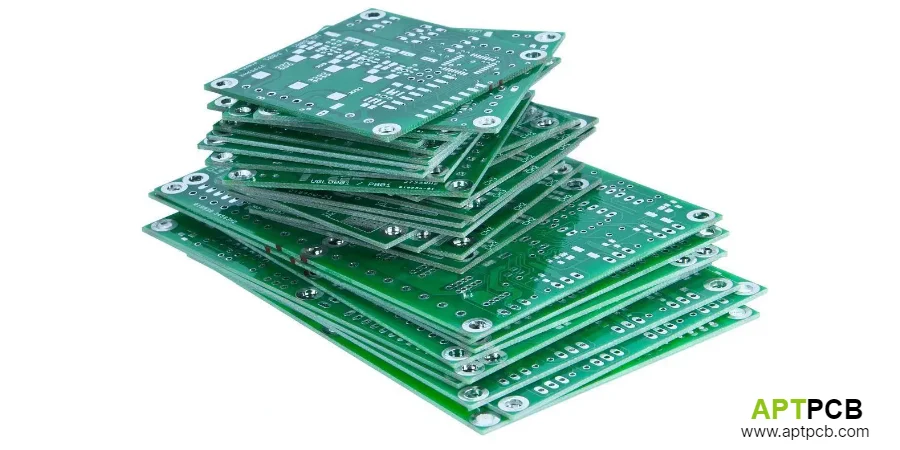
KB-6160A is Kingboard's standard FR-4 variant specifically optimized for double-sided (two-layer) PCB production. While sharing the IPC-4101D/21 classification with KB-6150 and KB-6160, KB-6160A adds a UVB-blocking property to its resin formulation that simplifies double-sided photoimaging—a meaningful production advantage for the enormous market of two-layer boards used in LED drivers, power supplies, motor controllers, HMI panels, and industrial control equipment.
In short: a KB6160A board is an ordinary FR-4 PCB built on a core that blocks UVB light, which makes thin two-layer boards easier to image. It is not a lead-free qualified or high-CTI grade, and it is sold as cores only, with no matching prepreg.
The double-sided PCB market represents the largest single segment of global PCB production by panel volume. In this high-volume, cost-sensitive environment, even small processing advantages translate to measurable yield improvements across millions of boards. KB-6160A's formulation targets exactly these production efficiencies while maintaining the standard FR-4 performance that double-sided designs require.
In This Guide
- Why Double-Sided PCB Production Benefits from Dedicated Material Optimization
- KB-6160A Technical Specifications and Core Thickness Range
- UVB-Blocking Property: How It Improves Double-Sided Imaging Yield
- KB-6160A vs KB-6160 vs KB-6160C: Choosing the Right Standard FR-4 Grade
- Core Thickness Range and Single-Lamination Board Construction
- LED Driver, Power Supply, and Industrial Control Applications
- Manufacturing Process Advantages for Two-Layer Production
- When to Move Beyond KB-6160A to Multilayer-Capable Materials
- How to Order KB-6160A PCBs from APTPCB
Why Double-Sided PCB Production Benefits from Dedicated Material Optimization
Double-sided PCBs have fundamentally different manufacturing requirements than multilayer boards. In multilayer construction, thin prepreg sheets bond multiple cores under heat and pressure. In double-sided construction, a single core of specific thickness IS the finished board—there is no lamination step. The core material's as-received properties directly determine production yield.
The most significant double-sided manufacturing challenge is photoimaging alignment and UV exposure control. When exposing the top-side circuit pattern, UV light must not penetrate through the core and pre-expose the bottom-side photoresist. Standard FR-4 cores, particularly at thicknesses below 0.8 mm, can transmit enough UV energy to cause bottom-side exposure artifacts—resulting in circuit defects that require rework or scrap.
KB-6160A addresses this with a resin formulation that blocks UVB wavelengths used in photoimaging equipment. This eliminates the need for light-blocking interleave sheets between panels during batch exposure, simplifies the imaging process flow, and directly improves yield for thin double-sided boards.
KB-6160A Technical Specifications and Core Thickness Range
Thermal and General Properties
| Property | KB-6160A (Estimated) | Test Method |
|---|---|---|
| Glass Transition (Tg, DSC) | ~130°C | IPC-TM-650 2.4.25 |
| Decomposition Temperature (Td) | ~300°C | IPC-TM-650 2.4.24.6 |
| Z-axis CTE (α1, below Tg) | ~65 ppm/°C | TMA |
| Z-axis CTE (50–260°C) | ~4.5% | TMA |
| Moisture Absorption | ≤0.35% | IPC-TM-650 2.6.2.1 |
| Flammability | V-0 | UL 94 |
| IPC Slash Sheet | IPC-4101D/21 | — |
| UL File | E123995 | — |
| Core Thickness Range | 0.4–3.2 mm | — |
| UV Blocking Property | Yes (UVB) | — |
Electrical Properties
| Property | KB-6160A (Estimated) | Test Method |
|---|---|---|
| Dk @1 MHz | ~4.5 | IPC-TM-650 2.5.5.9 |
| Dk @1 GHz | ~4.3 | IPC-TM-650 2.5.5.9 |
| Df @1 MHz | ~0.018 | IPC-TM-650 2.5.5.9 |
| Df @1 GHz | ~0.020 | IPC-TM-650 2.5.5.9 |
| CTI | ≥175V | IEC 60112 |
Mechanical Properties
| Property | KB-6160A (Estimated) | Test Method |
|---|---|---|
| Peel Strength (after float 288°C) | ≥1.05 N/mm | IPC-TM-650 2.4.8 |
| Flexural Strength (MD) | ~520 N/mm² | IPC-TM-650 2.4.4 |
Data Confidence Note: KB-6160A values are estimated from IPC-4101D/21 classification. The key distinction versus KB-6160 is the UVB-blocking resin and core thickness starting at 0.4 mm (versus 0.05 mm for KB-6160). Contact Kingboard for specific thickness and copper options.
UVB-Blocking Property: How It Improves Double-Sided Imaging Yield
In double-sided PCB production, both sides of a copper-clad core are coated with photoresist and each side must be exposed separately. The challenge arises because standard FR-4 is partially transparent to UVB wavelengths (300–400 nm) used in photoimaging equipment.
The problem without UV blocking: When exposing Side A, UV energy passes through 0.4–0.8 mm cores and partially exposes Side B photoresist. This "print-through" creates ghost images causing circuit defects, particularly on fine-pitch designs approaching resolution limits.
Traditional mitigation: Fabricators use black interleave paper or opaque backing plates during exposure. This adds handling steps, increases cycle time by 10–15%, and creates contamination potential. On cores below 0.6 mm, even interleave may not fully prevent print-through.
KB-6160A solution: The UVB-absorbing additive blocks critical wavelengths at the material level, eliminating print-through regardless of core thickness. Direct double-sided exposure without interleave reduces imaging cycle time and eliminates a contamination source. The blocking property has no measurable effect on electrical, thermal, or mechanical performance.
The yield impact is most significant for high-volume production runs where even a 0.5% yield improvement across 100K panels translates to 500 fewer scrapped panels—a material cost saving that far exceeds any KB-6160A price premium over KB-6150.
KB-6160A vs KB-6160 vs KB-6160C: Choosing the Right Standard FR-4 Grade
| Property | KB-6160A | KB-6160 (Verified) | KB-6160C |
|---|---|---|---|
| Tg (DSC) | ~130°C | 135°C ✓ | ~140°C |
| Td (TGA) | ~300°C | 305°C ✓ | ~310°C |
| Z-CTE (50–260°C) | ~4.5% | 4.3% ✓ | ~4.0% |
| Dk @1 GHz | ~4.3 | 4.25 ✓ | ~4.3 |
| IPC Slash Sheet | /21 | /21 ✓ | /24 |
| UV Blocking | Yes | No | No |
| Min Core Thickness | 0.4 mm | 0.05 mm | — |
| Prepreg System | Limited | KB-6060 (full) | KB-6060C |
| Lead-Free Qualified | No | No | Yes |
| Primary Use | Double-sided | General multilayer | Lead-free multilayer |
| Cost Position | ~1.0× | 1.0× | ~1.15× |
Choose KB-6160A when: Building 2-layer boards, especially at thicknesses 0.4–1.0 mm where UV print-through is a yield concern. High-volume double-sided production with standard thermal requirements.
Choose KB-6160 when: Building multilayer PCBs (4+ layers) that require the full KB-6060 prepreg system with characterized Dk/Df data. General-purpose applications at standard Tg.
Choose KB-6160C when: Lead-free qualification is required with formal T-260 and T-288 specifications per IPC-4101 /24 slash sheet.
The base KB-6160 laminate, with its verified datasheet values and the full KB-6060 prepreg table, is covered in the KB-6160 FR-4 laminate guide.
KB-6160 and KB-6160A CTI and UL 94V-0 rating
Searches such as "FR-4 KB-6160 CTI 600V" mix up two different properties. Both KB-6160 and KB-6160A are rated UL 94 V-0 for flammability. Their comparative tracking index (CTI) is ≥175V, which is PLC 3 under IEC 60112 and the normal value for standard FR-4. Neither grade is a CTI 600V material. If the creepage design depends on a CTI ≥600V (PLC 0) laminate, you need a high-CTI grade such as KB-6169GT, listed as CTI ≥600V in the Kingboard laminate selection guide, or an equivalent from another supplier. Put the CTI value on the fabrication drawing; "FR-4" on its own does not say anything about CTI.
Core Thickness Range and Single-Lamination Board Construction
KB-6160A's core thickness range of 0.4–3.2 mm is specifically designed for single-lamination (no-press) board construction. This is fundamentally different from KB-6160's range starting at 0.05 mm, which targets multilayer inner-layer cores that will be laminated with prepreg.
Standard KB-6160A core thicknesses and their typical applications:
| Core Thickness | Finished Board Thickness (with copper) | Typical Application |
|---|---|---|
| 0.4 mm | ~0.5 mm | Thin LED driver boards, space-constrained modules |
| 0.6 mm | ~0.7 mm | Compact power supply controls, IoT sensor boards |
| 0.8 mm | ~0.9 mm | Standard LED drivers, relay boards |
| 1.0 mm | ~1.1 mm | Small motor controllers, interface boards |
| 1.2 mm | ~1.3 mm | HMI controller boards, power distribution |
| 1.6 mm | ~1.7 mm | Standard double-sided boards (most common) |
| 2.0 mm | ~2.1 mm | Heavy copper power boards, structural boards |
| 3.2 mm | ~3.3 mm | Thick power distribution, connector backplanes |
The absence of thin cores (<0.4 mm) from KB-6160A's range is intentional—cores below 0.4 mm are primarily used as multilayer inner layers, which is KB-6160's domain. KB-6160A concentrates on the thicknesses needed for standalone two-layer boards.
Important limitation: KB-6160A does NOT have a corresponding prepreg system. It is a cores-only product. If your design requires multilayer construction (4+ layers), you must use KB-6160 cores with KB-6060 prepreg, or another material family with a matched prepreg system.
LED Driver, Power Supply, and Industrial Control Applications
LED Lighting Drivers: The largest single application for double-sided boards. LED driver circuits operate at modest temperatures (below 85°C ambient for most indoor applications) and require simple two-layer routing for the power conversion topology. KB-6160A's UVB blocking is particularly valuable for thin LED driver boards (0.4–0.8 mm) that fit inside compact luminaire housings.
Switch-Mode Power Supplies: Two-layer power supply boards for laptop chargers, USB-C PD adapters, phone chargers, and industrial power converters. The 1.6 mm standard thickness handles most power supply designs with adequate copper weight for current-carrying capacity.
Industrial HMI Panels: Human-machine interface controller boards behind touchscreen displays. These panels use double-sided PCBs for the display interface, button/LED circuits, and communication interfaces. Our industrial PCB capabilities handle KB-6160A for industrial control applications.
Motor Controllers: Simple brushless DC motor controllers for fans, pumps, and small appliances. The two-layer construction accommodates the gate driver, current sense, and power stage routing. For high-power motor controllers requiring thicker copper (2–3 oz), KB-6160A cores at 1.6–2.0 mm provide the necessary substrate rigidity.
Automotive Accessory Boards: Interior lighting controllers, window switch modules, seat heater controllers, and other non-safety-critical automotive accessories. For automotive temperature range requirements (-40°C to +85°C interior), KB-6160A's Tg ~130°C provides adequate margin. For under-hood or safety-critical applications, upgrade to KB-6167F with Tg >170°C.
Consumer Appliance Controls: Washing machine controllers, microwave display boards, HVAC thermostat boards, and similar household appliance electronics where two-layer construction is standard and production volumes justify material optimization.
Manufacturing Process Advantages for Two-Layer Production
KB-6160A's value proposition extends beyond the UVB-blocking feature to its overall optimization for two-layer production flow:
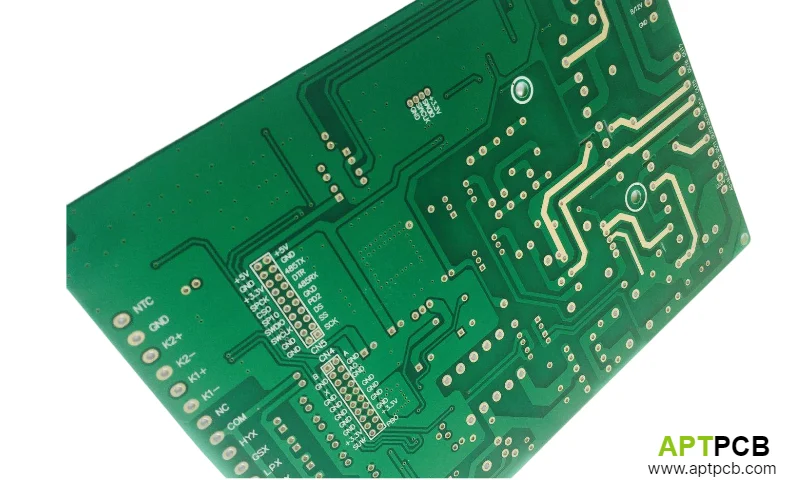
Simplified process flow: Double-sided boards skip the entire multilayer lamination process—no inner-layer imaging, no oxide treatment, no prepreg layup, no press cycle. The process goes directly from core material to outer-layer imaging, drilling, plating, and finishing. This shorter process flow means faster delivery times and lower fabrication costs.
Drilling performance: KB-6160A's standard DICY-cured, unfilled resin system drills cleanly with standard carbide bits at standard parameters. Drill bit wear is the lowest of any Kingboard material category—no filler particles to accelerate wear, no high-Tg resin requiring adjusted feed rates.
Plating compatibility: Standard electroless copper and electrolytic copper plating processes apply without modification. Through-hole plating on double-sided boards requires only single-pass plating (versus multiple plating cycles for multilayer blind/buried vias).
Surface finish options: All standard finishes are compatible: HASL (leaded and lead-free), ENIG, immersion silver, immersion tin, and OSP. For cost-sensitive high-volume production, HASL or OSP provides the lowest finish cost.
Our fabrication process is optimized for high-volume double-sided production with automated panel handling for KB-6160A boards.
When to Move Beyond KB-6160A to Multilayer-Capable Materials
KB-6160A's sweet spot is two-layer boards. When your design requirements exceed two-layer capability, the material selection must change:
| Design Requirement | Why KB-6160A Won't Work | Recommended Alternative |
|---|---|---|
| 4+ layer multilayer | No prepreg system available | KB-6160 + KB-6060 prepreg |
| Lead-free qualified assembly | No T-260/T-288 specification | KB-6160C |
| Operating temp >100°C | Tg ~130°C insufficient margin | KB-6165 (Tg 153°C) |
| Controlled impedance ±5% | Dk not characterized per glass style | KB-6160 (characterized Dk data) |
| Halogen-free compliance | Not halogen-free formulated | KB-6165G |
| High-speed signals (>1 Gbps) | Df ~0.020 too lossy | KB-6165GMD or higher |
| High aspect ratio vias | Z-CTE ~4.5% limits reliability | KB-6165 or KB-6167F |
The transition from KB-6160A to multilayer-capable materials represents a design complexity threshold, not just a material upgrade. If your circuit can be routed on two layers, KB-6160A provides the most cost-effective substrate. Once the design requires a third signal layer, the material ecosystem must support prepreg-based lamination.
To compare these Kingboard grades with other brands' circuit board materials, use our materials library. For aluminum-backed LED boards, flex circuits or package substrates instead of FR-4, see the PCB substrate selection guide.
How to Order KB-6160A PCBs from APTPCB
Submit your double-sided PCB design for a competitive KB-6160A quotation. Specify the target core thickness, copper weight, and surface finish. Our engineering team confirms KB-6160A suitability and identifies any design features that might benefit from an alternative material. For high-volume production with complete assembly services, we provide integrated quotes optimized for two-layer board economics with quality documentation included.