
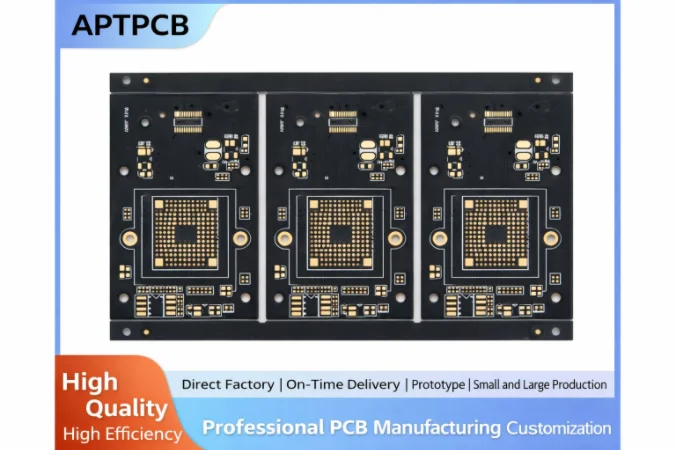
KB-6167F is a filled, multifunctional phenolic-cured high-Tg FR-4 laminate designed for thermally demanding multilayer PCB applications. The correct selection depends on the complete PCB construction: stack-up, KB-6067F prepreg configuration, impedance requirements, assembly profile, reliability targets, and manufacturing controls.
Key takeaways for selecting KB-6167F
- KB-6167F is typically specified with Tg 175°C by DSC, Td around 349°C by TGA, T-288 above 35 minutes, and Z-axis expansion around 2.6% from 50°C to 260°C.
- Published material values are references for defined test conditions, not automatic guarantees for every PCB construction.
- Dk and Df depend on glass style, resin content, frequency, copper geometry, and measurement method.
- A high Tg laminate does not define continuous operating temperature, via lifetime, or complete product qualification.
- Production release should define laminate, prepreg, copper, press profile, drill process, inspection evidence, and approved substitutions.
What is KB-6167F PCB material used for?
KB-6167F is a glass-reinforced epoxy laminate using a filled phenolic-cured resin system. It is intended for high-reliability multilayer PCB applications where thermal process margin, dimensional stability, and lead-free assembly compatibility are important.
Typical applications include:
| Application | Material selection consideration |
|---|---|
| Lead-free multilayer PCB | Thermal cycling and assembly profile must be reviewed |
| High-layer-count boards | Resin flow, registration, and press control become important |
| Industrial electronics | Environmental qualification determines final suitability |
| Automotive electronics | Material capability must be combined with product validation |
| Controlled impedance designs | Stack-specific dielectric data is required |
The laminate should be selected as part of the released PCB construction, not as a standalone replacement for a complete reliability analysis.
In purchasing terms, a KB-6167F build is a high Tg PCB: an FR4 PCB board whose resin system has been upgraded for lead-free and multilayer thermal stress. It is not halogen-free; for that requirement, compare Kingboard's halogen-free grades in the Kingboard PCB laminate overview.
What are the KB-6167F thermal and electrical properties?
The following values are published typical values for the stated test conditions.
| Property | Test method / condition | Typical value | Engineering meaning |
|---|---|---|---|
| Tg | IPC-TM-650 2.4.25 DSC | 175°C | Resin transition reference |
| Td | IPC-TM-650 2.4.24.6 TGA | 349°C | Decomposition indicator |
| Z-axis CTE below Tg | IPC-TM-650 2.4.24 | 40 ppm/°C | Through-thickness expansion behavior |
| Z-axis CTE above Tg | IPC-TM-650 2.4.24 | 230 ppm/°C | Expansion after resin transition |
| Z-axis expansion | 50–260°C | 2.6% | Thermal expansion indicator |
| T-260 | TMA | >60 min | Delamination resistance indicator |
| T-288 | TMA | >35 min | High-temperature exposure indicator |
| Moisture absorption | IPC-TM-650 2.6.2.1 | 0.09% | Moisture uptake reference |
| Flammability | UL94 | V-0 | Flammability classification |
Source values are based on Kingboard technical information and processing documents.
Does a 175°C Tg mean a PCB can operate at 175°C?
No. Tg identifies a resin transition measured by a defined method. Finished PCB operating limits depend on copper structures, components, solder system, thermal cycling, environmental exposure, aging requirements, and product standards.
How should KB-6167F Dk and Df values be used for impedance design?
KB-6167F publishes dielectric values including:
| Electrical property | Condition | Typical value |
|---|---|---|
| Dk | Etched specimen, RC 50%, 1 MHz | 4.8 |
| Dk | Etched specimen, RC 50%, 1 GHz | 4.6 |
| Df | Etched specimen, RC 50%, 1 MHz | 0.015 |
| Df | Etched specimen, RC 50%, 1 GHz | 0.016 |
| Dielectric breakdown | IPC-TM-650 2.5.6 | ≥45 kV |
| CTI | IEC 60112 | >175 V |
For controlled impedance designs, the released stack-up should define:
- Actual pressed dielectric thickness.
- Glass style and resin content.
- Copper foil and finished copper profile.
- Trace geometry.
- Frequency range.
- Coupon structure and correlation method.
The PCB stack-up guide and impedance-control workflow explain how these parameters move from design assumptions into production verification.
KB-6167F can support many controlled-impedance applications, but it is not automatically a low-loss laminate. Channel insertion loss requirements should be evaluated using the complete signal path.
How does KB-6067F prepreg affect KB-6167F stack-up design?
KB-6067F prepreg controls dielectric thickness, resin fill, and final electrical behavior.
| Prepreg style | Resin content | Dk at 1 GHz | Df at 1 GHz | Pressed thickness |
|---|---|---|---|---|
| 106 | 72 ±2% | 4.1 | 0.017 | 2.1 ±0.30 mil |
| 1080 | 62 ±2% | 4.3 | 0.016 | 2.8 ±0.30 mil |
| 3313 | 52 ±2% | 4.5 | 0.015 | 3.5 ±0.30 mil |
| 2116 | 53 ±2% | 4.5 | 0.016 | 4.7 ±0.40 mil |
| 7628 | 45 ±2% | 4.6 | 0.015 | 7.7 ±0.50 mil |
A production stack-up should identify exact prepreg construction, resin content, and target pressed thickness.
When is KB-6167F the right material choice?
| Design priority | KB-6167F suitability | Required review |
|---|---|---|
| Lead-free multilayer PCB | Strong candidate | Assembly profile and thermal cycling |
| High layer count | Suitable | Press registration and resin flow |
| Standard impedance control | Suitable | Fabricator stack-up correlation |
| Very low insertion loss channel | May require comparison | Complete loss budget |
| Continuous high-temperature product | Requires validation | Product-level thermal testing |
| Automotive qualification | Material is only one input | Full PCB and system approval |
Material substitution should compare resin chemistry, Dk/Df methods, glass construction, thermal expansion, processing compatibility, and qualification status.
What manufacturing controls are required for KB-6167F?
| Process stage | Engineering requirement |
|---|---|
| Material storage | Control moisture, packaging condition, and lot traceability |
| Inner layers | Establish dimensional compensation from construction and copper distribution |
| Press cycle | Use material-temperature-controlled curing |
| Cure | Above 190°C material temperature for at least 60 minutes |
| Pressure | Typical vacuum press range 300–400 psi |
| Heat-up | 1.5–2.5°C/min from 80°C to 140°C |
| Cooling | Below 3°C/min recommended in processing guidance |
| Drilling | Establish tool, feed, speed, stack height, and hole-quality controls |
Kingboard processing guidance provides starting parameters that require adjustment for the actual PCB design and factory process.
What KB-6167F PCB failures should engineers investigate?
| Failure mode | Possible cause | Verification evidence |
|---|---|---|
| Impedance shift | Wrong dielectric assumption, prepreg change, copper variation | Stack-up review, TDR coupon, cross-section |
| Thickness variation | Resin demand or press-flow mismatch | Press records, dielectric measurement |
| Warpage | Copper imbalance or lamination stress | Panel measurements, press profile |
| Hole defects | Drill, desmear, plating process issue | Microsections and process records |
| Via reliability failure | Excess thermal stress or poor geometry | Reliability testing, thermal cycling data |
| Excess channel loss | Incorrect Df, rough copper, route length | Loss modeling and validation |
How should KB-6167F builds be inspected?
A released PCB qualification package should include:
- Material identity and lot traceability.
- Approved stack-up and prepreg construction.
- Lamination profile records.
- Finished thickness and registration measurements.
- Hole-wall microsection results.
- Electrical test results.
- Impedance or insertion-loss coupon data when required.
- Assembly thermal history when reliability depends on reflow exposure.
The multilayer PCB manufacturing, fabrication-process, and PCB quality resources provide additional manufacturing context.
How do you choose a KB-6167 PCB manufacturer or supplier?
Many fabricators list KB-6167F, but stocking the laminate and building a reliable KB-6167 PCB are different claims. Ask any KB-6167 PCB manufacturer or supplier for evidence that matches your construction:
| Question to ask | Evidence that answers it |
|---|---|
| Do you stock KB-6167F cores and KB-6067F prepreg in the thicknesses and glass styles I need? | Stock list or confirmed lead time per core/prepreg, and the substitution rule if not stocked |
| What Dk values do you use for my stack-up? | Fabricator stack-up with the glass style, resin content, and frequency behind each Dk value |
| Which press profile do you run for this material? | Named lamination program and whether it was validated on similar layer counts |
| How do you verify finished boards? | Microsection plan, impedance coupon and TDR report, and the IPC-6012 class applied |
| Will the material be called out on the certificate of conformance? | CoC or material certificate that names the laminate and lot |
| Who approves an alternate laminate? | Written approval route; no silent substitution |
A supplier that answers these with documents rather than general statements gives you a construction you can repeat in production.
KB-6167F PCB RFQ checklist
Material and stack-up
- KB-6167F laminate grade and thickness.
- KB-6067F prepreg style and resin content.
- Copper weight and finished copper requirements.
- Controlled impedance targets.
- Approved substitute materials and change-control rules.
Manufacturing and reliability
- Layer count and board thickness.
- Via structures and aspect ratios.
- Assembly temperature profile.
- Thermal cycling, CAF, IST, humidity, or environmental requirements.
- Required inspection reports.
Supplier documentation
- Material certificates.
- Lot traceability.
- Press charts.
- Microsection reports.
- Electrical test records.
- Qualification evidence.
Standards and qualification boundary
Relevant references include:
- IPC-4101E/126 — Specification for Base Materials for Rigid and Multilayer Printed Boards
- IPC-TM-650 — Test Methods Manual
- IPC-6012 — Qualification and Performance Specification for Rigid Printed Boards
- IPC-2221 — Generic Standard on Printed Board Design
- IEC 60112 — Comparative Tracking Index testing
- UL94 — Flammability testing
A laminate datasheet does not certify a finished PCB. Final approval depends on the released construction, fabrication process, assembly conditions, product environment, and customer qualification requirements.
KB-6167F PCB FAQ
What is KB-6167F?
KB-6167F is a high-Tg filled FR-4 laminate designed for demanding multilayer PCB applications.
What prepreg is paired with KB-6167F?
KB-6067F is the companion prepreg system used to build multilayer constructions.
Is KB-6167F a low-loss PCB material?
It has published Df values suitable for many FR-4 applications, but high-speed channel suitability depends on the complete loss budget.
Can another high-Tg FR-4 replace KB-6167F?
Only after comparing electrical properties, thermal behavior, construction, processing compatibility, and qualification requirements.
Is KB-6167F the same as KB-6167?
"KB-6167" is commonly used as shorthand for the KB-6167F laminate. Kingboard also sells related grades with different suffixes (such as KB-6167GMD, a halogen-free mid-loss grade), so always state the full grade and the companion prepreg on the drawing.
What should an RFQ include?
An RFQ should define materials, stack-up, impedance requirements, manufacturing controls, inspection records, and reliability testing.
Request a KB-6167F stack-up review
Send the fabrication package, proposed stack-up, impedance requirements, via structures, assembly profile, qualification plan, quantities, and documentation requirements through the PCB quote workflow. APTPCB can review manufacturability and return a project-specific construction and evidence plan.