
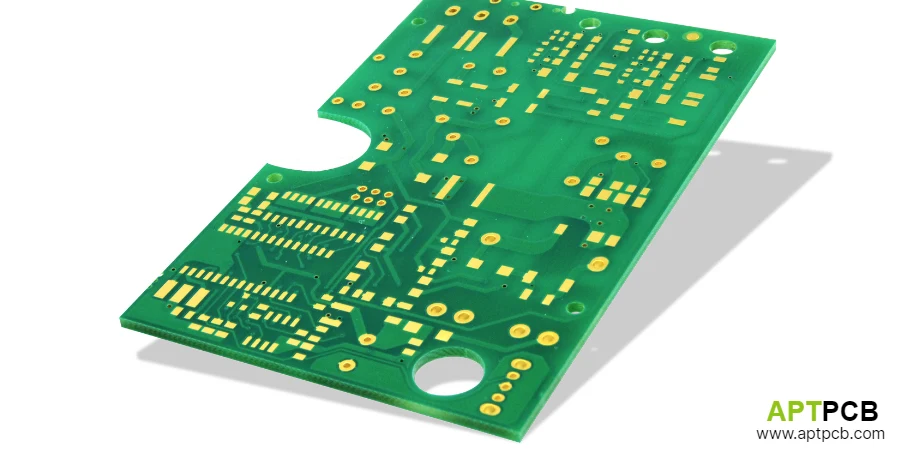
KB-6168LE is a Kingboard high-Tg FR-4 laminate designed for multilayer PCB applications where thermal cycling, plated-through-hole reliability, and lead-free assembly exposure require tighter material control than conventional FR-4. The low Z-axis expansion characteristic can reduce mechanical strain on plated vias, but the laminate is only one part of the reliability system.
A qualified KB-6168LE PCB depends on the complete construction: laminate grade, prepreg selection, resin content, copper distribution, board thickness, via geometry, drilling process, plating quality, and assembly profile.
KB-6168LE PCB selection: what should engineers verify first?
A material part number is not enough for a production release. The approved specification should identify the exact laminate construction, supplier documentation revision, and the performance evidence required for the finished PCB.
Key verification items include:
| Material decision item | Why it affects PCB performance | Qualification evidence |
|---|---|---|
| Exact laminate and prepreg designation | Different constructions can change flow, thickness, and electrical behavior | Current manufacturer datasheet and processing documentation |
| Tg and test method | DSC, DMA, and TMA values are not interchangeable | Property value, method, and document revision |
| Z-axis expansion | Controls thermal strain applied to plated holes | CTE data, temperature range, and test method |
| Td, T260, and T288 | Indicates thermal endurance and delamination resistance | Manufacturer test values and conditions |
| Dk and Df | Affects impedance and signal-loss calculations | Frequency, method, and design-Dk guidance |
| UL recognition | Supports compliance and material traceability | UL file and construction details |
| CAF performance | Depends on material and manufacturing conditions | Qualification data for the intended spacing and environment |
| Core and prepreg availability | Determines whether the released stack-up is manufacturable | Supplier material matrix and approved alternatives |
Public material listings can be useful for initial comparison, but production decisions should reference controlled manufacturer documents and the exact construction purchased. Independent databases commonly summarize KB-6168LE values such as Tg, Td, Dk, Df, and CTE, but they do not replace the controlled material specification.
Why does low Z-axis expansion improve via reliability?
During thermal cycling, the PCB expands through the thickness direction while copper plating inside a drilled hole resists that movement. Repeated heating from assembly, rework, and field operation creates stress at the via barrel and inner-layer connections.
KB-6168LE's low-expansion design can reduce one contributor to this stress. The final reliability result still depends on the complete PCB structure.
| Failure mode | Material-related contributor | PCB qualification control |
|---|---|---|
| Via barrel cracking | Z-axis expansion during thermal cycling | Thermal stress testing, microsections, and controlled plating requirements |
| Inner-layer connection failure | Resin movement, drilling damage, or weak connections | Coupon design, hole-wall inspection, and process monitoring |
| Delamination | Thermal exposure beyond material capability | T260/T288 review and assembly profile control |
| CAF growth | Material, spacing, moisture, and process interaction | Environmental qualification and manufacturing controls |
| Impedance variation | Resin content, glass style, and dielectric variation | Controlled stack-up and impedance coupons |
Lower expansion is valuable for thick multilayer boards and high thermal-cycle environments, but no laminate property alone guarantees via life.
KB-6168LE material selection matrix
The right question is not whether KB-6168LE has a high Tg. The decision depends on the dominant product requirement.
| Application requirement | KB-6168LE suitability | Additional evaluation |
|---|---|---|
| Thick multilayer PCB with many plated through holes | Strong candidate when via reliability is a priority | Confirm final thickness, aspect ratio, and plating capability |
| Multiple lead-free assembly cycles | Suitable when thermal margin is required | Review reflow profile and rework exposure |
| High-speed digital design | Possible after electrical validation | Confirm Dk, Df, glass weave, and impedance model |
| RF or microwave design | Requires application-specific review | Compare against purpose-built RF laminates |
| High continuous-temperature environment | May not be sufficient alone | Consider higher-temperature material systems |
| Cost-sensitive production | Requires value justification | Compare qualification cost, supply stability, and alternatives |
KB-6168LE appears in manufacturer and certification references as a recognized FR-4 material system, including UL-recognized constructions.
How should a KB-6168LE PCB stack-up be qualified?
A reliable stack-up begins with mechanical, electrical, and manufacturing constraints.
The qualification review should include:
- Freeze finished thickness, layer count, copper weights, impedance requirements, and assembly thermal exposure.
- Identify through vias, blind vias, buried vias, microvias, and sequential lamination structures.
- Calculate via aspect ratios using finished hole diameter and finished board thickness.
- Confirm available KB-6168LE cores and compatible prepregs.
- Review resin content, glass styles, copper balance, and resin fill requirements.
- Define plated-hole copper requirements and inspection criteria.
- Add representative coupons for impedance, plating evaluation, and reliability testing.
- Establish thermal-stress, IST, or cycling requirements before production release.
A material selection decision should produce a controlled stack-up, not only a laminate name.
What manufacturing controls are required for KB-6168LE PCBs?
KB-6168LE requires fabrication controls that match the selected construction. The PCB manufacturer should use qualified lamination, drilling, desmear, plating, and inspection processes supported by material documentation.
The production release package should include:
- incoming material identification and lot traceability;
- controlled lamination parameters;
- storage and moisture handling requirements;
- drilling capability review;
- desmear process compatibility;
- plated-hole copper measurement;
- microsection inspection criteria;
- dimensional verification;
- impedance coupon results when applicable;
- reliability-coupon results for critical applications.
A substitute high-Tg FR-4 material is not automatically equivalent. When KB-6168LE was selected for Z-axis expansion, thermal cycling, electrical properties, or certification requirements, the replacement material requires engineering review.
KB-6168LE PCB failure-mode decision table
| Design condition | Potential concern | Evidence needed before release |
|---|---|---|
| Thick board with small finished holes | High via stress from thermal expansion | Aspect-ratio review, plating data, reliability coupons |
| Heavy copper regions | Resin movement and local stress | Stack-up review and copper-balance analysis |
| High assembly cycle count | Reduced thermal margin | Assembly profile review and thermal testing |
| Tight impedance requirements | Dielectric variation | Controlled impedance coupons and stack-up modeling |
| Long field life requirement | Cumulative thermal cycling | Reliability testing plan and acceptance criteria |
KB-6168LE PCB RFQ checklist
A complete quotation package should include:
- Design files: Gerber X2, ODB++, or IPC-2581; drill files; drawings; revision information
- Stack-up data: Layer count, finished thickness, copper weights, impedance targets, KB-6168LE construction details
- Via information: Finished holes, aspect ratios, microvias, buried vias, via filling requirements
- Assembly exposure: Reflow alloy, temperature profile, number of cycles, rework limits
- Acceptance requirements: IPC class, plated-hole criteria, microsection requirements, electrical testing
- Reliability plan: Thermal stress, IST, cycling conditions, sample size, pass/fail criteria
- Supply controls: Approved material source, substitutions, lot traceability, and change notification
Use the controlled package when requesting fabrication through the PCB quotation page. For manufacturing review requirements, include the DFM guidelines.
Standards and reference documents
- Kingboard KB-6168LE/KB-6068LE Processing Guide
- IPC-4101 — Specification for Base Materials for Rigid and Multilayer Printed Boards
- IPC-2221 — Generic Standard on Printed Board Design
- IPC-6012 — Qualification and Performance Specification for Rigid Printed Boards
- IPC-TM-650 — Test Methods Manual
- IPC-2152 — Standard for Determining Current-Carrying Capacity in Printed Board Design
- IPC-9701 — Performance Test Methods and Qualification Requirements for Surface Mount Solder Attachments
Confirm current editions, slash sheets, test methods, and contractual acceptance criteria. Laminate selection supports PCB qualification but does not replace qualification of the finished assembly.
KB-6168LE PCB FAQ
Is KB-6168LE a high-Tg FR-4 laminate?
Yes. KB-6168LE is a Kingboard FR-4 laminate intended for applications requiring high thermal performance and low Z-axis expansion characteristics. Confirm the supplied construction using the current manufacturer documentation.
Does KB-6168LE prevent via cracking?
No laminate can guarantee that result by itself. Via reliability depends on board thickness, hole geometry, copper plating, inner-layer connection quality, thermal exposure, and manufacturing control.
Can KB-6168LE be used for high-speed PCB designs?
It can be evaluated for high-speed applications when verified electrical properties meet the channel requirements. Low Z-axis expansion does not automatically make a material a low-loss RF laminate.
What is the maximum aspect ratio for a KB-6168LE PCB?
There is no universal maximum. The reliable limit depends on finished thickness, hole size, drilling capability, plating performance, inspection criteria, and the fabricator's qualified process.
What evidence should accompany a KB-6168LE first article?
A typical package includes the approved stack-up, material identification, dimensional inspection, electrical test results, impedance data where required, microsections, and reliability testing results when specified.
Can another high-Tg FR-4 replace KB-6168LE?
Only after engineering approval. Compare thermal expansion, electrical properties, processing requirements, availability, certification status, and qualification evidence before substitution.