
Choose turnkey when you want the assembler to buy the agreed materials and manage their availability. Choose consigned assembly when your team can buy, control and deliver usable material kits. Choose partial turnkey when those abilities differ by BOM line—for example, when you own a programmed device but want the assembler to source standard parts.
The decisive question is not which label sounds simpler. It is: who will obtain each approved part, establish how much is usable, and act when the usable quantity is short? A shipment can contain enough parts for every board and still leave the assembly kit incomplete.
Before requesting a quote, make that decision line by line. Any unresolved source, approval or replenishment action should remain visible rather than being hidden under “customer supplied” or “assembler supplied.”
Start with purchasing ability and control
In full turnkey assembly, the assembler is asked to purchase the agreed components and, if included in the scope, the bare boards. This suits a project where the OEM wants one party to coordinate purchasing and the assembler can source the required parts under the agreed restrictions. It does not mean that every proposed source or substitute is automatically approved.
In consigned assembly, the OEM supplies the agreed materials for assembly. This can work well when the OEM already controls inventory, has a restricted purchasing arrangement or must provide programmed parts. It also places more kit-management work on the OEM: counting stock, resolving packaging issues, shipping it and arranging replenishment when needed.
In partial turnkey, the parties divide purchasing by BOM line. Use it when the OEM has reliable control of selected parts but would rather delegate the rest. The split should name one buyer and one replenishment-action owner for each line—not simply mark both parties as responsible.
The purchasing label does not settle material title, custody, product design ownership, test scope, liability or compensation. Record those separately in the quotation and order terms. In particular, material stored at an assembler’s site does not automatically become the assembler’s property.
APTPCB describes available turnkey assembly arrangements; use the RFQ to define which arrangement and purchasing scope fit the particular build.
Build a responsibility worksheet around each BOM line
A practical worksheet turns the choice into actions. Keep it with the released BOM revision and update it when an approval or supply decision changes.
| Worksheet field | What to record for the line |
|---|---|
| Buyer | The party that will purchase or supply the part, including any agreed ship-from location. |
| Approved MPN and source | The full orderable manufacturer part number, approved alternatives if any, and applicable source restrictions. Record the option ultimately selected. |
| Material title owner | Who owns this material under the agreed order terms; do not infer ownership from its physical location. |
| Physical custodian | Who receives, holds and records the material at the current handoff; custody alone does not define liability. |
| Technical approver | The person or role authorized to approve a new MPN, source or relevant technical exception. |
| Usable-quantity release | The required usable quantity, who can release received material for use, and the evidence needed for that release. |
| Replenishment action | Who will investigate and obtain more usable material if the line is short. |
| Spend approver | Who can authorize added purchase cost, freight or other exception spending. |
| Excess owner and disposition | Who owns unused or excess stock and whether it is to be returned, stored, used on another order or otherwise handled by authorization. |
| Readiness evidence | The receiving, approval and quantity evidence needed to show that this line is ready for the agreed production plan. |
Also identify the line and revision, quantity per board, and any DNP designation. The worksheet complements rather than replaces a controlled BOM. For the underlying file, see how to prepare a BOM for turnkey PCB assembly.
Example: three lines in one partial-turnkey RFQ
The following is a proposed division for a hypothetical order, not a commitment by either party:
| BOM line | Proposed buyer and replenishment owner | Approval and readiness decision |
|---|---|---|
| Standard passive component | Assembler buys and follows up on a shortage. | OEM engineering approves any part outside the agreed list; received quantity and packaging are released against the agreed requirements. |
| Pre-programmed device | OEM supplies and replenishes it. | OEM engineering controls the device and programming requirements; the parties define the evidence needed to release the received devices. |
| Restricted connector | Pending until an acceptable source and supply route are confirmed. | OEM engineering decides whether the proposed source is acceptable; no purchasing assignment is treated as complete until the parties accept it. |
The connector illustrates why the model name is not enough. Calling the order partial turnkey does not decide whether the OEM can source that connector, whether the assembler can buy it from an approved source, or who pays an unplanned premium.
For source restrictions and incoming-material decisions, the component sourcing service is a useful starting point for defining the requested scope. For the approval process itself, see how to avoid BOM mismatch and substitution risk.
Calculate usable need, not just installed demand
Installed demand is the board quantity multiplied by the quantity per board. It is not necessarily the whole material requirement: the agreed assembly and test plan may also need devices for feeding, reserve or destructive testing.
Consider this hypothetical BOM line for a 100-board order:
| Quantity | Assumption or status |
|---|---|
| 300 devices | Installed demand: 100 boards × 3 devices per board |
| 8 devices | Separate setup/feeding allowance |
| 4 devices | Additional process reserve |
| 2 devices | Consumed test samples |
| 314 devices | Total required usable quantity: 300 + 8 + 4 + 2 |
The allowances are deliberately non-overlapping. If the assembly plan already includes setup in a combined allowance, do not add it a second time. The eight setup/feeding devices are devices, not empty leader or trailer pockets. Empty carrier length is a separate packaging requirement.
Now assume 330 devices arrive, but the receiving review holds 20 while identity or packaging documentation is resolved. The remaining 310 are accepted as usable:
330 received = 310 accepted usable + 20 held
314 required usable − 310 accepted usable = 4-device shortage
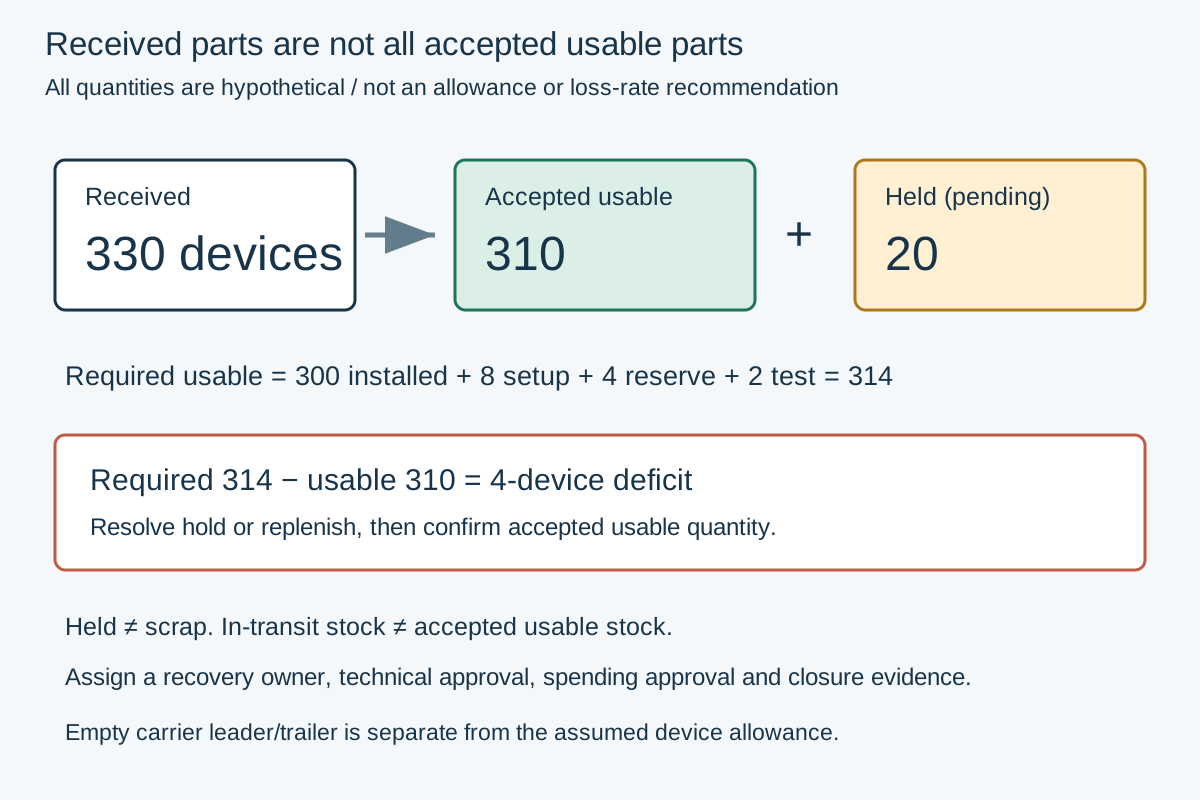
Conceptual illustration of the hypothetical quantities. Held material is awaiting a decision; it is not automatically scrap.
The shipment exceeds the 300 installed devices, but it does not yet satisfy the 314-device usable requirement. Material still in transit is likewise not accepted usable stock.
The hold may be resolved without a purchase. For example, if the designated release authority accepts four identifiable devices from the held group, the tally becomes 314 usable and 16 still held. That is a conditional outcome, not permission to count held stock before its status is resolved.
Conversely, if the held material cannot be released in time, the replenishment owner must obtain at least the four-device usable deficit under the agreed plan. An ordered replacement does not close the shortage until its receipt and usable release are established.
The example is an arithmetic aid, not a recommended allowance or loss rate. Obtain packaging and usable-quantity requirements for each BOM line from the actual assembler and agreed production plan.
Handle packaging and receiving as release questions
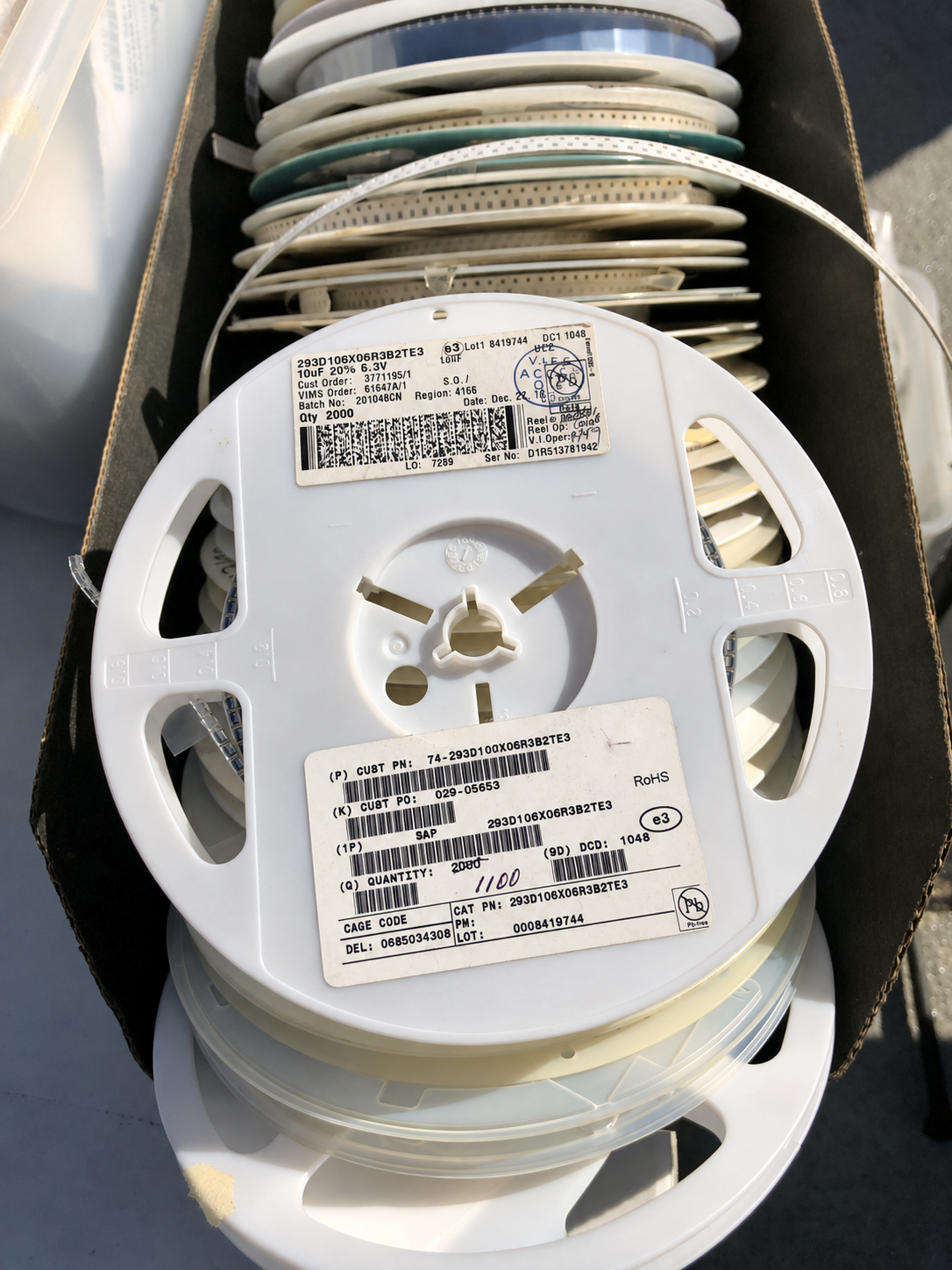
Retouched third-party reference photograph of component reels. Manufacturer branding has been removed and the affected areas reconstructed; label data must not be used to verify a part, lot or quantity. The image does not establish dimensions, material acceptance or APTPCB inventory. Original photo: ArnoldReinhold; adaptation shared under CC BY-SA 4.0. Image credit and full license.
A quantity count is only one part of a usable kit. Before buying or shipping, establish whether the assembler can accept the proposed carrier format, tape condition, orientation and any cut lengths or joined sections. Confirm the material required for feeding separately from empty leader and trailer. A reel, cut tape, tube or tray may be appropriate for a particular part and process; none is a universal answer.
Texas Instruments describes several carrier options for its own products. Its information is useful context, but it does not define acceptance rules for every manufacturer or assembler.
For moisture-sensitive devices, identify the actual part and packaging status, applicable handling information and any known exposure history. A damaged or opened package may need investigation before release. Do not assume every device requires dry packing or a bake, or apply a fixed bake recipe to an unidentified part.
Keep available labels and records connected to the purchase and receipt. They can help investigate part identity, lot or date-code restrictions and handling status, but a label or photo alone does not prove authenticity, internal performance or a complete storage history. Mixed date codes are not automatically unacceptable; if the project restricts them, state the restriction before purchase and agree how it will be checked.
Give shortages an owner and an exit path
When a line is short, log the affected BOM revision, required usable quantity, accepted quantity, held quantity, and reason for the hold or deficit. Then assign five decisions:
- Recovery action: Who will resolve the hold, replenish the kit or propose a different production plan?
- Replacement: Will the original approved part be sourced again, or is an alternative proposed?
- Technical approval: Who can approve a new part, source or change to the build?
- Spend approval: Who can authorize the additional material cost, freight or other recovery expense?
- Closure evidence: What receipt, release or approval record will demonstrate that the exception is closed?
For a consigned line, the OEM may replenish or authorize the assembler to buy. For a turnkey line, the assembler may pursue replenishment within the agreed scope. In either case, changing the MPN or source needs the designated technical approval; approving a substitute does not itself authorize extra spending, and approving spending does not establish technical suitability.
If recovery is not practical, the parties can evaluate a smaller build or a revised schedule. A smaller build needs a revised material and test plan; simply dividing available stock by the quantity per board ignores the remaining setup and test needs. A shortage never automatically authorizes substitution or a DNP.
Compare total cost on the same scope
A consigned assembly quote can look lower because material purchases sit outside it. Compare the total project cost rather than the assembler’s invoice alone.
For this hypothetical comparison, the board quantity, engineering and quality scope, component prices and delivery scope are held equal. Every amount below is invented for arithmetic, not an APTPCB price or market estimate.
| Assumed cost item | Turnkey quotation | Consigned assembler quotation | OEM cost outside the consigned quotation |
|---|---|---|---|
| Bare boards | $300 | $300 | $0 |
| Components | $1,500 | $0 | $1,500 |
| Purchasing work | $150 | $0 | $200 |
| Inbound component freight | $80 | $0 | $80 |
| Receiving and kit preparation | $120 | $120 | $0 |
| Assembly conversion | $500 | $500 | $0 |
| Setup | $200 | $200 | $0 |
| Agreed test | $300 | $300 | $0 |
| Outbound freight | $60 | $60 | $0 |
| Total | $3,210 | $1,480 | $1,780 |
The consigned project total is $1,480 + $1,780 = $3,260. The $50 difference comes entirely from the assumed purchasing work, $200 rather than $150. In this scenario the components sit outside the consigned assembler quotation but remain part of the project cost; a $0 in one column means allocated elsewhere in this example, not free material.
Those figures are not APTPCB prices or evidence that either model normally saves money. The example also leaves items such as taxes, duties, financing, storage, minimum-order excess, exception purchases, rework and expedited freight unestimated—not free. The four-device shortage above is not priced in this comparison. Existing inventory may reduce new cash spending, but its economic value should not be treated as zero.
Define readiness, schedule and excess before release
Separate purchasing time, inbound transport, receiving clearance, assembly, shipment release and final delivery in the project plan. Do not assume that the same event starts an assembly clock on every order.
Instead, propose the prerequisites for the specific schedule: released file revisions, accepted usable kits and bare boards, closure of relevant material exceptions, available test or firmware inputs where required, and an agreed production slot. Record what evidence establishes the actual start. A pending connector source or held kit may affect the plan even when other lines are ready.
For closeout, distinguish minimum-buy excess, unused planned reserve, recorded process losses, held material and stock made obsolete by an engineering change. Decide who owns each category, whether stock may be used on another order, and who authorizes return, storage or disposal. The disposition of excess should not be inferred from who physically holds it.
What to send for a project-specific quote
For the hypothetical 100-board build, a useful RFQ would request partial turnkey and include:
- The released BOM and build files, with the standard passive assigned to assembler purchase and the programmed device assigned to OEM supply.
- The restricted connector marked pending, with its source restriction and named technical approver—not an implied approval.
- The proposed 314-device usable requirement for the example line, clearly identified as an assumption for confirmation.
- The intended actions for a four-device shortage: first investigate release of held stock; otherwise identify who replenishes, approves any technical change and approves added spending.
- Requested test scope, material ownership and excess disposition, plus the proposed schedule prerequisites.
This gives APTPCB something concrete to evaluate and return with any necessary scope decisions. Submit the package through the quote page, or use contact to resolve an open responsibility before placing the order.
Source basis: Texas Instruments, What are carrier packaging options?; MSL Ratings and Reflow Profiles, SPRABY1A; and Texas Instruments General Quality Guidelines, SZZQ076 Rev. Q.