
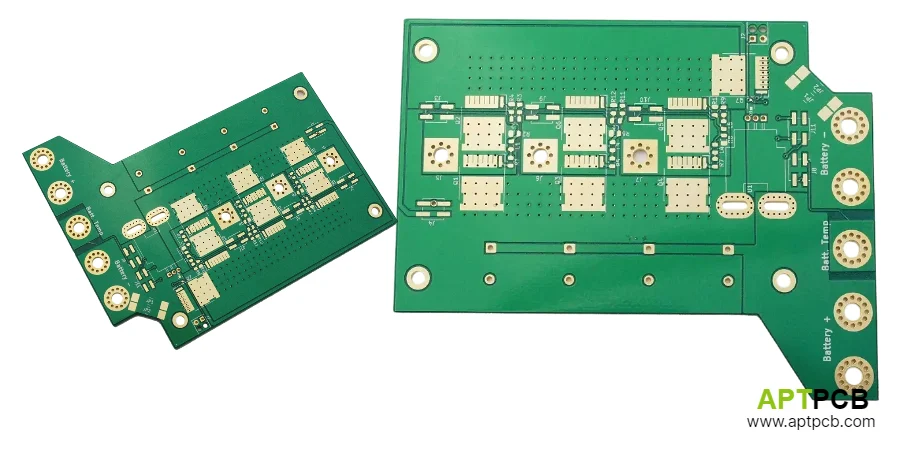
KB-6150 occupies the lowest cost position in Kingboard's FR-4 laminate portfolio, providing the baseline performance that millions of everyday electronic devices require. With a verified Tg of 132°C (DSC) and standard DICY-cured epoxy chemistry, KB-6150 is the pragmatic material choice for applications where the PCB substrate is not the performance-limiting factor—consumer electronics, LED lighting, simple IoT sensors, power supplies, and peripheral devices where design margins are comfortable and production volumes demand aggressive cost optimization.
Understanding KB-6150's capabilities and limitations is essential for engineers making material selections. Specifying KB-6167F (Tg 175°C, 1.4× cost) for a product that only needs Tg 130°C wastes material budget that could be allocated elsewhere in the BOM. Conversely, pushing KB-6150 beyond its thermal capabilities—thick multilayer boards with multiple lead-free reflow cycles—creates reliability risks that no amount of cost savings can justify. This guide provides the engineering data needed to make that boundary decision confidently.
In This Guide
- Where KB-6150 Fits in Kingboard's FR-4 Material Portfolio
- KB-6150 Technical Specifications and IPC-4101 Classification
- Thermal Reliability Limits: What KB-6150 Can and Cannot Survive
- KB-6150 vs KB-6160 vs KB-6160A: Entry-Level FR-4 Comparison
- Lead-Free Assembly Considerations and Reflow Profile Constraints
- Design Guidelines: Maximum Layer Count, Via Aspect Ratio, and Trace Width
- Target Applications and High-Volume Production Economics
- When to Upgrade: Clear Signals That KB-6150 Is Not Enough
- How to Order KB-6150 PCBs from APTPCB
Where KB-6150 Fits in Kingboard's FR-4 Material Portfolio
KB-6150 shares the IPC-4101D/21 slash sheet with KB-6160, placing both in the standard FR-4 category. The practical difference is optimization level: KB-6160 provides the complete KB-6060 prepreg system with characterized Dk/Df data per glass style, while KB-6150 is positioned as the economy alternative for applications where such characterization is unnecessary.
KB-6150 Technical Specifications and IPC-4101 Classification
KB-6150 specifications are verified from Kingboard's official product datasheet (kblaminates.com). Specimen thickness: 1.6 mm (8×7628 construction). IPC-4101E/21 ✓
Thermal Properties
| Property | Typical Value ✓ | Test Method |
|---|---|---|
| Glass Transition (Tg, DSC) | 132°C | IPC-TM-650 2.4.25 |
| Thermal Stress (288°C Float) | ≥180 sec | IPC-TM-650 2.4.13.1 |
| Decomposition Temperature (Td) | 305°C | IPC-TM-650 2.4.24.6 |
| Z-axis CTE Alpha 1 | 58 ppm/°C | TMA |
| Z-axis CTE Alpha 2 | 286 ppm/°C | TMA |
| Flammability | V-0 | UL 94 |
| IPC Slash Sheet | IPC-4101E/21 | — |
| UL File | E123995 | — |
Note: The official KB-6150 datasheet does NOT list Z-CTE 50-260°C, T-260, or T-288 values. This is consistent with the /21 slash sheet not requiring lead-free thermal endurance testing. The absence of these specs is an important indicator that KB-6150 is not formally lead-free qualified.
Electrical Properties
| Property | Typical Value ✓ | Test Method |
|---|---|---|
| Dk @1 MHz | 4.6 | IPC-TM-650 2.5.5.9 |
| Dk @1 GHz | 4.4 | IPC-TM-650 2.5.5.9 |
| Df @1 MHz | 0.017 | IPC-TM-650 2.5.5.9 |
| Df @1 GHz | 0.018 | IPC-TM-650 2.5.5.9 |
| CTI | ≥150V | IEC 60112 |
| Dielectric Breakdown | ≥45 kV | IPC-TM-650 2.5.6 |
| Arc Resistance | 125 sec | IPC-TM-650 2.5.1 |
| Surface Resistivity | 1.0×10⁶ MΩ | IPC-TM-650 2.5.17.1 |
| Volume Resistivity | 1.0×10⁸ MΩ·cm | IPC-TM-650 2.5.17.1 |
Mechanical Properties
| Property | Typical Value ✓ | Test Method |
|---|---|---|
| Peel Strength (Float 288°C/10s) | 1.75 N/mm | IPC-TM-650 2.4.8 |
| Flexural Strength (MD) | 560 N/mm² | IPC-TM-650 2.4.4 |
| Flexural Strength (XD) | 440 N/mm² | IPC-TM-650 2.4.4 |
| Water Absorption (D-24/23) | 0.17% | IPC-TM-650 2.6.2.1 |
Thermal Reliability Limits: What KB-6150 Can and Cannot Survive
Understanding KB-6150's thermal boundaries prevents both over-specification and under-specification:
What KB-6150 handles well: Single and double reflow with SAC305 solder (peak 245°C, ≤3 seconds above 240°C), moderate operating temperatures (-20°C to +85°C), standard wave soldering, and manual rework with localized heating. These cover the vast majority of consumer electronics assembly.
Where KB-6150 becomes risky: Multiple lead-free reflow cycles (≥3 passes through 260°C peak), boards >6 layers or >1.6 mm thickness, continuous operation above 100°C, and thermal cycling between -40°C and +125°C. The Z-CTE ~4.5% means 72 µm expansion on a 1.6 mm board through reflow—stressing via barrels near their fatigue limits.
What KB-6150 cannot survive reliably: Repeated 260°C reflow (>5 cycles), board thickness above 2.0 mm with through-hole vias, automotive temperature ranges (-40°C to +125°C continuous), and sustained temperatures above 105°C.
The Td of 305°C provides 45°C margin above 260°C lead-free reflow peak—identical to KB-6160. This is adequate but provides less margin than KB-6165's 75°C. The Z-CTE alpha1 of 58 ppm/°C and alpha2 of 286 ppm/°C indicate higher via stress than KB-6160 (60/300 ppm/°C), but the relationship is complex and depends on Tg as well.
KB-6150 vs KB-6160 vs KB-6160A: Entry-Level FR-4 Comparison
| Property | KB-6150 ✓ | KB-6160 ✓ | KB-6160A |
|---|---|---|---|
| Tg (DSC) | 132°C | 135°C | ~130°C |
| Td (TGA) | 305°C | 305°C | ~300°C |
| Z-CTE α1 | 58 ppm/°C | 60 ppm/°C | ~60 ppm/°C |
| Z-CTE α2 | 286 ppm/°C | 300 ppm/°C | ~300 ppm/°C |
| Z-CTE (50–260°C) | Not specified | 4.3% | ~4.5% |
| Dk @1 GHz | 4.4 | 4.25 | ~4.3 |
| Df @1 GHz | 0.018 | 0.018 | ~0.020 |
| CTI | ≥150V | ≥175V | ~150V |
| IPC Slash Sheet | /21 | /21 | /21 |
| Prepreg System | None | KB-6060 (full) | KB-6060A (limited) |
| Min Core Thickness | Not specified | 0.05 mm | 0.4 mm |
| Optimization | Economy | General purpose | Double-sided |
| Cost Position | Lowest | Baseline | ~KB-6150 |
KB-6150: Absolute lowest material cost, tolerates standard FR-4 performance. KB-6160: Full prepreg characterization, thin cores, formal material qualification. KB-6160A: Specifically optimized for double-sided (2-layer) boards with UVB-blocking property.
Lead-Free Assembly Considerations and Reflow Profile Constraints
KB-6150 is NOT formally qualified as a lead-free material per IPC-4101. Its /21 slash sheet carries no minimum T-260 or T-288 requirements—these thermal endurance tests are only specified in higher slash sheets (/99, /101, /124, /126).
Practical lead-free guidance:
Acceptable: Peak 245°C, ≤3 seconds above 240°C, maximum 2 reflow passes, board ≤1.6 mm with ≤6 layers, via aspect ratio ≤6:1.
Marginal: Peak 250°C, 3 reflow passes, board 1.6–2.0 mm. Risk of measurable via barrel damage at aspect ratios above 4:1.
Not recommended: Peak 260°C, ≥4 reflow passes, board >2.0 mm, or operating temperatures above 85°C.
For lead-free assembly with comfortable margins, KB-6160C provides the minimum qualified alternative at approximately 1.15× KB-6150 cost.
Design Guidelines: Maximum Layer Count, Via Aspect Ratio, and Trace Width
KB-6150's standard FR-4 properties establish practical design boundaries:
Maximum recommended layer count: 6 layers. Beyond 6 layers, board thickness exceeds 1.6 mm and via aspect ratios push into territory where Z-CTE ~4.5% creates unacceptable barrel stress. For 8+ layers, upgrade to KB-6165 or higher.
Via aspect ratio limit: 6:1 maximum for reliable plating and thermal cycling endurance. On a 1.6 mm board, this means minimum 0.27 mm (10.6 mil) drill diameter.
Impedance control: Achievable with ±10% tolerance. For ±5% impedance, use KB-6160 or above where prepreg Dk is characterized per glass style.
Minimum trace/space: Standard 4/4 mil (0.1/0.1 mm) for production, 3/3 mil with premium processing. KB-6150's unfilled resin drills and etches comparably to other standard FR-4.
Target Applications and High-Volume Production Economics
Consumer Electronics: Remote controls, IoT sensors, Bluetooth peripherals, USB chargers, LED controllers, audio equipment—applications where the PCB substrate is not performance-limiting.
LED Lighting Drivers: Single and double-sided boards for LED driver circuits at modest temperatures. Our LED PCB capabilities handle KB-6150 for high-volume driver board production.
Power Supplies and Adapters: Offline power supply PCBs for laptop chargers, USB-C PD adapters, and general SMPS where operating temperatures stay below 85°C.
Peripheral and Accessory Boards: Keyboards, mice, USB hubs, cable adapters—products where volumes exceed 100K units and material cost directly impacts unit economics.
Prototyping: Quick-turn prototype boards where the lowest-cost substrate enables rapid design iteration before material selection is finalized.
The production economics: on a typical consumer PCB at 100K annual volume, the difference between KB-6150 and KB-6165 (1.25×) is approximately $0.03–0.08 per board—$3,000–8,000 annually in cost-competitive markets.
When to Upgrade: Clear Signals That KB-6150 Is Not Enough
| Requirement | Upgrade To | Cost Impact |
|---|---|---|
| Formal lead-free qualification (T-260/T-288) | KB-6160C | +15% |
| Characterized prepreg Dk/Df data | KB-6160 | +5–10% |
| ≥8 layers or board >1.6 mm | KB-6165 | +25% |
| Halogen-free compliance | KB-6165G | +30% |
| Operating temperature >105°C | KB-6165 or KB-6167F | +25–40% |
| Anti-CAF for high-voltage spacing | KB-6164 | +20% |
| Signal speed >2.5 Gbps | KB-6165GMD+ | +50%+ |
For small boards (<50 cm²), the absolute cost difference between KB-6150 and KB-6165 may be less than $0.10—often not worth the risk of an underspecified material.
How to Order KB-6150 PCBs from APTPCB
Submit your design files for a competitive KB-6150 quotation. Our engineering team reviews the design against KB-6150's capabilities and proactively identifies any requirements suggesting a material upgrade—ensuring you get the right material at the right cost. For complete fabrication and assembly, we provide integrated quotes with quality assurance documentation.